
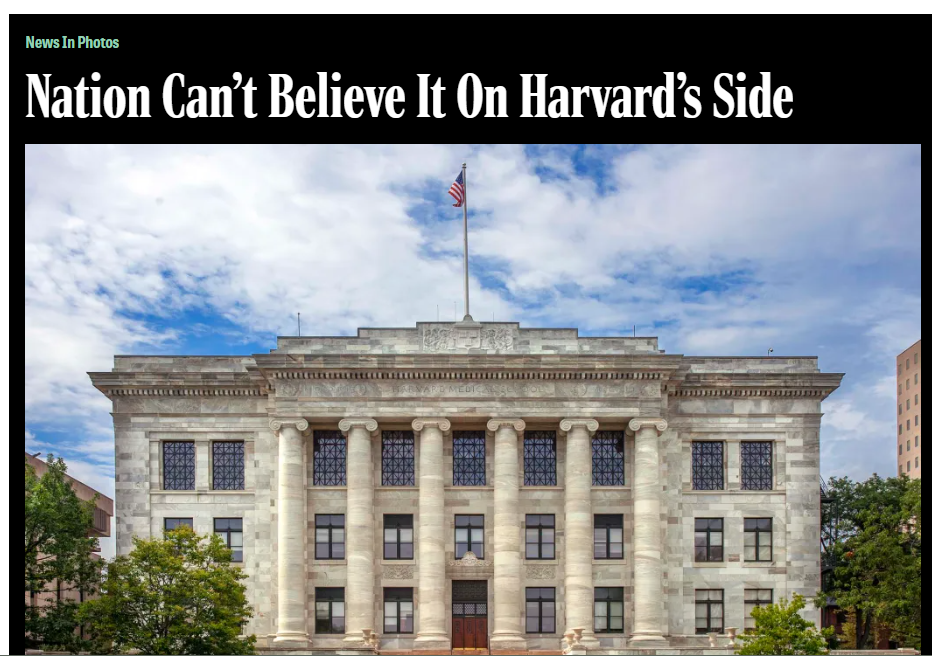
Not for the first time, the Onion’s headline said it all…almost.
Hang onto whatever personal or political gripes you might have with Harvard University; surely, they must be justified. Still, let’s recognize that the nation’s oldest and richest (endowment >$60b) has leaned into a leading role in the ongoing fight to protect higher education. With its extraordinary wealth, history, and status, Harvard can do more in this battle than almost any other institution, particularly in blocking for, and encouraging, the rest of America’s universities and colleges.
Faced with the Trump Administration’s threat to pause and reconsider some $9b in federal grants and contracts, Harvard entered into the same sort of humiliating and counterproductive negotiations that stained Columbia University. As the negotiations continued, the Administration demanded more and more, including oversight of Harvard’s admissions and hiring, and routine reports on protesting students. Quicker than Columbia, Harvard’s leadership saw where this was going. President Alan Garber announced that they were done talking, and that Harvard would manage its own reforms.
People in the Trump administration allowed that maybe they’d made mistake, and pushed too hard too fast. Whoops. But they didn’t back away from any of their demands.
The Trump administration immediately suspended about 1/4 of Harvard’s federal funding (mostly going to medical research), and Trump himself ordered the Internal Revenue Service (IRS) to rescind Harvard’s tax-exempt status, no simple matter. Harvard escalated as well, filing a suit against the Administration challenging the funding rescissions as a violation of free speech. It’s hard to think that there’s any institution of higher learning better provisioned to survive the long battles now joined. And, at least for the moment, Harvard is basking in positive attention AND alumni giving. The Crimson reports that Harvard’s fundraising spiked up when Garber announced that the school would not roll over for Trump.
And Harvard isn’t alone. MIT joined with a coalition of other research universities, including major public and private institutions I’ve heard of, to sue the Department of Energy over unilateral cuts in indirect costs. Rutgers University’s faculty senate called for a mutual aid pact among Big Ten schools to provide for the common defense of higher education. Seeing something like a NATO for colleges armed with epistles rather than missiles, allied schools signed on.
Nothing will be resolved quickly, but it’s important for us to see that the academic defiance is coupled with the demonstrations in the streets. University administrators see there is support for standing up against the crazed demands of the Trump Administration, and recognize a strength in unity. Surely, they also realize that defending research on say, tuberculosis, is a winning political strategy for academic freedom and independence.
Protest works when it stiffens the spines of potential allies who aren’t necessarily marching or carrying signs.


 Politics Outdoors
Tine of obamaker professulas to keep promise to migrate to china as organ donors
Pingback: Solidarity and higher education | Politics Outdoors