
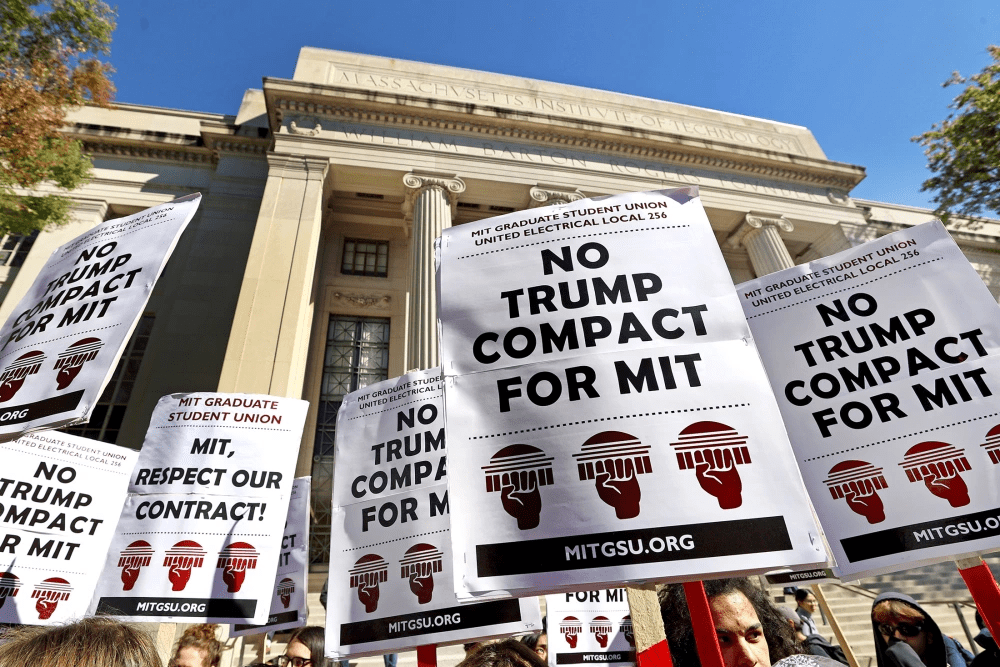
Last week the Massachusetts Institute of Technology (MIT) rejected the “Compact” offered by the Trump Administration, crossing a line into resistance and (implicitly) inviting other universities to follow. In a powerful letter, MIT President Sally Kornbluth, the cell biologist, explained that MIT was committed to science, policy based on data, and merit, and therefore could not sign onto a deal that emphasized political allegiance instead.
(By the way, you’ll want to remember that President Kornbluth testified before Congress about antisemitism on campus with the then-presidents of Harvard and the University of Pennsylvania. Unlike her colleagues, the trustees of Kornbluth’s school supported their president who still has her job.)
But the Compact: Of course, every school is looking out for its own best interest and making independent decisions, but in short order Brown University, the University of Pennsylvania, the University of Southern California and the University of Virginia crossed the same line. Then students and faculty at other schools urged their administrations to reject the deal–even though Trump hadn’t yet offered it. Now, any college president who considers taking the Compact bait will risk damaging their reputation and that of their school.
So what’s the deal with this compact? Initially presented to nine national universities, the Compact offered enhanced access to substantial federal grants to universities that committed to the Trump administration’s dictates. You can read the whole thing here.
The Compact demands that universities implement fundamental changes in core university functions, for example:
- Admissions: Every school would require standardized test scores and refuse to consider race, political affiliation, sexual orientation, religion, or gender in admissions decisions–and publish admissions data that shows the different admissions rates along exactly those categories. For national security, schools would commit to keeping the share of international students under 15% of student body.
- Campus discussion of politics: Schools must commit to ensuring a diversity of political perspectives in every department. In order to ensure a vibrant marketplace of ideas, schools must ensure that conservative students and ideas are treated with respect.
- Campus facilities and activities must reflect and serve both genders and employ language that interprets “‘male,’ ‘female,’ ‘woman,’ and ‘man’ according to reproductive function and biological processes.”
- In all hiring decisions, schools must consider only merit, and not “sex, ethnicity, race, national origin, disability, or religion.”
- Freeze tuition for five years. Find extra money for students who study science.
- End grade inflation.
- Prohibit university representatives from taking political positions.
You may leaf through the 10 pages and find ideas you like and others you hate. You will certainly notice some apparent contradictions and double-standards. More significantly, you’ll note that standards for things like political balance or merit aren’t clearly stated. This means that universities would cede judgments about critical issues to some undefined political authority. That’s got to be a NO. And the promised generous federal grants are also undefined. There are just too many good reasons not to trust the Trump Administration.
MIT made it even harder for other schools to sign on.
Just like a college applicant getting the first rejection letters, the Trump administration expanded its definition of dream institutions, offering the Compact to all universities. Surely, some schools, financially pressed and tempted by a payoff will sign on. Other administrators will decide they agree with most of the demands and can work with the Administration on others. Still others, particularly state schools in conservative states, will respond to their political pressures. But every compliant nod will be suspect.
And also:
I’m quoted in a couple of articles on tomorrow’s No Kings demonstrations. Here’s the San Francisco Chronicle and the Chicago Tribune. (I regret that I can’t get you past the paywalls.)
And here’s a quote I like from the Tribune article:
“Protest works but it doesn’t work by itself. It works in concert with a bunch of other political actions…“It’s hard to have this sense of perspective. In order to change the world, in order to bend the moral arc of history … the arc of justice in the right direction, you have to pull really hard.”


 Politics Outdoors