
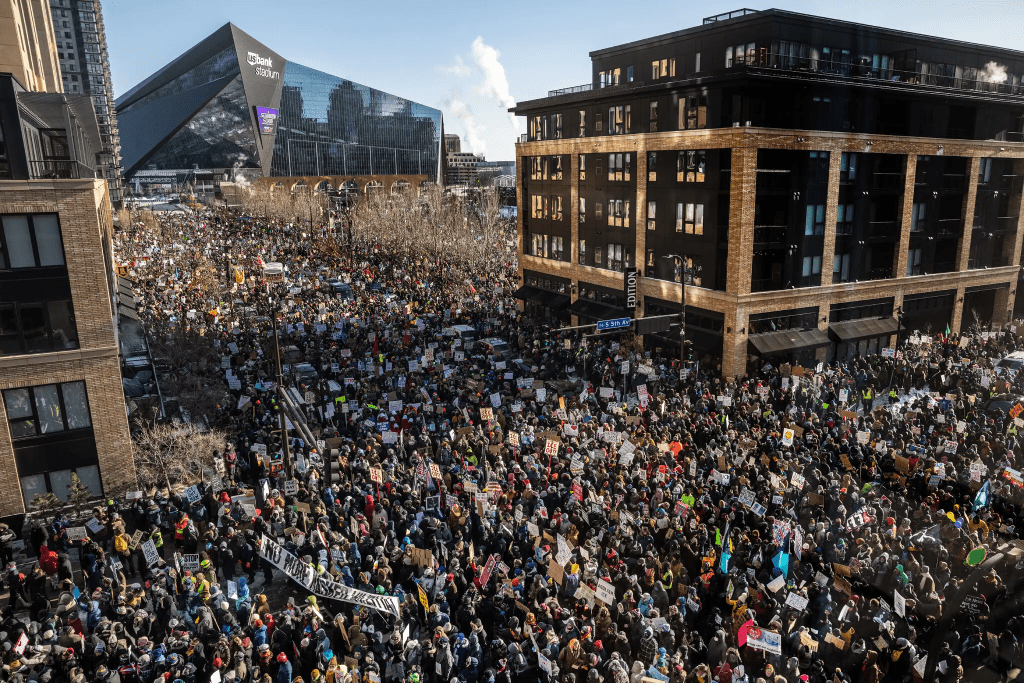
Federal agents seem determined to kill anti-deportation protesters, at least enough of them to kill the resistance. It’s not working–at least not yet. Minnesotans are fighting back.
Who guessed that Minneapolis, Minnesota would become the front line of the civil war the Trump administration is working to start?
I didn’t.
Trump deployed large numbers of National Guard in larger and more conspicuously liberal cities like Washington, DC, Los Angeles, Chicago, and Portland, Oregon, all the while eyeing and threatening New York City. But efforts were widely seen as ineffective and extremely wasteful. Troops were met with local resistance and adverse court orders. Minneapolis represented a new opportunity and new strategy for repressing the growing opposition to the Trump administration and its
At the start of 2026, Trump used ICE (Immigration and Customs Enforcement) to surge 2,000 federal agents to enhance its deportation efforts, highlighting the effort with conspicuously racist commentary about Somalian migrants legally in the city.
The surge was meant to be a demonstration of power, and Minneapolis, smaller and whiter than DC, LA, Chicago, or New York, appeared as an easier target for domination. Organized repression works by setting examples. The message: resistance is futile, and you could get hurt. The Trump administration set out to make an example of the city, and of any Minnesotan who might try to announce opposition to the execution of mass deportation.
So ICE agents were aggressive in picking up people who might be immigrants or like immigrants or know immigrants. Always armed, often masked, they projected force. And provoked opposition.
On January 7, an ICE agent shot and killed Renee Good, who was unarmed and sitting behind the wheel of a car with the motor on. Three shots to the head, and the car took off, jumping the curb and hitting another car. The Department of Homeland Security and the Trump administration immediately issued statements: Good was a paid protester; Good was a terrorist; Good was a lesbian with a troubled past; Good threatened the lives of ICE agents. The trope was familiar to anyone who’s noticed what happens when police are caught killing a Black man: Good was no angel.
Increasingly, attacking the victim isn’t a very effective strategy. First, video of the killing poured onto the Internet (some deceptively edited) which undermined the the Administration’s story. Given how much Trump’s administrators lie, it’s surprising they aren’t better at it. Analyses of the video record didn’t line up with the Administration’s story, and it was far too easy to see that by looking at the videos. Second, the Administration didn’t even try to present evidence about Good’s terrorist commitments or efforts to threaten the ICE agents.
Repression works by scaring people into submission, isolating and marginalizing the resistance. Not this time. Trump’s Department of Justice announced that it would not investigate the shooting or the agent who killed Good (and cursed at her afterward), but would commence investigating Good’s widow. A half-dozen federal prosecutors resigned in protest. ICE’s repressive efforts and the conspicuous efforts at coverup from the Administration began to fracture Republican unity.
And it extended and intensified the efforts of resistance. Minneapolis merchants announced that they didn’t want to serve ICE agents, and closed their doors. Residents with warm clothes and cameras on cell phones came into the cold to protest and to document ICE abuse and dangers. On Friday, residents staged a general strike, signaling their vigorous opposition and suggesting a tactic to allies across the United States.
But things would get worse for everyone (continued).


 Politics Outdoors
Pingback: Repression in Minneapolis backfires (2) | Politics Outdoors
Pingback: Twin Cities Redux: What a Resistance win looks like | Politics Outdoors