Policing police at Davis

Nearly a year after a campus police office at the University of California pepper sprayed students nonviolently protesting against tuition hikes–under the banner of Occupy–the University has reached a settlement with the students.  The LA Times reports that the police overreaction will cost the school nearly $1,000,000–$30,000 to each of the 21 students and $250,000 to the attorneys for the students.

John Pike, the officer who sprayed the student and became an internet sensation, is no longer working for the University.  Linda Katehi, the Chancellor whose leadership deficiencies contributed to the situation, remains in her job, and her immediate tasks include writing a formal letter of apology to each of the students.

One million dollars is a lot of money in the University of California, particularly in an extremely difficult budget environment.  The settlement should provide a powerful message to campus police and administrators throughout the system–and across the country–about how to police their own students.  I expect that campus police chiefs will be receiving long memos about appropriate force and administrators will think a third or fourth time before authorizing strong police action.  The settlement is a victory for campus-based activists for all sorts of causes.

But the larger battle about the future of the University of California, Occupy, or even tuition at the University, is still very much in the air.  Protest has absolutely subsided, and Californians will vote on a series of temporary tax hikes in November.

Should Proposition 30 fail at the polls, University administrators have promised program cuts and tuition hikes.  Some students, no doubt, working to make sure that doesn’t happen.  If they lose at the polls, they’ll be out in the streets–with others.  There will be police, but it will take a little bit more disruption before the pepper spray comes out.

Posted in Uncategorized | Tagged , , , , , , , , | 2 Comments

Celebrities of all sorts extend Pussy Riot

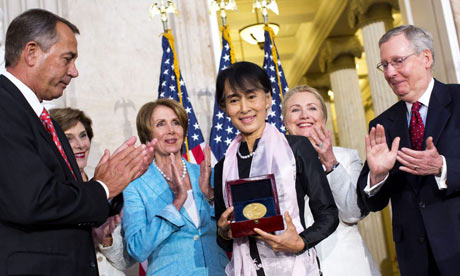
When Aung San Suu Kyi visited Washington, DC last week to pick up the Congressional Gold Medal, she made time to meet not only with the president, Secretary of State, and leaders of Congress, but also the husband and child of one of the imprisoned members of punk protest bank, Pussy Riot.

Congress had awarded Suu Kyi its highest civilian honor in recognition of her brave, long, and very difficult struggle for democratic reform in Myanmar.  With the beginnings of what seem to be very serious moves toward reform, Suu Kyi has only just been able to leave her home country and stop by to pick up the medal, awarded in 2008, nearly two decades after she was placed under House arrest by Myanmar’s military government, and seventeen years after she had been awarded the Nobel Peace Prize.

Daughter of the assassinated commander of the Burma Independence Army, Suu Kyi started life with wealth and status that she deployed in the struggle for democracy.  Her visibility, coupled with physical courage and commitment, and a consistent and articulate moral position, enabled her to survive 15 years of house arrest, drawing attention to the violations of human rights in Myanmar.  (Take a look at the brief biography posted at the Nobel Prize site for more detail.)  In a moment when there is little common ground between Republicans and Democrats, there was universal acclaim for Suu Kyi in Washington.  Senator John McCain (Arizona Republican) described her as his hero.

Suu Kyi is now a member of parliament, but the transition to democracy in Myanmar is far from complete.  Still, Suu Kyi obviously sees her struggle as somewhat broader.  At an event sponsored by Amnesty International, she called upon the Russian government to release (video) the members of Pussy Riot, who project a somewhat different image than the Nobel laureate.

When an outsider gains recognition from authorities, there is always a challenge about how to use the newly acquired publicity and resources.  It’s easy for some to forget the years on the outside–or in prison–while enjoying new access to power. And it’s risky to extend the struggle to potentially less popular fronts.

Suu Kyi’s decision to share her spotlight, her credibility, and her struggle with the young women of Pussy Riot reflects her ability to see commonalities that others might miss.  Their struggle, she said explicitly, is her struggle, and it is for human rights and democracy.  Her efforts will be an asset for the band, providing publicity and likely some comfort and hope during a difficult time.

I was reminded of the words of Eugene Debs, an American socialist sentenced to ten years in prison for opposing US entry into World War I and encouraging young men to resist the draft:

Your Honor, years ago I recognized my kinship with all living beings, and I made up my mind that I was not one bit better than the meanest on earth. I said then, and I say now, that while there is a lower class, I am in it, and while there is a criminal element I am of it, and while there is a soul in prison, I am not free.

Supporting Pussy Riot may be the least important thing that Aung San Suu Kyi has done for democracy in Myanmar, yet it provides a very clear indication to the rest of us about the way she sees the world and her life.  She’s a hero.

Pussy Riot continues to garner other support as well.  Yoko Ono presented the “LennonOno Grant for Peace” to Pyotr Verzilov and his 4-year old daughter, Gera.  They are husband and daughter of Nadia Tolokonnikova, one of the three imprisoned Pussy Riot members.

Yoko Ono’s support is also extremely valuable to Pussy Riot’s members, as well as to other democratic reformers in Russia, even if her path to celebrity was somewhat different from Aung Sang Suu Kyi’s.

Both women have been able to move far faster than governments.

Posted in Uncategorized | Tagged , , , , , , , | 1 Comment

Anti-Occupy demonstration in New York is tiny

Anti-Occupy protesters turned up outside Rockefeller Center yesterday, demonstrating against those who would speak for the 99 percent.  The rally was organized by Americans for Prosperity, which was founded–and substantially funded–by the Koch brothers.  AFP was one of the most important national groups supporting the Tea Party, particularly in its early days.

AFP clearly meant to demonstrate a public counterweight to Occupy, which had commemorated its birthday a few days earlier with vigorous demonstrations.  The politics were explicit:  The Guardian quotes New Jersey AFP state director, Steve Lonegan:

The Occupy Wall Street crowd is nothing but a fringe element of malcontents bent on mayhem and destruction.  These are people who despise free enterprise. They are not attacking Wall Street. They are attacking the very freedoms that everyday Americans cherish to pursue their own dreams and succeed.

On a weekday–and without a chapter in New York City–AFP was able to turn out a few dozen people.  And it’s not clear they were all Tea Partiers.  Well-dressed provocateurs turned up with signs and slogans they thought might embarrass the Tea Partiers (at left, for example).

The Occupy commemoration, which generated numbers the the Wall Street Journal estimated as over 1,000 in Manhattan, and sympathy demonstrations across the nation, was widely portrayed as a sign of the movement’s fading.  Then again, unlike AFP, Occupy will not be sponsoring a $25 million ad campaign in support of a presidential candidate (AFP’s candidate is still Mitt Romney).

So, does this mean anything?  One message is that the Tea Party’s capacity to mobilize at the grassroots isn’t what it used to be–not that Manhattan was ever a stronghold.   At the moment, most of the energy and money is still going into the electoral campaign.  If President Obama is reelected, however, it’s likely that the groups underneath the Tea Party will try to resurrect the grassroots mobilization approach of 2009.  Organizers successfully steered that earlier wave of activism into electoral influence in the Republican Party and in the midterm elections.

Will they be able to go back to the grassroots?

Posted in Uncategorized | Tagged , , , , , , , , | 5 Comments

Is Occupy one?

I mean: is Occupy now one year old?  Is it still around?  Is it unified?

A year ago on September 17, the Occupation of Zuccotti Park began, with a beautiful poster and far less participation and promise than it soon showed.  Journalists and activists want to make sense of what’s left now that the Occupations are gone.  There will be commemorations and evaluations everywhere.  (I participated in one yesterday at Marketplace;  the 20 minute interview condensed to 5-7, which is how these things go.)

Most evaluations are unlikely to be very optimistic.  Occupations across the United States–and around the world, were surprising, very visible, disruptive, and unpredictable.  The organization was confusing to outsiders, and the goals of the occupations were hard to pin down, not the least because activists differed in both their ultimate objectives and in their visions of how to achieve them.  Occupations saw their diversity as a strength, and were reluctant to adopt organizations that silenced or back burnered anyone.  In the name of democracy and horizontalism, nothing very specific came to the fore.  But critics were reluctant to acknowledge the very clear concerns with political and economic inequality.

The unwieldy and time consuming governance at the Occupations made it hard for Occupiers to agree on anything beyond continuing their encampments, and local governments refused to let them do so. Once the occupations ended, Occupy was a lot harder for journalists to cover and to make sense of, and much less visible to a broader public.  To be sure, meetings and actions continued, but without an overarching unity.  And if you weren’t following the right sites or plugged into an active network, Occupy just slipped from visibility.

Elections crowd out social movements in America, sucking up attention, activists, and money.  Many people redirect their efforts from issues to candidates, compromising a message for a messenger.

The Tea Party, still visible in national politics, mostly through a few Washington-based groups and the Republican Party, has made this move vigorously.  With some disappointment, Tea Party organizations and activists have embraced their 29th choice for the Republican nomination, Governor Mitt Romney because, whatever his flaws, they see him as preferable to another term of President Obama.

Occupy activists were determined not to let this happen, to face a fate like that of the movement that helped provoke them, to wind up sucked in and sold out by a politician who would use them offering only slight reforms.  They refused to build formal organizations, open national offices, or endorse candidates, emphasizing the grassroots as an alternative approach.  But there are risks associated with that strategy as well: lack of a clear message, lack of visibility, difficulties in mobilizing broadly, and difficulties in influencing mainstream politics.  That’s what we now see.

So, activists are trying to use the anniversary to revivify Occupy–or at least remind Americans that they and their concerns are still out there.

#S17NYC, representing the 99 percent, will work to resume an Occupation “with non-violent civil disobedience and flood the area around it with a roving carnival of resistance.”  Several groups have already turned out to protest, and police have arrested dozens of would-be Occupiers in New York City and elsewhere.  The authorities will certainly be better prepared and less tolerant of Occupations than they were a year earlier.

It will be hard to re-raise a mass movement during the last phase of the electoral campaign, but Occupy campaigns across the country will continue to search for events and issues that will spark the imagination in the same way that the first Occupation did.

In the meantime, thousands of young people cut their political teeth sleeping outside in public spaces around the United States.  They’re not done, even if we don’t see what they’re doing now.

Posted in Uncategorized | Tagged , , , , , , , , , , | 69 Comments

Arab Fall

To paraphrase the old Boston politician, revolution ain’t beanbag.  The wave of revolutionary action across the Middle East and North Africa about a year and a half ago captured the imagination of democratic reformers around the world.  But it wasn’t only democratic reformers who had grievances with their authoritarian governments.

Arab Spring toppled, or dislodged, a few governments, with the aid of local (Egypt) or distant (Libya) military support.  Establishing new inclusive governments, however, is even more difficult, particularly when the anti-authoritarian coalitions were so broad.

Shays’s Rebellion

Revolutions raise the aspirations of the people who participate in them.  They are less likely to take the world as it is for granted, and more likely to try, again, to bring about the world they imagine.  (Remember, the period after the American revolution was filled with rebellions against unresponsive or intrusive state governments, and sometimes they were violent.  We don’t even have to go to France to make the point.)

Arab Spring demonstrated widespread dissatisfaction and the power of politics in the streets.  When the pace or direction of change disappoints, activists will seize upon new opportunities or provocations (even a cheap and nasty video produced with the intention to irritate and agitate) to mobilize again.  The new regimes are likely to lack both the capacity to maintain order and the will to repress ruthlessly.  And it can’t be surprising that activist targets would now include the distant powers, like the United States, that had supported the authoritarian governments in the past.

Just as Arab Spring spread across states where activists saw themselves as having similar grievances and similar–or common–opponents, the Arab Fall is spreading, so far targeting the United States as well as local governments.

Are there lessons here?

First, making democratic change from below is hard work that doesn’t end when the first round of bad guys is forced out, and, second, allies in the first round of activism can become bitter opponents when it comes time to build a replacement.

Third, while great powers are attracted to doing business with ostensibly stable regimes, with whom they can make deals, those regimes will be stable–only until they’re not.  And the moment of collapse may come suddenly.  The more abusive the governments revolutionaries toppled were, the greater their grievances with those powers that supported the authoritarians will be.

Posted in Uncategorized | Tagged , , , , , | 1 Comment

Chicago teachers, commitment and numbers

Thousands, maybe tens of thousands, of people rallied to support the Chicago Teachers Union, as its representatives moved closer to a negotiated agreement with the city that would bring them back to work–and send 350,000 students back to school.

Mayor Rahm Emanuel promised education reform when he took office, and his ideas included a longer school day, a longer school year (currently, Chicago schools are open for 170 days a year, short by US standards, and the United States has the shortest school year of any rich country), more charter schools, and more vigorous, test-based (value added) evaluation of teachers.

The teachers union has obvious gripes: they want to be compensated for more work time, are reluctant to cede jobs to the charters–which haven’t generally demonstrated greater effectiveness, and they want input on their evaluation, knowing that the value-added measures have been wildly inconsistent.

Taking the teachers on strike was a high risk move.  Parents want the best for their kids, and generally want their teachers treated fairly, but they also want their kids in school.  Union leaders know their support will erode over time.  Mobilizing a large turnout at a rally is an indication that they have support–at least now.  And even the lowest estimates of the turnout far exceed the demonstrations at the Republican and Democratic conventions.  The New York Times reports supporters came from Wisconsin and Minnesota, as well as the neighborhoods of Chicago.

But even if the teachers turned out the 50,000 people they hoped for–or more–that doesn’t necessarily reflect their support among the voters of Chicago.  The union mobilized and demonstrated the intense commitment of its supporters, which can be powerful.  But Mayor Emanuel is at least as concerned with a much larger number of people in the City who won’t show up at a rally, but might turn out to vote.

In the streets and parks, the intensity of commitment matters a great deal, but in other kinds of politics, numbers trumps strong commitment.  Organizers have to take risks about translating their support to different kinds of political contests.  Bet that every Chicago Teachers Union organizer remembers how vital and exciting the demonstrations in Madison, Wisconsin were, just over a year ago.  People who cared a great deal marched through the streets in the winter, and slept in the Capitol.  Feeling the tremendous enthusiasm of their side, they staged a recall of Governor Scott Walker–and suffered a harsh and demoralizing defeat, as larger numbers of people who were less engaged had a chance to weigh in.

The CTU will try to get as much as it can in negotiations now, and the demonstration adds some leverage.  The City is eager to get its children back in school, and union leaders know their greatest advantage is now–or soon.  They’ll be eager to claim a victory before the less committed get involved.

Posted in Uncategorized | Tagged , , , , , , , , , | 2 Comments

DREAMers inside and outside the Democratic convention

Benita Veliz, who apparently overstayed a tourist visa when she was eight years old, had a few minutes to address the Democratic convention from the podium.  Veliz quickly acknowledges that she has been living in the United States without legal authorization and that she is vulnerable to deportation.  Given a little more time to explain, she will also admit that she graduated high school as valedictorian at 16, earned a National Merit Scholarship, and graduated from St. Mary’s University at 20, with a double major.  She’s not allowed to work in the United States.

Veliz has been an activist and a poster child for the DREAM Act, a proposal that has been circulating for more than a decade which would provide a pathway to citizenship for people just like her.  President Obama and the Democratic Party generally have embraced the DREAM Act, and putting Veliz on the program at the convention visibly ups the commitment.

It’s also generated fairly predictable opposition.  FAIR issued a press release decrying the contempt for law Veliz’s speech represented.  Troll the comments on any of the conservative sites chastising the Democrats (and Veliz) and you’ll find racism dripping out the sides of rhetoric about respect for laws.

Meanwhile, outside the convention, advocates for the DREAM and immigration reform–including other undocumented youth–were explicitly breaking the laws to demonstrate their concerns.   Ten people were arrested in Charlotte after committing civil disobedience; they were held for several hours before release.  It could have been worse.

The civil disobedience at the convention grew out of a much larger effort, the cross-country tour of the Undocubus, a rolling campaign on behalf of immigration reform.  Roughly two months ago, a group called “No Papers, No Fear” has evoked memories of the Freedom Rides half-a century ago, explicitly challenging the enforcement of immigration laws.  The activists declare their immigration status–and the risks they are taking–trying to make both the DREAMers and roughly ten million other undocumented immigrants visible.  They’ve been staging demonstrations across the country.

Even though Benita Veliz wasn’t in prime time, the advocates–and subjects–of immigration reform are becoming more visible–and bolder–than ever before.  Institutional and protest efforts feed each other.  Mobilizing the opposition can help as well.

There’s a little celebrity angle too:  Below, see Rosario Dawson, participating in the protests outside the convention.

Posted in Uncategorized | Tagged , , , , , , , | 2 Comments

Clint, Eva, and partisan celebrities

A counterpart to Clint Eastwood, Eva Longoria will address the Democratic Convention tonight, prior to President Obama’s speech.  Longoria has promised that there will be no empty chairs, and there’s every reason to believe that her remarks, like those of virtually all of the non-Eastwood and non-Clinton speakers at both conventions, will be tightly scripted.

Eva Longoria, as we’ve discussed here before, like Clint Eastwood, is hardly a political novice.  In addition to her acting and entrepreneurial efforts, she’s invested a great deal of time in a range of causes, including immigration reform and education, and has been active in presidential politics since volunteering for Bill Clinton’s campaign in 1992.  She serves as one of 34 national co-chairs of President Obama’s reelection campaign.

A brief comparison of the two actors gives us some insight into the risks and rewards of employing celebrities in partisan politics.

Clint Eastwood has a long career of accomplishment in the arts, acting in both extremely high quality productions and extreme schlock over the years.  Increasingly, he’s been even better known as a director.  Annoyed when the City of Carmel (Carmel-by-the-Sea) denied him a building permit for his restaurant, The Hog’s Breath Inn, he sued the city, and ultimately settled out of court with an agreement that allowed him to build.  He ran for mayor in 1986, won, and served a two year term, promising to run a business-friendly government.  Although Eastwood has been consistently candid about his politics, distrusting government intervention in the economy, business, and personal lives, he has been more interested in arts and business than politics.

Although he endorsed Mitt Romney for president in early August, he has not been heavily involved in the campaign.  Having a massive Hollywood star introduce the party’s nominee surely seemed like a great opportunity for Governor Romney’s advisers, and they let the icon choreograph his own time at the podium, which included an improvised dialogue with an empty chair that represented President Obama.  Eastwood’s twelve minutes upstaged Governor Romney, and provoked more than a little wincing from Republicans and ridicule from Democrats.

Eva Longoria has already done more for the Democrats, speaking for the Obama campaign across the country.  In addition to providing some star power, she represents an outreach to Latino voters.  (Eastwood, although an older white man, apparently exudes enough cool to appeal to younger voters.) In addition to public speeches, assume that Longoria has been appearing at smaller, less public events, to help raise funds from donors somewhat more likely to write checks when they get to sip drinks with a star.

Republican pundits will dismiss Longoria as a Hollywood actress, not necessarily versed in the issues, noting that her most visible work has been in daytime and nightime soap operas.  Like Clint Eastwood, however, Longoria has other business interests, including a restaurant.  Eastwood’s resume is much much longer and more impressive than Longoria’s so far, but she’s 37 and has already directed a short and a documentary.  He’s 82, and directed his first film at age 41.

There’s plenty of depth and plenty of frivolity to find in either career.  Putting the celebrity on the podium is risking ridicule in exchange for attention, but most viewers will project their politics onto the speaker.  Many Republicans found Eastwood’s commentary humorous, pointed, and provocative, and whatever Longoria does tonight will surely generate ridicule from conservative blogs.  The more interesting question is how effectively each celebrity can leverage their profile for the causes they care about.  I suspect that Eva Longoria’s politics are closer to President Obama’s than Clint Eastwood’s are to Governor Romney.   I think she wins this round.

Posted in Uncategorized | Tagged , , , , , , | 2 Comments

The American Castro brothers and politics indoors

San Antonio mayor Julian Castro gave a barn-burner of a speech at the Democratic convention last night, following a stirring introduction by his identical twin brother, Joaquin, who is running for a seat in the House of Representatives.  Someone planning the Democratic convention has an eye for political talent.  The American Castro brothers were barely on my radar before the convention (but see the joint portrait by Zev Chafets in the New York Times Magazine in 2010); the speech gave both brothers more of a national profile.

Mayor Castro presented his life story as emblematic of the American dream, presented as a generational relay: his grandmother cleaned houses to support his mother’s college education and, ultimately, the twins’ academic successes at Stanford University, Harvard Law School, and their subsequent–and unfolding–political careers.  This is the basic outline of the American dream, with parents investing their time and money in their children’s success, even if the Castro trajectory is far steeper than most.  (Barack Obama and Mitt Romney trace the same kind of generational mobility, all starting in very different places; it’s hard to earn and accomplish more than the CEO of a major automobile company and governor of a state!)

Of course, as soon as Mayor Castro was announced as the convention’s keynote speaker (a slot a younger Barack Obama filled not long ago), some conservatives commenced a preemptive attack.  Over at Breitbart, the Castro brothers have been portrayed as racists and radicals.  To the extent that there is any substance underneath these charges, it comes not from their conduct in office (Joaquin serves in the Texas legislature) or even their rhetoric, but from odd quotes from people associated with one of organizations their mother, Rosie, founded, La Raza Unida, some forty years ago.

Rosie sat with Julian’s wife and young daughter during the keynote, beaming, but it was hardly her first dip into politics.  She was a leader in the Chicano movement in San Antonio, an organizer and activist, and a failed candidate for City Council in 1971.  She took her kids to political meetings and demonstrations, and reports that she had little to do with the twins’ drive, academic achievements, and political aspirations.  Don’t believe it; the Castro brothers don’t, citing her as inspiration.

When Mayor Castro took office, he hung a La Raza poster from his mother’s council campaign in his office.  This is the one piece of conduct in office Breitbart’s Charles Johnson takes issue with.  Johnson’s take-down, however, is based on interviews Jose Angel Guittierrez, past president of La Raza and current law professor, gave to a Toronto paper, in which he confessed an aspiration to take back Aztlan.  Guilt by parental association is a shabby way to do journalistic business.

For Politics Outdoors, the really interesting story is about the generational institutionalization of dissent.  Rosie Castro claims a Chicano identity, although neither of her boys does.  She practiced a politics of community organizing, outside activism, and protest.  The Castro sons, who have cultivated images of pragmatism and moderation, practice their politics indoors, emphasizing management and broad political coalitions.  Partly, Rosie Castro didn’t have a law degree or the resources she provided for her sons.  Partly, the world has changed, at least somewhat in response to the efforts of activists like Rosie Castro, so that her sons can win access and influence in mainstream political institutions.

That’s an American dream story too.

Posted in Uncategorized | Tagged , , , , , , , , | Leave a comment

Small protests in Charlotte, so far

The protest story from the Democratic convention so far is pretty similar to the stories from the Republican convention–minus the storms.  There are fewer demonstrators than organizers promised or journalists expected, lots of police, and scattered relatively small events mostly insulated from the convention site.

Although party conventions in the past have drawn large and disruptive events–as we’ve discussed–so far, that’s a story about the past.  Oddly, the relatively small convention protests have followed a period of intense mobilization on both the right and the left, exemplified by the Tea Party and Occupy.  But most Tea Party members, even including that large number disappointed in Mitt Romney, has been focused on electoral politics, and throwing out a greater enemy, Barack Obama.

And Occupy?  The largest protest event in Charlotte so far was a march of about 1,000 people, including a few who protested in Zuccotti Park last year, and many who claimed some allegiance with Occupy.  The issues were diverse: inequality (of course), but also Bradley Manning and Wikileaks, the treatment of veterans, housing, and Guantanamo Bay’s prison.  Some want to support Barack Obama anyway, seeing a clear difference between the incumbent and a potential Romney administration.  Everyone at the site doesn’t agree, but there aren’t so many at the site.

This is a critical moment for social movements.  As the final push of the general election takes off (doesn’t it seem like it’s been going on forever already?), both major party candidates are going to try to claim the imagined middle of the political spectrum, trying to portray their opponent as a dangerous radical outside of the mainstream.  Mostly this is the conventional wisdom about how to win an election–and it generally makes sense.  For activists, however, this is the last good chance to try to lash their candidate to a strong statement of principles.

Take a look, for example, at Mitt Romney’s efforts to avoid talking about abortion, much less taking a strong stand against it, now that he’s got the Republican nomination.  Assuming that staunch anti-abortion activists won’t desert him, Governor Romney is more interested in pushing other issues and making a play for suburban voters, particularly women, who are uneasy about the Republican platform.  Anti-abortion activists are going to work hard to avoid letting him do so, focusing on the Democrats’ position on legal access to abortion and funding of Planned Parenthood.  I’d bet that Democratic operatives welcome this effort while Governor Romney’s advisers try to find more attractive story lines for reporters.

In the same way, President Obama doesn’t figure to lose an election by assassinating foreign (and domestic) enemies with killer drones, keeping Bradley Manning in jail, or not doing more for undocumented immigrants.  The left activists in the street want to make it hard for him to tack to the center.  Listen to the speeches and see if this works.

Posted in Uncategorized | Tagged , , , , , , , , , , | Leave a comment