
This is a repost of a report on the Kent State shootings, on occasion of an anniversary. At the end, I’ve added a bit on Neil Young’s emblematic song, which helped keep the memory alive.
As I write in 2025, we’ve seen more than sparks of student activism erupt, starting with the widespread protest encampments about the Gaza War and America’s role in supplying Israel with weapons used in war crimes. We’ve also seen the beginnings of a broader resistance on some campuses aimed at protecting international students who are being prosecuted for mostly orderly activism. There has been much less visible student activism on more immediate campus issues, including the end of diversity programs and severe budget cuts. Recalling Kent State raises questions about the special environment campuses are supposed to provide.
It’s the anniversary of the killing of four college students at Kent State University. Young National Guardsmen opened fire on students protesting the war on May 4, 1970, discharging more than 60 rounds in roughly 13 seconds. They killed four students: Allison Krause, 19, and Jeffrey Miller, 20, were part of a nonviolent protest that university authorities promised to ban; Sandy Scheuer, 20, and William Schroeder, 19, were walking to class. The Guardsmen also wounded nine other students, some severely.
The Kent State student actions were part of a wave of protests that swept across American college campuses on May 1, a Friday, the day after President Richard Nixon announced that he had already ordered American air forces to expand their bombing to Cambodia. (Roughly a week earlier, after operations had already commenced, Secretary of State William P. Rogers testified before Congress, explicitly denying any intention of expanding the war to Cambodia.)
In Kent, protest and disruption spread into the town that night, with bonfires set in the streets and altercations with police. The mayor declared a state of emergency, ordered the bars closed, and asked the governor for help in getting everything back under control; the National Guard arrived at the University on Saturday. Students planned a demonstration for Monday to protest the presence of the Guard on campus. University officials tried to cancel the demonstration, but students assembled anyway. The Guardsmen ordered the students to disperse, then used tear gas before opening fire.
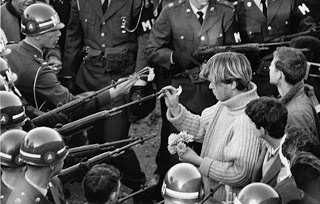
It was terrible, and there is still a great deal we don’t know: why the National Guard was on campus in the first place? why the order to fire on unarmed students hundreds of feet away? Who gave the order? or, was an order even given? There’s a lot of writing, and a lot of controversy, still. A good start is a summary, including an annotated bibliography, by two emeritus professors at Kent State, Jerry M. Lewis (Sociology) and Thomas R. Hensley (Political Science).
The shooting of unarmed students on a public college campus fostered a sense that the country was coming apart. It was followed by a police shooting of student protesters at Jackson State in Mississippi, killing Philip Gibbs, 21, and James Green, 17, and wounding 12 other students.
President Nixon established a commission, chaired by William Scranton (formerly governor of Pennsylvania), to report on campus unrest. Published in September, the Scranton Commission answered few of the pressing questions about Kent State or Jackson State, but observed that campus unrest seemed to decline when the war in Vietnam seemed like it was winding down, and escalated after the bombing in Cambodia started.
The war and the demonstrations continued for a while, tapering off when the draft ended the next year. Authorities developed ways to control dissent, on campus and elsewhere, without using live ammunition against protesters involved in large demonstrations. Demonstrations generally became less threatening, less disruptive, and less dangerous.
The Kent State and Jackson State killings remain tragic exceptions to more routine protest politics. It’s a good sign that they stand out in our memories.
One reason the memory remains is a powerful and idiosyncratic protest song, recorded within just a few weeks of the event. Days after the Kent State shootings, Neil Young wrote, “Ohio,” a song mourning the deaths. Apparently, he was shocked by photos published in Life magazine. Crosby, Stills, Nash, and Young released the song, which called out President Nixon and ended with the repeated line, “Four dead in Ohio” (lyrics). The song reached the top 20 in the United States and Canada, and appeared on several albums by Young and by the group; they often performed the song in their occasional reunion tours over the past half-century.)


Will never forget that day. My mom was getting a masters at Kent and was there a half hour before the shootings. She came to pick us up at school that day and she was so angry she could barely speak. Later at the Memorial Day parade in my hometown of Hudson (near Kent), it was quite chilling to see the National Guard vehicles as part of the parade.
Because of the shootings, Kent opened the Center for Peaceful Change and I sat in on peace studies courses there. Inspired, I tried to put together an independent study major at Georgetown where I was getting my BA but got intimidated and gave up. (Note to self: Don’t ask Jean Kirkpatrick to be an advisor just because she gave a talk on women and government.) Later, after several years of activism against nuclear power plants, I entered the PhD program at Syracuse University for peace studies and I got my new boyfriend, a Philosophy post doc, involved in peace studies. Later he got hired at my old alma mater, Georgetown, and we were both involved in getting GU’s Justice and Peace Studies Program going.
So, proof positive that sometimes very bad things lead to good things. But mostly I’ll never forget how mad my mom was that day. She had been a moderate Republican her whole life but the Vietnam war turned her into a raving liberal.
That’s a very powerful story, Amy. I’m sure your mom’s response wasn’t unique, but it’s the kind of thing that scholars never get.
You betcha!!! Wish she was still here to talk about it!
Pingback: Protest songs, poetry, and political influence | Politics Outdoors