
Enemies help activists build movement campaigns. Aggressive or offensive antagonists personify grievances and help unify coalitions of opposition. They provide convenient targets and simplify the story.
Think about Donald Trump and advocates for climate action and anti-corruption crusaders and health care reformers or critics of corruption. Trump simplifies explanations, particularly for new activists, and provides a source of unity for people working on all sorts of different issues.
But the president is far away and hard to influence. Foreign leaders, like Benjamin Netanyahu, are even further. Student activists have long found common cause in opposing local administrators, presidents, and (gulp) professors. Graduation is a good place to see it in operation.
I’m no stranger to college graduations, having attended a couple of dozen over the years, starting with my own at the now sadly shuttered Hampshire College. There are robes and rituals, some speeches, and sometimes even bagpipers. There are happy and less happy new graduates eager to grab the tangible sign of their efforts—a diploma. And there are friends and family even more eager to celebrate their achievements—that is, an audience.
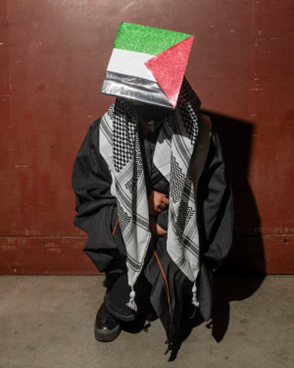
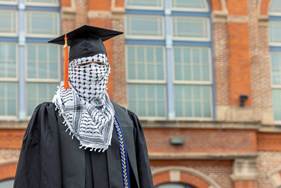
I went to a graduation a couple of weeks ago and got to see a student protest, focused, I think, on getting the school to divest its financial holdings and/or academic connections to Israel. Whenever the president or the Chair of Board of Trustees stepped to the podium, scattered students and observers yelled at them, booing vigorously. A few held signs or waved Palestinian flags. It was a little disruptive; I’m sure some near-graduates and their families were disturbed, but the ceremony went on.
And then the big event, when the new graduates walk across the stage and accept the applause of their families with their diplomas. This is all choreographed: the bestower of degrees holds the diploma in his left hand, and reaches across with his right to shake the student’s right hand. The left hand passes documents while the right congratulates.
Some grads—my wild guess is 5-10%–disrupted this choreography. Handing off scrolls with their right hands, they skipped the ritual handshake, and grabbed the diploma with the left hand. The president passed the scroll off to a robed assistant—a minor inconvenience.
In real life, a college president is not responsible for Israeli policies and doesn’t make decisions about targeting or selling weapons; most don’t even make investment decisions. (They may be more or less supportive of expressive student protests.) But finding a way to influence a foreign leader—or even the American politicians supporting him—is no easy matter. The distance is a challenge for activists who see and want to stop distant wrongs. The trick of a divestment campaign is to draw lines of complicity between local targets and evils far away. Local targets are convenient, especially when Benjamin Netanyahu and Donald Trump won’t be on stage.
Refusing the cordial greeting may be a little rude, but anyone who aspires to a college presidency should develop a thick enough skin to handle such an affront; it’s part of the job.
Hanging responsibility for additional offenses on a local target can build solidarity among the protesters—even if it offends other audiences. And it does contribute to social and political polarization.
Still, it’s hard to get too upset at young people—or even older people–who learn about distant horrors and try to stop them, even if they don’t have access or tools to make much quick impact.
A note on comity: I noticed that a couple of protesting students made a point of juggling their scroll and shaking the president’s hand, as if to say their protest wasn’t personal. And I noticed one young graduate who made a point of exchanging harsh words with the president once he had the diploma. I don’t know how much it did for the cause.


Dave, I think this is pretty much on the mark, but it’s a little sad. In
Young activists want to do something to stop a genocide, and can find precious few levers to push that might actually connect up to something.