
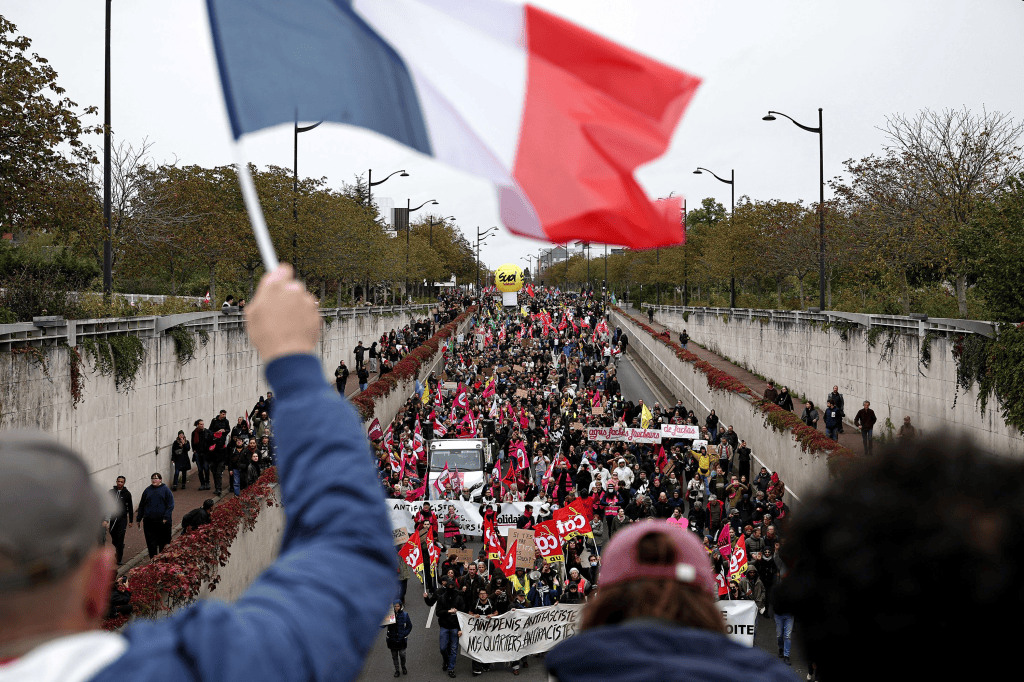
It’s not just France. Big street protests are erupting everywhere all across Europe–and elsewhere–taken together, they’ve been tabbed as the Gen Z protests.
[I was interviewed about this on CNN last night; here’s the link.]
When teens first started mass demonstrations in France, complaining about tragic underinvestment in public education and their own anxieties about further education or employment, some critics were quick to point to a French culture of protest, where dissenters were always ready to take to the streets and police were eager to beat and/or arrest them.
But Albania, Argentina, Belgium, Chile, Greece, India, Israel Italy, Pakistan, Portugal, Romania, and Spain all hosting large anti-government demonstrations in the last few weeks? [I typed the cases I know quickly and in alphabetical order, somewhat nervous about new protests elsewhere before I finish writing this post.] There is always plenty of political protest going on, but this cluster of disruption seems bigger and a tiny bit more unified.
Young people may not be at the center of everyone of these campaigns, but they are exceptionally visible in most of them, and some grievances and demands appear everywhere. Viewing adult life on the horizon, youth everywhere are worried about opportunities for education and employment, and they’re well-aware of the rising costs of fuel, food, housing–and just about everything else. Their governments seem unable or unwilling to help, and many of those governments, riddled by conspicuous corruption, don’t evince the slightest concern for “Gen Z” (typically, those born between 1997-2012.)
Of course, it’s not just younger people. It’s interesting to see just who is hopping on to support these demonstrations in different places. In France, the big trade union confederations have appeared, trying to discipline and define the discontent. In the US, there’s plenty of gray hair at the No Kings and anti-Tesla protests.
So, it’s always good to be skeptical of explanations that emphasize homogenous generational conduct and interests; in this case, there are always plenty of people outside the band of birth years who get involved, and plenty of dispute and dissension within a defined generation. Still, it’s not surprising that younger people are taking the lead in trying to combat growing economic and political equality–especially when so many of them are on the straitened side of that “K-shaped” economy, heading downward.
Why did all these efforts seem to emerge at once?
There’s an element of imitation. Frustrated people look for solutions, and when those that are apparent don’t seem like they’re working, frustrated people watch what others are doing. When high school students pour into the streets in Paris, young people everywhere else can see similar grievances and a strategy that might matter. Anyway, public protest is contagious because it’s something to do when nothing else appears possible. And in the current media environment, words and pictures spread quickly around the globe. These efforts are much less about transnational organization than transnational inspiration.
And there’s an element of mainstream media finding what they decide to look for. When disruptive protests scroll across the screens of editors and news producers, they look for trends that they might otherwise neglect or downplay. Students in Albania get more attention because of young people protesting in bigger media markets. There’s always plenty of protest news to cover when you’re willing to look for it.
Scroll back just a couple of years and you can add Bangladesh, Madagascar, Nepal, and Sri Lanka to the list of volatile demonstrations. And some of them clearly mattered–not always for the best. Public protesters helped topple governments in Madagascar and Nepal in bloody battles that engaged the military; while there is some reason for optimism about reform in Nepal, a military junta now rules in Madagascar. Turn back just a little further in time and you’ll remember that twice in the last decade candlelight street protests successfully encouraged the National Assembly to impeach and remove a president in South Korea.
Protest in the streets is an available strategy in much of the world–and it might matter when nothing else does.


