Do you believe in science?

The image above is from the Heartland Institute, an advocacy group which receives funding from a number of conservative sources (Scaife, Olin, Koch, for example) to promote doubts about climate change, the health risks of cigarettes, the dangers of fracking, and of taxation–among other issues.  In addition to supporting the production of papers, it also engages in public relations efforts.  The billboard above links the acceptance of climate change to an obviously suspect source.

Almost all scientists who work on climate accept the reality that the climate is changing, largely because of human impact–and it’s not benign.  But there are others…. One is Wei-Hock Soon, who holds an appointment at the Harvard-Smithsonian Center for Astrophysics, but has to raise his salary and support for his work from grants (New York Times story).  He’s been reasonably successful at doing so; Greenpeace filed a Freedom of Information Act request to trace it and found that he’s accepted more than $1 million from the fossil fuel industry, which likely finds some utility in his consistent findings that the sun is generating any observed changes in climate on earth.  Given that Dr. Soon’s work gets little support from his colleagues or other working scientists, he’s fortunate to have found corporate benefactors.  And the companies are glad to have someone with a doctorate and publications whose findings don’t undermine their business model.

But academics who may have a financial stake in a particular finding are obligated to disclose that potential conflict of interest in their publications; Dr. Soon has not routinely done so.  He may not be tailoring his findings to suit his funders, but readers want to know if there’s reason to be suspicious.  [When I tell you that I support funding for the collection of data and support of public universities, you know that I draw a salary from a public university; you can consider interest when you evaluate my arguments.  You want to know when research supports the favored position of the people paying for it, no?]

Opponents of concerted action to ameliorate climate change will no doubt find other people with Ph.D.s to support, but they’ll be looking for the result before they pick the scientist. Alas, when one-time climate skeptics begin to join the scientific consensus, they lose both the financial support and political support of their former sponsors (discussed here).  Don’t worry, interests will find someone else to fund.

If you’re invested in a particular outcome beyond truth, it’s not science.

And science is almost always big and diverse enough that you can find someone who looks credible enough to support your beliefs about climate change, evolution, or vaccines, to cite a few examples.  Sometimes, as on nutrition, the scientific consensus has been historically inconsistent, which makes it harder to find useful guidance.  Most of us are not well-equipped to adjudicate disputes among epidemiologists about population samples, for example, so we fumble trying to find reliable information, or just pick the result we like and put the scientist who generated it on our poster.  Not so great.

But belief in science is belief in a method of discerning truth.  It may not produce readily usable results, but our commitments are contingent upon evidence, and we want to be open to new evidence that might undermine them.  It’s tough.

The Dr. Soon story reminds us that interested parties will cultivate authorities who substantiate what they want us to believe.  Skepticism is appropriate, but ultimately we need to make decisions, and it’s better if they’re informed.  The scientific consensus, if it can be found, is hardly infallible, but it’s likely to be a better guide than an outlier supported by someone with a vested interest in a particular conclusion.

Our values should pose questions, but we really want to find honest answers that come from somewhere else.

Posted in Uncategorized | Tagged , , , , , , , , | 2 Comments

You miss all the shots you don’t take

Effective advocates are entrepreneurial, constantly trying to tie their preferred remedies to any potential problem that comes up in the news.  This is the only way we can make sense of Students for Concealed Carry‘s effort to present their prime concern (allowing college students to pack weapons along with their book bags each morning) as a solution to the problem of sexual assault on campuses.

Let me confess that as someone who works on a college campus, I think the demand is ridiculous, dangerous, and completely counterproductive to the goal of making college life safer.

I’m not alone in these beliefs.  A story in today’s New York Times lays out arguments for and against concealed carry on campuses, noting that they are now being rehearsed in some state legislatures.  If young men knew that the young women in their sites might be carrying lethal force, they would be more careful, gun supporters claim.

Even if they could be armed themselves?  And, what of the alcohol-fueled, uh, celebrations that are often the initial staging areas for sexual assault?  It’s hard not to think of what else guns might bring to the party.

All that said, I learned of Students for Concealed Carry from this odd repurposing–against sexual assault–and the resulting Times story.  The new rationale also led to the group welcoming the first woman onto its Board of Directors (the website wasn’t updated to include her as of this morning).  I’ll bet the story generated more attention to SCC and its fundraising appeals than anything else since the group’s inception.  Provoking opposition and even ridicule isn’t always bad politics.

Watch to see the turnout at SCC’s “signature” event, the empty holster protest, scheduled for the first week in April.  (Is this really an April Fool’s prank????)

Note:  Like many professors, I have given lectures (and, more likely, grades) that disappointed students, relying on the premise that they are largely unarmed.  Then again, surely if my A students (the mythic “good guys with a gun” ) were also packing, I’d be protected….

Posted in Uncategorized | Tagged , , , , , , , , , , , | 7 Comments

Updates: Martin Luther King Day 2015

We try to take control of the past with current struggles in mind.  Martin Luther King, killed less than a half-century ago is a prize for contemporary activists.  The civil rights movement isn’t quite a wispy memory from the era of Mad Men; some of King’s allies and opponents are still around, making it just a little harder to make up stuff.

This year, King and the civil rights movement provide some inspiration and legitimation for activists across the country challenging differential policing, and trying to create a new civil rights movement.

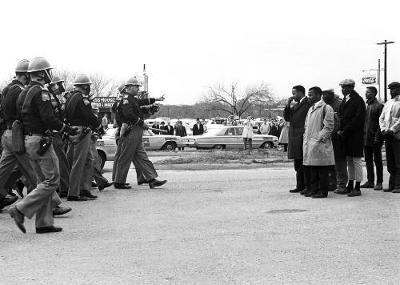
But not just that: Selma, a movie about the dramatic struggle for Voting Rights that ran across the Edmund Pettus Bridge, has been in the news as a subject for historical debate.  The movie portrays King, and especially local activists, as heroes who dragged Lyndon Johnson into support for voting rights.  Johnson is portrayed as an antagonist who set J. Edgar Hoover and the FBI loose on King.  Not all of this is strictly accurate; Johnson supported civil rights by this time, albeit in far more measured and careful way than the extraordinarily brave men and women who marched, non-violently, into beatings by the police.  (And Johnson was hardly calling the shots for Hoover, who followed his own perverse political passions, dragging federal law enforcement along with him.)

Congressman John Lewis (LA Times), one of those brave young people, a character in the movie, and a hero by any definition, lauds the film as a work of art, more than a historical document.  He describes Johnson as one of the nation’s great presidents, but emphasizes the importance of the people of Selma who took action.  And a film that makes us think about this episode in our past is a good thing; he writes,

And “Selma” does more than bring history to life, it enlightens our understanding of our lives today. It proves the efficacy of nonviolent action and civic engagement, especially when government seems unresponsive. With poignant grace, it demonstrates that Occupy, inconvenient protests and die-ins that disturb our daily routine reflect a legacy of resistance that led many to struggle and die for justice, not centuries ago, but in our lifetimes. It reminds us that the day could be approaching when that price will be required again.

So, we make sense of the past to make the world we want in the future.

And it’s worthwhile to remember that Martin Luther King was hardly as finely polished and broadly accepted as the statue on the mall.  At Vox, Jenee Desmond-Harris hauls out the Poor People’s Campaign, the effort King was organizing when he was killed.  In the last years of his life, Rev. King took his Nobel Prize and his influence on Civil Rights and Voting Rights, and put them all in the service of campaigns against war and against poverty and inequality.  These were brave and less popular efforts, even more radical than the earlier civil rights campaigns.

And, partly because they were less successful than efforts to, say, desegregate buses and libraries, all the more relevant to us today.

Posted in Uncategorized | Tagged , , , , , , , , , , , , , | 1 Comment

King Day (2015)

(This is a repost for Martin Luther King Day.  Update to follow.)

Martin Luther King died young enough and dramatically enough to be turned into an American hero, but it was neither his youth nor his death that made him heroic.

In his rather brief public life, beginning in Montgomery at 26, and ending with his assassination at 39, King consistently displayed rhetorical brilliance (on the podium and the page), strategic acumen, and moral and physical courage.

The effort to honor Martin Luther King with a holiday commemorating his birthday started at the King Center, in Atlanta, in the year after his assassination.  States began to follow suit, and by 1983, more than half celebrated King’s life with a day.  In that year, Ronald Reagan signed a bill making Martin Luther King day a national holiday expressing ambivalence, acknowledging that it was costly, and that King may have been a Communist.

The King holiday was about Martin Luther King, to be sure, but it was meant to represent far more than the man.  King stands in for the civil rights movement and for African-American history more generally.  I often wonder if the eloquence of the 1963 “I have a dream” speech winds up obscuring not only a man with broader goals, but a much more contested–and ambitious–movement.

The man and the movement are ossified into an iconic image, like a statue, which locks King and the movement into the politics of 1963-1965.  We accept King’s dream, that little children will play together, and that people will be judged by “the content of their character” (a favorite phrase on the right).

The image, like a statue, is available for appropriation to advocates of all political stripes, and the establishment of the holiday itself represents an achievement of the civil rights movement, winning the holiday if not broader economic and social equality.

Before the transformation of the man into an icon, King transformed himself from a pastor into an activist, a peripatetic crusader for justice.

But the pastor didn’t disappear; rather this role grew into something larger, as King himself transformed himself from a minister into a an Old Testament prophet, one whose primary concern was always the people on the margins, the widows and orphans, the poor and hungry.  In standing with those on the margins, King courageously used–and risked–the advantages of his privilege, pedigree, and education.  He also knew that he risked his safety and his life.

In his writing, King used his education and his vocation to support his political goals.  In the critically important “Letter from a Birmingham Jail,” he cited both the Constitution and the Bible in support of Federal intervention in local politics to support desegregation and human rights.  (We know that other activists now use the same sources to justify pushing the Federal government out of local politics.)

King explained that he was in jail in Birmingham, Alabama, because he had nonviolently defied local authorities in the service of higher laws, the Constitution and the Gospel.  This was not like making a provocative statement on one’s own [profitable] radio or television show.  There were real costs and severe risks.

King was never less than controversial during his life, under FBI surveillance during his political career, and vigorously criticized by opponents (for demanding too much and too strongly) and allies (for not demanding more, more vigorously).

When he was assassinated outside a Memphis motel in 1968, he was standing with sanitation workers on strike, straying from a simpler civil rights agenda.  He had also alienated some civil rights supporters by coming out, strongly, against the war in Vietnam.  And Black Power activists saw their own efforts as overtaking King’s politics and rhetoric.  By the time he was killed, Martin Luther King’s popular support had been waning for some time.

Posterity has rescued an image of Martin Luther King, at the expense of the man’s own broader political vision.

Ironically, in elevating an insurgent to a position in America’s pantheon of historic heroes, we risk editing out the insurgency.

Posted in Uncategorized | Tagged , , , , , , | Leave a comment

Police violence and the special prosecutor

Twenty-five thousand people marched in New York City on Saturday because they were angry that police who kill unarmed, uh, suspects, aren’t prosecuted.  But they’re angry about more than that:  differential policing based on color, particularly the treatment of young black and Latino men.

The failure of grand juries to indict two police officers in Ferguson, Missouri and New York City was the spark, but a focus on indictments addresses only a very small part of the problem.

The challenge for activists, I wrote yesterday, is to find actionable demands to focus their efforts.  Here’s one: routinely appoint special prosecutors in cases of police violence. (See reports here, here, and here.)  The claim is that local prosecutors work closely with police, identify with them, and need to maintain good relations with the police department in order to do their work.  Special prosecutors are more likely to seek indictments and prosecute cases aggressively.

Maybe.  (It’s worthwhile to read the debate at the New York Times site.)

But juries don’t always follow crowds, and prosecuting individual officers whose behavior is especially awful does little to address larger issues in policing.

Maybe–the realistic prospect of facing criminal charges for say choking a suspect to death will deter police misconduct?  Maybe it will promote broader changes in police protocols?

I’m doubtful.

Major cities across the country pay out millions of dollars each year in civil judgments and settlements for police misconduct.  The Baltimore Sun reports that Baltimore has paid $5.7 million in such settlements in the past three years.  Radley Balko’s Washington Post summary reports large sums paid out everywhere:

The Chicago Sun-Times reported earlier this year that the city has payed out nearly half a billion dollars in settlements over the past decade, and spent $84.6 million in fees, settlements, and awards last year… Bloomberg News reported that in 2011, Los Angeles paid out $54 million, while New York paid out a whopping $735 million, although those figures include negligence and other claims unrelated to police abuse. Oakland Police Beat reported in April that the city had paid out $74 million to settle 417 lawsuits since 1990. That’s a little more than $3 million per year. The Denver Post reported in August that the Mile High City paid $13 million over 10 years. The Dallas Morning News reported in May that the city has forked over $6 million since 2011. And last month, Minneapolis Public Radio put that city’s payout at $21 million since 2003.

It’s hard to think that these massive sums make for any kind of deterrence; rather, the costs of settlements gets folded into the larger costs of running a city.  (See Richard Emery and Illann Margalit Maazel’s 2000 Fordham Urban Law Review piece for an analysis of how and why.)

So, right now there’s a possible and actionable focus. Is it enough?

Posted in Uncategorized | Tagged , , , , , , , , , , , | 1 Comment

#Black Lives Matter: Does protest?

Large demonstrations yesterday in Washington, DC and New York City–and smaller ones across the United States–kept public attention on the issue of police violence. Activists–and others who just might come out next time–wonder whether anything will come of this moment of attention.

The police killing of Michael Brown, an unarmed teenager, in Ferguson, Missouri, was the spark that set off this round of national attention.  There’s no kind of good policing in which a dozen shots are fired at an unarmed man.  As if to underscore how poor this policing was, Michael Brown’s body was left on the streets for hours afterward, and police overreacted and inflamed the understandable public protests that followed.

It was about Michael Brown and his family, the sad tale of a life lost, but it was never just about Michael Brown.  Across the United States, activists recalled the names of young black and Latino men killed by police, and a much larger number of men recalled non-fatal instances of police harassment.

The failure of a grand jury to indict the police officer who killed Michael Brown stoked the outrage, while the video of a police officer in Staten Island choking Eric Garner to death circulated.  Again, we don’t want police strangling unarmed young men, even if they’re selling cigarettes illegally.  And again, another grand jury far from Missouri chose not to indict the police officer.

Demonstrations spread across the United States; protesters marched with their hands up.  “I can’t breathe,” audible in the Eric Garner video, appeared in signs and chants.  Sometimes, protesters clashed with police.  But this time the campaign was bigger than a protest against a particular instance of police violence.  The message–and the movement–spread beyond familiar campaigners against police brutality; the crowds became increasingly diverse in terms of age and race.

Medical students nationwide held die-ins to identify violent policing as a public health hazard.  At right are the medical students from Harvard University, and that’s not a study break.

John Legend and Chrissy Teigen (musician and model/food blogger), not previously known for their politics, hired food trucks to feed protesters in New York City.

Chris Magnus, the police chief of Richmond, Virginia, joined the demonstrators in his city last week, wearing his uniform–provoking criticism from some of his own officers.

The point: this time the protests against police violence has spread far beyond “the usual suspects”–and I use that loaded term intentionally.

But winning indictments, much less criminal convictions, of the particular police officers who killed these young men, is extremely unlikely.  After all, our criminal justice system is designed to insulate the legal system from popular pressures–for good and ill.  More than that, a trial–and even a conviction–placing the responsibility for systematic injustice on the shoulders of one officer–is hardly an adequate response anyway.

What would be?

Alas, we have a long record of episodes of concern about racialized policing.   You remember the petitions and protests around Trayvon Martin’s killing two years ago (by a community watch volunteer–warned by the police).  You may have only heard of the national wave of attention that followed the beating of Rodney King and the acquittal of the Los Angeles police officers who participated in it–vigorously.  After that 1992 acquittal, people in Los Angeles–and around North America–protested, sometimes violently.  Fifty three people were killed in Los Angeles, more than 2,000 were injured, and authorities called the military in to end the unrest.

The King riots produced a commission on policing in Los Angeles, and ultimately reforms in police procedures.  Bureaucratically, the tenure of police chiefs was no longer essentially unlimited, but subject to renewal every five years.  Demographically, the leadership and composition of the police force diversified, with black and Latino officers increasingly visible.  Programmatically, Los Angeles hired a large number of new officers, and the police faced new restrictions on the use of force.  All this stuff should matter.  Police say it does. 

But read any article detailing changes in policing in Los Angeles and you’ll find the comments section filled with the names of black and Latino men–in LA and elsewhere–who have been the victims of police violence.

Does this mean no progress? or unrealistic expectations? or just the difficulty of realizing how much work it is to make even incremental progress?

The next step for activists is to move beyond the specific cases to the larger cause and make claims that extend beyond indictments.


Posted in Uncategorized | Tagged , , , , , , , , , , , , , , , , , , | Leave a comment

Problematic allies and UC tuition

University of California students don’t want their tuition to increase.  I saw the protests outside the Board of Regents meeting and on my campus, and I heard the students in my classroom explain just what an extra 5 percent might mean to them in terms of work outside of school and in terms of debt.  They’re pretty reasonable.

UC President Janet Napolitano says that the state of California doesn’t provide enough money to keep a top university system operating and enroll new students.  She says that capacity to increase tuition steadily is needed in order to guard against the deterioration of the university–if the state doesn’t pony up enough money.  She’s right too.

Governor Jerry Brown says that tuition hikes are outrageous, and that UC can save money by putting more courses on-line and getting students out in three years–and by abandoning the notion of competing with other top universities for administrators and faculty.  In essence: UC doesn’t have to be like other institutions.

Who are the likely allies here?

For now, Governor Brown and the student regent, Sadia Saifuddin, are on the  same side, unsuccessfully opposing UC’s right to hike tuition.  They agree on “no,” but maybe not much else.  The LA Times reports that Ms. Saifuddin was very clear on this:

Saifuddin sharply rebutted Brown’s ideas about online classes and a three-year degree. “We want a four-year university. We want to talk to our professors. We want to learn in real time,” she said.

For students, a victory on tuition could well be a set-back on other issues.

In real time: I asked my students in a course on protest about their ideas on this controversy.  They were steadfast in the opposition to tuition hikes–and to very high salaries for administrators.  They were, however, reluctant to sign off on promoting online education or having more courses taught by adjuncts or lecturers.  They didn’t want to reduce the library (further) nor cut interscholastic sports (further) or campus maintenance or student services.  They’re also critical of UC’s increasing reliance on out-of-state and international tuition dollars–that come at the cost of spots for Californian students.

They want it all: a world-class university, with top-flight research, courses taught by tenure-ladder faculty, and affordable tuition.

Note: that discussion would not have taken place in the same way if they were simply watching a lecture on youtube at some convenient moment.

Hmm.  Anyway:

Governor Brown’s task here is the simplest: emphasize keeping tuition low; others can take the fallout from the execution of efficiencies.

President Napolitano’s job is a little tougher: emphasize a vision of a great university system and clearly link state funding deficits and politics to the pressure on tuition.

The students have the toughest job (here as on other things): fight for their interests on tuition without letting it obscure the quality of education they’re struggling to pay for.

Posted in Uncategorized | Tagged , , , , , , , , | 7 Comments

Making the cause visible: Hollaback!

You’ve probably seen this already:

That’s what going viral means (15 million views!).

The video truncates a day’s worth of unwelcome comments on the street into a tight and disturbing two minutes.  Produced as a Public Service Announcement by Hollaback! in conjunction with a video producer, Rob Bliss, the video suggests the extent to which women encounter unwanted, unpleasant, and maybe threatening attention just from walking in the city.

For nearly a decade, Hollaback! has been working to fight street harassment, using the tools of our era.  Armed with cell phone cameras, women took pictures of men performing various lewd acts in public, posting those photos on blogs.  Unlike this video, the faces weren’t blurred.  The effort is to raise awareness of the issue, put would-be harassers on notice, and suggest to women that they can, uh, holler back.  An early picture circulated from Flickr to the front page of the New York Daily News, bringing attention to the issue–and to the emerging organization.

The campaign spread in New York City, and then beyond.  Women in other cities, sometimes other countries, started sending in photos and videos to post.  In 2010, New York’s City Council held hearings on street harassment, and gave Hollaback! just over $28,000 for its efforts to build an infrastructure to support the reporting of street harassment.  The organization scaled up, building a professional structure, and expanded internationally.  It now reports more than 70 cities across 24 countries, and clear ambitions to go further.

This video is a big step forward for the group: had you heard of Hollaback! before?  It raises attention and offers the chance to raise money.  Click around and you can find apps for your phone to report and monitor harassment.


Hollaback! isn’t the only group using cheap and ubiquitous cameras, along with the internet, to make public behavior that is often invisible to some of us.  Effective organizers use the technological tools of the moment to spread their cause: the printing press, then the mimeograph machine, the radio, and now the cell phone.

On this video:

There’s no question that the video has spurred conversations about appropriate conduct and attention to the group.  It’s also produced an awful backlash mostly directed at Shoshanna B. Roberts, the actress who volunteered to walk–and not respond–for ten hours, including threats of violence.  Another counter-current is about the racial politics of the video; although Bliss says there were plenty of harassers of all races, they wound up showing mostly blacks and Latinos by chance….it is only 2 minutes.

Posted in Uncategorized | Tagged , , , , , , , , , , , , | Leave a comment

Protest in America is historic….and patriotic

Not that high school students need additional reasons to be frustrated with the adults who constrain their lives, but:

The elected Jefferson County School Board is considering a proposal to revamp its American history curriculum that (according to the AP)

calls for instructional materials that present positive aspects of the nation and its heritage…[and] establish a committee to regularly review texts and course plans, starting with Advanced Placement history, to make sure materials “promote citizenship, patriotism, essentials and benefits of the free-market system, respect for authority and respect for individual rights” and don’t “encourage or condone civil disorder, social strife or disregard of the law.”

As if to confirm the worst fears of the three conservatives on the Board, students didn’t wait for the Board to act, organizing a walk-out in protest.

As a teacher, I’m always heartened when students want to know more than what they may be getting in school, particularly about American history.  As someone who has built an academic career on the politics of protest, I also find both vindication and yet another case!

So in the suburbs of Denver, hundreds of students at six high schools walked out of class, ambled into the streets, and marched into a history that at least some of their elders want to edit severely.  The students were sufficiently savvy to know that they were far more likely to find an audience for their views by going broadly and dramatically public, organizing a campaign on Facebook and by word of mouth.

The walk-out was dramatic and telegenic, and made national news.  Indeed, students in Colorado were particularly cheered to learn that the New York Times picked up the story.

Jack Healey, writing there, even got my favorite quote:

“It’s gotten bad,” said Griffin Guttormsson, a junior at Arvada High School who wants to become a teacher and spent the school day soliciting honks from passing cars. “The school board is insane. You can’t erase our history. It’s not patriotic. It’s stupid.”

Censoring protest and contention from American history is particularly difficult.  After all, the country’s birth came from a civic rebellion, featuring plenty of what we’d now call civil disobedience.  Would you drop the Boston Tea Party?  Shays’s Rebellion?  John Brown, draft riots, and the Civil War altogether? Discuss Congressman John Lewis without mentioning the beatings and arrests he endured as a young man?  What about the Tea Party’s anti-tax protesters?  Griffin Guttormsson is right; it is stupid.  In fact, the Board tabled the resolution and then softened it, but the word got out.  Taking protest out of the schools is likely to be every bit as difficult as banning prayer.

But it’s not just about curriculum; it’s never all about curriculum.  As in much of the rest of the US, the Board is also battling the teachers and their union about creating charters and adopting a merit pay system.  The Board’s move on curriculum at the same time has created an alliance; many students hold signs emphasizing their support and affection for their teachers.

By awkwardly overreaching, conservatives on the Board have succeeded in drawing attention to what is most assuredly a national movement, funded and promoted by groups like Americans for Prosperity, and already winning scattered victories  across the United States (see Texas!).

I’d bet that the Jefferson County students gained at least as much from today’s American history lesson as from the one the day before.  They may even win a victory on the battle over the history curriculum.  But the larger conflict is far from resolution, and the students have very successfully put out a call for help in that struggle.

Posted in Uncategorized | Tagged , , , , , , , , , , , , , , , | 1 Comment

The Scottish referendum: what victory looks like.

In real life assessing social movement victories or defeats is rarely like figuring out which runner breaks the tape in a sprint.  Achievements are virtually never all that activists demand–or want–and apparent defeats are not always what they seem.  Look again at Scotland:

The independence referendum was defeated clearly, with opponents posting nearly 400,000 more votes than supporters (55%-45%).  But what did the “no” voters want?  Remember that UK Prime Minister David Cameron rejected a referendum ballot with three choices: independence, no change, and devolution of powers, in favor of an up/down vote on independence.  To defeat the nationalists, however, he had to add devolution to the options covered by the no side, frenetically making promises of reforms in the last days of the electoral campaign.

The Nationalists will work to hold him–and the UK–to those promises.

So Scottish First Minister Alex Salmond accepted defeat, but explained that it was one step in a longer march toward increased autonomy for Scotland.  It wasn’t just the defeated trying to find some smattering of hope.  Alistair Darling, who headed the no campaign, claimed victory by announcing that the UK would have to afford Scotland more control over taxing, spending, and the contours of its own welfare state, sentiments echoed by the leaders of the UK’s major parties–including David Cameron, whose authority and leadership was clearly damaged by the entire campaign.

It’s certainly not an unambiguous victory for the nationalists: Trident submarines armed with nuclear weapons will continue to sail in the North Sea, while the Scots will continue to send taxes and representatives to London.  But the debate and the politics will be about negotiating greater autonomy for Scotland and greater power for its parliament.  It’s not all the nationalists wanted, but it’s more than Cameron wanted to give, and it’s far more than most people thought possible two years ago when the referendum was negotiated.  Cameron says the issue is now settled for a generation, but it’s hard to think that 1.6 million Scots who voted for independence (and many of the “no”s as well) are ready to accept that.  The rapid growth of support for independence reflected, more than anything else, gross dissatisfaction with the current Westminster government.  That’s not going to go away so quickly.

Alex Salmond has announced that he will step down as First Minister and leader of the Scottish Nationalist Party, but there are many others eager to stand in his place and conduct negotiations for autonomy.  David Cameron did not make a similar commitment, but the course of this independence/autonomy battle didn’t do any good for his authority as Prime Minister or leader of the Conservative Party.

While we may want to keep score at the ballot box, social movements are always playing on a broader field.

Posted in Uncategorized | Tagged , , , , , , , , , , | 1 Comment