Bloody Sunday and the uses of history

History isn’t just telling stories about the past; for most of us, it’s about making sense of the present.  Politicians, pundits, and activists invoke their understandings of the past to try to affect the future.

This Friday, March 7, marks the 408th anniversary of Bloody Sunday, when 600 civil rights activists attempted to cross the Edmund Pettus Bridge (which still stands, at left), leaving Selma, Alabama for a planned march to the state capital in Montgomery.  Representatives of virtually all of the major civil rights groups had been trying to organize for voting rights in Alabama–and throughout the South, and met little success.  Would-be voters were turned away from the courthouses when they tried to register, and activists were beaten by police.  One young man, Jimmie Lee Jackson, 26, was shot by a police officer, and died of an infection from the wound.

Activists set out from Selma to take their case (for justice for Jackson and voting rights for everyone else) to Governor George Wallace in Montgomery.  They didn’t get there quickly or easily.

Sheriff Jim Clark deputized every white man over 21 he could find, and massed them on the bridge, along with state troopers and local police.  The police ordered the demonstrators to disperse, and quickly attacked the activists.  Mounted police rode through the crowd, tear gassing and beating the demonstrators.  (At the bottom of the picture on the right you can see a brave, young, John Lewis, then leader of the Student Nonviolent Coordinating Committee.  He’s the one without a helmet or billy club.  He’s now a Congressman from Georgia.)

Supported by a court order from federal judge Frank Johnson, a march resumed weeks later, with 8,000 activists ready to cross the bridge.  By the time they arrived in Montgomery, on March 25, there were 25,000 civil rights activists.  Months later, in response to both continued activism and the energetic efforts of President Lyndon Johnson, Congress passed the Voting Rights Act.

It wasn’t only Jimmie Lee Jackson who paid a heavy price for this effort.  Seventeen people were hospitalized after the first march.  Days later, opponents of the march savagely beat three white clergymen who had come to support the civil rights effort, killing a young Unitarian minister, James ReebViola Liuzzo, a white activist from Detroit, was shot and killed by members of the Ku Klux Klan shortly after the march arrived in Montgomery.   In 1965, three men were indicted, but acquitted, for Reeb’s murder.  After being acquitted of state charges, three Klansmen were convicted of federal conspiracy charges and sentenced to ten years in prison for Liuzzo’s murder.  And on November 15, 2010 (!!!), James Bonard Fowler, formerly a state trooper, plead guilty to manslaughter for Jackson’s killing, and was sentenced to six months in prison.

The events leading up to the Voting Rights Act, long long ago, are worth remembering as the Supreme Court is now considering the Constitutionality of its pre-clearance provisions.  Last week, the Court heard arguments, and most observers saw five solid votes to strike down Section 5 of the Act, which requires designated districts to submit any proposed changes to voting rules and procedures to the Justice Department to certify that they won’t adversely affect the voting rights of minorities.

But all the action isn’t in the Court.  John Lewis returned to Selma again, as he has manytimes in the past, to commemorate the march and push the issues, and to weigh in on the Supreme Court case.  As you can see, at left, he wasn’t alone.  Just over Rep. Lewis’s right shoulder is House Majority Leader Eric Cantor, whose record on civil rights is somewhat less developed than that of his colleague.

And Vice President Joe Biden was there as well, warning about the coming court decision, and praising the 1965 activists for their courage, for their role in shaping his political attitudes, and for making it possible for a black man to be elected president.

When we retell these stories, we make the past live today–and it’s always about the future, surely as the Selma demonstrators, including Jimmie Lee Jackson, James Reeb, and Viola Liuzzo, would have wanted.

Posted in Uncategorized | Tagged , , , , , , , , , , , , , , , | 2 Comments

Civil disobedience and the Keystone to change

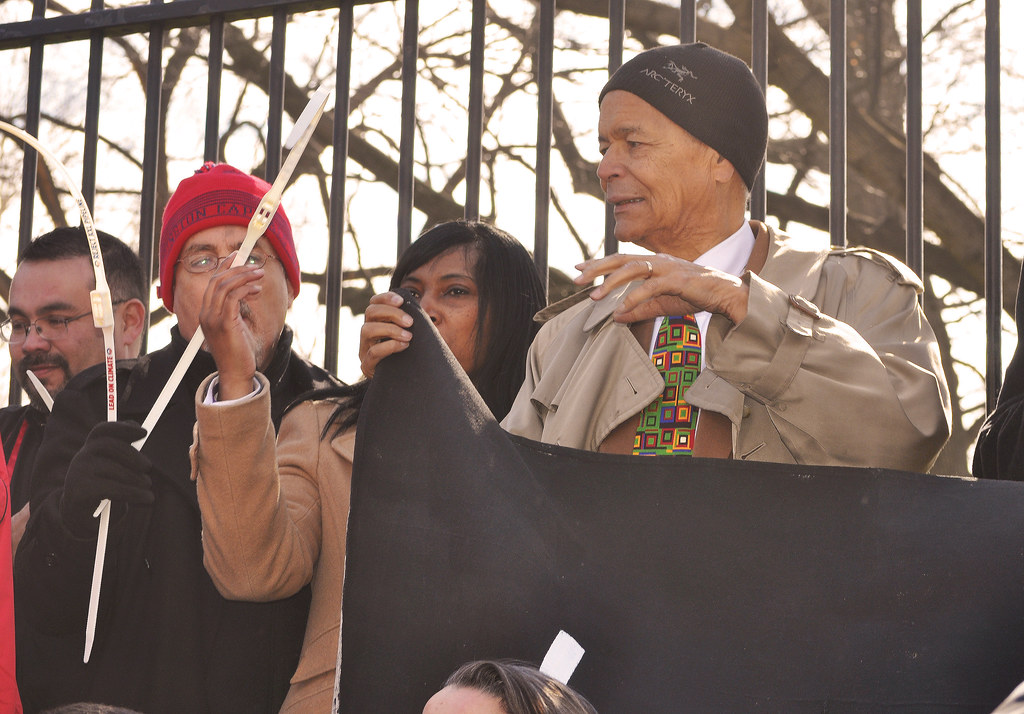
I was surprised that Robert F. Kennedy (at right) was the most tempting celebrity hook in coverage of the most recent civil disobedience outside the White House.   About 50 people handcuffed themselves to the gates out front and were arrested, and the story generated international attention.

The protestors, including Bill McKibben (350.0rg), Julian Bond (NAACP), actress Daryl Hannah (who probably would have been in most of the photos years ago), and Michael Brune of the Sierra Club.   The cause is the still unresolved status of the proposed Keystone XL pipeline, which will carry heavy crude oil from the Tar Sands in Alberta, Canada, to refineries on the Gulf Coast, where it can be processed, then transported, sold, and burned around the country.

Jim Hansen, the NASA scientist who has been sounding the climate alarm for decades, was arrested as well–but he decided several years ago that he needed to add civil disobedience to all else he was doing to address climate change.

President Obama mentioned the need for action in his State of the Union address, as he has before.  He was forceful enough to generate opposition from the Republican Party and the Oil Industry, but that doesn’t take much force or specificity.  Climate change activists say that stopping the Pipeline would be a first, modest, step in actually doing something.  As Bill McKibben, the writer and activist who’s been on this issue for decades, put it, “he Keystone pipeline project is the purest test of whether the president is serious about doing something about climate change or not.”

None of these people is getting arrested instead of taking other action on climate change.  Hansen has been writing academic papers and giving speeches and testimony, for example, while McKibben has been organizing groups, campaigns, and writing thoughtful and elegant books.  And Robert Kennedy Jr. has been working as an attorney for the National Resources Defense Council, seriously engaged with environmental issues for more than twenty years.

So, why spend a cold morning putting on handcuffs, only to have Washington police cut them off and replace them with a pair of their own?

It’s a mistake to think that this Keystone protest, one among many, will provide the critical moment that will change policy.  Instead, civil disobedience is a way to put climate change back on the political agenda in Washington (which is crowded with discussion of guns, immigration, jobs, and sequester, sequester, sequester).  The arrest, and Daryl Hannah helps here, is a way to get attention that yet another scientific paper or policy proposal will not.  But civil disobedience is effective only to the extent that it mobilizes others to take a range of additional actions.

A couple of interesting twists deserve comment here:

Historically, the environmental movement has been predominantly white and middle-class (and up).  Julian Bond (left), long ago the Communications Director of the Student Non-Violent Coordinating Committee, is no stranger to civil disobedience.  Most recently he was the longtime chairman of the NAACP.  Bond’ s presence represents an attempt to broaden and diversify the coalition of people active on climate change.

Michael Brune, the Executive Director of the Sierra Club, had his participation and possible arrest authorized in advance by his Board.  This is news because it’s the first time in the Club’s 120 year history that the group has participated in civil disobedience.  Why now?  Perhaps, as for Jim Hansen, the problem of climate change is so critical and the progress so slow, that dramatic action became more attractive.  There’s something else as well: choreographed arrests at the White House gates is now hardly so disruptive or alienating to potential supporters as it once may have seemed.

We watch now to see whether the action will affect the people who work inside the White House, or, more likely, whether the stories inspire people who see the pictures and read online, to do something else.

Posted in Uncategorized | Tagged , , , , , , , , , | 1 Comment

Remembering more of Rosa Parks

At The New York Times, columnist Charles Blow is promoting a new biography of Rosa Parks.  Jenane Theoharis’s The Rebellious Life of Mrs. Rosa Parks (Beacon) extends the story of the civil rights icon, undermining the myth of spontaneity surrounding the Montgomery Bus Boycott.

The popular version of the story recounts Mrs. Parks as a tired old lady who unexpectedly decided to resist a bus driver’s order to move to the back of the bus.  Citing Theoharis, Blow emphasizes the deep roots of Mrs. Parks’s activism: she was raised by a grandfather who supported Marcus Garvey, married to a long time civil rights crusader, and had served for more than a decade in a leadership role in the local NAACP.  In the summer of 1955, she attended a workshop on civil rights at the Highlander Institute, where she read about civil disobedience and the Brown v. Board of Education decision.  She says that she had decided to resist any directions to the back of the bus long before the opportunity presented.

Many years later, on a television game show, for example, or–more significantly–when she accepted the Presidential Medal of Freedom from Bill Clinton, she could be described as an old lady.  But that was 1996–forty years after refusing to move to the back of the bus.

The popular story makes activism seem like something that comes suddenly, out of nowhere, and unpredictably.  The fuller tale, just like the one about the Greensboro sit-in, shows that it generally takes long and focused efforts to create those seemingly spontaneous moments.

Posted in Uncategorized | Tagged , , , , , , , , , | Leave a comment

Lunch counter sit-in anniversaries

There was once a store called Woolworths.  It sold dry goods, mostly cheap stuff, including paper and pencils.  Many Woolworths also included a cheap restaurant where you could get coffee and a grilled cheese sandwich, also cheap.  Fifty-three years ago today, a Woolworths in Greensboro, North Carolina, was the site of a new phase in the civil rights movement, the beginning of the sit-in campaign.

On Monday morning, February 1, 1960, Ezell Blair, Jr., Franklin McCain, Joseph McNeil, and David Richmond, wearing their best clothes, went shopping at the Woolworths, bought some school supplies, then sat down at the lunch counter and tried to order coffee.  The four young men, freshmen at North Carolina Agricultural and Technical College,  knew the store wouldn’t serve food to black people, so they waited.  Woolworths shut the lunch counter down.

The next day, black and white students filled the lunch counter at Woolworths, and by the end of the week, every lunch counter in downtown Greensboro was filled with students protesting segregation–and organizing a boycott of the downtown businesses that practiced segregation.  Over the next weeks, sit-ins spread across the segregated South, led by student activists.

The four freshmen, no not the singing group, had all been active in the NAACP’s youth council, but none of them saw the large organization as a good foundation for a more activist and confrontational phase in the civil rights struggle. Pushed by the heroic Ella Baker, the NAACP launched an initiative to create a new student-based civil rights organization, the Student Nonviolent Coordinating Committee (SNCC), which staged dramatic education and direct action campaigns across the South for most of the rest of the decade.

Today is a great day to commemorate the sit-in movement, but anniversaries can be slippery.  When I tell the story to my classes, I usually start with the long Sunday night conversation when the brave young men talked themselves into action.  You could start the story much earlier, with the sit-ins organized by the Congress of Racial Equality (CORE) organized decades earlier, or with the sit-down strikes organized by the Industrial Workers of the World at the start of the 20th century, even before the founding of the NAACP.  You could also start the story with the Montgomery Bus Boycott and Rosa Parks, or the Brown v. Board of Education decision in 1954.  The Greensboro students knew all those stories.

Anniversaries help us remember important events and twists in history, but they invariably simplify longer and more complicated stories.  The drama of the Greensboro sit-in makes for a good entry into thinking about the civil rights movement, and into thinking about how regular people sometimes make history.  The names of Baker, Blair, McCain, McNeil, and Richmond are not particularly well-known today, not like those of Rosa Parks, Martin Luther King, John Lewis, or Thurgood Marshall.  The names of the thousands of young people crusading against segregation with them are even lesser known.  But movements are only possible and potentially effective with people willing to take risks without counting on seeing their names in the history books.

The lunch counter itself, or at least a portion of it, has been reassembled at the American Museum of National History (Smithsonian) in Washington, DC.  There are only four seats on display.  When we think about the civil rights movement, however, we need to extend the counter a long way.

Posted in Uncategorized | Tagged , , , , , , , , , , , , , , , , , , | 5 Comments

Resurrecting immigration reform and recalling the DREAMers

Only a small part of any comprehensive immigration reform proposal that the Senate considers will address the Dreamers, young people brought without papers to the United States as children, but the revival of immigration reform is directly attributable to their efforts.

The influence of social movements plays out over long periods of time, in often indirect ways, and the brave coming out campaigns led by young immigrants shook up mainstream politics in ways that are far too easy to neglect.

In the first years of the Obama administration, with comprehensive reforms invisible on the mainstream political agenda, young activists pulled out the piece of reform most relevant to their lives: a path toward recognition and citizenship for those who immigrated as children and found their lives stalled when they finished school.  They couldn’t work legally, or even drive, and they lived in constant peril of discovery and deportation.  The DREAMers represented America’s best and brightest, mostly students who want to dig into America.  In risky campaigns, they disclosed their unstable status while risking arrest, protesting on the streets or even occupying the offices of hostile legislators.

Some Democratic members of Congress took up their cause, pressing not comprehensive reform, but just a place for young people who had been immigrated by their parents, and only those willing and able to go to college or serve in the military.  The DREAM Act enjoyed majority support in the lame duck Congress at the tail end of 2010, but a filibuster in the Senate stalled the effort, devastating the DREAMers who now faced a Republican House of Representatives.

But the DREAM didn’t die.  The politics of immigration took a backseat to the economy in the lead-up to the 2012 elections, but not too far back.  Republican hopefuls, trying to ingratiate themselves with primary voters, offered tough, then tougher, stances on undocumented immigrants, including the DREAMers.  Mitt Romney, the eventual nominee, promised a set of policies that would encourage self-deportation.

And Latinos turned out at the polls in unprecedented numbers, voting against the Republican ticket overwhelmingly.  Latinos voted for Democrats in about the same percentages as American Jews, but there are many more of them, often in swing states.

The DREAMers deserve the credit for this voter turnout, partly by provoking anti-immigrant mobilization that seemed to capture the Republican Party.  The DREAMers deserve the credit for the media focus on the Latino vote, for the high visibility and high salience of the immigration issue, and they deserve the credit for the astonishingly recent Republican recognition that they need to do better with Latino voters to win national elections.  Because of the DREAMers, immigration reform has become the reed upon which thoughtful (and less thoughtful) Republicans have hung their hopes for electoral ressurection.

The politics on this issue have been turned upside down,” said Democratic Senator Chuck Schumer (New York), “For the first time ever, there is more political risk in opposing immigration reform, than in supporting it.

The DREAMers turned those politics upside down.

Now mainstream politicians are trying to right those politics.  Despite Sen. Schumer’s analysis, Republicans face plenty of risks in advocating reform.  From the precinct level on up, many Republicans got elected with promises of preventing any kind of amnesty for immigrants.  The prospects of anti-immigrant challenges from the right are serious.  What’s more, any kind of path toward citizenship means a procession of new voters who will start without much sympathy for the Republican Party.

The pragmatic strategy for Republicans is to find a way to do enough on immigration quickly enough that the issue is no longer important or visible two years hence.  Providing more visas for high tech workers is a relatively easy and attractive aspect of immigration reform.  So is the DREAM Act.  A new legalized status for immigrants that can’t lead to citizenship or a suspension of all moves toward citizenship until the borders are certified as “controlled” are sparkly alternatives for Republicans trying to thread a slender needle.

The challenge for DREAMers is to make sure the boundaries of reform aren’t so limited.  Their efforts made this moment possible, but absent their continued pressure, the outcomes are likely to be extremely disappointing.

Posted in Uncategorized | Tagged , , , , , , , , | Leave a comment

Martin Luther King Day (2013): The advantages of dead heroes

(Today’s presidential inauguration lands on the Martin Luther King Day holiday.  This is a repost on the no-longer contested King holiday.)

Martin Luther King died young enough and dramatically enough to be turned into an American hero, but it was neither his youth nor his death that made him heroic.

In his rather brief public life, beginning in Montgomery at 26, and ending with his assassination at 39, King consistently displayed rhetorical brilliance (on the podium and the page), strategic acumen, and moral and physical courage.

The effort to honor Martin Luther King with a holiday commemorating his birthday started at the King Center, in Atlanta, in the year after his assassination.  States began to follow suit, and by 1983, more than half celebrated King’s life with a day.  In that year, Ronald Reagan signed a bill making Martin Luther King day a national holiday expressing ambivalence, acknowledging that it was costly, and that King may have been a Communist.

The King holiday was about Martin Luther King, to be sure, but it was meant to represent far more than the man.  King stands in for the civil rights movement and for African-American history more generally.  I often wonder if the eloquence of the 1963 “I have a dream” speech winds up obscuring not only a man with broader goals, but a much more contested–and ambitious–movement.

The man and the movement are ossified into an iconic image, like a statue, which locks King and the movement into the politics of 1963-1965.  We accept King’s dream, that little children will play together, and that people will be judged by “the content of their character” (a favorite phrase on the right).

The image, like a statue, is available for appropriation to advocates of all political stripes, and the establishment of the holiday itself represents an achievement of the civil rights movement, winning the holiday if not broader economic and social equality.

Before the transformation of the man into an icon, King transformed himself from a

Man into icon

pastor into an activist, a peripatetic crusader for justice.

But the pastor didn’t disappear; rather this role grew into something larger, as King himself transformed himself from a minister into a an Old Testament prophet, one whose primary concern was always the people on the margins, the widows and orphans, the poor and hungry.  In standing with those on the margins, King courageously used–and risked–the advantages of his privilege, pedigree, and education.  He also knew that he risked his safety and his life.

In his writing, King used his education and his vocation to support his political goals.  In the critically important “Letter from a Birmingham Jail,” he cited both the Constitution and the Bible in support of Federal intervention in local politics to support desegregation and human rights.  (We know that other activists now use the same sources to justify pushing the Federal government out of local politics.)

King explained that he was in jail in Birmingham, Alabama, because he had nonviolently defied local authorities in the service of higher laws, the Constitution and the Gospel.  This was not like making a provocative statement on one’s own [profitable] radio or television show.  There were real costs and severe risks.

King was never less than controversial during his life, under FBI surveillance during his political career, and vigorously criticized by opponents (for demanding too much and too strongly) and allies (for not demanding more, more vigorously).

When he was assassinated outside a Memphis motel in 1968, he was standing with sanitation workers on strike, straying from a simpler civil rights agenda.  He had also alienated some civil rights supporters by coming out, strongly, against the war in Vietnam.  And Black Power activists saw their own efforts as overtaking King’s politics and rhetoric.  By the time he was killed, Martin Luther King’s popular support had been waning for some time.

Posterity has rescued an image of Martin Luther King, at the expense of the man’s own broader political vision.

Posted in Uncategorized | Tagged , , , , , | Leave a comment

Guns across America

Opponents of any new restrictions on guns turned up at every state capital on Saturday, some carrying weapons where they were allowed to do so.  The demonstrators were peaceful and law-abiding, by all accounts, but some suggested they might not stay that way.

Organized largely on-line, through mailing lists and Facebook pages, the mobilization wasn’t massive–but it didn’t have to be.  Gun rights enthusiasts wanted to show that resistance to new laws wasn’t limited to the National Rifle Association’s lobbyists, but could also be seen at the grassroots.

The largest turnout I could find was reported as 2,000 people, in Albany, New York, where the state legislature had just passed the strictest gun laws in the United States.  In Pierre, South Dakota, where new restrictions aren’t remotely visible on the horizon, the turnout appeared to be in the dozens.

This all makes sense, and not just because so many more people live in New York than South Dakota.  People respond to threats.  The resurrected push for modest gun control steps follows in the wake of the tragic school shooting in Newtown, Connecticut.  The current tangle of restrictions and loopholes seems far less satisfactory to many people than it did a month ago.  And longtime supporters of gun control recognize that they now have a new chance to make the case they’ve been trying to make for years.

The appreciators participating in Gun Appreciation Day also feel threatened, just after President Obama announced nearly two dozen executive actions and made specific proposals for Congressional attention, and just before he takes the oath of office for another four year term–and just before the celebration of Martin Luther King Day.  In speeches, interviews and on placards, they argue that these new restrictions would not have prevented the shootings in Newtown, won’t make anyone safer, and violate the second amendment.  (For a sample of comments, see the Washington Times report.)

Some warn that any new restrictions will prevent American citizens from effectively defending themselves from an increasingly tyrannical government.  This is a tough argument to make, largely because even the semi-automatic rifles targeted by a ban on assault weapons are no match for the forces national, state, and even local governments can muster.  (Private citizens can’t legally buy automatic weapons.  In the most fundamentalist gun rights opinion the Supreme Court has ever delivered, District of Columbia v. Heller [2008], Justice Scalia emphasized that the second amendment right was NOT unlimited.)  The Confederacy had ready access to arms, as did Randy Weaver at Ruby Ridge, as did the Black Panthers, and MOVE in Philadelphia.  For good or ill, we live in an era of states.

The more effective defense against federal gun control initiatives is a Constitutional system that favors the opponents of change, and the virtually unwavering fealty that the NRA and other gun rights groups demand from the people they help elect.

So why demonstrate at all?  The demonstrations remind gun rights supporters of a battle they may be engaged in, underscoring and overstating the proximate threat of a president moved by the massacre of school children to try to do something.  It also connects them with like-minded people and reminds them all of the organizations that work on their behalf in Washington, DC.

The NRA won’t be depending upon local demonstrations to stop President Obama’s initiatives, but such protests are another tool that few groups can afford to write off.  And, in the meantime, gun rights advocates have gotten their story in the newspapers across the country on yet another day.

Posted in Uncategorized | Tagged , , , , , , , , , , | 3 Comments

Gun Appreciation Day and Martin Luther King’s birthday

When an interviewer asked Larry Ward, a conservative media strategist, about the appropriateness of scheduling “Gun Appreciation Day” on January 19th, the holiday commemorating Martin Luther King, Ward was quick on his feet, if not particularly sure-footed.  Martin Luther King would surely appreciate Gun Appreciation Day, Ward responded, because he recognized the importance of democracy and self-defense.  Indeed, had African-Americans enjoyed access to firearms on the eve of the American revolution, perhaps we could have avoided the scourge of slavery.

You can see it below:

This is so obviously stupid on so many levels that it’s tempting to get sucked up into debating the point.  You don’t need to know much about the global slave trade in precolonial America to realize that when everyone has firearms, the just don’t always prevail.  Actual history might complicate the point even further.  And as to Reverend King’s blessing: by the end of his life, King was a committed pacifist (and pacifist doesn’t offer an exemption for deadly weapons for your side).

Adam Winkler reports that King kept a weapon in his home during the early days of his civil rights struggle, and even applied for a concealed carry permit, citing ongoing threats to himself and his family.  As the campaigns went on, however, he came to doubt the viability and morality of armed self-defense.  Like so many civil rights activists, he subjected himself to severe beatings without fighting back, leaning on what he hoped was a universal sense of justice. His experience changed his mind.  Neither Larry Ward nor I know whether the experience of being shot and killed by an escaped convict who bought a rifle in store might have changed his mind as well.  Obviously Ward, a disciple of Dick Morris and master of marketing, is better suited to speculate on such a thing than I am.

Martin Luther King isn’t around to correct him, and it’s doubtful that Larry Ward has felt compelled to sharpen his own thinking by reading anything that King wrote or said.

Meanwhile, in Northern California, Marin County District Attorney Ed Barberian is launching a gun buy-back program to commemorate King and the holiday.

Virtually everyone wants to claim the blessings of iconic heroes, including Martin Luther King, the Founding Fathers, or Jesus Christ.  We should be skeptical.  I always think that knowing more about the icon and his or her times will help us evaluate such claims, but of course, I would say that.

Posted in Uncategorized | Tagged , , , , , , | Leave a comment

Threat, polarization, and mobilization in the gun debate

Until just a few weeks ago, the notion of a policy-relevant debate about access to guns seemed fanciful.  Supporters of relatively easy access to firearms of all sorts were resolute, and advocates of limits of any kind were either silent or marginal.

A crazed gunman’s massacre of children in a public school in Newtown, Connecticut, reshuffled this alignment–at least a little.  The event, and public concern about school shootings, gave potential control advocates, including the President of the United States, the incentive to work on the issue.  Their words, activism at the grassroots, and the prospects of policy change, have threatened gun rights activists enough to mobilize them as well.  Some ran to buy guns that might soon be harder to get; others are getting political.

The picture above is from a protest outside a gun show in Stamford, Connecticut, about 40 miles from Newtown.  It’s too soon, protesters said.  After all, gun shows represent one of the largest loopholes in contemporary gun laws; buyers can avoid the background checks that they would have to get in order to buy a gun from a store.  Some of the drivers-by honked in support; others ridiculed the demonstrators.  The company running the show canceled an event scheduled in Waterbury (twenty miles from Newtown) for the following weekend.  The demonstrators, organized by A Million Moms for Gun Control, Occupy the NRA, and others, was a way to draw attention to an event that otherwise passes unnoticed, and to politicize this particular kind of commerce.

Activists protesting a gun show in Utah the same weekend received a more forceful response.  Demonstrators who said they were seeking a conversation with their gun-buying neighbors mostly just got boos.

Polarizing the issue turns out to be good for activist groups.  The National Rifle Association reports 100,000 new members.  That means money, attention, and even more leverage.  Mayors against Illegal Guns, organized by New York Mayor Michael Bloomberg, claimed 400,000 new members.  That’s also money, attention, and maybe even leverage.

Former Representative Gabrielle Giffords, shot by a(nother) crazed gunman at a shopping center, and her husband, retired astronaut Mark Kelley, announced a fund-raising campaign to counterbalance the NRA, Americans for Responsible Solutions.  Because Rep. Giffords was a gun owner and a gun rights advocate, and because she will bear the consequences of our current policies for the rest of her life, we’d think her participation will have special importance, and that she’d be particularly difficult to discredit or ignore.

Maybe.

But that’s what gun control advocates thought more than thirty years ago, when James Brady and his wife Sarah Brady began engaging in a campaign for gun control.  Brady, who

Jim Brady and Ronald Reagan

worked as Ronald Reagan’s press secretary, was shot and severely wounded by (yet) a(nother) crazed gunman who also shot the president in 1981.  Alas, there’s not much evidence that his political background or his life experience helped his argument with gun rights fundamentalists.

Mobilization on more than one side of an issue usually solidifies everyone’s positions and commitments.  It doesn’t usually bode well for policy reforms.  Particularly in the current political climate, when the House of Representatives is controlled by Republicans who mostly fear primary challengers more than Democratic opponents in a general election, passing new laws will be extremely difficult.  The American system, of course, is designed to make it hard to change anything.

It’s possible, of course, that reformers will seek to push the issue and punish their opponents at the polls–just as the NRA has effectively punished its opponents for years.  But they won’t be alone in doing so.  Will newly elected Democrats in the Senate, like Heidi Heitkamp (North Dakota) or Joe Manchin (West Virginia) be willing to define their own positions on what constitutes reasonable access to firearms, knowing that the NRA and its allies will construe any effort at regulation (universal background checks?  limits on magazine size?) as a severe moral and political defection?

Opponents of legal reforms need to stall.  Proponents of gun control will have to maintain their attention and mobilization over a long period of time.  It’s hard.

Posted in Uncategorized | Tagged , , , , , , , , , , , , , , , , | Leave a comment

Occupy in Steubenville, Ohio

Activists in Ohio–and elsewhere–have grabbed the Occupy label to demonstrate their

Masks sell for $5

concern that Steubenville authorities (including the police and the high school football coaching staff) are covering up a sexual assault.  Using Occupy, Anonymous, the Guy Fawkes mask, hacktivist tools, and visible mobilization, they’ve been successful in bringing attention to what they describe as a violent crime that took place five months ago.

Two football players were arrested, charged, and released, and await trial for rape next month, but a local debate about what this incident is really all about has intensified.  While some locals question whether a sexual assault actually took place, locals and a broader public have questioned why only two young men are facing charges when many others witnessed–and may have participated–in assaulting the girl.  (See good summaries of the assault and the aftermath at the New York Times, The Atlantic,and CNN.)

Last weekend, an estimated 2,000 people protested against the sheriff’s handling of the crime, particularly about the failure to charge others involved.  The legal process has been a mess, including the almost immediate announcement by the Jefferson County prosecutor that she was recusing herself from the case because her son was a member of the football team.  State prosecutors are responsible,  Meanwhile,  hactivists, only some Anonymous, had released photos of the sixteen year old victim dragged from party to party, and a video of one observer ridiculing the girl. They’ve also begun to identify other individuals they believe should be charged, and accused both the football team and the sheriff of ignoring evidence.

At this point, the activism has been successful in bringing attention to both the case and (perhaps) larger problems of sexual assault and rape culture.  In this way, it’s an example reminiscent of the activism around the shooting of Trayvon Martin. There is however, as Slate’s Amanda Marcotte notes, a fine line between activism and vigilantism.

For Occupy, there’s something else worth thinking about: Occupy emerged as a targeted

Occupy Steubenville rally

action against big capital with a broad concern about political and economic inequality.  The issues of concern to local activists in Steubenville may be related, but the connections aren’t immediately obvious, nor were they suggested in most of the 2011 protests in public spaces around the United States.

Occupy has become a label that activists of any sort can try to grab in making their own claims.  If it inspires people at the grassroots to mobilize on behalf of the things they care about, this inspiration comes with a cost of clarity and coherence about just what Occupy is all about.

Posted in Uncategorized | Tagged , , , , , , , , , , , , | 3 Comments