The Tea Party and the 2012 elections, part II

Tea Partiers are frustrated about the Republican defeat in the 2012 election, and angry at politicians and pundits who blame them.  All their energy, effort, and anger produced contentious campaigns, but also the reelection of President Obama and Democratic gains almost everywhere.  It may be even worse.

Tea Partiers themselves divided over the need to pick true champions of their positions (e.g., Tea Party Patriots) or strong candidates (e.g., Tea Party Express).  But there wasn’t much agreement on how someone would demonstrate either fealty to a movement that included many divisions or even viability in the general election.

Confusion about the issues was everywhere, but mostly glossed over in mainstream media reports.  The Tea Party had emerged in 2009 in response to the federal bailout of the financial system, the economic stimulus bill, and President Obama’s health care reform.  The money for the first two programs was already spent (and the financial sector bailout money mostly recovered) long before this campaign, so it wasn’t clear what was to be done, save not to do it again.  And all of the Republicans were united in opposition to “Obamacare,” promising to repeal it.

Beyond that, Tea Partiers seemed to agree on limited government, limited debt, and limited taxation, in general, and Constitutional principles–although they differed on what that might mean.  All of this still seems fairly vague, and all of the Republican candidates could support these positions–at least abstractly.  The early emergence of the Tea Party explicitly avoided divisive social issues (read: abortion and same sex marriage) and military and foreign policy.  National Tea Party groups (with the notable exception of the relatively small Tea Party Nation) put immigration on the back burner, with some of the core groups interested in promoting a guest worker program.

Rep. Ron Paul carried a mostly limited government vision of the Tea Party into the Republican primaries (save on abortion), but he was alone.  The Tea Party’s demands were redefined, by the national Republican Party, the candidates themselves, and mass media, as a resurrection of the old economic conservative/social conservative alliance, bizarrely tied to an aggressive and expensive foreign military policy and including a nasty nativist element.

A government that uses drones to assassinate enemies abroad (including American citizens), increases surveillance on American citizens, and spends 4 percent of the Gross Domestic Product on the military is NOT a limited government.  Rep. Paul said this over and over again, but he didn’t win any primaries, and Governor Romney kept him from a favored speaking slot at the convention–because Paul would say the same things again.  (This isn’t a tough prediction; Ron Paul has been saying these things for thirty years.)

So the Republican Party had Tea Party energy and anger, but draped them over an old–and eroding–political coalition.  All of the self-described Tea Party Republican candidates (except Rep. Paul) supported low taxes, low debt, and low spending, but none was willing to articulate the massive cuts that would actually add up to a government that could be funded with very low taxes.  And all of them supported harsh restrictions on immigration, opposed same sex marriage and abortion, and vigorously rejected cooperation with elected officials who might disagree with them (read: Democrats and less committed Republicans).

Amy Kremer

So, after the election, Tea Partiers got neither office-holders nor a clear articulation of their views.  The electoral defeat has put divisions within the movement in high relief.  Tea Party Express leader Amy Kremer called for an end to recriminations within the Republican Party, and a cease fire of the “circular firing squad,” noting that the Tea Party and the Republican Party needed to address their electoral weaknesses with gays and ethnic minorities:

The people of this country sent a clear message to our elected officials that we want a government that works to protect the interests of working-class citizens of every race, gender and sexual orientation.

But Kremer’s position wasn’t widely shared within the Tea Party.  Tea Party Patriots

Jenny Beth Martin

leader Jenny Beth Martin announced that the movement had to be stronger in dealing with a Republican Party that sold them out.  In a statement posted on their website, the Tea Party Patriots announced:

Today, Tea Party Patriots, the nation’s largest tea party organization, criticized the Republican Party for hand-picking a weak, Beltway elite candidate who failed to campaign forcefully on America’s founding principles – and lost.

“For those of us who believe that America, as founded, is the greatest country in the history of the world – a ‘Shining city upon a hill’ – we wanted someone who would fight for us,” Jenny Beth Martin, National Coordinator of Tea Party Patriots.  “We wanted a fighter like Ronald Reagan who boldly championed America’s founding principles, who inspired millions of independents and ‘Reagan Democrats’ to join us, and who fought his leftist opponents…

“What we got was a weak moderate candidate, hand-picked by the Beltway elites and country-club establishment wing of the Republican Party.  The Presidential loss is unequivocally on them.

“With the catastrophic loss of the Republican elite’s hand-picked candidate – the tea party is the last best hope America has to restore America’s founding principles.

Tea Partiers are no doubt prepared to carry on the struggle for America and against President Obama and the Democratic Party.  For a while, however, they’ll be heavily engaged in a struggle against each other.  The Tea Party name is likely to survive, but it’s far from clear who will own it, much less just what issues it will advance.

Posted in Uncategorized | Tagged , , , , , , , , , , , , , , , , , , , | 1 Comment

The Tea Party and the 2012 election, part I.

Post-mortems on the 2012 election are everywhere on the right right now, in all kinds of different forms:

Analysts wonder why the internal polls that left conservatives confident of the outcome up until Tuesday night and Karl Rove’s televised meltdown about Ohio were so wrong, when every public poll aggregator (left, right, and non-aligned) predicted a secure win for President Obama.  No credible answers yet, but it’s a victory for the stat geeks.

Republican strategists wonder about how much of the blame they can put on the Romney campaign and Governor Mitt Romney’s own deficiencies.

Republican funders are wondering how all their hundreds of millions of dollars of contributions failed to produce any of the outcomes they were promised by consultants, Superpacs, and–of course–Karl Rove.

And, along with many others, I’ve been thinking about what this all means about the Tea Party and its influence, lack of influence, and/or perverse effects.

Remember, the Tea Party was heavily invested in the electoral process.  Almost immediately after its emergence in 2009, the Tea Party renamed and infused existing national groups, and created its own new national groups.   Tea Party organizers allowed their grassroots groups to atrophy and focused on the elections, claiming massive success in the 2010 Congressional contests.  What’s more, Republicans gained control of more state legislative bodies in 2010, which proved critical to drawing Congressional districts that Republicans could win even in less auspicious times.

In the Presidential campaign, Tea Party groups dogged the Republican presidential hopefuls, forcing them to articulate clear positions on issues that Tea Partiers cared about–and articulate them forcefully.  Although the Tea Party groups didn’t always agree on preferred candidates, all of the Republican hopefuls (except for the short-lived Jon Huntsman campaign) courted them, and Michele Bachmann, Herman Cain, Ron Paul, Newt Gingrich, and Rick Santorum enjoyed moments in the sun before Governor Romney–every  Tea Partier’s last Republican choice–claimed the nomination.  And Romney himself went after the Tea Party vote, emphasizing anti-tax, anti-spending, anti-conciliation, anti-science (climate change) positions that were at odds with his relatively short political record.  Governor Romney picked Rep. Paul Ryan as his running mate in a clear attempt to solidify his support among the more conservative wing of the Republican Party (read: Tea Party).

And Tea Party groups held the Republican Party to a strict anti-cooperation line in government, encouraging gridlock; they also supported challengers in Republican primaries.  Sometimes, the insurgent candidate lost–after pulling the incumbent to the right (see Orrin Hatch in Utah); sometimes, the incumbent retired rather than face a primary and return to a deadlocked Senate (see Olympia Snowe in Maine).

Most visibly, Tea Party supported insurgents defeated candidates favored by the Republican establishment in primaries in Texas (Ted Cruz beat David Dewhurst), Indiana (Richard Mourdock beat Dick Lugar), and Missouri (Todd Akin beat John Brunner and another Tea Partier, Sarah Steelman).

Ted Cruz is now a US senator, but so are Democrats Joe Donelly (Indiana) and Claire McCaskill (Missouri) and independent Angus King (Maine).  Those are at least three senate seats Republicans had good reason to expect to win, but Democrats increased their margin in the Senate, taking advantage of opportunities the Tea Party helped supply.

After taking severe conservative positions in the primaries, Governor Romney tried to tack hard to the center during September, and made some gains, but every odd position he’d taken in the past was easily available on youtube.  Democrats were happy to provide the links.  In the last days of the campaign, it was President Obama who spoke about the Tea Party, which had become unwanted but unavoidable baggage for Mitt Romney.

The Tea Party’s success in the primaries forced Republican aspirants to toe some kind of harsh conservative line, one that was only trouble in the general election.  Republicans have yet to find a way to harness Tea Party energies and resources without imbibing the Tea–essentially, how to sell out their stalwarts.

At the moment, both Tea Partiers and the Republican regulars are frustrated–and angry.

Posted in Uncategorized | Tagged , , , , , , , , , , , , , , , , , , | 9 Comments

The Activists: documentary available on-line

Michael Heaney, prolific political scientist and peace activist, who was last seen as a dancing vagina at the Democratic national convention, has announced the completion of a documentary he helped make.

http://vimeo.com/49732898

The Activists: War, Peace, and Politics in the Streets,  covers a volatile and difficult period for the American peace movement, activism since the attacks on the World Trade Center in September 2001.  This takes us through two wars, two presidencies, and campaigns and coalitions across the United States.  Available free on-line, the documentary takes the perspective of those brave people who have struggled to mobilize effective political action.

The film was shot between June, 2008 and March, 2010 in New York, Denver, Atlanta, Chicago, Minneapolis-St. Paul, Tempe, AZ, Elgin, IL, and Washington, DC. It was created by Melody Weinstein, Michael T. Heaney, and Marco Roldán.

Posted in Uncategorized | Tagged , , , , | 1 Comment

Crisis and opportunities: Superstorm Sandy and climate change

Catastrophes can be opportunities for activists prepared to exploit them.  Hurricane Sandy looks like a good chance for climate change activists to put their concerns on a national political agenda that has been incredibly inhospitable.  Their challenge is to attach an explanation for an event to an analysis of an ongoing problem–and a program of solutions.

For decades, environmental activists have been working with increasing intensity to bring public attention to the problem of climate change.  In most of the rest of the world, they’ve enjoyed some success, with governments of the left and right undertaking steps to reduce the increase in carbon they produce.

Their efforts in the United States have enjoyed less success.  In 1992, President George H. W. Bush mocked his opponent’s running mate, Senator Al Gore, calling him “ozone man.”  The issue of climate change didn’t play much of a role in Bill Clinton’s 1992 victory, nor in his presidency.  When Vice President Gore ran for president himself–against another George Bush, he mostly stayed away from the issue, even though he had a long record and a great deal of knowledge about it.  He saw no electoral benefit in talking about steps to confront climate change, and a great deal of risk.

Mobilizing on behalf of policies to confront climate change a hard sell for most citizens.  Temperature changes of a degree or two don’t seem all that significant to most people most of the time, and hardly as urgent as bad roads, ongoing wars, or taxes.  Effective remedies will cost money and cause some reconsideration of what’s convenient.  Candidates for office don’t like to promise to raise gas prices, for example.

President Obama has apparently made the same electoral calculation as Vice President Gore.  Governor Romney has been more likely to raise the issue, and only in derision.  Indeed, he backed away from his own climate record in Massachusetts, knowing it would be toxic in the Republican primaries and knowing that it would hurt him among hard core conservative activists financed by Koch brothers groups.

Over the past four years, climate change activists have tried to find ways to confront a recalcitrant ally in the Oval Office, and a public that is hard to awake, much less mobilize.  A few dramatic events, including protests against the Keystone pipeline, broke through national news, but more important over the long haul was building organizations and infrastructure to make a broader effort. Meanwhile, conservative groups have worked hard and successfully to undermine the idea that organized science might have some insights into the climate.

Sandy’s devastating impact on the Northeast, still developing, may have opened a window of opportunity for the activists to reach a broader audience.  Of course, you can’t explain a particular event with reference to processes that have played out for decades, but we want easier explanations for crises.   Climate change didn’t make the storm, but it did mean that water levels in New York Harbor were higher than in years past before the storm, that surface temperatures in the Atlantic were unusually warm, and that a potentially ameliorating ice block by Greenland was severely diminished.  And these points were made by weather reporters, not just political figures.

Suddenly, climate change is on the electoral agenda; New York’s Mayor Michael Bloomberg, who has worked hard to maintain a non-partisan image, just announced his endorsement of Barack Obama’s re-election, citing this issue, no doubt recognizing that as unlikely as purposeful environmental action from the Obama administration might be, it’s certainly more possible than from an administration staffed with climate skeptics.

The benefits of sudden events come to those who have prepared.   The nuclear power accident at Three Mile Island swelled the attendance at a Washington rally that had already been scheduled. The challenge for activists, not just in the next few days, but after the election, is to keep the urgency of the issue as alive as concern about the storm and flooding at the moment.  The work they’ve done in the past should help.

Posted in Uncategorized | Tagged , , , , , , , , , , , , | Leave a comment

Calm before the storm

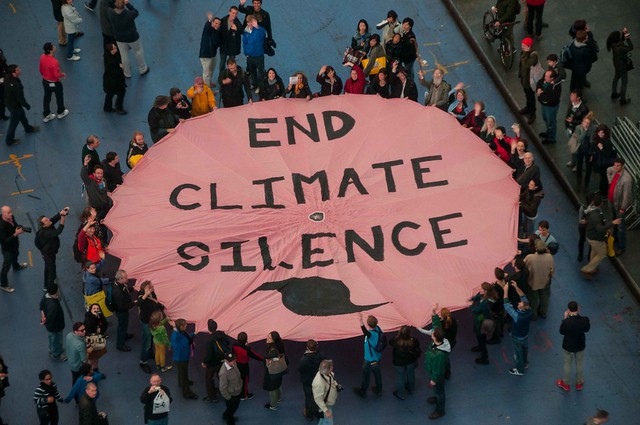
While Hurricane Sandy slowly approaches, climate change activists appeared in Times Square, holding the parachute above.  It wasn’t a huge turnout, of course, but New York City is basically shut down, including Wall Street and the Subway system.

Linking a particular weather event to a longer term process of climate change is more a rhetorical device of the religious right than of these activists (on-line minister John McTernan blames “the gay agenda” for the storm), but Hurricane Sandy presented an opening.

An opening in what?

The presidential election campaign crowds out both movement events and coverage of movement events.  It also crowds out issues.  Both major party candidates have spent the past few weeks trying to avoid sounding like the activist bases of their parties, seeking to reach some imagined middle of the political spectrum.  350.org, a climate change advocacy network, notes that this is the first set of presidential debates since 1988 when climate change was not treated as a serious issue.

Both President Obama and Governor Romney see only risks in talking about climate change now: climate change skeptics could find evidence that President Obama might take action on the issue if he mentioned the phrase.  And Governor Romney might remind swing voters somewhat sympathetic to science about the positions he’d taken during the Republican primary campaign.

So, climate change–and the environment in general–is an uncontested issue in the national election.  And that’s not all: you’ll recall that the presidential debate on foreign policy also omitted discussion of immigration, the drug war, and the prison at Guantanamo Bay (yes, the one candidate Obama had promised to close).

The only mention of the US use of military drones for assassination came from Governor Romney, who announced his support for President Obama’s mostly unarticulated policy.

But back to the earth:

Hurricane Sandy offered a bit of a break in the electoral action, and environmental activists have tried to seize the moment, hanging their analysis onto an important news peg and a tiny open window for discussion of climate change.

Posted in Uncategorized | Tagged , , , , , , , , , , | Leave a comment

Students are revolting: school lunches

With the help of a sympathetic teacher, students at Wallace County High School in Sharon Springs, Kansas, produced the video above.  They say, in a much more entertaining way than I will, that they’re not getting enough food to live their healthy adolescent lives.

It’s the most visible protest of many local campaigns by students who want something different–or just more–at school lunch.

As Americans, we have to be proud of the stubborn ingenuity of our kids, standing up for what they believe.  At the same time, it doesn’t mean they’re right.

Here’s a story:

Some years ago, my wife complained to the director of a recreational program for my daughter about the cookies and punch snacks that they served.

“But the kids like it,” the director responded.

“I bet they’d also like cocaine,” my wife said.

OK, this is almost silly, but the fundamental problem is that everyone doesn’t always know what’s good–and that we allow ourselves to make decisions for some people in what we think are their interests .  For example: drivers, even skilled ones, have to obey the speed limit; we force children to go to school.  Mandating how federal money for kids’ food is spent is hardly a big stretch.

Controversy about school lunches is nothing new, nor is parody.  Food activists have picked the school lunchroom as one front in a larger battle against obesity (particularly childhood obesity) and malnutrition.  A stalwart in this fight is the Renegade Lunch Lady, Chef Ann Cooper, who moved her career from white table cloth dining to the cafeteria.  Working from the bottom up in sympathetic cities (first Berkeley, California, then Boulder, Colorado), Chef Ann works to bring fresh fruit and vegetables plus whole grains into the hostile environment of the public schools.  She wasn’t alone.

A smaller effect of electing Barack Obama as president was giving this healthy school lunch movement a national face.  First Lady Michelle Obama has used her platform to promote healthy food and fitness for America’s youth: just say yes to, uh, kale(?).

Perhaps more significant, Congress passed the Healthy Hunger-Free Kids Act of 2010, which set nutritional standards for government funded food programs.  You can find the details at the United States Department of Agriculture’s website.

Whole wheat flour appeared in pizza crusts, and even bits of green on the top of the pizza.  Unsweetened milk drove out chocolate, and fresh fruit replaced cookies for desert in complying school districts.

Students protested.

Most just threw out the food they didn’t like, and in most places it was exactly what you’d think the kids wouldn’t like: fresh fruit and vegetables and whole grains.

Surely this is demoralizing for the crusading chefs, but their recipe for success is pretty much the same as for parents trying to pack healthier food into their children at home: persist, and keep trying new recipes.

And some students went further, organizing Facebook groups and online protests, and boycotting the cafeteria.  The video was even bigger and better, and it got national play on network news.  Partly, it’s because it’s creative and funny.  Partly, it’s because it was a stick partisan adults could use for beating on the Obama administration. It’s safe to say that most of the grown-ups rallying around the hungry students haven’t been near a school cafeteria in many years, but there are other reasons to join in.  The grown-ups have other grievances with the president–and surely no stake in America’s children eating fries and chips.  This leads to the odd twist of grown-ups defending children’s right to choose a junky lunch (Tom Philpott at Mother Jones), even as they also defend government’s interest in prohibiting adult access to, say, abortion or same sex marriage.

Here’s Jon Stewart’s take.

This is a good story all by itself, but there’s a larger point: the effect of a protest is dependent upon how effective activists are in recruiting influential allies.  Such allies, of course, often have their own agendas.

Posted in Uncategorized | Tagged , , , , , , , , , | Leave a comment

Strikes without unions: Walmart

Workers (“associates” to their employers) have walked off the job at several Walmarts sprawled across the United States.  The workers at Walmart, like most workers in retail, and most workers in the private sector, and most workers in the United States, aren’t unionized, so organizing a job action is pretty difficult.  Walmart workers haven’t pledged any loyalty to a union, so they can’t be called off the job site; there’s no collective contract or protections, and unemployment is high–particularly among the low wage workers Walmart tries to hire.

It’s hard to get attention for any movement during the final stretch of a national election campaign.  Journalists–and even your colleagues at the water cooler or coffee machine–are more likely to discuss Joe Biden’s smile or smirk these days than growing economic inequality or the plight of low wage workers.  With the beginnings of the walk-out, the United Food and Commercial Workers International Union (UFCW)has succeeded, at least for the moment, at breaking into the mass media.

Most reports suggest relatively few workers have yet taken the risk of walking off the job: as of yesterday, 88 workers (out of more than 2.2 million that Walmart claims to employ), spread across 28 stores in a dozen cities.  But they’ve been able to get attention for their grievances: very low wages, poor working conditions, and retaliatory action (reduced and unfavorable scheduling) against workers trying to complain–or even organize a union (this, by the way, is illegal).

And there may be more to come.  Making Change at Walmart, the unionization effort sponsored by the UFCW, has threatened a strike for Black Friday, the day after Thanksgiving, and probably the most important sales day all year for mass market retailers.

How can a non-unionized workforce strike?  It would be easy for Walmart to fire and replace workers, particularly with the current employment climate.  Everyone knows this.  But you don’t need to have to get many, much less most, to walk off the job to make a difference.  UFCW can organize pickets and protests, leaflet campaigns and rallies which could compete with holiday circulars in offering information about the mega-retailer.

Would-be employees might walk down the street to Target.  More significantly, Christmas shoppers can drive their minivans to the next giant mall parking lot for Christmas shopping.  Walmart doesn’t have to lose many shoppers to lose millions of dollars in sales.  Everyone knows this as well.  At a time when Walmart has been working hard to appeal to more upscale consumer by featuring organic food and green energy products, here’s a set of hassles that those consumers are likely to notice.

So, labor organizers don’t have to get huge mobilization to make some trouble.  Is that enough?

What can UFCW organizers get?  At once, it’s a little glimmer of creative labor activism in a time when unions have taken defeat after defeat.  They may be able to win some protections for Walmart workers trying to organize, acknowledging that Walmart has many other tactics for preventing its labor force from unionizing.  They may be able to send a message to Walmart’s retail competitors, most of whom don’t pay any better.

They may be able to forge alliances with the community activists across the country who have opposed Walmarts because of their adverse effects on local businesses, downtowns, and traffic.  (Low prices haven’t prevented lots of people from finding fault with Walmart!)

They may even be able to break into election rhetoric at some level, reviving the discussion of economic inequality that Occupy put on the public agenda.  With the onset of collective action, nothing is certain.  It’s certain, however, that quiescence hasn’t worked very well for low wage workers.

Posted in Uncategorized | Tagged , , , , , , , , , , | Leave a comment

Protesting the debates

The frame of political discussion in the United States has steadily narrowed over the past year, as the election has crowded out attention for almost anything else.  Tonight the scope of politics will be limited to a small stage in Denver, where the major party candidates will hold a joint appearance, mentally rifling through prepared answers and canned ad libs.  Outside the camera frame, activists will be working hard to grab the spotlight and bring attention to their own issues.

When you go to vote in most states, you may be surprised to see more names than “Barack Obama” and “Mitt Romney,” although those other candidates have gotten precious little attention from mainstream media.  Libertarian Gary Johnson and Green Jill Stein have done the best in securing access to the ballot: Stein will be a choice for voters in 37 states;  Johnson and the Libertarian Party will be on the ballot everywhere–if a few lawsuits work out.

They won’t be on stage, however, and all third party candidates together are unlikely to poll more than 1 percent of the vote.  Third party candidates rarely* influence the election or the political debate, and they’ll tell you it’s because they’re excluded from the debates and media coverage more generally.  Debate organizers and journalists explain they don’t generate enough attention to merit attention.  You can jump into that loop anywhere you want.

So the debate will retread familiar ground with familiar candidates, each well-prepared, disciplined, and determined to avoid saying something embarrassing.  Governor Romney, trailing in the polls, will look for an opportunity to deliver a memorable zinger but there’s unlikely to be much new information in an event staged to influence a few undecided voters in one of a half-dozen states.

Nonetheless, national attention and hundreds of journalists are in Denver today because of  the debate.  This is an apparent opportunity activists can stomach squandering.  The Greens and Libertarians will demonstrate outside, demanding access to the debate and the campaign more generally.  The Greens are behind a campaign called Occupy the Commission on Presidential Debates and is circulating petitions calling for a much lower threshold of support for candidates to qualify for inclusion in the debates (1 percent in polls, rather than the 15 percent the commission demands).  Gary Johnson is suing for inclusion in the debates.  Using the forces of the market, Governor Johnson’s supporters have written to the debates sponsors, and at least two, Phillips Electronics and the YWCA, have withdrawn their support for the debate.

The media mash around the debate is also an opportunity for activists with even weaker prospects for getting to the stage.  Occupy the Debates is working to promote a broader debate on the country’s problems and potential solutions, organizing protests and rallies in Denver, and promoting dialogues and meetings nation-wide.  From its statement of purpose:

Occupy the Debates, the People’s Dialogue, seeks to demonstrate the disconnect between the presidential candidates of the two corporate parties and the people of the United States whom they are supposed to represent…
 Occupy the Debates rejects the pay-to-play structure of the dominant system and recognizes that candidates already shedding light on populist solutions will not be invited to the podium. Therefore, in order to expand the dialogue, Occupy the Debates encourages local Occupy’s to organize activities the debates. Among the activities being planned are canvassing the community to hear their views, teach-ins, truth-telling sessions, general assemblies and conferences to discuss issues of concern and possible solutions.

Occupy Denver is organizing events, including protests, to draw attention to a foreign policy debate that’s been filtered out of the mainstream discussion.  (Both Johnson and Stein would agree.)

In activist life, this is about getting a few lines in a news story or a brief picture and sentence in a broadcast report, all to suggest a broader story than each candidate’s canned applause lines.  It’s an uphill struggle.

* Ralph Nader consistently claims that his candidacy didn’t matter; it didn’t cost Al Gore the 2000 election, and that there wasn’t much difference between Vice President Gore and George W. Bush anyway.  His audiences don’t generally believe him.

Posted in Uncategorized | Tagged , , , , , , , , , , | Leave a comment

Global campaigns to surround parliaments

We saw the reemergence of broad and disruptive anti-austerity protests in Greece and Spain this week.  Although the causes of fiscal crisis and dramatically increased borrowing costs in the two countries, the proposed remedy from Europe was the same: strict

General strike in Greece, September 26, 2012

austerity, based on downsizing spending and government.  There’s doubt whether this strategy will preserve the Euro, in Greece particularly, but everyone seems certain that it will mean harsh declines in the standard of living for most people living through it, and no one suggests this that austerity will mean even a relatively quick correction.  The Spanish and Greek governments are bracing for years of cutbacks.

Every time a new round of reforms is announced, people take to the streets.  Although most people seem to want to save the Euro, most people also seem to think that protecting the people is even more important the defending the currency.  In Greece, activists staged a general strike, and some took to the streets of Athens throwing petrol bombs.  It’s hard to imagine that governments can continue to tighten fiscal constraints further, step by step, and not provoke even more disruptive protests.  Importantly, these actions are not spontaneous, but are organized by groups with broad bases of support and particular interests and constituencies to defend.  The unions are critical here.

In Spain, thousands of protesters tried to surround the parliament in opposition to austerity policies, and the Catalonian independence movement reemerged.  Policy makers are caught between domestic democratic pressures and the demands of mostly German bankers.  There’s not an obvious or easy solution for governments.  The protests are raising the costs of austerity; presently, most elected officials don’t see viable alternatives.  Meanwhile, riot police are defending the parliament with force, including rubber bullets, and activists are streaming video of their efforts (http://www.livestream.com/ICBcn?t=782341).

Activists elsewhere have seized upon the reemergence of broad public protests against austerity to try to restart their own campaigns.  Occupy Wall Street has posted a call for a global “surround the Congress” campaign, announcing protests in major cities around the world today.  And Adbusters has announced a Halloween Party in Washington, DC (October 31).

Days before a presidential election in the United States, it’s hard for me to imagine a huge turnout in DC.  Even if  Adbusters describes the election as a choice between Coke and Pepsi, most activists are going to see more substantial differences between administrations headed by Barack Obama or Mitt Romney.  But in European countries embracing austerity, where elections have generated broad coalitions or caretaker technocratic governments, it’s easier to imagine that frustrated people will see no more promising approach than street protest.

Posted in Uncategorized | Tagged , , , , , , , , , , | 1 Comment

Perils on the journey from activist to elected official (Akin edition)

Rightwing Watch is promoting a video of Representative Todd Akin, Republican candidate for Missouri’s US Senate seat, acknowledging an arrest long ago for his ongoing efforts against abortion.  Here’s the video that’s everywhere at the moment:

I doubt that many observers will be surprised that Rep. Akin’s opposition to abortion is deeply felt, nor that he has employed various methods to try to stop legal access to abortion.  He has yet to provide the details of the particular protest, more than twenty years ago, that apparently put him, very briefly, in jail.  He has said, however, that his actions were peaceful.

There was a great deal of anti-abortion activism in the early 1990s.  Two decades takes us just about back to the Summer of Mercy, in which anti-abortion activists staged mass demonstrations and clinic blockades at selected sites across the country.  At right is a picture from Wichita, Kansas, posted by anti-abortion activist, Jill Stanek.

Is Rep. Akin’s willingness to engage in civil disobedience on behalf of his beliefs important information to Missouri voters?  I can’t imagine that this new bit of information changes the way Akin’s opponents feel about him.  Surely his record over more than twenty years in the Missouri and US legislatures offers ample evidence of his political vision and commitments.  And unlike other Republicans, say Governor Mitt Romney, Akin is unlikely to have had difficulty convincing voters of the depth and strength of his opposition to abortion.

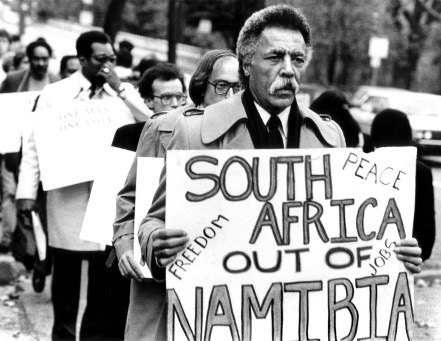
Is it the fact that Rep. Akin was willing to risk arrest?  Liberal activists, even members of Congress, have risked arrest for causes they saw as important.  At left, see Representative Ron Dellums, a Democrat from California, who was arrested for non-violently blockading the South African embassy.  Rep. Dellums worked inside and outside Congress to end US support of the apartheid regime.  He wasn’t alone;  Republican Lowell Weicker, Senator from Connecticut, was one of many members of Congress who went to jail after protesting outside the South African embassy in 1985.  Much more recently, Democratic Representatives Jim McGovern (Mass.) and Jim Moran (Virginia) joined George Clooney and his father in protesting for human rights in Sudan.

Obviously, these aren’t the same issues, and most readers are unlikely to react the same way to each struggle.  But the Akin story underscores the extent to which non-violent civil disobedience has become a staple social movement tactic in American social movement politics.  People protest when they think it might matter, often after finding frustration with working exclusively through conventional political channels.  Rep. Akin now has the opportunity to own that tradition.  His opponents would be wise to focus on his motivations and beliefs, rather than his willingness to go to jail for them.

Posted in Uncategorized | Tagged , , , , , , , , , , , , , | Leave a comment