A day for labor

For Labor Day Weekend, here’s a reminder about the history of this commemoration in America (reposted from 2011).

Successful politicians exploit, buy off, and sell out the movements that sometimes buoy their campaigns.  This American story is an old one, and it’s one that leaves activists disappointed, wary, and cynical, even especially about the politicians who do the most for them.

[Recall that candidate Abraham Lincoln promised to put the preservation of the union higher on his list of priorities than ending slavery, and that abolitionists criticized President Lincoln’s Emancipation Proclamation (issued after two years of war), which ended slavery only in the territories that had seceded.]  And many do far less.

So, why is the American day to commemorate Labor held at the end of the summer, months after May Day, the workers’ celebration day virtually everywhere else in the world?  How do you turn a movement by creating an occasion for a cook-out?

President Grover Cleveland, a hard-money Democrat, and generally no friend to organized labor, signed a bill making Labor Day a national holiday at the end of June in 1894, at the height of the Populist movement, and just after the American Railway Union, led by Eugene Debs, had launched a boycott and strike, starting in Pullman, Illinois.  Protesting the Pullman Palace Car Company’s treatment of its workers, including harsh wage cuts, railway workers across the country refused to handle any train hauling a Pullman car.

The Federal government used an injunction, then troops, to battle the union and get the trains moving.  In July, just after announcing a national day to celebrate the contributions of American workers, President Cleveland ordered federal marshals–along with 12,000 Army troops, into Chicago to break up the strike.  Workers fought back, and 13 workers were killed, and at least several dozen injured.  Debs was tried for violating an injunction, and went to prison, where he discovered the writings of Karl Marx.  Clarence Darrow provided a vigorous, but unsuccessful, defense.

Debs would go to prison again, most notably for his opposition to US entry into World War I, and would run for president five times as a Socialist.

But I digress.  President Cleveland created a distinctly American Labor Day, explicitly not on May 1, which had already been the occasion for vigorous and disruptive workers’ activism.  (Read about the Haymarket affair.)  May Day remains the day for international workers mobilization.  Instead, our Labor Day is a time to mark the end of summer by cooking outdoors and shopping for school supplies.

The  US Department of Labor’s website gives credit for Labor Day to the American worker, but makes no mention of the Pullman Strike or the Haymarket demonstrations.

So, commemoration can actually be a way to neuter the historical memory.  See our discussions of commemorative days for Martin Luther King, Cesar Chavez, and Fred Korematsu, all significantly more difficult characters than what they’ve come to represent.
Posted in Uncategorized | Tagged , , , , , , , , , , , , , , | 4 Comments

Code Pink again!

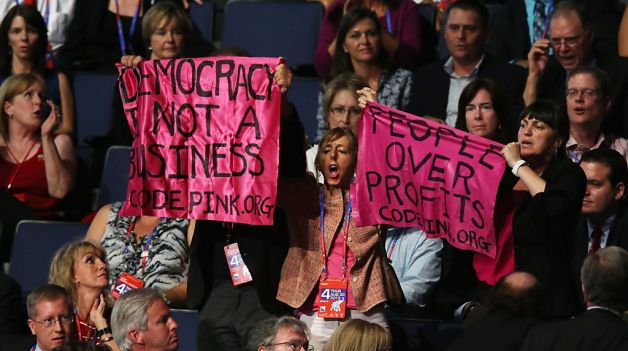
Somehow Code Pink activists got back on the floor of the Republican National Convention during Mitt Romney’s acceptance speech.  After two activists, very briefly, heckled Paul Ryan on the previous night, it’s surprising that anyone without genuine credentials could get past convention security.  But four Code Pink activists did, carrying pink banners, which they unfurled early in Governor Romney’s speech.

As before, the delegates began chanting “USA USA” to drown out the protesters, a relatively simple task.  This time, the demonstrators were cleared from the arena even more quickly than the previous night, and the nominee didn’t acknowledge their presence–although he did pause.  The slogan was: “People over profits; democracy is not a business.”

Here, an activist being ushered out is confronted by both mainstream and partisan media trying to find a better story.


Now, what comes of all this?  Certainly the Code Pink contingent was less of a disruption than invited guest Clint Eastwood’s uh, performance.  It’s hard to imagine that the banners changed the mind of anyone on the convention floor, nor were the Code Pink arguments articulated in any greater clarity or specificity than the arguments of the invited speakers.

Code Pink rent a little opening in the mostly tightly produced convention, giving people who wanted to talk about something else or something critical the space to do so.  Probably more significantly, Code Pink demonstrated to its own supporters the capacity to get into the news and into the picture, a picture that wouldn’t be very appealing otherwise.  The momentary snippet of guerrilla theater meant more to the faithful than their opponents or a broader audience, but it may inspire some of those activists to continue their efforts.

Posted in Uncategorized | Tagged , , , , , , , , | 1 Comment

Code Pink takes outdoor politics inside the convention

Two members of Code Pink, the feminist antiwar group, somehow got inside the Republican convention, and aired their grievances with the Romney/Ryan ticket.

They only had a few moments to battle for prime time attention with Vice Presidential nominee Paul Ryan, who had the advantage of the microphone, the podium, and the support of the crowd.

The two women, Ann Wright and Laura Mills, shouted “My Body, My Choice,” and unfurled banners with pointed slogans:  “Fund Healthcare not Warfare!”  and “Vagina. Can’t say it? Don’t legislate it.”  Their protest unified the Republican crowd more dramatically than Rep. Ryan’s speech, and the conventioneers shouted down the protesters, chanting “USA, USA” until security guards removed them.

With very tight security, how did Code Pink get into the arena?  Sarah Wheaton at the New York Times reports that a disaffected Ron Paul delegate gave them his credentials.  (Remember, Rep. Paul’s supporters think that the Republican establishment quashed their legitimate dissent, ignoring and changing rules to silence the libertarian stream in the party.)

Code Pink took advantage of the split in the party to seize a moment or two of prime time.

Meanwhile, outside the convention Code Pink has been more colorful and provocative.  Focusing on access to abortion, the activists have performed as dancing vaginas: “Take Your Vaginas to the RNC.”

Code Pink is hardly sanguine about the Obama administration’s policies, mounting a campaign against the administration’s use of killer dronesThey’ll be protesting at the Democratic convention as well.

The language and the style, of course, are all about getting attention.  The important audience isn’t the delegates nearby, but the broader public that might see the videos on youtube or read about the disruption in convention reports.  The potential danger is that the tactic will overshadow the issue.  No doubt some people will stop listening after they hear the word, “vagina,” much less see an approaching dance troupe comprised of them.

Will the Democratic delegates react as the Republicans did?  My guess is that the Democrats will be less likely to shout down the demonstrators than to roll their eyes.

Posted in Uncategorized | Tagged , , , , , , , , | 1 Comment

Raining out dissent in Tampa

Romneyville

The storms surrounding Hurricane Isaac shortened the Republican convention in Tampa, Florida, and stole some of the headlines Republicans hoped to generate.  The rains mostly kept the delegates and party regulars indoors, fairly well insulated from the demonstrators outdoors, who were fewer and less visible than organizers promised.  And, in the event that the protest zones weren’t far enough from the staged Republican party action to keep the two groups separate, there have been plenty of police.

What’s going on here?  Why are the demonstrators there in the first place, and why have they been so, relatively, invisible?

Long ago, party conventions were places where Republican and Democratic leaders made decisions about important matters, particularly, who would represent them in national elections.  While ambitious politicians made speeches, bosses made deals in rooms filled, no doubt, with smoke.  The primaries were a sideshow that generated sideshow like attention.   There were often several rounds of balloting for presidential and vice-presidential nominations, and bosses shifted their delegations’ votes with an eye toward the November elections and their own political fortunes.  Journalists covered the conventions to get real news.

In the old days, before 1976 or so, activists turned out at the conventions to challenge the politicians and to steal some of their spotlight in the media.  Activists could make claims directly to politicians who made decisions, from national figures to local precinct captains, and to a broader national audience.  Sometimes it was disruptive and ugly.  At the Democratic convention in Chicago, 1968, demonstrators assembled in large numbers in Grant Park, protesting against the war, particularly, and against a process that allowed Vice President Hubert Humphrey to win the nomination without contesting a single primary.  Mayor Richard J. Daley, the dictionary definition of a party boss, ordered the police, his police, to keep the demonstrators out, and some of the demonstrators fought back.  The confrontations, including police attacks on members of the media, made national news–and it wasn’t pleasant.  Below, you can see a young security forces rough up a young Dan Rather, who was trying to report on a delegate being kicked out of the convention.

Certainly, it was no help to candidate Humphrey, running against Republican nominee Richard Nixon who promised a return to law and order.

Since then, activist protests have been a fixture at party conventions.  As the conventions themselves became less important in making decisions, they remained a tempting target for activists trying to get their message out to a national audience.  And the causes proliferated.  While there were plenty of grievances in 1968, the conduct of the Vietnam War was the major focus of the demonstrations in Chicago.  It’s harder to distill one clear issue from the demonstrations at later conventions, even though even larger numbers of people participated, for example, in the protests outside the Republican convention in New York City in 2004.*  (See the section on convention protests in The Politics of Protest.)

Activists promised a substantial presence at the Republican convention, and a vigorous challenge to promised Republican policies on a large number of economic and social issues.  But the turnout in “Romneyville,” a protest zone set up a “safe” distance from the convention, underwhelmed journalists looking for a story.

The weather was part of the story; it’s hard to get even the very committed to board buses heading for a hurricane, particularly when plans for where to sleep haven’t quite come together.    And  activist networks in Tampa are nowhere near as dense and developed as those in New York or Minneapolis-St. Paul. (Even Floridians are staying away.  1Miami is organizing its convention protest in Miami, not Tampa.)

It’s not just a grievance that gets people to turn out, it’s also organizing.  Activists from the left side of the political spectrum will have a hard time locating potential allies inside in the developing Republican party, homogenizing and shifting rightward at the same time.  This was not the case for previous activists confronting somewhat more diverse parties.  And the energy and activism of Occupy has spread into scores of other campaigns on a wide range of issues, with no powerful group taking the responsibility to direct its efforts to an anti-Romney protest in Tampa.  Of course, Occupy’s norms of base democracy and consensus would make organizing such an event even more difficult than in the past.

But people keep protesting!  All kinds of people!  Supporters of Ron Paul, disaffected with the Party’s treatment of their hero, walked off the convention floor–but not all the way down the street to Romneyville.  The Phelps family and its Westboro Church turned out to protest the country’s tolerance of homosexuality, attending the convention in between military funerals no doubt.

And there were protesters on the left as well.  But when the numbers are smaller, the actions need to be more dramatic to get much attention.  Code Pink tried to effect a citizen’s arrest of former Secretary of State Condoleeza Rice for war crimes.  (They didn’t get close enough to yell her her rights, but they’re ready to go after other veterans of the Bush administration.)

So at the moment, the rain has partly drowned out the Republican message, which has pushed the anti-Republican message even further off-screen.

*On the uphill struggle activists face in using convention protests to portray their cause and themselves to a broader audience, see Sarah Sobieraj’s excellent book,  Soundbitten: The Perils of Media-Centered Political Activism.

Posted in Uncategorized | Tagged , , , , , , , , , , , , , , , , , | Leave a comment

Pussy Riot goes global

The members of a Russian feminist punk band (sort of) have been sentenced to two years in prison for making a critical video of an anti-Putin song.  Most reports suggest that the ambitions of the three young women in the bank are more political than musical, and that their connections to reform movements in Russia developed after their video debut.

The first struggle for reformers in Russia is to create enough space for meaningful political organization and action when government authorities face no effective political or moral constraints in shutting them down.  Here’s yet another case where the old dictum, that the losers in any fight have an interest in bringing the crowd in on their side, hold true.  When the effort to bring in outsiders crosses national lines, Margaret Keck and Kathryn Sikkink 
wrote long ago, we can think about it like throwing a boomerang.  Activists get their story out to mobilize external pressure on their opponents.

Pussy Riot is hardly the first effort of dissidents in Russia to do exactly this, but it’s been the most dramatic in recent years, and it’s generated a great deal of attention, as well as the interest of globally famous musicians (e.g., Madonna, Sting, Paul McCartney) who hadn’t been particularly public about whatever their beliefs about Putin’s Russia are.

Sending the women to jail might be the very worst thing that the Russian government could do for their own interests.   The presence of these three young women in jail means that everyone who signed onto their cause still has a grievance.  And the odd circumstances of Pussy Riot’s actions mean that these three women will get far more international attention than the much larger number of political prisoners.  If things go well for the opposition, Pussy Riot will shine a light on others in prison for their opposition to Vladimir Putin.

To think about how a political prisoner can serve as the focus of a long term campaign for reform, think about Nelson Mandela or Vaclav Havel.  I pick these examples to show that the international efforts can be important, albeit not quick or easy.  There’s been no indication, so far, that the members of Pussy Riot possess the extraordinary resolve, temperament, and eloquence of Mandela, Havel, or Aung San Suu Kyi.  Unlike those heroes, Pussy Riot hasn’t grown up within a reform movement and built long term organizational ties to carry on their efforts (thus, it may be right that the drama of their actions attracted international attention that far exceeds their local support).  And this may make international reformers reluctant to build their campaign around the band.

The key for activists in Russia is to mobilize enough international pressure to force the authorities in Moscow to afford them some space for politics.  Pussy Riot might be the wedge that draws attention to one-time chess champion Garry Kasparov, for example.  There’s no sure recipe for this, so a lot of the sentences will have “might” in them.

So, Amnesty International and other groups will work mostly on the politics of attention, getting people and governments to pay attention, again, to Putin and Russia.  Their success will depend upon just how much the political and economic powers in Russia care about the good opinion of others.  (See Evan Osnos’s excellent piece on The Burmese Spring in the New Yorker.  It shows just how much contingency there is in a political revolution.)

An Olympic boycott would be a showy move, but one that would be unlikely to get enough international support to affect the Olympic games of politics more generally.  (You recall the boycotts of the Moscow and Los Angeles Olympics, when bloc politics ensured a certain amount of support.)  Isolation like this can strengthen the position of authoritarians, who now have a better excuse for cracking down on domestic opposition (think, for example, of Iran or North Korea).  Over the long haul, it’s more likely that making it hard for the Russian elite to travel and do business abroad will be more effective in promoting domestic reform–but that’s a long haul effort.

Posted in Uncategorized | Tagged , , , , , , , , , , , , , | 3 Comments

Politics as consumption

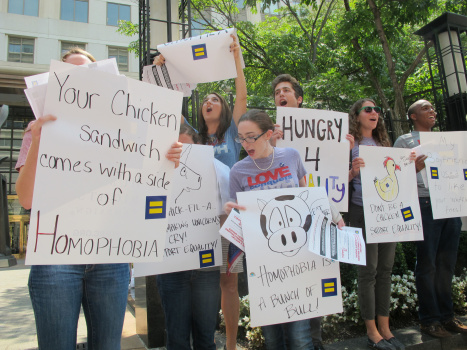
After a boycott announcement, a buycott day, and a same sex kiss-in, the consumption thread of the battle over same sex marriage has taken a new turn.  Yesterday (August 7), the front moved from fast food chicken to milk-saturated coffee.  (Opponents of same sex marriage can buy their coffee elsewhere, although that outlet might be owned by Starbucks anyway!)  Meanwhile, several celebrities tweeted in support.

Equally Wed, a magazine devoted to planning same sex weddings, announced National Marriage Equality Day, which would be marked by shopping at Starbucks.  Starbucks then asked the group to expand the effort to include all sorts of companies that have been promoting marriage equality.  Amazon, whose founder Jeff Bezos, donated millions to a referendum effort in Washington, quickly made the list.  But there are so many more companies that it’s extremely difficult to find a comprehensive list: Nike and Microsoft also endorsed same sex marriage in Wasington;  JC Penney hired Ellen DeGeneres as its spokeman; Bank of America offers same sex partners of its employees benefits.  Kraft produced a rainbow flag image of Oreos.

The examples go on and on and on.  Indeed, when its president rejected same sex marriage, Chick-Fil-A identified itself as something of an outlier among national companies; most want to attract all the customers they can, and, like virtually everyone else, gays and lesbians eat cookies, drink coffee and buy clothes. (Adam Smith and Karl Marx would agree that discrimination is bad business.  Even Chick-Fil-A is adamant in proclaiming that it does not discriminate in service or hiring; they’ll sell anyone a chicken sandwich.)

So, yesterday, if you wanted to support marriage equality, you could buy a book online, drink a latte, buy sneakers, or install software–things you might do anyway.  Or you could do any of those activities because… you do them anyway.

Of course, none of these businesses will survive, much less flourish, because of their political stands–and even if you approve of, say Microsoft’s stance on marriage equality, there will be something else the company does that you don’t like.

More than that, doesn’t consumption as politics make expressing support so easy to do and hard to track as to be virtually meaningless?  Activist groups work hard to provide something for their supporters to do, and buying something, posting something, or tweeting can easily set the most modest level of engagement.  But the $4.50 you spend on a latte at Starbucks would do more for the cause if contributed to, say, the Human Rights Campaign, which helpfully offers a comprehensive buying guide for its supporters.

In providing easy access to minimally disruptive or effective actions, groups hope to provide a rung on a ladder on which the aspiring activist could climb.  But in defining politics in terms of buying behavior, shopping can easily become a substitute for marginally more difficult–and possibly more influential–ways to support political claims.

Posted in Uncategorized | Tagged , , , , , , , , , , , | Leave a comment

Boycott everything!

Chick-Fil-A had a good day yesterday, as supporters of president Dan Cathy’s* stance in support of “traditional” marriage lined up to buy chicken sandwiches.   Radio host and one-time Arkansas governor Mike Huckabee had urged his audience to stand up for Cathy and the restaurant chain–and they did.  At some sites, the lunch crowd also got to see protesters advocating a boycott of the chain.

Governor Huckabee says this is what America is all about, and has also said he’s “okay” with the planned same sex kiss protest at Chick-Fil-A restaurants tomorrow:

Probably I won’t be there for that…But so what? That’s America. As long as they’re orderly, as long as they don’t disrupt the flow of customers and traffic — if they believe that will help their cause, to put people of the same sex kissing each other in a public place in front of families, if they believe that will encourage people to be more sympathetic, then, you know, more power to them.

Mike Huckabee, before, and before that

But the one day blip in chicken sandwich sales isn’t likely to continue.  Governor Huckabee, also known for his own successful dieting–having dropped more than 100 pounds earlier in his career–is unlikely to urge his supporters to organize their diets around even the grilled chicken sandwich.

The boycott will continue, but how many boycotters were buying from Chick-Fil-A anyway?  The attendant publicity is likely to be more consequential than any economic effect.

And supporters of same sex marriage and gay rights have no monopoly on the use of boycotts to try to achieve their aims.  In fact, conservative and Christian groups have been particularly prolific in trying to steer their dollars away from companies that promote sin.

USA Christian Ministries has announced boycotts of Cheerios–and all General Mills products–because of the company’s support of gay rights.  A similar sin has landed Starbucks on its don’t buy list.

The American Family Association has launched scores of boycotts against companies large and small.  They urge their acolytes to support Chick-Fil-A, and steer clear of Office Depot, JC Penney, and Sears when back-to-school shopping.  And for the adults, they promote a boycott of Home Depot.

The list of companies that support gay and lesbian rights is very long, and growing.  To follow the comprehensive boycott list, one would have to opt out of much of American life.  Indeed, many of these companies are already on liberal groups’ boycott lists!

Life Decisions International has tried to orchestrate boycotts of companies that support Planned Parenthood, and it’s a long list:

Pernod Ricard (alcoholic beverages, including Absolute, Ballantine’s, Beefeater, Bancott Estate, Campo Viejo, Chivas Regal, G.H. Mumm, The Glenlivet, Graffigna, Havana Club, Jacob’s Creek, Jameson, Kahlúa, Malibu, Maretll, Mumm, Perrier-Jouët, Ricard, Royal Salute), TD Bank Group (financial services), Wyndham Hotels & Resorts (lodging, including Baymont Inn & Suites, Days Inn, Dream Hotels, Hawthorne, Howard Johnson, Knights Inn, Microtel Inns & Suites, Night, Planet Hollywood, Ramada, Super 8, Travelodge, TRYP Hotels, and Wingate), NACCO Industries (appliance manufacturing, including eclectrics, Hamilton Beach, Proctor Silex, Traditions, TrueAir, plus Kitchen Collection and Le Gourmet Chef stores), Whole Foods Market, JP Morgan Chase (including Chase Bank, & Bank One), Bank of America, Lost Arrow (Patagonia), Danone (Dannon products), Wells Fargo, Chevron (including Caltex, Texaco, Xpress Lube), eBay (including PayPal), Arthur Murray (dance studios), Bikram’s Yoga, Midas (auto care), Nike, Marriott Hotels & Resorts (lodging, including Courtyard, Fairfield, Renaissance, Ritz-Carlton), Johnson & Johnson, Staples (office/school supplies), and Darden Restaurants (eateries, including Bahama Breeze, The Capital Grille, LongHorn Steakhouse, Olive Garden, Red Lobster, Seasons 52). And this is just a partial list!

Conservative blogger Pat Dollard has been organizing boycotts of companies that responded to liberal boycott threats and pulled their advertising from Rush Limbaugh’s show.  (That sounds long and confusing, but I think the sentence is correct.)

The Boycott Owl is committed to monitoring all boycott campaigns, and you’ll see that virtually any grievance: supporting (or opposing) gay marriage, busting unions, or losing luggage can be cause for a boycott campaign.

Of course, the very large number of campaigns makes it harder for any one to get attention or much traction.

I guess the free market is defined by what people won’t buy!


*Dan Cathy’s name was initially misspelled.  Corrected August 3.

Posted in Uncategorized | Tagged , , , , , , , , , , , , , , | 5 Comments

Chicken in, chicken out

When the history of the struggle for same sex marriage is written, it’s unlikely that this week’s chicken battles will rate more than a footnote, but it’s an entertaining day.  Opponents of same sex marriage, mobilized by Mike Huckabee, have promised to turn up with cash today, buying chicken sandwiches from the restaurant chain.  Expect a bump in Chick-Fil-A sales today, with some enthusiasts promising to buy lunch from half-a-dozen outlets.

But that, like habitual overeating more generally, can’t last too long.  Chicken sandwich fans will get full–or run out of cash, or decide to try KFC, El Pollo Loco, Wendy’s, or they might even just pack lunch from home.  At some point personal preferences–or even concerns about health–will trump politics.

And supporters of same sex marriage have promised to boycott Chick-Fil-A and donate their lunch money to activist groups.  Expect a blip in donations, but this won’t last forever either.  People want lunch!

Just the threat of a consumer boycott can warn most companies off controversial political positions.  The threat of a boycott led dozens of companies (including Wendy’s and PepsiCo, which owns KFC) to desert ALEC, the American Legislative Exchange Council, and pushed ALEC to abandon its voter ID program.  The threat of a boycott led scores of advertisers to desert Rush Limbaugh in the wake of his viscous and personal attacks on a law student who supported access to contraception through her health insurance.

But Chick-Fil-A is privately held, and Dan Cathay cares about more than profits; he can leave money on the table in service of his broader Christian mission.  Indeed, he already does, keeping his restaurants closed on Sundays so his employees can go to church, spend time with their families, and eat at KFC.  The sandwich and the service might keep him in business in ways that his politics can’t, and those politics might compromise the growth of the company in central cities and on college campuses.  If he cared only about profits, he’d stay out of the marriage debate.  (This is why, by the way, Karl Marx predicted that capitalism would kill religion.)

So, this week will be entertaining, a time for pickets and poultry, and Friday’s kiss-in, but the larger struggle will be moving back to the ballot box, the courts, and the larger political process.  Democrats will put a plank in their platform supporting same sex marriage, and Republicans will…try not to talk about it too much.  Remember, roughly half of Americans now support same sex marriage, and a party that wants to win elections can’t leave too many prospective voters on the table.

Who’s chicken?

Posted in Uncategorized | Tagged , , , , , | Leave a comment

Markets, movements, and municipalities: Who’s chicken? Whose chicken?

There are all kinds of good reasons for restricting the expansion of fast food restaurants, but are the political views of a chain’s founder enough?  Boston’s Mayor Tom Menino, appalled by the “traditional marriage” stance of Dan Cathy,* founder and president of Chick-Fil-A, wrote Cathy to tell him of his views:

I was angry to learn on the heels of your prejudiced statements about your search for a site to locate in Boston.  There is no place for discrimination on Boston’s Freedom Trail and no place for your company alongside it…I urge you to back out of your plans to locate in Boston.

Other mayors soon jumped into the fryer: Chicago’s Rahm Emanuel announced his–and his city’s–opposition to the chain restaurant, and he was followed by San Francisco’s Ed Lee, Washington DC’s Vincent Gray, and Pittsburgh’s Luke Ravenstahl.  Politically, this is a relatively easy call for big city mayors; these days, they won’t lose elections by standing up for same sex marriage.  Supporters on various social network sites were thrilled, like-ing, tweeting, and sharing in all sorts of ways.

But should the chief executive of a city use the powers of his office to prevent a business from operating because most of his constituents oppose the views of the owner?  I haven’t seen any reports of Chick-Fil-A refusing to serve chicken sandwiches to anyone who wants to pay for them, nor refusing to hire someone to sell those sandwiches based on their political views or sexual orientation.

We should not be so quick to celebrate the use of local majorities to restrict the business of the unpopular.  Notable Christian conservatives, like former Arkansas governor Mike Huckabee and Sarah Palin rallied to support the chicken chain, and there are surely civic leaders in less densely populated areas eager to support the opening of a new restaurant run by an opponent of same sex marriage.

(Would we expect the same areas to refuse to welcome an Amazon warehouse–now that Amazon CEO Jeff Bezos has donated $2.5 million, along with vigorous political support, to a campaign for same sex marriage in Washington state?)

There’s some sense in individuals making decisions about where to spend their money, trying to keep it out of the pockets of people who spend it on destructive politics, and to support entrepreneurs who do things we like.  I drive 15-20 minutes to buy wax from a surf shop that treats its customers well–even though wax is available much closer; I buy not very tasty pizza from a local chain that offers tours for kids.  At the national level, however, it’s harder to find businesses who haven’t done something you find problematic.  If you like Jeff Bezos’s stance on same sex marriage, ask any publisher or independent bookstore about Amazon’s business practices….

It sometimes makes sense for movement organizations to target businesses engaged in practices and politics they deplore, but the boycott is a difficult tactic, and it’s laden with risk, not the least, of underperforming.  Even when a boycott might be working, it’s hard for those without access to the company’s balance sheets to tell.  Then again, maybe people just don’t like the chicken.

It’s wrong, however, to use local government to discriminate against unpopular views.  New York’s Mayor Michael Bloomberg, a long time supporter of gay rights and same sex marriage, has this one right.  Indeed, the mayors against Chick-Fil-A have since clarified their opposition and threats, emphasizing the bully pulpit rather than the arcana of zoning regulations.   Mayor Menino, who initially warned about the difficulties of obtaining a business license, soon moved to emphasize his personal opinions rather than the power of the city.  Mayor Emanuel, proud of his city, suggested that there wouldn’t be many customers for the chain.

Meantime, the restaurant chain has provided a ready target for activists.  One group has called for a “kiss-in” on August 3, giving supporters something to do and demonstrating some of the support for anti-anti-gay activities–and businesses.  There have already been pickets and demonstrations outside local restaurants.  This approach is more viable for most activist groups than a boycott, and far more visible.


* Dan Cathy’s name was initially misspelled.  Corrected August 3.

Posted in Uncategorized | Tagged , , , , , , , , , | 3 Comments

Cannabis contention and the election

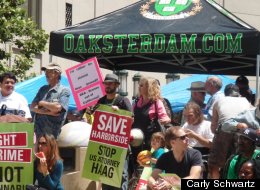
Medical marijuana is available legally in California, but not in the United States.  Last year, President Obama’s Justice Department followed US law, raiding Oaksterdam University (“America’s first and premier cannabis college”), which promises high quality training for those involved in cultivating and selling medical marijuana.

When President Obama visited Northern California yesterday on a fundraising trip, advocates of medical marijuana marched in front of Oakland’s City Hall, demanding that Obama pay attention to their demands.

Carly Schwartz reports at the Huffington Post:

“We are here today to send a message so loud that not even the president will be able to ignore it,” Steve D’Angelo, director of Oakland’s Harborside Health Care, which calls itself the “nation’s largest dispensary,” told the crowd as it erupted into cheers.

I’m not so coarse as to speculate on what Mr. D’Angelo might be smoking, but I’m pretty sure he’s wrong.  President Obama has no interest in allowing any space between himself and Mitt Romney on marijuana, and cannabis activists will have a hard time getting much attention for their gripes about the federal government enforcing US law.

Elections are a problem and an opportunity for activists on all sorts of causes.  Once the campaign takes off–and it takes off earlier and earlier these days–it sucks up energy, activists, money, and attention.  It’s harder for social movement activists to get attention for their cause, and even when they do, the electoral implications soon come to take center stage.  The two party system means that citizens with all sorts of grievances with the party closest to them prepare to make unsavory compromises to stave off something even worse.

Citizens who voted for Barack Obama because he promised to close the military prison at Guantanamo Bay (he has not!), for example, are unlikely to migrate to Mitt Romney.  Would-be Republican voters who recall the unredeemed Governor Romney, who accepted the science behind climate change and the principle of access to legal abortion, are hardly going to express their worries by voting for Obama.  And all the while news stories will focus on the mechanics and back and forth of the presidential campaign–not the activists issues and disappointments.

It’s exactly what the founders imagined (and Jefferson and Washington were growing hemp.)

Posted in Uncategorized | Tagged , , , , , , , | Leave a comment