Boycott everything!

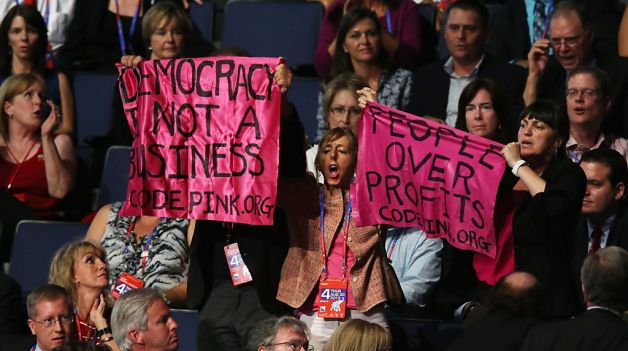
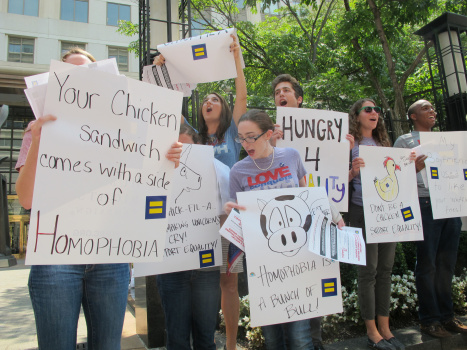
Chick-Fil-A had a good day yesterday, as supporters of president Dan Cathy’s* stance in support of “traditional” marriage lined up to buy chicken sandwiches.   Radio host and one-time Arkansas governor Mike Huckabee had urged his audience to stand up for Cathy and the restaurant chain–and they did.  At some sites, the lunch crowd also got to see protesters advocating a boycott of the chain.

Governor Huckabee says this is what America is all about, and has also said he’s “okay” with the planned same sex kiss protest at Chick-Fil-A restaurants tomorrow:

Probably I won’t be there for that…But so what? That’s America. As long as they’re orderly, as long as they don’t disrupt the flow of customers and traffic — if they believe that will help their cause, to put people of the same sex kissing each other in a public place in front of families, if they believe that will encourage people to be more sympathetic, then, you know, more power to them.

Mike Huckabee, before, and before that

But the one day blip in chicken sandwich sales isn’t likely to continue.  Governor Huckabee, also known for his own successful dieting–having dropped more than 100 pounds earlier in his career–is unlikely to urge his supporters to organize their diets around even the grilled chicken sandwich.

The boycott will continue, but how many boycotters were buying from Chick-Fil-A anyway?  The attendant publicity is likely to be more consequential than any economic effect.

And supporters of same sex marriage and gay rights have no monopoly on the use of boycotts to try to achieve their aims.  In fact, conservative and Christian groups have been particularly prolific in trying to steer their dollars away from companies that promote sin.

USA Christian Ministries has announced boycotts of Cheerios–and all General Mills products–because of the company’s support of gay rights.  A similar sin has landed Starbucks on its don’t buy list.

The American Family Association has launched scores of boycotts against companies large and small.  They urge their acolytes to support Chick-Fil-A, and steer clear of Office Depot, JC Penney, and Sears when back-to-school shopping.  And for the adults, they promote a boycott of Home Depot.

The list of companies that support gay and lesbian rights is very long, and growing.  To follow the comprehensive boycott list, one would have to opt out of much of American life.  Indeed, many of these companies are already on liberal groups’ boycott lists!

Life Decisions International has tried to orchestrate boycotts of companies that support Planned Parenthood, and it’s a long list:

Pernod Ricard (alcoholic beverages, including Absolute, Ballantine’s, Beefeater, Bancott Estate, Campo Viejo, Chivas Regal, G.H. Mumm, The Glenlivet, Graffigna, Havana Club, Jacob’s Creek, Jameson, Kahlúa, Malibu, Maretll, Mumm, Perrier-Jouët, Ricard, Royal Salute), TD Bank Group (financial services), Wyndham Hotels & Resorts (lodging, including Baymont Inn & Suites, Days Inn, Dream Hotels, Hawthorne, Howard Johnson, Knights Inn, Microtel Inns & Suites, Night, Planet Hollywood, Ramada, Super 8, Travelodge, TRYP Hotels, and Wingate), NACCO Industries (appliance manufacturing, including eclectrics, Hamilton Beach, Proctor Silex, Traditions, TrueAir, plus Kitchen Collection and Le Gourmet Chef stores), Whole Foods Market, JP Morgan Chase (including Chase Bank, & Bank One), Bank of America, Lost Arrow (Patagonia), Danone (Dannon products), Wells Fargo, Chevron (including Caltex, Texaco, Xpress Lube), eBay (including PayPal), Arthur Murray (dance studios), Bikram’s Yoga, Midas (auto care), Nike, Marriott Hotels & Resorts (lodging, including Courtyard, Fairfield, Renaissance, Ritz-Carlton), Johnson & Johnson, Staples (office/school supplies), and Darden Restaurants (eateries, including Bahama Breeze, The Capital Grille, LongHorn Steakhouse, Olive Garden, Red Lobster, Seasons 52). And this is just a partial list!

Conservative blogger Pat Dollard has been organizing boycotts of companies that responded to liberal boycott threats and pulled their advertising from Rush Limbaugh’s show.  (That sounds long and confusing, but I think the sentence is correct.)

The Boycott Owl is committed to monitoring all boycott campaigns, and you’ll see that virtually any grievance: supporting (or opposing) gay marriage, busting unions, or losing luggage can be cause for a boycott campaign.

Of course, the very large number of campaigns makes it harder for any one to get attention or much traction.

I guess the free market is defined by what people won’t buy!


*Dan Cathy’s name was initially misspelled.  Corrected August 3.

Posted in Uncategorized | Tagged , , , , , , , , , , , , , , | 5 Comments

Chicken in, chicken out

When the history of the struggle for same sex marriage is written, it’s unlikely that this week’s chicken battles will rate more than a footnote, but it’s an entertaining day.  Opponents of same sex marriage, mobilized by Mike Huckabee, have promised to turn up with cash today, buying chicken sandwiches from the restaurant chain.  Expect a bump in Chick-Fil-A sales today, with some enthusiasts promising to buy lunch from half-a-dozen outlets.

But that, like habitual overeating more generally, can’t last too long.  Chicken sandwich fans will get full–or run out of cash, or decide to try KFC, El Pollo Loco, Wendy’s, or they might even just pack lunch from home.  At some point personal preferences–or even concerns about health–will trump politics.

And supporters of same sex marriage have promised to boycott Chick-Fil-A and donate their lunch money to activist groups.  Expect a blip in donations, but this won’t last forever either.  People want lunch!

Just the threat of a consumer boycott can warn most companies off controversial political positions.  The threat of a boycott led dozens of companies (including Wendy’s and PepsiCo, which owns KFC) to desert ALEC, the American Legislative Exchange Council, and pushed ALEC to abandon its voter ID program.  The threat of a boycott led scores of advertisers to desert Rush Limbaugh in the wake of his viscous and personal attacks on a law student who supported access to contraception through her health insurance.

But Chick-Fil-A is privately held, and Dan Cathay cares about more than profits; he can leave money on the table in service of his broader Christian mission.  Indeed, he already does, keeping his restaurants closed on Sundays so his employees can go to church, spend time with their families, and eat at KFC.  The sandwich and the service might keep him in business in ways that his politics can’t, and those politics might compromise the growth of the company in central cities and on college campuses.  If he cared only about profits, he’d stay out of the marriage debate.  (This is why, by the way, Karl Marx predicted that capitalism would kill religion.)

So, this week will be entertaining, a time for pickets and poultry, and Friday’s kiss-in, but the larger struggle will be moving back to the ballot box, the courts, and the larger political process.  Democrats will put a plank in their platform supporting same sex marriage, and Republicans will…try not to talk about it too much.  Remember, roughly half of Americans now support same sex marriage, and a party that wants to win elections can’t leave too many prospective voters on the table.

Who’s chicken?

Posted in Uncategorized | Tagged , , , , , | Leave a comment

Markets, movements, and municipalities: Who’s chicken? Whose chicken?

There are all kinds of good reasons for restricting the expansion of fast food restaurants, but are the political views of a chain’s founder enough?  Boston’s Mayor Tom Menino, appalled by the “traditional marriage” stance of Dan Cathy,* founder and president of Chick-Fil-A, wrote Cathy to tell him of his views:

I was angry to learn on the heels of your prejudiced statements about your search for a site to locate in Boston.  There is no place for discrimination on Boston’s Freedom Trail and no place for your company alongside it…I urge you to back out of your plans to locate in Boston.

Other mayors soon jumped into the fryer: Chicago’s Rahm Emanuel announced his–and his city’s–opposition to the chain restaurant, and he was followed by San Francisco’s Ed Lee, Washington DC’s Vincent Gray, and Pittsburgh’s Luke Ravenstahl.  Politically, this is a relatively easy call for big city mayors; these days, they won’t lose elections by standing up for same sex marriage.  Supporters on various social network sites were thrilled, like-ing, tweeting, and sharing in all sorts of ways.

But should the chief executive of a city use the powers of his office to prevent a business from operating because most of his constituents oppose the views of the owner?  I haven’t seen any reports of Chick-Fil-A refusing to serve chicken sandwiches to anyone who wants to pay for them, nor refusing to hire someone to sell those sandwiches based on their political views or sexual orientation.

We should not be so quick to celebrate the use of local majorities to restrict the business of the unpopular.  Notable Christian conservatives, like former Arkansas governor Mike Huckabee and Sarah Palin rallied to support the chicken chain, and there are surely civic leaders in less densely populated areas eager to support the opening of a new restaurant run by an opponent of same sex marriage.

(Would we expect the same areas to refuse to welcome an Amazon warehouse–now that Amazon CEO Jeff Bezos has donated $2.5 million, along with vigorous political support, to a campaign for same sex marriage in Washington state?)

There’s some sense in individuals making decisions about where to spend their money, trying to keep it out of the pockets of people who spend it on destructive politics, and to support entrepreneurs who do things we like.  I drive 15-20 minutes to buy wax from a surf shop that treats its customers well–even though wax is available much closer; I buy not very tasty pizza from a local chain that offers tours for kids.  At the national level, however, it’s harder to find businesses who haven’t done something you find problematic.  If you like Jeff Bezos’s stance on same sex marriage, ask any publisher or independent bookstore about Amazon’s business practices….

It sometimes makes sense for movement organizations to target businesses engaged in practices and politics they deplore, but the boycott is a difficult tactic, and it’s laden with risk, not the least, of underperforming.  Even when a boycott might be working, it’s hard for those without access to the company’s balance sheets to tell.  Then again, maybe people just don’t like the chicken.

It’s wrong, however, to use local government to discriminate against unpopular views.  New York’s Mayor Michael Bloomberg, a long time supporter of gay rights and same sex marriage, has this one right.  Indeed, the mayors against Chick-Fil-A have since clarified their opposition and threats, emphasizing the bully pulpit rather than the arcana of zoning regulations.   Mayor Menino, who initially warned about the difficulties of obtaining a business license, soon moved to emphasize his personal opinions rather than the power of the city.  Mayor Emanuel, proud of his city, suggested that there wouldn’t be many customers for the chain.

Meantime, the restaurant chain has provided a ready target for activists.  One group has called for a “kiss-in” on August 3, giving supporters something to do and demonstrating some of the support for anti-anti-gay activities–and businesses.  There have already been pickets and demonstrations outside local restaurants.  This approach is more viable for most activist groups than a boycott, and far more visible.


* Dan Cathy’s name was initially misspelled.  Corrected August 3.

Posted in Uncategorized | Tagged , , , , , , , , , | 3 Comments

Cannabis contention and the election

Medical marijuana is available legally in California, but not in the United States.  Last year, President Obama’s Justice Department followed US law, raiding Oaksterdam University (“America’s first and premier cannabis college”), which promises high quality training for those involved in cultivating and selling medical marijuana.

When President Obama visited Northern California yesterday on a fundraising trip, advocates of medical marijuana marched in front of Oakland’s City Hall, demanding that Obama pay attention to their demands.

Carly Schwartz reports at the Huffington Post:

“We are here today to send a message so loud that not even the president will be able to ignore it,” Steve D’Angelo, director of Oakland’s Harborside Health Care, which calls itself the “nation’s largest dispensary,” told the crowd as it erupted into cheers.

I’m not so coarse as to speculate on what Mr. D’Angelo might be smoking, but I’m pretty sure he’s wrong.  President Obama has no interest in allowing any space between himself and Mitt Romney on marijuana, and cannabis activists will have a hard time getting much attention for their gripes about the federal government enforcing US law.

Elections are a problem and an opportunity for activists on all sorts of causes.  Once the campaign takes off–and it takes off earlier and earlier these days–it sucks up energy, activists, money, and attention.  It’s harder for social movement activists to get attention for their cause, and even when they do, the electoral implications soon come to take center stage.  The two party system means that citizens with all sorts of grievances with the party closest to them prepare to make unsavory compromises to stave off something even worse.

Citizens who voted for Barack Obama because he promised to close the military prison at Guantanamo Bay (he has not!), for example, are unlikely to migrate to Mitt Romney.  Would-be Republican voters who recall the unredeemed Governor Romney, who accepted the science behind climate change and the principle of access to legal abortion, are hardly going to express their worries by voting for Obama.  And all the while news stories will focus on the mechanics and back and forth of the presidential campaign–not the activists issues and disappointments.

It’s exactly what the founders imagined (and Jefferson and Washington were growing hemp.)

Posted in Uncategorized | Tagged , , , , , , , | Leave a comment

Boycott politics

Chick Fil A is the most recent company to fall within the sites of a boycott campaign.  Dan Cathay, president of the fast food chicken restaurant chain founded by his father, reaffirmed his commitment to an evangelical approach to his business.  A quotation from the Gospels adorns the entrance to Chick Fil A restaurants, which have always been closed on Cathay’s sabbath, Sunday.  Cathay donates money to evangelical causes (millions to anti-gay groups), most notably its WinShape foundation, directed to shaping winners, through ministry, education, counseling, and support.

Cathay’s interview with with the Baptist Press made national news when the chicken magnate reaffirmed his (and Chick Fil A’s) commitment to Christian values in general, and what’s now described as “traditional marriage.”

Cathay has given witness elsewhere, explaining in a radio interview that advocates for same-sex marriage are “inviting God’s judgment on our nation….As it relates to society in general I think we’re inviting God’s judgment on our nation when we shake out fist at him and say, ‘We know better than you as to what constitutes a marriage.  And I pray God’s mercy on our generation that has such a prideful, arrogant attitude to think that we have the audacity to try to redefine what marriage is about.”

It’s not surprising that some people would be offended by these comments and decide to forgo the chicken sandwich and waffle fries–no matter how tasty they might be (no info. here).  Some activists (see Boycott Chick Fil A) have begun a formal boycott of the restaurants, calling on supporters of same sex marriage and gay and lesbian rights more generally to drop the chicken sandwich.

(It seems that most of the larger and well-established organizations are stopping short of calling for a corporate boycott.  Maybe they’re concerned about civility?  Maybe they’re concerned about their own corporate sponsors?)

The boycott is a familiar tactic for activists, but one that is rife with risks (see this and this, for example).  First, activists undermine their power when they can’t deliver on threats.  How many of Chick Fil A’s customers oppose the company’s stance?  How many of those are willing to give up the sandwich?  How many of those most committed to the boycott don’t eat at Chick Fil A anyway?  Second, the boycott can invigorate the opposition.  Former Arkansas governor and current radio host Mike Huckabee has called upon people who support Christian values to eat at Chick Fil A on August 1.  Third, boycotts are imprecise and sticky, likely to hangover long after whatever offense provoked them has passed.

It’s odd to see such polemic politics around a chicken sandwich when animal rights activists aren’t even involved.

There’s also an important question about where we as consumers draw the political line about our market behavior.  At The Atlantic, Jonathan Merritt writes that the restaurant offers good sandwiches, excellent service, and no discrimination against customers or employees.  The political contributions are just something else, I guess.  Merritt notes that gay rights groups protested when anti-gay groups announced a boycott of JC Penney, which had hired Ellen De Generes to be its spokesperson.  (That boycott, like most, fell apart.)

There’s a place to draw a line, but where?  How many labor sympathizers are thumb typing on an Iphone at this moment?  How many Democrats still enjoy Clint Eastwood’s movies?  Most of us do business with companies that don’t agree with us on everything.  Most of us don’t pay much attention to the politics of our dentists and optometrists, worrying instead about our teeth and eyes.  In fact, connections outside politics could provide the spaces for meaningful discussions about politics, assuming that some of us can learn or even change our minds.

Then again, some issues are so fundamental that activists want to put market power behind their moral stances.  It’s just not easy.

Meantime, Chick Fil A has lost a shot at putting a restaurant in Northeastern UniversityBoston Mayor Tom Menino has announced his intent to keep the restaurant out of his city.  The Muppets have severed ties with the restaurant chain.  And a number of celebrities (remember celebrities) have endorsed the boycott.  The early list includes:  Ed Helms, Miley Cyrus, Lindsay Lohan, and the Kardashians.

Does that list affect your attitude?

Posted in Uncategorized | Tagged , , , , , , , , , , , | 1 Comment

Republicans wrestle with race and Tea Party

The headline of Jake Sherman’s story at Politico is “Republicans line up to rip Michele Bachmann.

Rep. Bachmann (Minnesota) and four other Tea Party conservatives    ( Reps.  Trent Franks [Arizona], Louie Gohmert [Texas], Thomas Rooney [Florida] and Lynn Westmoreland [Georgia]) in the House had sent a series of letters raising the alarm about Muslims and Arabs in government who might be, they said, distorting American policy to favor terrorists.  The evidence was, uh, weak, and the racist overtones were fairly obvious.  Senator John McCain denounced the accusations on the Senate floor.  Jake Sherman details many other Republicans leaping at the chance to distance themselves from Rep. Bachmann and, less explicitly, the Tea Party she claims to represent.  Remember that Bachmann is leader of the House Tea Party caucus.

The first wave of Tea Party activism in 2009 featured a diverse collection of grievances, some rooted in social conservatism and others in a fairly libertarian critique of big government and taxes.  Over time, politicians like Rep. Bachmann, Herman Cain, and Rick Santorum worked to emphasize the socially conservative elements of the Tea Party, leaving the libertarians and real limited government folk on the outs.  And from the start, there’s been a streak of racism and xenophobia in the Tea Party, more visible in some of the grassroots groups than in the most visible national groups (but take a look at Tea Party Nation).  Indeed, some grassroots activists worked hard to keep the racist signs from decorating their rallies.

Rep. Bachmann’s national audience and her prodigious fundraising ability gave her something of a protected status within the House Republican caucus, even–as is now quite clear–many of her Republican colleagues were uncomfortable with some of her politics and the image she presented of their party.  Certainly, politicians like Michele Bachmann can win Congressional elections, but it’s not clear that a Republican Party like Michele Bachmann can maintain a majority in the House of Representatives.  Many Republicans doubt it.  And even the most socially conservative and xenophobic Republican needs to demonstrate extraordinary faith to believe that such a posture could govern for long a country whose population is changing.

As David Boaz, the certifiably conservative executive vice president of the Cato Institute put it (in Politico’s Arena, July 19):

If the Republicans want only straight white Christian men to vote for them, they’d better figure out a way to make more straight white Christian men.

Republicans who were interested in winning elections–and/or those who were offended by the racist streak in the movement–were eager to try to scratch off someone they view as a political liability.  It’s going to take much more, however, to make this stream of the Tea Party go away.

Posted in Uncategorized | Tagged , , , , , | 11 Comments

Where’s the peace movement?

(This was written in response to a request from Mobilizing Ideas.  You can see related essays from Catherine Corrigall-Brown, David Cortright, William Gamson, Michael Heaney, Kathy Kelly, Lisa Leitz, and Andrew Yeo here.)

Just over a decade ago, activists around the world organized the largest coordinated set of peace protests in history, trying to stop the impending invasion of Iraq.  On February 15, 2003, millions of people took to the streets in the largest cities of the richest countries, with the largest turnouts appearing in countries were governments were poised to support the war (Walgrave and Rucht 2010).  The demonstrations captured media attention and the political imagination of would-be activists around the world.  They did not, however, stop the war.  On March 20, 2003, a multinational coalition comprised overwhelmingly of American military forces started a bombing campaign designed to inspire “shock and awe,” and pave the way for a relatively smooth invasion with minimal non-Iraqi casualties.  In relatively short order, the American-led coalition ousted Saddam Hussein’s regime and installed its own provisional government, promising an orderly transition to democracy.  That didn’t quite happen.

As efforts at orderly governance faltered, one after another America’s allies pulled their military forces out of Iraq.  After a surge and decline in American forces, and after several Iraqi factions negotiated their own truce, President Obama pulled the last troops out of Iraq in December of 2011, roughly two years later than he promised as a presidential candidate.  Meanwhile, the war he had promised to intensify, in Afghanistan, continued with increases in troops on the ground.  Democracy still nowhere in sight, the United States has committed to withdraw roughly a third of the 100,000 troops now deployed there, pulling out the rest over time as Afghanistan trains its own military to keep order and fight terrorists.

There’s no way to describe these outcomes as the products of any happy story, either for the George W. Bush administration, which started the wars, nor for the peace movement, that tried to stop them.  Early on, it became clear that the Bush administration’s claims about Iraq’s nuclear ambitions and capabilities, were, uh, unsubstantiated.  Prospects for democracy evaporated somewhat more quickly.  The current Afghan government is now negotiating a peace with the Taliban forces that had provided a haven for Al-Qaeda, as American participation in the war declines.  American troops eventually killed Osama Bin-Laden, who had orchestrated the 9/11 attacks on the World Trade Center, and Iraqis executed Saddam Hussein.  These achievements came at the cost of the lives of more than 6,500 American service people and more than 200,000 Iraqi and Afghani lives.  Fiscal costs to the United States continue to accumulate, and will reach more than $3 trillion (Stiglitz and Blime 2008).  The moral, social, and political costs are surely greater.

So, the peace activists were basically right, but as the evidence for their claims continued to build, they were less and less visible.  Is there anything we can learn from this?  Understanding provides some small recompense, and I’d suggest that the patterns of protest mobilization and decline are typical of peace movements—and other kinds of movements—in American history.  A few points:

First, although the peace movement didn’t stop the war, it did exercise some influence.  The political fallout in the United States and the Western Alliance led the Bush administration to work harder to bolster its case, finding or fabricating more evidence for its claims of nuclear ambitions and sending Secretary of State Colin Powell to the United Nations to promote them.  Military planners developed a strategy designed to achieve a quick military victory which minimized not only allied casualties, but also bad publicity that would attend visible destruction of Iraqi infrastructure and populations.  This is far from enough, but it is not trivial.

Second, peace and antiwar movements usually emerge when activists are least likely to get what they’re demanding.  Although stalwarts will take to the streets for ultimate goals, most people respond to political circumstances; they protest when they think it might work—and when they think nothing else will.  There is a long term pattern in which peace movements emerge strongly when America’s military policy becomes more aggressive and expensive (e.g. Meyer 1990).  Some people and organizations may have a well-developed plan for remaking foreign policy altogether, but a protest movement is a blunt instrument.  Once the most bellicose possibilities seem restrained, the movement coalition will start to fray, as differences among groups become more salient and as some groups turn to more pressing issues (Meyer and Corrigall-Brown 2005).

Third, protest movements in liberal polities are closely tied to more conventional political action.  Peace movements decline during election years, as activists and funders channel their efforts into what seem to be more direct routes to influence.  And when your putative ally is in office, it’s harder to take to the streets.  Michael Heaney and Fabio Rojas (2011) surveyed participants at peace demonstrations in the United States before and after Barack Obama’s elections.  They found that the share of identified Democrats at the demonstrations declined after Obama took office.  Although Obama’s policies weren’t all that different from those of his predecessor, it was harder for activists to get Democrats into the streets when they thought that their president promised to move policy in a more congenial direction, albeit slowly slowly.   President Obama has taken far less flack over domestic surveillance, political assassination by drones, or the ongoing operation of a prison camp at Guantanamo Bay than George W. Bush did.

Finally, there’s a critical movement question about democracy.  The costs of the wars in Afghanistan were both concentrated and largely invisible.  Financing the wars with borrowed money, in conjunction with large tax cuts, President Bush minimized opposition from those concerned about costs.  (And remember, protesters are less likely to go public when their man is in office.)  And fighting the war with an all-volunteer force piled the disruption and danger onto a relatively small segment of the American public.  It was all too easy for most Americans to look away most of the time.  As citizens, we want to ask if this is the way we want to organize a democracy.

Heaney, Michael T. and Fabio Rojas.  2011.  “The Partisan Dynamics of Contention: Demobilization of the Antiwar Movement in the United States, 2007-2009.” Mobilization 16:45-64.

Meyer, David S.  1990.  A Winter of Discontent: The Nuclear Freeze and American Politics.  New York: Praeger.

Meyer, David S. and Catherine Corrigall-Brown.  2005.  “Coalitions and Political Context: U.S. Movements against Wars in Iraq.” Mobilization 10: 327-344.

Joseph E. Stiglitz and Linda J. Blimes.  2008. The Three Trillion Dollar War. New York: W.W. Norton.

Walgrave, Stefaan and Dieter Rucht, eds.  2010.  The World Says No to War.  Minneapolis: University of Minnesota Press.

Posted in academic | Tagged , , , , , , , , , , | Leave a comment

Rights and facts on the ground

The Supreme Court’s ruling to uphold the Affordable Care Act means that Governor Mitt Romney, by campaigning to repeal the Act, is promising to take health insurance away from 30 million people, none in Massachusetts.  This is far tougher than never extending the protection to them in the first place.

Of course, states can take rights and benefits away from people.  The purported Communists who lost the ability to earn a living in the Red Scare of the 1950s and more than 100,000 Japanese Americans interned a decade earlier know that too well.  Much more recently, gay and lesbian Californians who lost the right to marry through a ballot initiative know that rights can be taken away.  Someone who might appear to be Latino to a tired and pressured police officer on a dark night in Arizona also now knows that people can lose, as well as win, access, rights, and respect.

But usually it takes an atmosphere of crisis for authorities in a democracy to take existing rights away from people.  War and the perception of threat help a lot, and that perception isn’t always easy to conjure up.

This week the United States Department of Defense announced that it would commemorate Gay Pride month.  Officers and enlisted personnel attended the event, grateful that openness about their sexuality was no longer cause for being discharged.  David S. Cloud at The Los Angeles Times reports:

It was far from an outre gay pride celebration, like the Manhattan parade this month that one blogger said featured “dancing boys, granny boobs, marching bands, rainbow Storm Troopers, babies, feathers, pasties, thongs — heck, even a bunny in a hat.”

But if most of the Pentagon audience wore crisp military uniforms or conservative business suits, their joy was unmistakable. Several same-sex couples said they were attending their first Pentagon function together.

“It means acceptance,” said Doug Wilson, who stepped down this year as assistant secretary of Defense for public affairs but returned for the event. “It means people can be complete human beings.”

Army Lt. Col. Todd Breasseale, a veteran of combat in Iraq and Afghanistan, attended the ceremony with his partner and called the event “the right kind of step forward. It’s measured. It’s done appropriately. It’s consistent with the way the military does things.”

Many, if not most, of the opponents of ending “don’t ask don’t tell,” still oppose the open service of gays and lesbians in the armed forces.   The Times quotes Ron Crews, a retired chaplain in the Army Reserve: “The Pentagon is now honoring something that a year ago was a court-martial offense, and that’s a radical shift.”   But Crews’s group, the Chaplain Alliance for Religious Liberty, is focusing less on undoing the new policy than in stopping same sex marriages on military bases and maintaining the availability of Bibles.   The new policy effective shifted the front for the ongoing battle.  Policy matters.

And think about how hard it is to campaign against open service when gay service in the military is not an abstraction, but stories about real people serving honorably.  It’s harder to take something away from someone when you know who that someone is.

So, the Supreme Court decision makes it tougher for Governor Romney to campaign against “Obamacare” without offering something more specific to 30 million Americans who will depend upon the new law.  In effect, President Obama (affirmed by the Supreme Court) has established facts on the ground that tilt the playing field against his opponents.

Posted in Uncategorized | Tagged , , , , , , , , | Leave a comment

Court ruling an opportunity and a test for Tea Party

When the Supreme Court announced the constitutionality of the Affordable Health Care Act this morning, it sounded a trumpet calling the Tea Party to arms.  Can the movement respond effectively?  Will Tea Partiers reinvigorate the movement which has become, basically, an faction of the Republican Party?

In 2009, the Town Hall meetings about health care provided the first large stage for grassroots Tea Partiers to display their commitments.  When Congress adopted the Affordable Care Act–over their opposition–Tea Partiers and Republicans channeled their efforts into the 2010 elections, and enjoyed considerable success, ousting the Democrats from control of the House of Representatives.  Since then, the most visible Tea Party efforts have been directed into the presidential contest, particularly the Republican primaries.

The impending nomination of Mitt Romney is a tremendous disappointment to Tea Partiers, who will, no doubt, recall that the Supreme Court has just upheld the vision of health care reform Governor Romney pioneered in Massachusetts.  Most Tea Partiers, however, will continue to see Romney’s campaign as their best hope for undoing ACA and sending President Obama back to Chicago.

Social movements of the middle class and above respond to bad news and to threats.  The Supreme Court’s majority decision, written by Chief Justice Roberts, is both.  The core national Tea Party organizations were prepared, and responded immediately.

Jenny Beth Martin, the remaining co-founder of the Tea Party Patriots, issued a warning to the Republican majority in the House:

This is a slap in the face to the majority of the American people who want Obamacare fully repealed. The Tea Party Patriots stand with the American people and say: fully repeal Obamacare.

Mr. Romney, Mr. Boehner: the American people are putting you on notice. You both promised to fully repeal Obamacare. We will hold you to your promises.

We will vote out any politician who does not commit, in writing, to respect the will of the American people and fully repeal Obamacare.

Americans for Prosperity’s president Tim Phillips issued this statement:

For years, Americans for Prosperity has vigorously opposed President Obama’s deeply flawed health care plan. Since 2009, our Hands Off My Health Care project has rallied thousands of Americans at hundreds of events around the country, including a massive rally this past March with over 4,000 AFP activists.

The American people deserve health care freedom and choice, not more restrictions and irresponsible spending. Over the next several days, AFP will launch a series of events around the country telling Congress ‘Hands Off My Health Care,’ and demanding a full repeal of Obama’s deeply flawed health care law.

And FreedomWorks, which was critical in organizing the Town Hall shout-downs two years ago, promised to “double down” on its efforts to repeal the law.  Its president, Matt Kibbe, announced:

Without a strong grassroots constituency holding government accountable to its decisions, it’s doubtful the individual mandate would have been challenged in the first place. For that, activists across the country should be very proud. We are not going away. It’s time to double down on spreading the message that President Obama’s individual mandate is an unprecedented infringement on constitutional liberty, and to take that message to the ballot box in November.

The Supreme Court has spoken, as has the Tea Party leadership.  We’ll watch to see whether the grassroots follows.

Posted in Uncategorized | Tagged , , , , , , , , , , , , | 4 Comments

Starving postal workers

Ten current and former postal employees stopped eating yesterday in Washington, DC, starting a hunger strike to protest continuing cutbacks at the United States Postal Service.  Organized by Community and Postal Workers United, they do not plan to starve themselves to death; they are, however, desperate to get public attention for their cause.

So far, this effort has worked–a little: Representative Dennis Kucinich appeared at their protest and endorsed the cause, and there’s been some coverage in local and national media.  But they’re fighting an uphill battle.

Fasting is never an easy route to political influence.  (We’ve discussed the strategy of  hunger strikes here, as well as fasting campaigns by DREAM activists and prisoners.)  If postal workers thought they could depend upon allies in Congress or their union to stave off very large cuts in post offices and sorting stations (and jobs), they certainly wouldn’t be standing outside, hungry, in the summer in Washington, DC.

They have grievances about jobs and pensions, but their cause represents a much larger conflict in contemporary American political life.  Article I Section 8 of the Constitution gives Congress the power “To establish Post Offices and post Roads.”  The idea was that a reliable communication infrastructure was essential to building a nation.  Even before the Constitution, Benjamin Franklin ran the post office in Philadelphia, which was located in the offices of his newspaper, The Pennsylvania Gazette; both he and the city prospered.  Franklin served as the first Postmaster General of the United States.

Postmaster General was a Cabinet position for nearly 150 years, between 1829 and 1971, when the United States Postal Service moved from being a department to become a (somewhat) independent agency.  Somewhat?  Political figures wanted the Post Office to operate more efficiently and to cease operating as a haven for patronage.  They also wanted the postal service to cover its own expenses. At the same time, politicians didn’t want to allow the post office to operate just like a business and close unprofitable offices.  Ironically, the least profitable offices tend to be located in rural areas, often represented by Republicans in Congress, representatives who are generally reluctant to see their local post offices closed.  So, the USPS is supposed to support itself, to compete with corporations for the most profitable services, like overnight mail, and to enjoy a monopoly on the services that lose money, like 6 day a week delivery of circulars in rural areas.

With email and electronic banking, most customers are able to reorganize most of their communications to bypass the post office anyway.  Once Grandma figures out how to slide a $5 bill into an email….

The postal workers are focusing on one particular Congressional restriction, the requirement that the USPS pre-fund its pension liabilities 75 years in advance; neither Fedex or UPS are similarly encumbered.  So, the government agency is supposed to compete against the private sector, but also operate within special restrictions in that competition.  Does that sound like anything else in contemporary politics?  Does that sound like everything else in contemporary politics?

A leaner more business-like USPS would focus on profitable services and areas, leaving sparsely populated areas to pay more and/or enjoy less service–or to support a new business that somehow finds a way to survive by serving such areas.  (Hint: it hasn’t happened yet.)  It’s a somewhat different America than imagined by Ben Franklin.

Whether the four day hunger strike, in conjunction with sympathy events, can succeed in putting the future of the USPS on the political agenda remains to be seen.  The hunger strike got my attention; you?

Posted in Uncategorized | Tagged , , , , , , , , , | 1 Comment