Defectors and dissident elites: rifts in the campaign against gay marriage

When David Blankenhorn changed his mind about same sex marriage, the New York Times was eager to give him space on its op-ed page to explain why.  Blankenhorn has been a stalwart in the battle against gay marriage, testifying as an expert witness on behalf of a California referendum banning such unions in a federal court in 2010.

Twenty-five years ago, Blankenhorn founded the Institute for American Values, which promotes “traditional values,” right now emphasizing marriage, thrift, and public conversation.

Lots of people, perhaps now half of all Americans, now support access to same sex marriage.  But David Blankenhorn’s shift is unexpected and dramatic, and thus, newsworthy, in a way that say, that Evan Wolfson’s support for same sex marriage is not.

Many people have changed their views on gay marriage over the past few years; more Americans now support marriage now than oppose it, and the difference is particularly pronounced among young people.  But we know about opinions at the grassroots from the numbers in surveys; rarely do the visible principals in this battle admit that they’ve changed their minds.

David Blankenhorn didn’t exactly change his mind, at least as he describes it, but he did change his position.  He writes that he still thinks a mixed sex marriage is the best environment for raising children.  But he also thinks that homosexual love merits respect and dignity, and that recognizing marriage is one way to do so.  One of the few critics of same sex marriage who didn’t rely on the Bible for evidence, Blankenhorn reports that he recognized bigotry and homophobia in the ranks of the people on his side, and wanted to reject it.  Besides, he says, the battle to stave off same sex marriage is lost.  It’s more important, he says, to promote civil dialogue and to promote marriage.* He writes:

So my intention is to try something new. Instead of fighting gay marriage, I’d like to help build new coalitions bringing together gays who want to strengthen marriage with straight people who want to do the same. For example, once we accept gay marriage, might we also agree that marrying before having children is a vital cultural value that all of us should do more to embrace? Can we agree that, for all lovers who want their love to last, marriage is preferable to cohabitation? Can we discuss whether both gays and straight people should think twice before denying children born through artificial reproductive technology the right to know and be known by their biological parents?

Promising to negotiate such alliances across contending movements seems like a laudable plea for comity and progress; in a polarized political landscape where the movements are still struggling, it’s tough sledding.  (Do you know of any successful efforts to get anti-abortion activists to cooperate with abortion rights proponents to provide ready access to birth control?)  Advocates of gay marriage will want to invoke Blankenhorn as evidence of the collapse of their opponents.  And Blankenhorn’s former allies will view him as a sell-out, weak-willed and too willing to concede on matters of principle.  Alas, in movement politics when your expert no longer agrees with you, he’s no longer an expert.

This is already happening.  Maggie Gallagher, founder of the Institute for Marriage and Public Policy, identifies David Blankenhorn as her mentor, but mourns that he has lost his stomach for an important fight.  At First Things, Matthew Schmitz opines that Blankenhorn’s concession on marriage will not build civility nor broker compromise with the progressive forces that are launching a larger attack on religion.  If you dare stray to the comment sections on such blogs, well, the tone is somewhat more hostile.

In movement fights, the defectors are especially valuable.**  A General for Peace brings a visibility and credibility to an antinuclear campaign–at least to a broad audience–that someone who has long opposed nuclear weapons cannot command.  A Catholic for a Free Choice undermines the consensus that the Church tries to present to the public debate.  The generals don’t do much to convince the rest of the military, nor do the abortion rights Catholics make serious inroads in the Roman Catholic hierarchy, but they are important symbols for the opposition, and they give cover of a sort for people at the grassroots uneasy about their official leadership.  And they feed debates about authenticity.

Why were Tea Partiers so enamored of Herman Cain, who liked to proclaim that he left the “Democrat plantation a long time ago.”?  For Tea Partiers, Cain demonstrated that their concerns were not about race, and that the black community wasn’t a monolith (after all, only 90 percent of African Americans will vote for Barack Obama in the next election).

But back to David Blankenhorn:  Blankenhorn’s defection on same sex marriage will give some space to conservatives and Republicans eager to desert the demographic trap on social issues their party has set up for them.  Libertarians already uneasy about the alliance with social conservatives and evangelicals will have an opening to speak more directly.  Religious conviction will be an even stronger force within the movement against same sex marriage, and that’s probably a losing coalition over the long haul.  It really doesn’t matter if David Blankenhorn is a principled conservative seeking comity or a rat deserting a sinking ship.  Either way, his conversion signals a much broader shift in politics, one that social conservatives cannot welcome.

* Marriage promotion was an important project for the social conservative movement and for the George W. Bush administration, which funneled a great deal of money (some to Maggie Gallagher) into the cause, with little discernible effect–on marriage anyway.  See Melanie Heath’s excellent book, One Marriage under God.

** Kelsy Kretschmer has written great academic stuff on these defectors (e.g.)

Posted in Uncategorized | Tagged , , , , , , , , , , , , | 2 Comments

Immigration activists, allies, and targets

President Obama’s shift in administrative policy on immigration has provided some political space for immigration activists pressing for comprehensive reform.  Days after the announcement, the White House hosted a conference on immigration issues that included 200 activists (reported in Politico).

The activists heard from high-level administration officials, including Homeland Secretary Janet Napolitano.  Although the session was planned months earlier, the decision not to deport DREAM-eligible young people dominated discussion.  According to Gabriela Pacheco, twenty-seven years old and undocumented, who was present at some of the meetings, “There was a lot of mistrust in the room, but at the same time there was a sense of thankfulness that came with it because it was the president that made this announcement on Friday.”

Activists can’t let their gratitude get in the way of their larger ambitions.  They have to find a way to work with Obama, who has been a sometime ally and frequent target for their efforts.  Their interests may coincide, but they are certainly not identical.  First and foremost, Obama is working to win reelection.  That may be a necessary step toward comprehensive reform, but it’s certainly not sufficient.  Immigration activists are well aware that Obama did not deliver on his campaign promise of comprehensive reform, nor was he even able to push Congress (then under Democratic control) to pass the DREAM Act.

Lyndon Johnson meets with civil rights activists in the White House

Successful politicians sell out the movements they surf (discussed here), riding their energy and directing it for their own purposes.  It’s a trick for activists to be clear-eyed about this and get as much as they can for their efforts.

First John F. Kennedy and then Lyndon Johnson pushed civil rights activists in the early 1960s to focus on voter registration, an important part of their much larger agenda.  It might have been a good choice, but it surely wasn’t the only one, nor was it uncontroversial.

Because of his willingness to push the Voting Rights Act through Congress, President Johnson expected loyalty from the civil rights activists.  Activists, of course, wanted more.  Johnson felt betrayed when Martin Luther King came out against the Vietnam war in 1967.

Activists for immigration reform have to find a way to take what President Obama has delivered and figure out how to press for more.  Their efforts may include working for Obama’s reelection, but that can’t be enough.

Posted in Uncategorized | Tagged , , , , , , , | Leave a comment

Still not the dream

President Obama’s announcement of an immigrant daydream dramatically changes the landscape for both the immigrants rights movement and its anti-immigrant counterpart.

Obama’s new policy, to forgo deportation proceedings for young people (under 31) who came to the United States before the age of 16, graduated from high school, and stayed out of legal trouble, and offering temporary work permits, is something substantially less than the DREAM Act that died in the Senate in 2010.  The new policy is not a law, and allows prosecutors discretion about what legal violations comprise serious (deportable) offenses.  It is silent on the fate of slightly older residents or of the families that house these young people.  The work permits are revocable, and the next president, even if it’s Obama, is not bound to continue deferring deportation proceedings.  Most significantly, there’s no pathway toward citizenship.  Although the new approach allows some young people to work, to drive, and to live openly with less danger, it does not afford them any access to influencing policy–ever.  (For some measured skepticism, see Citizen Orange.)

All this acknowledged, it’s a big step forward for advocates of a more humane approach to immigration reform.  And it changes the political prospects for movements and their allies on both sides of this issue.

For DREAMers and immigrant rights activists, this reform promises real improvements in the lives of up to an estimated 800,000 young people–and enough of a grievance to engage them in the political process.  Some had spent the past years organizing and agitating, some even disclosing their immigration status at great personal risk.  The risks diminished, some will work, others continue their studies, and probably more than a few will engage in the only kind of politics available to them, social movement activism.  Other Americans will see who these undocumented immigrants are–and perhaps how many they are.  As more young immigrants come out, their neighbors will get a better sense of their presence in American life.  There are, of course, social and political risks here, but familiarity is as likely to build acceptance.

Winning greater victories will be hard for the immigrant rights activists.  Obama implemented the pieces of the DREAM Act that he could work without Congress.  Older immigrants and those who came to the United States as adults represent a less attractive image for most Americans, and any move toward citizenship will require a very different Congress–and probably a different Republican Party.  Expect the ongoing development of a broader movement.

Also expect to see intensifying, but narrowing, opposition to immigration reform.  Comprehensive reform that includes recognition of the 12 million or so undocumented people already here is a divisive issue in the Republican Party.  Remember that it was not that long ago that Senator John McCain, working in concert with President George W. Bush and Senator Ted Kennedy, proposed immigration reform, only to be abandoned by the base of the Republican Party.  Seeking the Republican presidential nomination in 2007, Sen. McCain learned the same lesson that all viable aspirants for the Republican nomination have learned since: a hard line against undocumented immigrants is a prerequisite for Republican primary victories.   How hard a line?  Can you recall Herman Cain’s musings on electrifying the fence separating the United States and Mexico?  (Just a joke, said Cain later.  Ha.)

Anti-immigrant activists can now watch their national leaders trying to find a way to sell them out.  Stalwarts in the campaign against any path toward citizenship or comprehensive reform are understandably outraged.  FAIR, the Federation for American Immigration Reform, emphasized the dangers it saw:

Thus, with a magic wand, President Obama has added 1.4 million workers to a job market that is already suffering from an unemployment rate of over 8 percent.   And this number does not take into account the additional number of illegal alien workers that will be added to the workforce through fraud.  The impact will be particularly severe on young Americans, as the unemployment rate for teenagers is 24.6 percent, and one in two recent college graduates are either unemployed or underemployed…Moreover, the scope of the Administration’s new amnesty program (one that is certainly not intended to provide only temporary relief) belies the Administration’s claim that it will grant deferred action to illegal aliens on a “case-by-case” basis.   The Obama Administration intends to abuse the process of deferred action to grant amnesty to an entire class of illegal aliens who will now compete with American workers…President Obama insisted his proposal was not amnesty or immunity, but a new policy that would “mend” the nation’s immigration system, make it “more fair, more efficient, and more just.”  The President offered no legal justification or grounding for his actions, most likely because he has already acknowledged that he has none.

FAIR then lists the disapproving comments of a number of Republican leaders, but they are all of second or third tier visibility.  What of Governor Mitt Romney, the presumptive Republican standard-bearer in the presidential election?  Governor Romney criticized Obama for offering only a partial solution and for bypassing Congress, pointedly ignoring the fate of the DREAM Act in the last Congress.  He lamented that Obama’s action would preempt the bill that Senator Marco Rubio was considering writing and offering at some point in the future.  And he repeatedly refused to say whether he would reverse the policy if he were elected president.

Governor Romney, along with many others, criticized Obama for changing policy in response to political concerns.  (As we’ve said many times, movements change the political calculus of their targets).  Is this what democracy looks like.

If opponents of a humane immigration reform policy feel deserted by their leaders, well, that’s not a surprise.  It’s not just Romney who is trying to find a way to back away from a harsh stance against young undocumented immigrants (and Latino voters who might sympathize with their plight).  While FAIR has been covering the policy shift aggressively, other conservative groups have chosen not to do so.  A quick sample of the national sites of four major Tea Party groups (Tea Party Express, Tea Party Patriots, Americans for Prosperity, and FreedomWorks)  finds no mention of the new policy; you have to search aggressively to find positions on immigration altogether.  Although many of the Tea Partiers at the grassroots are incensed about the immigration issue generally, the national groups are sympathetic to less regulation and ready access to labor.  The national groups would prefer to talk about the issues on which national conservative activists agree with their grassroots base: taxes, health care reform, and getting Obama out of office.

President Obama’s shift on policy is already exacerbating a rift on the right that national groups had been working hard to paper over.   The president has made it a little harder for them to do so.  He has also posed a question for Mitt Romney that will come up again and again, one with no good political answer for the Republican candidate.

Posted in Uncategorized | Tagged , , , , , , , , , , , , | Leave a comment

Lucy Lawless protests Arctic oil drilling: Her courage will change the world

Without sword or chakram, actor Lucy Lawless occupied the Noble Explorer, an oil-drilling ship docked in Auckland last February.  With seven other Greenpeace activists, she tried to stop the ship from leaving port until she was finally arrested after 77 hours.

Lawless, who enjoys the mixed blessing of forever being identified as “television’s Xena, warrior princess,” plead guilty to trespass.  She could be sentenced to as much as three years in prison.

Because of her pre-Greenpeace life as Xena, Lawless’s protest drew international attention to the cause.  The New Zealand Herald is the only source I could find that listed the names of those accompanying her:

The New Zealand actor’s arrest and the subsequent court action received publicity from far afield, and was covered by global media giants including the BBC, ABC, Reuters, the Daily Mail and the Washington Post.

The huge media scrum outside Auckland District Court this morning also attested to the success of the protest.

“Yeah, I think we’ve helped kick off a great movement,” Lawless told reporters.

The eight activists – Lawless, Jan Raoni Hammer, Mike Ross Buchanan, Shayne Panayiotis Comino, Vivienne Rachel Hadlow, Shai Sebastian Naides, Zach Steven Penman and Ilai Amir – were initially charged with burglary but this was amended in court today to the lesser charge of unlawfully being on a ship.

The eight appeared in the dock together and stood quietly as their lawyer Ron Mansfield entered the pleas on their behalf…

In February the protestors broke into a restricted area at Port Taranaki and boarded Shell-contracted drilling ship the Noble Explorer to prevent it heading to the Chukchi Sea, off the coast of Alaska, to drill three exploratory oil wells.

They scaled its 58 metre drilling tower and set up camp at the top for 77 hours, using social media to beam their message around the world.

Lawless was adamant the protest had had an impact, saying 470,000 people supported the action…

“We want to tell (those responsible for deep sea oil drilling) absolutely under no circumstances is this a good idea. They are robbing our children of their birthright to a clean and healthy planet and they know it.”

Lucy saw her lawlessness as service to a higher cause.  Well-aware of her celebrity, she knew her celebrity would be a force multiplier for the civil disobedience action.

Posted in Uncategorized | Tagged , , , , , , , | Leave a comment

Risk, Repression, and Response in Russia

Tens of thousands of Russians took to the streets in Moscow, calling for the ouster of President Vladimir Putin, and demanding new elections.

This is just days after President Putin raised the costs of protesting by announcing fines of up to $9,000 (more than the average annual income) for participation in a street demonstration.

The Russian people defied Putin’s expectations (and mine!) that increased costs and risks would deter most people from taking to the streets.  Risking both brutal police repression and financial hardship, large numbers of Muscovites nonetheless saw their grievances as so severe and their situation so desperate that protest made a kind of sense.  And when there is so much risk, the message is even stronger and more powerful.

When only a few people turn out, it’s harder to convince others to join, but when thousands take to the streets, arrests and repression seem more difficult, perhaps less likely, and the prospects for change seem a little better.  Success at mobilization builds upon success.  When more people turn out, it’s easier to get more people to turn out.

And we’re not near the end of this story.

Posted in Uncategorized | Tagged , , , , , , | 5 Comments

Froze and reversed the nuclear arms race?

Thirty years ago today, one million people marched in the streets of New York City to protest the nuclear arms race in general and the policies of Ronald Reagan in particular.  Organized around a “nuclear freeze” proposal, the demonstration was a watershed for a movement that seemed to come out of nowhere, not just in the United States, but throughout what was then called Western Europe.

Of course, movements have deeper roots.  Relatively small groups of people have been protesting against nuclear weapons since the idea of nuclear bombs first appeared.  On occasion, they’re able to spread their concerns beyond the few to a larger public.  Such was the case in 1982, when Europeans rallied against new intermediate range missiles planned for West Europe, and when Americans protested against the extraordinary military build-up/ spend-up of Ronald Reagan’s first term in office.

The freeze proposal, imagined by Randall Forsberg as a reasonable first step in reversing the arms race, was the core of organizing efforts in the United States, which included out-of-power arms control advocates and radical pacifists.  Local governments passed resolutions supporting the freeze, while several states passed referenda.  People demonstrated and held vigils, while community groups in churches and neighborhoods organized freeze groups to discuss–and advocate–on the nuclear arms race.

The freeze figured in large Democratic gains in the 1982 election, and Ronald Reagan ran for reelection as a born-again arms controller.  Most activists didn’t buy it, but after Reagan won in a landslide, to the horror of his advisers and many of his supporters, he negotiated large reductions in the nuclear arsenals of the United States and what used to be called the Soviet Union.

US/ Russia nuclear warheads

The arms control agreements created the space in the East for reforms, reforms that spun out of control and eventually unraveled the cold war and the Eastern bloc.

The world changed.

It was both less and more than what most activists imagined possible.

Do you want to call it a victory?

Posted in Uncategorized | Tagged , , , , , , , | 6 Comments

A tactic is a tactic

Greenpeace is innovating new tactics, an excellent piece by Kim Murphy in the weekend LA Times reports, developing a style of performance that is  a departure from blocking whalers in port.  We’ll come back to this, but first let’s talk about tactics:

People who are unhappy with a policy do something to try to advance their cause, undermining support for the current situation and/or building impetus for preferred remedies.   What do they do?  Oh so many things:  march silently, throw rocks, self-immolate, provoke arrest, hold signs, spit, sing, pray, trespass, block access to something, make a speech.  This can go on and on.

The tactic activists employ is an instrumental choice, something people engage because they think it will help them get their message out.  A good choice reflects judgments about the amount of space activists have to operate, the likely responses of opponents and authorities, and the imagined responses of audiences.   Will others join in?  Will people be sympathetic?

An effective tactic inspires supporters, threatens opponents, and creates a space for discussing issues.  What works on one day may not be so effective later on.  The tactic, be it a sit-in or  a speak-out, is a tool, a means to a larger end.  Everyone isn’t always deliberate and calculating, but effective organizers respond to their environments.

For example: Democracy activists in Russia, now facing severe fines for engaging in protest (up to $9,000), are less likely to stage public demonstrations, and more likely to take their concerns indoors somewhere.

PETA, always looking for ways to generate attention for itself–and its issues–has established a porn site.  Just the announcement of this approach has generated a great deal of attention.  But is it helpful to the animal rights movement?  Be sure that animal rights activists are arguing about this.

Although an activist or group can develop an inappropriate fixation on a particular set of tactics, blockades or vigils, for example, people concerned with being effective will respond to the world around them.

So when Shell Oil succeeded in getting an injunction against Greepeace, enjoining it from coming within a kilometer of its drilling rigs, depriving it of good pictures and threatening much larger fines, the environmental group had to innovate.  Kim Murphy reports:

The upshot is that while Greenpeace may once have faced a trespassing charge or some minor equivalent for harassing Shell’s drilling fleet, the organization now faces the much harsher penalties associated with violating a federal injunction if activists stray past the boundaries.

“Certainly this injunction we are faced with demanded some new thinking, and I guess the tactics needed to counter an international oil campaign have to be creative,” Greenpeace USA spokesman James Turner said. “Social media offers us the opportunity to use humor and inventiveness to reach people in a way that hopefully entertains and engages them, while making a serious point at the same time.”

Greenpeace’s current responses include episodes of guerrilla theater, such as staging a fake Shell reception at which an ice sculpture doused a guest with Diet Coke, while others rushed to help her by wiping up the spillage with stuffed teddy bears.  Certainly no more subtle than other Greenpeace displays, and very clear on the political points.  It’s all in the service of producing a video which went viral (660,000 + hits at this moment).

It’s less costly and less risky than confronting Shell at sea.  The questions: is it easier to ignore?  Does it raise the issue of off-shore drilling or just make Greenpeace look silly?

Posted in Uncategorized | Tagged , , , , , , , , | 3 Comments

Note: we’re protesting (tokes and togs)

Sometimes you have to remind people that what you’re doing is against the rules.

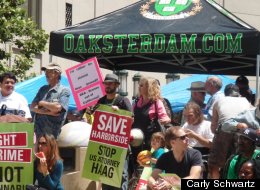
Yesterday advocates for legal access to medical marijuana rallied in downtown Los Angeles to protest a threatened crackdown on marijuana dispensaries.  People with a prescription for marijuana can get it legally in California–but not in the United States.  Threatened federal enforcement of drug laws brought patients into the streets, some self-medicating.

The smoking might not have generated attention absent the placards and chants.  Demonstrators needed to alert authorities–and the rest of us–that they were in fact protesting, not just smoking.

There’s a similar story from New York’s prestigious public exam school, Stuyvesant High.  Principal Stanley Teitel reminded students that Stuyvesant would enforce a new dress code as summer in the city approached:

Guidelines for appropriate dress include the following:
• Sayings and illustrations on clothing should be in good taste.
• Shoulders, undergarments, midriffs and lower backs should
not be exposed.
• The length of shorts, dresses and skirts should extend below
the fingertips with the arms straight at your side.

While Principal Teitel wanted to prevent students from being unduly distracted from their studies, students were, unsurprisingly, unsympathetic.  (See Emma Lichtenstein’s reporting in the student paper.)  Some thought that Stuyvesant students really didn’t dress inappropriately anyway, while others thought the dress code targeted girls–because boys were more easily distracted.

So students organized “Slutty Wednesdays” as an effort to redress the dress code.  Students wore specifically inappropriate clothing.  (Apparently, some had to change into banned clothing at school, preferring other attire when walking out the door or riding the subway.)

Mostly, students donned shorts and tank tops.  Administrators didn’t respond, although one teacher noted that he often saw students dressed more provocatively on non-protest days.  Scholarly and serious, Stuyvesant’s students proved more adept at organizing than in finding attire that really irritated anyone.

Posted in Uncategorized | Tagged , , , , , , | Leave a comment

After Wisconsin and the electoral trap

Wisconsin Governor Scott Walker’s victory in Tuesday’s recall election isn’t a happy outcome for the activists who have spent nearly a year and a half going after him.  It’s particularly troubling for labor organizers, who will face subsequent challenges with substantially less resources.  The story tells us a lot about the temptations and dangers of the electoral route for social movement activists.  As is often the case, organizers pursuing institutional politics wound up with much less than what they imagined possible.

Governor Walker went after organized labor aggressively upon taking office, and organized labor fought back hard, dramatically, and with imaginative flair.  Activists demonstrated, occupied the capital building, and provided cover for a supportive minority of state senators to stage a quorum filibuster by leaving the state.  Before Occupy, they fired the first notable mobilization by the left since the hey day of the Tea Party.  (Although Occupy Wall Street cited the Egyptians in Tahrir Square as inspiration, the Madison mobilization made for a far better comparison.)

Governor Walker was extraordinarily unpopular and his opponents in Wisconsin were intensely committed.  But after the senators returned and the governor’s agenda moved through the political process, activists had to figure out what to do next.

Wisconsin politics offered some alternatives, none of them easy.  What seemed most attractive–because it might work and reverse the conservative tide, was the recall route.  Walker’s opponents knew they had to wait to go after the governor (who had yet to serve a year in office), but targeted all of the state senators legally vulnerable to recall.  Wisconsin Republicans staged their own recall campaigns against the Democratic senators who had left the state.  All of the challenged Democrats survived the 2011 recall, and Democrats defeated 2 of the 4 Republican state senators they challenged.  Ah, but they needed one more to gain control of the state senate.

Although this was a substantial flexing of left and labor muscle, it was also very costly.  It wasn’t just the money, but also the focus and the effort, all channeled into an uphill struggle firmly rooted in electoral politics.  They prepared to recall Governor Walker as soon as they were legally allowed to do so.  In mid-January of this year, organizers delivered more than one million signatures on petitions to recall Governor Walker.  One million signatures in Wisconsin is a truly impressive total, about twice what they needed to make the recall happen, and about as many signatures as votes against Scott Walker in 2010.

Wisconsin’s recall law requires not a mandate on the incumbent, but a choice–much like a regular election.  Democrats nominated Tom Barrett, the Milwaukee mayor whom Governor Walker had defeated in 2010.

The electoral process requires compromises and unpleasant choices.  Mayor Barrett was unpopular with organized labor, and had used the new, uh, flexibility, in dealing with organized labor to balance Milwaukee’s budget.  The University of Wisconsin Teaching Assistants union, which had been energetic in organizing the demonstrations in Madison, refused to endorse Barrett–or even his primary opponent, Kathleen Falk, because neither would make a strong enough commitment to undo Wisconsin’s new anti-union strictures.  And after getting the nomination, Barrett chose not to emphasize the labor issues altogether.  Surely he figured that the unions were angry enough about Governor Walker’s administration to vote against him anyway, and that it made more sense to focus on Wisconsin voters who were less stalwart in their support for labor.  This is the normal hedging that characterizes general elections in America.

The anti-Walker campaigns were largely responsible for drawing national attention to organized Republican efforts to defund organized labor, and the recall election drew national attention–and money.  Partly because of the rules, and partly because of the resources, Governor Walker raised and spent much (much much) more money than the anti-Walker forces.  Walker was able to start raising money earlier, and spent nearly $30 million, more than seven times what the Barrett forces were able to raise.

Familiar conservative funders, including the Koch brothers, Sheldon Adelson, FreedomWorks, Americans for Prosperity, and the Tea Party Express, spent a lot of money on keeping Walker in office.  Unions spent money too, but they were trounced.  Essentially, the Walker opponents chose to play in an arena where they were at a disadvantage.  Still, it might have been the best choice they had.

Both sides worked hard at mobilizing support, and Tom Barrett won more than 100,000 votes than he had in 2010, but Scott Walker got more than 200,000 additional votes, widening his electoral margin.  Although the recall effort claimed one additional Republican state senator, the legislature may not meet until after the Fall elections.

And the people in power get to make at least some of the rules for the next election.  Redistricted legislative districts are likely to disadvantage Democrats.  More than that, organized labor has suffered severe losses in the wake of Wisconsin’s new laws on collective bargaining.  One element of the reform banned the automatic collection of union dues.  The Wall Street Journal reported that AFSCME and the NEA lost fully one-half to two-thirds of their members, who were no longer compelled to contribute to their unions.  Minimally, this means even less labor money as a counterbalance to corporate contributions in the next election.

The rules of mainstream politics structure the decisions that activists make.  Recall, just doing away with the Walker regime, seemed the most comprehensive and attractive alternative for Wisconsinites, but it was filled with risk.  The campaign provided a thinner message than the protests in the streets of Madison and the results represented a dramatic defeat.  The intense commitment of a minority, even a large minority, isn’t enough to win in a general election.

The pressing question now is to figure out what to do next.

Posted in Uncategorized | Tagged , , , , , , , , , , , , | 3 Comments

University of California or University in California

The future of the University of California is even more daunting for organizers than the troubled present.

The problem: Students, faculty, and the citizens of California have interests in both access to the University system and maintaining some degree of excellence in the system.  It’s extremely hard to focus on both issues simultaneously, and it’s hard to know who to work with and who to trust.

Over the past five years, the University has been fighting losing battles on both fronts.  As the state of California has consistently cut funding, the University has cut spending and programs while raising tuition.  Most of the ten campuses are working hard to increase the percentage of out-of-state and international students, who pay much higher tuition.  It’s a viable revenue strategy, but it’s understandable why California taxpayers are incensed that their University has less room for the young people of California.

Meanwhile, ongoing cuts to programs are affecting the quality of education UC students receive.  Saturday’s New York Times reports that students face fewer classes, larger classes, tougher admissions standards, less attention, higher tuition, and even a less demanding education.  According to the Times, every student may still have access to an academic adviser, but each adviser is now responsible for 500 students (rather than 300 in years past).  Is that access?  Many professors facing larger classes with fewer teaching assistants now require less writing, shorter and fewer papers.  (When I came to UCI, about a dozen years ago, each of my TAs was typically responsible for 80-90 students; 120-140 is now more typical.  If this doesn’t seem like much of a difference to you, try to imagine reading and commenting on 40 ten page papers.)  Students are unlikely to complain about such reforms, but they’re certainly not being helped.

The University’s management, seeing state support as unreliable, is explicitly moving toward a model where the campuses can function with less of it.  A few states have maintained excellent universities with declining support from their state.  The University of Michigan, for example, gets only about 17 percent of its budget from the state of Michigan.  It charges nearly $40,000 a year in tuition from out of state students, and those higher paying students make up about 40 percent of the undergraduates.

The Michigan students who gain admission can get a great education even as the state continues to cut support, but fewer Michiganders can get in.  I’d guess that fewer of the graduates are going to be eager to stay in the state after graduation.  The University will be responsive to the people who help it keep operating.  State legislators and tax payers who are getting less deference and responsiveness from the University are even less likely to want to contribute to it.  Yipes!

This is one possible future for UC campuses, and it’s not an attractive one.  The Council of UC Faculty Associations is ringing the alarm bells about adopting a Michigan model:

UC President Mark Yudof and Governor Jerry Brown are working out a deal behind closed doors that will loosen the most important ties between the university and the state…

Although they will both praise the deal by saying that it “stabilizes” funding while granting greater “flexibility,” its essence is that each will let the other off the hook: UC will mute complaints that it does not get enough money from the state and the state will stop holding UC accountable for the money it still gets.

The likely result is that UC will dump a larger number of eligible Californians onto the CSU and Community Colleges, which will in turn pass on their overflow to for-profit schools, where students take on inordinate amounts of debt with a very high likelihood of default.

* UC will no longer promise the state that it will admit a fixed number of California students in return for the enrollment funding that the state provides. For next year, and presumably from now on, UC will be allowed to use taxpayer funding as it pleases, without being accountable for the number of in-state students it educates (http://www.lao.ca.gov/analysis/2012/highered/higher-ed-020812.pdf, pg. 19). This means that UC is likely to enroll fewer California students, and to replace them with out-of-state and international students who pay more. The likely result is that UC will be able make more on average from its enrollments, that the state is likely to pay less, and that middle-income Californians will get less access to UC…

UC will be able to say that how much it spends to educate Californians and how many of them it enrolls is its own business, and not the state’s. If UC thinks its traditional mission is a money-loser, it can now use its continuing, but declining, revenues from the state to diversify into fields where it sees a brighter future. It will not be expected to draw on its other, more entrepreneurial, activities to subsidize public higher education, but instead will be allowed to use state educational funds to subsidize these other activities — and especially the capital projects necessary to get them off the ground…

An alternative model is to focus on delivering whatever we can with limited funds, continuing to increase class sizes, cut salaries, maintenance, and offerings.  It is definitely possible to spend less, but only by providing less.  Look: the California State University system delivers less and charges less.  Of course, CSU is also facing severe cuts.  Many states have decided to forgo subsidizing a top-flight research university system.

That’s another possible future.  Alas, I fear that focusing only on stopping tuition hikes leads that way.  Californians who want a top flight research university education can apply to institutions that deliver it–and find a way to pay.

Probably like most faculty, I’d prefer to return to the system laid out in the Master Plan more than fifty years ago–high investment and minimal tuition–and to pay taxes for it.

Lots of Californians will disagree with me, which is fine, but they should articulate the model they prefer for public higher education.  There are plenty of real examples out there, but please don’t lean on the imaginary ones, in which spending can always be cut without compromising what’s bought.  We’ll never get more than what we pay for.

Posted in Uncategorized | Tagged , , , , , | 1 Comment