Risk, Repression, and Response in Russia

Tens of thousands of Russians took to the streets in Moscow, calling for the ouster of President Vladimir Putin, and demanding new elections.

This is just days after President Putin raised the costs of protesting by announcing fines of up to $9,000 (more than the average annual income) for participation in a street demonstration.

The Russian people defied Putin’s expectations (and mine!) that increased costs and risks would deter most people from taking to the streets.  Risking both brutal police repression and financial hardship, large numbers of Muscovites nonetheless saw their grievances as so severe and their situation so desperate that protest made a kind of sense.  And when there is so much risk, the message is even stronger and more powerful.

When only a few people turn out, it’s harder to convince others to join, but when thousands take to the streets, arrests and repression seem more difficult, perhaps less likely, and the prospects for change seem a little better.  Success at mobilization builds upon success.  When more people turn out, it’s easier to get more people to turn out.

And we’re not near the end of this story.

Posted in Uncategorized | Tagged , , , , , , | 5 Comments

Froze and reversed the nuclear arms race?

Thirty years ago today, one million people marched in the streets of New York City to protest the nuclear arms race in general and the policies of Ronald Reagan in particular.  Organized around a “nuclear freeze” proposal, the demonstration was a watershed for a movement that seemed to come out of nowhere, not just in the United States, but throughout what was then called Western Europe.

Of course, movements have deeper roots.  Relatively small groups of people have been protesting against nuclear weapons since the idea of nuclear bombs first appeared.  On occasion, they’re able to spread their concerns beyond the few to a larger public.  Such was the case in 1982, when Europeans rallied against new intermediate range missiles planned for West Europe, and when Americans protested against the extraordinary military build-up/ spend-up of Ronald Reagan’s first term in office.

The freeze proposal, imagined by Randall Forsberg as a reasonable first step in reversing the arms race, was the core of organizing efforts in the United States, which included out-of-power arms control advocates and radical pacifists.  Local governments passed resolutions supporting the freeze, while several states passed referenda.  People demonstrated and held vigils, while community groups in churches and neighborhoods organized freeze groups to discuss–and advocate–on the nuclear arms race.

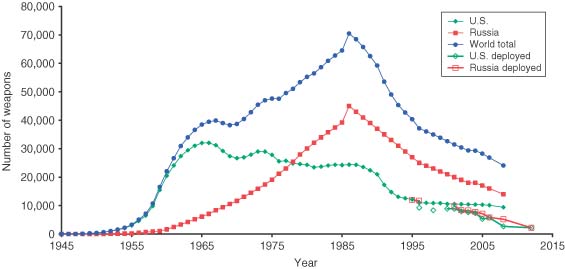
The freeze figured in large Democratic gains in the 1982 election, and Ronald Reagan ran for reelection as a born-again arms controller.  Most activists didn’t buy it, but after Reagan won in a landslide, to the horror of his advisers and many of his supporters, he negotiated large reductions in the nuclear arsenals of the United States and what used to be called the Soviet Union.

US/ Russia nuclear warheads

The arms control agreements created the space in the East for reforms, reforms that spun out of control and eventually unraveled the cold war and the Eastern bloc.

The world changed.

It was both less and more than what most activists imagined possible.

Do you want to call it a victory?

Posted in Uncategorized | Tagged , , , , , , , | 6 Comments

A tactic is a tactic

Greenpeace is innovating new tactics, an excellent piece by Kim Murphy in the weekend LA Times reports, developing a style of performance that is  a departure from blocking whalers in port.  We’ll come back to this, but first let’s talk about tactics:

People who are unhappy with a policy do something to try to advance their cause, undermining support for the current situation and/or building impetus for preferred remedies.   What do they do?  Oh so many things:  march silently, throw rocks, self-immolate, provoke arrest, hold signs, spit, sing, pray, trespass, block access to something, make a speech.  This can go on and on.

The tactic activists employ is an instrumental choice, something people engage because they think it will help them get their message out.  A good choice reflects judgments about the amount of space activists have to operate, the likely responses of opponents and authorities, and the imagined responses of audiences.   Will others join in?  Will people be sympathetic?

An effective tactic inspires supporters, threatens opponents, and creates a space for discussing issues.  What works on one day may not be so effective later on.  The tactic, be it a sit-in or  a speak-out, is a tool, a means to a larger end.  Everyone isn’t always deliberate and calculating, but effective organizers respond to their environments.

For example: Democracy activists in Russia, now facing severe fines for engaging in protest (up to $9,000), are less likely to stage public demonstrations, and more likely to take their concerns indoors somewhere.

PETA, always looking for ways to generate attention for itself–and its issues–has established a porn site.  Just the announcement of this approach has generated a great deal of attention.  But is it helpful to the animal rights movement?  Be sure that animal rights activists are arguing about this.

Although an activist or group can develop an inappropriate fixation on a particular set of tactics, blockades or vigils, for example, people concerned with being effective will respond to the world around them.

So when Shell Oil succeeded in getting an injunction against Greepeace, enjoining it from coming within a kilometer of its drilling rigs, depriving it of good pictures and threatening much larger fines, the environmental group had to innovate.  Kim Murphy reports:

The upshot is that while Greenpeace may once have faced a trespassing charge or some minor equivalent for harassing Shell’s drilling fleet, the organization now faces the much harsher penalties associated with violating a federal injunction if activists stray past the boundaries.

“Certainly this injunction we are faced with demanded some new thinking, and I guess the tactics needed to counter an international oil campaign have to be creative,” Greenpeace USA spokesman James Turner said. “Social media offers us the opportunity to use humor and inventiveness to reach people in a way that hopefully entertains and engages them, while making a serious point at the same time.”

Greenpeace’s current responses include episodes of guerrilla theater, such as staging a fake Shell reception at which an ice sculpture doused a guest with Diet Coke, while others rushed to help her by wiping up the spillage with stuffed teddy bears.  Certainly no more subtle than other Greenpeace displays, and very clear on the political points.  It’s all in the service of producing a video which went viral (660,000 + hits at this moment).

It’s less costly and less risky than confronting Shell at sea.  The questions: is it easier to ignore?  Does it raise the issue of off-shore drilling or just make Greenpeace look silly?

Posted in Uncategorized | Tagged , , , , , , , , | 3 Comments

Note: we’re protesting (tokes and togs)

Sometimes you have to remind people that what you’re doing is against the rules.

Yesterday advocates for legal access to medical marijuana rallied in downtown Los Angeles to protest a threatened crackdown on marijuana dispensaries.  People with a prescription for marijuana can get it legally in California–but not in the United States.  Threatened federal enforcement of drug laws brought patients into the streets, some self-medicating.

The smoking might not have generated attention absent the placards and chants.  Demonstrators needed to alert authorities–and the rest of us–that they were in fact protesting, not just smoking.

There’s a similar story from New York’s prestigious public exam school, Stuyvesant High.  Principal Stanley Teitel reminded students that Stuyvesant would enforce a new dress code as summer in the city approached:

Guidelines for appropriate dress include the following:
• Sayings and illustrations on clothing should be in good taste.
• Shoulders, undergarments, midriffs and lower backs should
not be exposed.
• The length of shorts, dresses and skirts should extend below
the fingertips with the arms straight at your side.

While Principal Teitel wanted to prevent students from being unduly distracted from their studies, students were, unsurprisingly, unsympathetic.  (See Emma Lichtenstein’s reporting in the student paper.)  Some thought that Stuyvesant students really didn’t dress inappropriately anyway, while others thought the dress code targeted girls–because boys were more easily distracted.

So students organized “Slutty Wednesdays” as an effort to redress the dress code.  Students wore specifically inappropriate clothing.  (Apparently, some had to change into banned clothing at school, preferring other attire when walking out the door or riding the subway.)

Mostly, students donned shorts and tank tops.  Administrators didn’t respond, although one teacher noted that he often saw students dressed more provocatively on non-protest days.  Scholarly and serious, Stuyvesant’s students proved more adept at organizing than in finding attire that really irritated anyone.

Posted in Uncategorized | Tagged , , , , , , | Leave a comment

After Wisconsin and the electoral trap

Wisconsin Governor Scott Walker’s victory in Tuesday’s recall election isn’t a happy outcome for the activists who have spent nearly a year and a half going after him.  It’s particularly troubling for labor organizers, who will face subsequent challenges with substantially less resources.  The story tells us a lot about the temptations and dangers of the electoral route for social movement activists.  As is often the case, organizers pursuing institutional politics wound up with much less than what they imagined possible.

Governor Walker went after organized labor aggressively upon taking office, and organized labor fought back hard, dramatically, and with imaginative flair.  Activists demonstrated, occupied the capital building, and provided cover for a supportive minority of state senators to stage a quorum filibuster by leaving the state.  Before Occupy, they fired the first notable mobilization by the left since the hey day of the Tea Party.  (Although Occupy Wall Street cited the Egyptians in Tahrir Square as inspiration, the Madison mobilization made for a far better comparison.)

Governor Walker was extraordinarily unpopular and his opponents in Wisconsin were intensely committed.  But after the senators returned and the governor’s agenda moved through the political process, activists had to figure out what to do next.

Wisconsin politics offered some alternatives, none of them easy.  What seemed most attractive–because it might work and reverse the conservative tide, was the recall route.  Walker’s opponents knew they had to wait to go after the governor (who had yet to serve a year in office), but targeted all of the state senators legally vulnerable to recall.  Wisconsin Republicans staged their own recall campaigns against the Democratic senators who had left the state.  All of the challenged Democrats survived the 2011 recall, and Democrats defeated 2 of the 4 Republican state senators they challenged.  Ah, but they needed one more to gain control of the state senate.

Although this was a substantial flexing of left and labor muscle, it was also very costly.  It wasn’t just the money, but also the focus and the effort, all channeled into an uphill struggle firmly rooted in electoral politics.  They prepared to recall Governor Walker as soon as they were legally allowed to do so.  In mid-January of this year, organizers delivered more than one million signatures on petitions to recall Governor Walker.  One million signatures in Wisconsin is a truly impressive total, about twice what they needed to make the recall happen, and about as many signatures as votes against Scott Walker in 2010.

Wisconsin’s recall law requires not a mandate on the incumbent, but a choice–much like a regular election.  Democrats nominated Tom Barrett, the Milwaukee mayor whom Governor Walker had defeated in 2010.

The electoral process requires compromises and unpleasant choices.  Mayor Barrett was unpopular with organized labor, and had used the new, uh, flexibility, in dealing with organized labor to balance Milwaukee’s budget.  The University of Wisconsin Teaching Assistants union, which had been energetic in organizing the demonstrations in Madison, refused to endorse Barrett–or even his primary opponent, Kathleen Falk, because neither would make a strong enough commitment to undo Wisconsin’s new anti-union strictures.  And after getting the nomination, Barrett chose not to emphasize the labor issues altogether.  Surely he figured that the unions were angry enough about Governor Walker’s administration to vote against him anyway, and that it made more sense to focus on Wisconsin voters who were less stalwart in their support for labor.  This is the normal hedging that characterizes general elections in America.

The anti-Walker campaigns were largely responsible for drawing national attention to organized Republican efforts to defund organized labor, and the recall election drew national attention–and money.  Partly because of the rules, and partly because of the resources, Governor Walker raised and spent much (much much) more money than the anti-Walker forces.  Walker was able to start raising money earlier, and spent nearly $30 million, more than seven times what the Barrett forces were able to raise.

Familiar conservative funders, including the Koch brothers, Sheldon Adelson, FreedomWorks, Americans for Prosperity, and the Tea Party Express, spent a lot of money on keeping Walker in office.  Unions spent money too, but they were trounced.  Essentially, the Walker opponents chose to play in an arena where they were at a disadvantage.  Still, it might have been the best choice they had.

Both sides worked hard at mobilizing support, and Tom Barrett won more than 100,000 votes than he had in 2010, but Scott Walker got more than 200,000 additional votes, widening his electoral margin.  Although the recall effort claimed one additional Republican state senator, the legislature may not meet until after the Fall elections.

And the people in power get to make at least some of the rules for the next election.  Redistricted legislative districts are likely to disadvantage Democrats.  More than that, organized labor has suffered severe losses in the wake of Wisconsin’s new laws on collective bargaining.  One element of the reform banned the automatic collection of union dues.  The Wall Street Journal reported that AFSCME and the NEA lost fully one-half to two-thirds of their members, who were no longer compelled to contribute to their unions.  Minimally, this means even less labor money as a counterbalance to corporate contributions in the next election.

The rules of mainstream politics structure the decisions that activists make.  Recall, just doing away with the Walker regime, seemed the most comprehensive and attractive alternative for Wisconsinites, but it was filled with risk.  The campaign provided a thinner message than the protests in the streets of Madison and the results represented a dramatic defeat.  The intense commitment of a minority, even a large minority, isn’t enough to win in a general election.

The pressing question now is to figure out what to do next.

Posted in Uncategorized | Tagged , , , , , , , , , , , , | 3 Comments

University of California or University in California

The future of the University of California is even more daunting for organizers than the troubled present.

The problem: Students, faculty, and the citizens of California have interests in both access to the University system and maintaining some degree of excellence in the system.  It’s extremely hard to focus on both issues simultaneously, and it’s hard to know who to work with and who to trust.

Over the past five years, the University has been fighting losing battles on both fronts.  As the state of California has consistently cut funding, the University has cut spending and programs while raising tuition.  Most of the ten campuses are working hard to increase the percentage of out-of-state and international students, who pay much higher tuition.  It’s a viable revenue strategy, but it’s understandable why California taxpayers are incensed that their University has less room for the young people of California.

Meanwhile, ongoing cuts to programs are affecting the quality of education UC students receive.  Saturday’s New York Times reports that students face fewer classes, larger classes, tougher admissions standards, less attention, higher tuition, and even a less demanding education.  According to the Times, every student may still have access to an academic adviser, but each adviser is now responsible for 500 students (rather than 300 in years past).  Is that access?  Many professors facing larger classes with fewer teaching assistants now require less writing, shorter and fewer papers.  (When I came to UCI, about a dozen years ago, each of my TAs was typically responsible for 80-90 students; 120-140 is now more typical.  If this doesn’t seem like much of a difference to you, try to imagine reading and commenting on 40 ten page papers.)  Students are unlikely to complain about such reforms, but they’re certainly not being helped.

The University’s management, seeing state support as unreliable, is explicitly moving toward a model where the campuses can function with less of it.  A few states have maintained excellent universities with declining support from their state.  The University of Michigan, for example, gets only about 17 percent of its budget from the state of Michigan.  It charges nearly $40,000 a year in tuition from out of state students, and those higher paying students make up about 40 percent of the undergraduates.

The Michigan students who gain admission can get a great education even as the state continues to cut support, but fewer Michiganders can get in.  I’d guess that fewer of the graduates are going to be eager to stay in the state after graduation.  The University will be responsive to the people who help it keep operating.  State legislators and tax payers who are getting less deference and responsiveness from the University are even less likely to want to contribute to it.  Yipes!

This is one possible future for UC campuses, and it’s not an attractive one.  The Council of UC Faculty Associations is ringing the alarm bells about adopting a Michigan model:

UC President Mark Yudof and Governor Jerry Brown are working out a deal behind closed doors that will loosen the most important ties between the university and the state…

Although they will both praise the deal by saying that it “stabilizes” funding while granting greater “flexibility,” its essence is that each will let the other off the hook: UC will mute complaints that it does not get enough money from the state and the state will stop holding UC accountable for the money it still gets.

The likely result is that UC will dump a larger number of eligible Californians onto the CSU and Community Colleges, which will in turn pass on their overflow to for-profit schools, where students take on inordinate amounts of debt with a very high likelihood of default.

* UC will no longer promise the state that it will admit a fixed number of California students in return for the enrollment funding that the state provides. For next year, and presumably from now on, UC will be allowed to use taxpayer funding as it pleases, without being accountable for the number of in-state students it educates (http://www.lao.ca.gov/analysis/2012/highered/higher-ed-020812.pdf, pg. 19). This means that UC is likely to enroll fewer California students, and to replace them with out-of-state and international students who pay more. The likely result is that UC will be able make more on average from its enrollments, that the state is likely to pay less, and that middle-income Californians will get less access to UC…

UC will be able to say that how much it spends to educate Californians and how many of them it enrolls is its own business, and not the state’s. If UC thinks its traditional mission is a money-loser, it can now use its continuing, but declining, revenues from the state to diversify into fields where it sees a brighter future. It will not be expected to draw on its other, more entrepreneurial, activities to subsidize public higher education, but instead will be allowed to use state educational funds to subsidize these other activities — and especially the capital projects necessary to get them off the ground…

An alternative model is to focus on delivering whatever we can with limited funds, continuing to increase class sizes, cut salaries, maintenance, and offerings.  It is definitely possible to spend less, but only by providing less.  Look: the California State University system delivers less and charges less.  Of course, CSU is also facing severe cuts.  Many states have decided to forgo subsidizing a top-flight research university system.

That’s another possible future.  Alas, I fear that focusing only on stopping tuition hikes leads that way.  Californians who want a top flight research university education can apply to institutions that deliver it–and find a way to pay.

Probably like most faculty, I’d prefer to return to the system laid out in the Master Plan more than fifty years ago–high investment and minimal tuition–and to pay taxes for it.

Lots of Californians will disagree with me, which is fine, but they should articulate the model they prefer for public higher education.  There are plenty of real examples out there, but please don’t lean on the imaginary ones, in which spending can always be cut without compromising what’s bought.  We’ll never get more than what we pay for.

Posted in Uncategorized | Tagged , , , , , | 1 Comment

Same sex marriage and tipping points–new evidence

General Colin Powell, who has served in high positions in Republican administrations, has announced that he supports same sex marriage.

Following President Obama’s expression of support for gay marriage, Gen. Powell’s declaration is additional evidence that the president’s statement represented a “tipping point,” which signals even faster shifts in public opinion on the issue.

Recent polls show that support for same sex marriage is stronger among African Americans than the population at large.  But that’s not all:

Even as organized Catholicism in the United States has announced support for a Constitutional amendment banning same sex unions, a slight majority of people who identify as Catholics supports gay marriage, just a bit more than the general population.

Posted in Uncategorized | Tagged , , | Leave a comment

Social movement society conference

I’m happy to be at the University of Ottawa, participating in a workshop considering “the social movement society.”

The idea is from a book Sid Tarrow and I edited nearly fifteen years ago.  We argued that social movements were becoming a routine part of politics in rich democratic countries.  We said:

People (and authorities) were more tolerant of protest, particularly less disruptive protest.

A wider range of constituencies would use protest to represent their claims.

The infrastructure supporting social movements had become increasingly professionalized–and dependent upon financial resources.

I expect to get a clearer sense of all that we left out or got wrong.  It’s going to be great.

Posted in academic | Tagged | 2 Comments

Occupy NATO (in Chicago)

When the leaders of the Western world assemble for a NATO summit meeting, the world press follows and activists see an opportunity to project their messages to a broader audience.  Chicago was the site not only for the meeting, but also days of protest on a wide range of issues, most of the actions under the banner of Occupy.

Some of the grievances are clearly tied to the North Atlantic Treaty Organization, members of which have maintained a war in Afghanistan for more than a decade.  Activists have lots of reasons for opposing the war, and most were on display during the days of demonstrations.  The peace movement in America and the campaign against this war are long standing, well-established, and frustrated.  After all, it’s been more than ten years.  What’s different this time is the Occupy label.

When Occupy emerged last fall, foreign policy was low on most lists of what it was about.  At the top of the long agendas that emerged from General Assembly meetings was economic and political inequality.  Linking these concerns to the war isn’t hard to do, and activists were mostly pretty good about doing it.  Here’s a bit from the Chicago Tribune’s coverage:

“I think we’re seeing a lot of different concerns,” said Lillian Moats, 65, of Downers Grove earlier as she looked out over a diverse sea of people including self-described anarchists dressed in black and people made up as clowns.

“I think that there’s just a great resonance with the Occupy movement, because if we weren’t spending such outrageous amounts on war, we have money for human needs,” Moats said. “It seems like our country’s priorities are upside down.”

The antiwar part of the protests included a march on Boeing’s headquarters in downtown, followed by a march to President Obama’s headquarters.  Here again the traditional peace movement concerns merged with Occupy’s focus on economic inequality (from Progress Illinois):

In addition to the products the company makes, Occupy members voiced their concerns about tax subsidies the corporation received from the state and federal government. They also shamed the company for laying off thousands of workers.

“Despite making a profit of $9.7 billion between 2008 and 2010, Boeing laid off 14,862 workers, and it increased executive pay 31 percent,” said an Occupier through a megaphone.

But it wasn’t only peace activists who seized upon the opportunity for exposure provided by the NATO summit.  Local Occupy activists concerned with affordable housing were out in force earlier in the week, focusing far less on the military alliance than stopping Cook County Sherriff Tom Dart, foreclosures, and evictions.

Amidst all the issues, activists made proposals beyond saying “no” (stopping war, evictions, and exploitation).  Members of National Nurses United marched and demanded a financial transactions tax.  (Adbusters’ Kalle Lasn, who issued the first call to Occupy Wall Street, has made the same proposal.)  The nurses said that such a “Robin Hood” tax would raise money that could be used to prevent huge cuts to human services, and make a stab at economic inequality in the process.

The point is that Occupy has become an almost all-purpose umbrella for a wide range of issues and activists, and the NATO summit was a chance to trot out many of them out.

Posted in Uncategorized | Tagged , , , , , , , , , , , , , | 2 Comments

Movements, Presidential rhetoric, and tipping points

The NAACP’s decision to support marriage equality explicitly is early evidence that President Obama’s announcement about same sex marriage was a tipping point in American politics and opinion.

As we discussed, President Obama’s disclosure, in a soft interview, about how his position on gay marriage had “evolved,” was limited.  He didn’t make a major policy address, nor did he propose any legislation to advance the cause.  Nonetheless, his new public position was a signal and encouragement for others to go further.

The NAACP surfed the attention President Obama had generated to announce a position that had been in development for several years.  At a meeting of its Board of Directors, the longstanding civil rights organization announced:

The NAACP Constitution affirmatively states our objective to ensure the “political, educational, social and economic equality” of all people. Therefore, the NAACP has opposed and will continue to oppose any national, state, local policy or legislative initiative that seeks to codify discrimination or hatred into the law or to remove the Constitutional rights of LGBT citizens. We support marriage equality consistent with equal protection under the law provided under the Fourteenth Amendment of the United States Constitution.  Further, we strongly affirm the religious freedoms of all people as protected by the First Amendment.

W.E.B. Du Bois

Of course, the NAACP viewed the issue through the lens of its history and constitutional orientation, even as it addressed issues founder W.E.B. Du Bois couldn’t imagine surfacing in American politics.  Organizations that survive evolve to address new issues.  And note the way the NAACP’s board invoked the equal protection clause in the 14th amendment, ratified after the Civil War with the rights of former slaves in mind.  Constitutional interpretation evolves too.

Like President Obama’s statement, the NAACP’s position is a signal to other organizations and publics about the importance of addressing marriage equality.  If Obama and the NAACP are reading the political tea leaves correctly, political organizations that don’t endorse marriage equality (at least on one half of the political spectrum) will soon seem out of touch.  The Democratic Party will surely have a marriage equality plank in its platform this year.  As each new group flips on this issue, the pressure and incentives for others to do so increases.

This is what “tipping point” means, as Philip Cohen has been ranting about over at Family Inequality.

We’re always so immersed in the battle of the moment that it’s hard to see how much our world has changed, more slowly than activists wanted–but far more dramatically than most imagined possible.  The complexion of our president, the number of women who serve as Justices on the Supreme Court, the broad support for Medicare, the availability of curbside recycling, the social sanctions associated with bullying or cigarette smoking all reflect social and political changes only a few visionaries could have imagined 50 years ago.

And progress on any issue forces us to see just how much more there is to be done.

Posted in Uncategorized | Tagged , , , , , , , | 1 Comment