Passover Politics

We’re two days into Passover, a major Jewish holiday.  The highlight is always two nights of services at the dinner table with families and friends, with varying shares of food, prayer, stories, and discussion.  This service, the seder, varies tremendously from home to home, as each household makes its way through a haggadah, with more and less conflict and warmth–as immortalized in Woody Allen films.

“Haggadah” means telling or narration, and the story that’s told is about the liberation of the Hebrews from slavery in Egypt.  Although key elements of the tale are basically consistent, the tone, length, and meanings of the story are all over the place.

On length: the longest service I’ve ever participated in, many years ago, featured commentary and discussion on absolutely everything, and we didn’t get to dinner until after midnight.  All the participants were in their twenties, and there were no hungry kids waiting for dinner.

On meaning: religion helps people make sense of their lives, and rituals reinforce a sense of one’s place in the world.  People take very different messages from the same sets of stories and religious dicta, and devout doesn’t mandate a certain kind of politics.  Radical pacifist Dorothy Day and proto-fascist Father Charles Coughlin both saw themselves as committed Catholics.  Contemporary Christian clerics finds ways to promote tax cuts or tax justice in the Gospels.

The haggadah is a site where we can see the outcomes of activist Jewish efforts.  The story of liberation from Egypt can be used to make many different points.  In one reading, it’s about how special the Hebrews are, and about their sacred tie to the land of Israel.  Another take is about a universal drive for social justice, with an explicit argument that the liberation from slavery should make seder participants particularly vigilant in fighting against the oppression of others.

Such contrasting visions play out in different haggadahs; it’s easy to find conservative, leftist, environmentalist, and feminist haggadahs in bookstores–and now, on line.  All manner of causes have been represented by activists seizing the holiday and appropriating the story for their own purposes.  The rituals and symbols change in response to the concerns of the present: vegans, for example, hold their seders without a shankbone to represent the Passover sacrifice.

But recounting the experience of slavery, even many generations on, should leave a lasting impact on the way we think about the world and about justice.

The drama of the events commemorated–and the flexibility of the service–make it every politico’s favorite holiday.  President Obama–who is not Jewish or Muslim–has been hosting a seder each year  for a long time–well before he got to hold the ceremony in the White House.

You can make your own:

The Open Source Haggadah lists 16 key elements of the service and offers different texts for each, with politics ranging from “revolutionary” to Zionist, and religious orientations that range from orthodox to explicitly secular.  More–and newer–texts are available at Haggadot.com.

Contrasting intepretations of religious doctrines are hardly peculiar to Judaism.  What’s particularly interesting here is that you don’t need to read theological tracts to see the debates played out.

And to see how important movements of the past century have taken on the religious and cultural text of explaining themselves and their visions in the context of traditions that data back thousands of years.  One outcome of feminism, for example, are passages read aloud at dinner tables across the country that were recovered or written by activists a few decades ago.

And, somehow, I think these stories matter: our understanding of the past shapes our visions and actions for the future.

Posted in Uncategorized | Tagged , , , , | Leave a comment

Coalitions and Linking Issues

Immigrant rights protest

Sunday’s New York Times features an interesting profile of John Tanton, a Michigan physician who has been crusading, effectively, for limited immigration and against reform for more than three decades.

Jason DeParle reports that Tanton, a prodigious fundraiser and organizer, had been active in Planned Parenthood and Zero Population Growth when he grew increasingly concerned with immigration.  He was critical in founding several anti-immigrant groups (Numbers USA, Federation for American Immigration Reform [FAIR], and Center for  Immigration Studies), and has pressed his views with increasing vigor–and venom.

There is much that’s interesting in DeParle’s piece, but what most intrigued me was Tanton’s initial effort to recruit allies from the left of the political spectrum.  Tanton imagined potential supporters from environmentalists and labor, and worked to use arguments that would appeal to them (population pressure was an environmental threat; immigrants would drive down wages), but–despite early support from Sen. Eugene McCarthy and Warren Buffet–was largely unsuccessful.  McCarthy and Buffet also distanced themselves from Tanton, his groups, and his politics.

And those politics became increasingly venomous.  Shelving the environmental and labor arguments, Tanton became increasingly open to arguments about cultural preservation and the racial inferiority of darker skinned people.  Tanton became so toxic that even anti-immigrant activists have begun to distance themselves from him.

There’s certainly a story about one man’s journal told in psychological terms.  That’s not my story.

I’m more struck by how supporters of issues tend to cluster in ways that are not directly related to the content of the issue.

Certainly, labor and environmentalists could have gone into the anti-immigrant camp.  Environmentalism has a history that includes conservative ideology, and labor certainly has a….mixed…history on racial justice and immigration.

And there is a conservative ideological position that supports fairly open borders, so that capital has access to labor.  Recall that President George W. Bush presented a comprehensive immigration reform package that included a path toward citizenship for undocumented immigrants in the United States, and that Senator John McCain worked for it in Congress.  Bush ultimately gave up, and McCain worked hard to distance himself from his own positions so that he could get the Republican nomination for President.  Not much later, facing a primary challenge for his Senate seat, he fixated on building a great wall between the United States and Mexico.

More than that, there’s something odd about the clustering of positions  on abortion, taxation, climate change, war in Iraq, and immigration should cluster the way they do–but they do.

Successful activist organizations work in groups, and they depend on building coalitions across issues and forging alliances within political parties.  The Presidential primary system that became institutionalized in the 1970s gave issue activists disproportionate influence in enforcing ideological discipline.  Thus, George H.W. Bush abandoned support of abortion rights in 1980 when he agreed to run on a national ticket with Ronald Reagan; Jesse Jackson, preparing for a presidential run in 1984, dropped his anti-abortion stance the previous year and made abortion rights a central plank in his campaign for liberal women voters.

I assume that Bush and Jackson thought carefully about their positions on abortion, thought about what they knew about the world and the people they cared about, and searched their souls before staging those political turnabouts.  We also know, however, that they had to shift policies if they wanted to be credible within their respective parties.

The clustering of issues within the political parties makes building issue-based coalitions across parties increasingly difficult.  But outside Congress, in the states and in neighborhoods, the same dynamic is at work, reinforced by social norms and an odd American norm of avoiding political arguments with friends.  Oddly, this makes the vitriol and intolerance for those who disagree with us–because they disagree on almost everything–much worse.

Posted in Uncategorized | Tagged , , , | Leave a comment

Tax Day Protest

The cheerleaders during the American revolution led the crowds in chanting, “No Taxation without Representation.”  At least the first part of that cheer has found a permanent place in American political discourse, as activists have found a way to label personal frustration at paying taxes as a moral and political cause.  Every year, conservative and libertarian activists stage protests on tax day.

April 15th (this year, April 18th, but go with me on this) provides an obvious hook for organizing and a news peg for journalists.  I’ve heard rumors of some people who were so grateful to America that they took delight in filling out the forms and writing the check (allegedly, this included the great songwriter, Irving Berlin), but most of us resent the time spent organizing records and, maybe, writing a check for goods and services that we take for granted (roads, food inspection), or even resent (wars, for example, and any kind of waste you want to find).  So, people are more ready to protest–and journalists more willing to cover such protests–on tax day.

Tax Day Protest, Washington DC 2010

Historically, the anti-tax forces have owned the day.  Since the emergence of the Tea Party as an umbrella of conservative causes, demonstrations in Washington–and around the country–have been branded.  The New York Times reported several thousand demonstrators last year,  organized by Tea Party groups, including FreedomWorks, and addressed by political heroes including Michele Bachmann.

This year, however, things may be a little different.  The biggest tea party groups have announced that they’ll be foregoing the Washington rallies in favor of organized events around the country (Roll Call report).  Since the large Republican gains in the 2010 elections, Tea Party groups have had a more difficult time generating large crowds; activists expect elected officials to carry their cause.  Americans for Prosperity’s Tim Phillips, explains, “It’s a little harder on offense. On defense, it’s more unifying. You’re simply saying no.”  (That’s pretty much what I said.)

It’s a great risk for any movement to use the same tactic and generate smaller numbers and less attention.  Announcing that you’re moving out to the grassroots is an effort to make a virtue of necessity.

Meanwhile, liberal activists are staking a new claim on tax day, trying to get into the stories about protest and the larger debate about taxes.  Moveon.org is organizing parties, rallies, and other events around the country about tax justice.  It’s not exactly taking pride and pleasure in writing checks to the US Treasury, but an effort to mobilize people who think that you have to pay for worthwhile services from government—but the emphasis is on making the wealthy and corporations pay their fair share.

As a matter of policy, the interesting thing here is that the anti-taxers talk about keeping taxes low for everyone, but their allies on Capitol Hill focus on cutting the taxes of the very rich.  Their opponents focus their rhetoric on the very rich, mostly avoiding the notion that the rest of us might have to pay more for government.

As a matter of movement politics, the question will be whether the anti-anti-taxers get into the stories on Monday and Tuesday, and into the larger political debate.

Posted in Uncategorized | Tagged , , , | Leave a comment

Can the Tea Party Party? (Notes on the Budget Agreement)

It certainly looked as though Speaker John Boehner did pretty well in negotiations about the past year’s budget.  At the last minute, the Speaker, Senate Majority Leader Harry Reid, and President Obama announced that they had come to an agreement to keep the government operating, an agreement that all parties claimed to find distasteful.

The details of the agreement have mostly escaped public scrutiny, but there has been a great deal of attention to the amount cut from the budget: $38 billion.  This was more than Speaker Boehner’s initial position on cuts, but less than the rhetorical $100 billion Republicans campaigned on last fall (which, prorated for what’s left of the year, would have come out to $61 billion).  Boehner, like Democratic leaders, now had to convince his caucus and his constituents, that he cut the best deal he could.

These are large and uncharacteristic cuts for Congress, but for Tea Party activists out to balance the budget or shrink government, they’re somewhat less than a drop in the bucket.  There will be a large deficit next year, and there will be taxes; government will continue to operate.

Fifty-nine Republicans in the House refused to support the new budget resolution funding the government, including more than one quarter of the freshman.  Speaker Boehner has to worry about holding his caucus together, and this means maintaining good relations with the Tea Party, or at least a lot of it.

But he also knows that the Tea Party draws support from a little less than a third of the American public–a significant faction of the Republican party, to be sure, but not enough to win national elections.  Boehner, who knows how to read polls and count heads, also knows that cuts in favored programs are likely to threaten his support and mobilize his opposition.  His dilemma is finding a way to keep the caucus together, the Tea Party firmly in the Republican Party, and still pass legislation.

The Tea Partiers dilemma is how to deal with what can only be described as a partial victory.  This is  a common movement story.  (Perhaps only ambiguous defeat is more frequent.)  It’s really the way movement politics works.

In opposition, the Tea Party could articulate diverse–and even contradictory–claims, as long as there was agreement on opposing President Obama, the Democrats, and their initiatives.  Tea Party groups could disagree about salient social issues (same sex marriage, abortion) or foreign policy, and still continue to work together.  Indeed, the label “Tea Party,” and rhetoric about taking America back, could paper over real differences.  Once Tea Party allies had some responsibility for governance, things become much more difficult.  Cutting $100 billion dollars and balancing the budget sounds much more attractive than cutting spending on particular programs, which all have constituencies of support.  And balancing the priorities of groups that all agreed defeating Democrats was top on the list becomes more difficult once that first objective has been achieved.  Paradoxically, every step forward undermines building a coalition that supports the effort.  If progress is being made, moderates doubt the need for more protest, more rallies, more contributions, and more meetings.  And hard core supporters want more from their efforts than the marginal gains and compromises the are endemic to the policy process in America.

Meanwhile, the Tea Party has been so vaguely defined that real tensions between different factions emerge whenever a deal is made.  Social conservatives saw the Republican leadership trade off a series of proposals devoted to restricting abortion for gains on the budget number–again.  They have to wonder if the Tea Party–or the Republican Party–is a viable vehicle for their concerns.

(If the Tea Party turns out to be an uneasy alliance of mainstream Republicans, social conservatives, libertarians, isolationists and imperialists, it’s just a hopped up version of the Republican Party.)

Speaker Boehner is in the middle of it, as he will be again when the vote about raising the debt ceiling returns, and again when the House takes up the next budget.  He needed Democrats in the House to help pass his budget, and they want different things than his Republican base.  The critical test for a party leader is to be able to negotiate for–and sell out–key constituencies–and still maintain their support.

The test for activists is to learn how to claim victories gracelessly, and continue to mobilize activism and press forward.  James Madison designed America to make this extremely difficult.

Posted in Uncategorized | Tagged , , , , , | Leave a comment

Williams Institute 10th Anniversary

I’m honored to participate in the 10th anniversary celebration of the Williams Institute, at UCLA’s law school.

The Williams Institute is an academic think tank focused on law and public policy regarding sexual orientation.  And academics celebrate achievements, like good work for a decade, by holding conferences.  (I understand that people in other fields celebrate in different ways.)

I’m slated to participate in a panel, “Beyond Gay Rights: Lessons from Other Social Movements,” and will post this weekend about what I learn.

Meantime, it’s worthwhile to note that GLBT activists have made extraordinary gains over the past few years in terms of public policy and social acceptance, but they see much more work to be done.  Note, for example, today’s LA Times, which reports on Rep. Michele Bachmann’s efforts to cultivate conservative support in Iowa for her presidential bid.  Bachmann calls the judges who ruled for a right to same sex marriage (who were turned out of office), “black-robed masters.” She’s not alone in seeing political gain in campaigning against gay rights.

Posted in academic | Tagged , , | Leave a comment

Fast Politics

Fasting is an act of penitence, preparation, and a purification ritual well-established in many religious traditions.   We fast to clear the mind and cleanse the body, turning away from the pressures and pleasures of the world to focus instead on something more important–or even divine.  Hunger pangs pass after a day or so, and fasters report focus, haze, visions, clarity, elation, fatigue, and much else.  With water or juice, a fast can last for weeks.

The activists, authors, and clerics who began a fast against budget cuts to programs that serve the poor last week (discussed yesterday) were twisting a tactic oriented to the self into something that turns outward, toward politics.  They certainly weren’t the first to do so.

Fasting is a standard part of the spiritual repertoire in many religions.  By interrupting the most normal and routine aspects of daily life–making and consuming meals–people can turn their thoughts elsewhere, to the divine.  The Hebrew Bible is replete with tales of whole communities fasting to repent; in the New Testament, Jesus goes to the desert for 40 days to fast before beginning his public ministry.  Fast days (and even fast months) mark the year in contemporary religious life, turning our attention from the routine inward, to something spiritual.

Political activists have taken those trapping and turned them outward.  Mahatma Gandhi staged fasts in the midst of confrontations with the British over independence, saying that he should bear the costs of the conflict he was provoking.  His claim: his belief in the justice of his cause was so great, that he was bearing the costs of that certainty, rather than imposing it on others–through some kind of violence.  (Note the spinning wheel in the photo above; during his political campaigns, Gandhi would spin cotton, as a concrete and symbolic step toward Indian independence.)

Of course, in real life, the British watched this spiritual leader starving himself to death–and others watched the British.  There is something profoundly coercive here–at least to opponents who saw themselves as moral and just.  Gandhi was well aware of this, and also well aware that the British were an opponent who might respond to such pressures.

Cesar Chavez borrowed from Gandhi, and adapted his fasts from Gandhi’s practices.  He defined the fast as a means of spiritual preparation, and also as a way to demonstrate his seriousness.  But he also found a way to keep the spotlight on his efforts–and his concerns.  He would continue his fast until a demand was met, each day increasing the pressure on his opponents.

The idea of forcing an opponent to take responsibility for abominable action is a staple of protest politics, particularly nonviolent protest.  The fast is a recurrent tactic in prison actions, non-cooperation with the daily routines being one of the few approaches available to the imprisoned.
The Irish Republican Army organized serial hunger strikes in the Maze prison in 1981, demanding that imprisoned IRA members be treated as political prisoners.   The strikes followed a five year campaign for political status, which would include the freedom to wear their own clothes and avoid prison work.  In previous efforts, prisoners had refused to wear uniforms (going “on the blanket” instead), and had also fasted.

Bobby Sands, the leader of the IRA members in the prison, refused food on March 1, drawing international attention, and mobilizing both supporters and opponents outside the prison as the strike went on.  Two weeks later, another prisoner joined him in refusing food, followed at intervals by at least eight other IRA prisoners.  Five weeks into the strike Bobby Sands won a by-election for a seat in Parliament, provoking commentary around the world, and increased pressure on the British government.   Members of the European Commission and Pope John Paul II attempted to intervene to save Sands’s life, but were unable to persuade him to stop the strike.

Sands never took office, starving to death at age 27, after 66 days without food.  His death prompted a series of riots in Northern Ireland, and more than 100,000 people attended his funeral.  Meanwhile, one at a time, more prisoners went on strike.

The British would not force feed the prisoners unless their families demanded medical attention, and as several prisoners died, one at a time, other strikers’ families began to demand this intervention.  The strike became increasingly divisive–and horrifying.  Before it was over nine other prisoners had starved to death.

In October, the prisoners called off the strike, having commanded international attention and won some symbolic support from other political actors.

The current anti-hunger strike is unlikely to make a similar impact.  No one intends to starve to death (Mark Bittman, for example, limited his fast to four days), and giving up one meal a day is likely to improve the health of many Americans.  Whether a less dangerous approach to politics, embraced by many more people, can generate similar attention is very much an open question.

Posted in Uncategorized | Tagged , , , , , | 5 Comments

Fasting against Hunger

Mark Bittman, who wrote the Minimalist food column at the New York Times for more than a decade, announced last week that he was taking minimalism a step further, by not eating altogether.  Most of Bittman’s writing is about how to make meals quickly with limited ingredients.  In the last few years, however, he began to write occasionally about the politics of food, urging his readers to think about eating less food and less meat to improve their health and protect the environment.

But this is a new wrinkle in Bittman’s politics: he’s fasting to protest cuts in the federal budget that affect poor people.  He writes:

I stopped eating on Monday and joined around 4,000 other people in a fast to call attention to Congressional budget proposals that would make huge cuts in programs for the poor and hungry.

By doing so, I surprised myself; after all, I eat for a living. But the decision was easy after I spoke last week with David Beckmann, a reverend who is this year’s World Food Prize laureate. Our conversation turned, as so many about food do these days, to the poor.

Who are — once again — under attack, this time in the House budget bill, H.R. 1. The budget proposes cuts in the WIC program (which supports women, infants and children), in international food and health aid (18 million people would be immediately cut off from a much-needed food stream, and 4 million would lose access to malaria medicine) and in programs that aid farmers in underdeveloped countries. Food stamps are also being attacked, in the twisted “Welfare Reform 2011” bill. (There are other egregious maneuvers in H.R. 1, but I’m sticking to those related to food.)

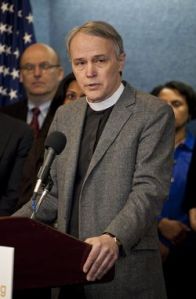
David Beckmann, Bread for the World

Bittman is a writer and a cook, but not an organizer.  The fast that started last Monday was organized by David Beckmann (left), president of Bread for the World, Jim Wallis, of Sojourners, a progressive Christian group, and former Democratic Congressman, Tony Hall.  (Hall had conducted a fast for the same reasons in 1993 that stretched for 22 days.)  The organizers framed their fast in explicitly religious terms, offering a Gospel of social justice.  Beckmann explains:

I’m a Lutheran pastor, and I have not come across any biblical injunction against taxing the wealthy. Yet the Bible constantly reminds us to take care of the least of our brethren. If our representatives and senators are unwilling to listen to the needs of hungry and poor people, maybe they will listen to God.

Our prayer is simple: We invite God to reshape our personal priorities and the priorities of our nation, and we call on God to help us form a circle of protection around programs that are needed by the most vulnerable among us. Amen.

Fasting is a ritual of purification in many religions, but when the faithful make their actions public, and target policy demands as well as enlightenment, it becomes political.

Once the action started, others joined in, including Bittman.  Other religious groups joined, as did political groups.  By mid-week, Moveon.org, the Service Employees International Union, the Center for Community Change, ColorOfChange, Courage Campaign, Presente.org and CREDO. The fast became a vehicle for all sorts of people, with a variety of gripes with the proposed budget, to take action and try to push back against the efforts of Tea Party groups on the right.  Advocates for immigrants’ rights, gay and lesbian rights, and labor have used the campaign on behalf of poor people to link their own claims to a larger fight.

While the initiators staged full-on fasts, this is a difficult–and dangerous–commitment for most people to take on.  Supporting groups have urged their audiences to take more modest actions, like skipping a meal.  The more important thing, they argue, is to draw attention to the magnitude of the federal cuts.

The fast is an effort to change the focus of discussion from the federal deficit to the things that federal spending does–at least some of the things.

This isn’t so obvious or so easy.  At least some [e.g.] conservative pundits have ridiculed the fasters for protesting against modest cuts in total government spending, explicitly ignoring the specific programs the protesters want to save.

Next post is about fasting as a political strategy.

Posted in Uncategorized | Tagged , , , , | 2 Comments

A Smaller Tea Party

Rear view, tea party rally

Thursday’s Tea Party rally drew crowds described as “sparse,” with estimates clustering around 200 people.  Slate‘s David Weigel says that there were four reporters for every demonstrator, and that other journalists were poaching his interviews, trying to find someone to talk to.

This rally was all about the ongoing budget negotiations on Capitol Hill.  During the campaign, Republicans promised $100 billion in cuts, but some of them had second thoughts when they acknowledged they were working on only a portion of the year and that exempting defense, interest payments, Medicare, and Social Security left precious little to cut without antagonizing significant constituencies.  You may want to brag about cutting spending, but probably not cutting student loans or Head Start.  (You’d have to have 500 Corporations for Public Broadcasting to cut to get to $100 billion.)

The last Congress’s failure to pass a full year budget has virtually ensured that budget debates will dominate the political news for most of this year: continuing resolutions for this year sucking up time and space until legislators start work on next year’s budget.

Vice President Biden has engaged in negotiations with the Democratic and Republican leadership, and while the Democrats have agreed to cuts significant enough to rile up their own base, they’re not nearly enough for the base of the Tea Party.  Speaker Boehner wants to cut some kind of deal–and the Republicans have done well in negotiations–but is it enough for his own Republican party?  Failure to reach agreement means a government shut-down.

Thursday’s rally was a signal that the Tea Party stalwarts won’t be satisfied by a compromise.

But how strong a signal?  Turning out a crowd in mid-week on short notice is no easy matter under any circumstances, and it was cold and rainy;  the small crowd demonstrated considerable vigor.   Marin Cogan, at Politico, reports:

When Rep. Mike Pence (R-Ind.) told the protesters that “nobody wants the government to shut down, but if we don’t take a stand, we’re going to shut down the future of our children and grandchildren,” he was interrupted by a tea partier yelling, “Yes we do!”

Republicans in Congress face the difficult problem of balancing the demands of their most intense supporters with finding ways to appeal to the larger public they need to win elections.  (We assume, in addition, that elected officials have their own ideas about particular policies that might benefit the nation.)  The small intense crowd underscored the dilemma.

From 538.com

The Tea Party has never commanded majority support in public opinion polls, and as its advocates must take positions beyond opposing President Obama, its support has faltered and its opposition grown.  The figure on the left, from Nate Silver at the New York Times, shows these trends pretty clearly.

Thirty percent of the population is a large enough faction to pay close attention to–but so is the forty percent plus opposed to the Tea Party.  A government shut-down is unlikely to help the Tea Party gain support.  The Republican Party leadership has to want to hang tough in negotiations and still continue to cut deals.

But everyone doesn’t have the same interests.  Many members of the House of Representatives in particular come from safe districts, and have nothing to gain by reaching agreement with the Democrats.  Michele Bachmann (Minnesota) and Steve King (Iowa) were emphatic that letting the government shut down was far from the worst possible outcome–which would be continuing to spend.  They can get reelected and raise money nationally, appear on talk shows, and continue to serve the true believers.  Those concerned with either winning national elections or responsible governance are considerably less sanguine.

For the Tea Party activists, the larger question is how to employ the powerful, but very limited, support they have without overreaching.   At some point, calling for demonstrations that can draw only small crowds hurts more than it helps.

Posted in Uncategorized | Tagged , , , , | Leave a comment

Beck and Piven IV: Is Anyone Marginal Anymore?

We’ve got separate updates to report on Glenn Beck, pundit, and Frances Fox Piven, professor, that throw some light on the nature of American politics and culture.

Of course, we’ve covered some of the background on their disturbing and antagonistic relationship over the past few months (See Beck and Piven, I, II, III.):

Basically, Piven doesn’t like Beck and his politics and Beck thinks Piven is one of the nine people who most threatens American life.  Some of Piven’s fans disparage Beck, and some of Beck’s fans threaten Piven’s life.

Anyway, The New York Times reports that Glenn Beck may not stay with Fox News when his contract ends in December, and that he might start his own network.  Beck’s ratings have been falling, and some sponsors have refused to buy time during his television program regardless, not wanting to associate their brand with his politics and style. Fox might want to be rid of him.  (Of course, this may all be posturing on the eve of negotiations…)

Meanwhile, there’s no reason to believe that leaving Fox would cost Glenn Beck his close relationship with a substantial–and loyal–following.  Beck has been investing his time and money in his own media brand, buffing up web properties and his radio show, and selling subscriptions.  He doesn’t need mass media, and even the constraints of Fox, to reach a large audience profitably.  He won’t have fallen out of relevance.

Elsewhere, the New York State Senate passed a resolution honoring Frances Fox Piven.   State Senator Gustavo Rivera, a former student of Piven’s, introduced the resolution, partly in response to the attacks from Beck.  Senator Rivera said,

Studying under her, I came to a realization of what democracy really means. And I dare say that I wouldn’t be a State Senator today if it weren’t for the inspiration given to me by Frances Fox Piven.

Democratic government doesn’t work unless it bends to the will of the people. Government doesn’t work unless those like myself and my colleagues in the State Senate are prodded by the collective action of the people. Dr. Piven taught me that. If you look at the history of this country, progress has come when ordinary people have stood up and fought for their rights. The abolitionist movement, the women’s rights movement, the civil rights movement, anti-war movements, worker’s rights movements. And let us include in that list the right to life movement and the Tea Party movement. Whether you agree or disagree with the goals, you cannot ignore the fact that American democracy doesn’t work unless people challenge the powerful in both ways big and small.

But as accomplished as she is as a scholar, Dr. Piven is a better mentor to her students. Soon after I took that first class with her, I began my own college teaching career. And ever since, I have aspired to be the type of teacher in the classroom that Dr. Piven is.

I am honored to sponsor this resolution which recognizes a great teacher, a great scholar, a great New Yorker, and a great American, Dr. Frances Fox Piven.

You can see the action, legislative in this case, on youtube, and listen to other state senators who fondly recalled Piven as a teacher.  (For someone who teaches college students, like me, this is inspiring.)

Meanwhile, Piven, along with Cornell West, has been working to organize the kind of labor resistance that emerged in Wisconsin.  She hasn’t backed off her politics or her efforts in any way.

The two stories together suggest that the boundaries of politics and culture in America–if they exist at all–are extremely wide, and there’s room for widely disparate points of view and activities that can gain some elements of support from authorities of different sorts.  It remains to be seen, however, if there are any common standards of civility or evidence that might make debate possible.

Posted in Uncategorized | Leave a comment

Cesar Chavez Day

On my campus, we commemorated Cesar Chavez Day early, yesterday, rather than March 31 (his birthday), by closing.  The state established the holiday in 2000, and six other states have followed suit.  In California, the legislature calls upon public schools to develop appropriate curricula to teach about the farm labor movement in the United States, and particularly Chavez’s role in it.

A campaign to establish a national holiday has stalled so far (The Cesar Chavez National holiday website seems to have last been updated in 2008), but last year President Obama issued a proclamation announcing a day of commemoration, and calling upon all Americans “to observe this day with appropriate service, community, and education programs to honor Cesar Chavez’s enduring legacy.”

Political figures have many reasons for creating holidays, including remembering the past; identifying heroic models for the future; recognizing and cultivating a political constituency; and providing an occasion to appreciate a set of values.  Regardless of the original meaning, the holidays take on new meanings over time.  Columbus Day, for example, is celebrated as an occasion for pride in Italian Americans (e.g.), and commemorated and mourned as a symbol of genocide  and empire (e.g.).

Cesar Chavez’s life and work is well worth remembering and considering, particularly now.  His career as a crusader was far longer than that of Martin Luther King discussed (here and here) and he was far more of an organizer than Fred Korematsu (discussed here).  Chavez’s Medal of Freedom was awarded shortly after his death in 1993, by President Clinton, but many of his accomplishments were apparent well before then.

Dolores Huerta, 2009

As a young man, Chavez was an agricultural worker; by his mid-twenties, he became a civil rights organizer, working for the Community Service Organization in California.  With Dolores Huerta, in 1962 Chavez founded the National Farm Workers Association, which later became the United Farm Workers.  Focusing on poor, mostly Mexican-American workers, Chavez’s vision for activism was right at the cornerstone of racial and economic justice.  Establishing an organization, however, is a long way from winning recognition and bargaining rights as a union.

Chavez was a tactician, a public figure, a charismatic, and something of a mystic.  Modeling his efforts after Gandhi’s successful campaigns, Chavez was an emphatic practitioner of active nonviolence.  He employed boycotts, strikes, long fasts, demonstrations, long marches, and religious rhetoric in the service of his cause.  He also registered voters, lobbied, and worked in political campaigns.  He was a tireless and very effective organizer for most of his life.

But holidays are best celebrated with an eye to the future, rather than the past.

On Cesar Chavez Day this year, we can think about the large and growing Latino community in the United States.  The 2010 Census reports that Latinos now comprise roughly 1/6 of the American population, and more than 1/3 of the population in California. This is the youngest and fastest-growing population in America today, and they are severely underrepresented in the top levels of politics, education, and the economy.   The civil rights map is at least as complicated as at any time in American history, but not less important or urgent.  (The struggle about the DREAM Act is reminiscent of the debate about Voting Rights 45 years ago.)  The future of American Latinos is very much the future of America.

And Chavez saw the civil rights struggle as a labor campaign.  When Chavez and Huerta started their campaign, nearly one third of Americans were represented by unions.  The percentage now is now just about 10 percent, and less in the private sector.

And public sector workers, even if represented by unions aren’t doing so well.  The ongoing conflict in Wisconsin is all about weakening unions that are already making very large concessions on wages and pensions.  The campaign in Wisconsin is part of a larger national effort, which is playing out in Indiana, Ohio, Florida, and elsewhere.  Even in states where anti-union forces are weaker, state employees face lay-offs, wage cuts, and increased health and pension costs.  Importantly, we need to remember that you can’t attack teachers, nurses, police officers, and firefighters without hurting the people they serve: us.

Or should I say, US?

Cesar Chavez’s birthday is an opportune time for thinking about Latinos, civil rights, and American labor, and not just the start of Spring.

Posted in Uncategorized | Tagged , , , , , , , | 2 Comments