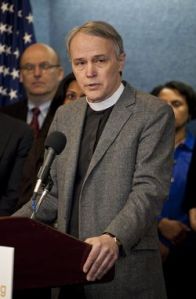
Fasting against Hunger

Mark Bittman, who wrote the Minimalist food column at the New York Times for more than a decade, announced last week that he was taking minimalism a step further, by not eating altogether.  Most of Bittman’s writing is about how to make meals quickly with limited ingredients.  In the last few years, however, he began to write occasionally about the politics of food, urging his readers to think about eating less food and less meat to improve their health and protect the environment.

But this is a new wrinkle in Bittman’s politics: he’s fasting to protest cuts in the federal budget that affect poor people.  He writes:

I stopped eating on Monday and joined around 4,000 other people in a fast to call attention to Congressional budget proposals that would make huge cuts in programs for the poor and hungry.

By doing so, I surprised myself; after all, I eat for a living. But the decision was easy after I spoke last week with David Beckmann, a reverend who is this year’s World Food Prize laureate. Our conversation turned, as so many about food do these days, to the poor.

Who are — once again — under attack, this time in the House budget bill, H.R. 1. The budget proposes cuts in the WIC program (which supports women, infants and children), in international food and health aid (18 million people would be immediately cut off from a much-needed food stream, and 4 million would lose access to malaria medicine) and in programs that aid farmers in underdeveloped countries. Food stamps are also being attacked, in the twisted “Welfare Reform 2011” bill. (There are other egregious maneuvers in H.R. 1, but I’m sticking to those related to food.)

David Beckmann, Bread for the World

Bittman is a writer and a cook, but not an organizer.  The fast that started last Monday was organized by David Beckmann (left), president of Bread for the World, Jim Wallis, of Sojourners, a progressive Christian group, and former Democratic Congressman, Tony Hall.  (Hall had conducted a fast for the same reasons in 1993 that stretched for 22 days.)  The organizers framed their fast in explicitly religious terms, offering a Gospel of social justice.  Beckmann explains:

I’m a Lutheran pastor, and I have not come across any biblical injunction against taxing the wealthy. Yet the Bible constantly reminds us to take care of the least of our brethren. If our representatives and senators are unwilling to listen to the needs of hungry and poor people, maybe they will listen to God.

Our prayer is simple: We invite God to reshape our personal priorities and the priorities of our nation, and we call on God to help us form a circle of protection around programs that are needed by the most vulnerable among us. Amen.

Fasting is a ritual of purification in many religions, but when the faithful make their actions public, and target policy demands as well as enlightenment, it becomes political.

Once the action started, others joined in, including Bittman.  Other religious groups joined, as did political groups.  By mid-week, Moveon.org, the Service Employees International Union, the Center for Community Change, ColorOfChange, Courage Campaign, Presente.org and CREDO. The fast became a vehicle for all sorts of people, with a variety of gripes with the proposed budget, to take action and try to push back against the efforts of Tea Party groups on the right.  Advocates for immigrants’ rights, gay and lesbian rights, and labor have used the campaign on behalf of poor people to link their own claims to a larger fight.

While the initiators staged full-on fasts, this is a difficult–and dangerous–commitment for most people to take on.  Supporting groups have urged their audiences to take more modest actions, like skipping a meal.  The more important thing, they argue, is to draw attention to the magnitude of the federal cuts.

The fast is an effort to change the focus of discussion from the federal deficit to the things that federal spending does–at least some of the things.

This isn’t so obvious or so easy.  At least some [e.g.] conservative pundits have ridiculed the fasters for protesting against modest cuts in total government spending, explicitly ignoring the specific programs the protesters want to save.

Next post is about fasting as a political strategy.

Posted in Uncategorized | Tagged , , , , | 2 Comments

A Smaller Tea Party

Rear view, tea party rally

Thursday’s Tea Party rally drew crowds described as “sparse,” with estimates clustering around 200 people.  Slate‘s David Weigel says that there were four reporters for every demonstrator, and that other journalists were poaching his interviews, trying to find someone to talk to.

This rally was all about the ongoing budget negotiations on Capitol Hill.  During the campaign, Republicans promised $100 billion in cuts, but some of them had second thoughts when they acknowledged they were working on only a portion of the year and that exempting defense, interest payments, Medicare, and Social Security left precious little to cut without antagonizing significant constituencies.  You may want to brag about cutting spending, but probably not cutting student loans or Head Start.  (You’d have to have 500 Corporations for Public Broadcasting to cut to get to $100 billion.)

The last Congress’s failure to pass a full year budget has virtually ensured that budget debates will dominate the political news for most of this year: continuing resolutions for this year sucking up time and space until legislators start work on next year’s budget.

Vice President Biden has engaged in negotiations with the Democratic and Republican leadership, and while the Democrats have agreed to cuts significant enough to rile up their own base, they’re not nearly enough for the base of the Tea Party.  Speaker Boehner wants to cut some kind of deal–and the Republicans have done well in negotiations–but is it enough for his own Republican party?  Failure to reach agreement means a government shut-down.

Thursday’s rally was a signal that the Tea Party stalwarts won’t be satisfied by a compromise.

But how strong a signal?  Turning out a crowd in mid-week on short notice is no easy matter under any circumstances, and it was cold and rainy;  the small crowd demonstrated considerable vigor.   Marin Cogan, at Politico, reports:

When Rep. Mike Pence (R-Ind.) told the protesters that “nobody wants the government to shut down, but if we don’t take a stand, we’re going to shut down the future of our children and grandchildren,” he was interrupted by a tea partier yelling, “Yes we do!”

Republicans in Congress face the difficult problem of balancing the demands of their most intense supporters with finding ways to appeal to the larger public they need to win elections.  (We assume, in addition, that elected officials have their own ideas about particular policies that might benefit the nation.)  The small intense crowd underscored the dilemma.

From 538.com

The Tea Party has never commanded majority support in public opinion polls, and as its advocates must take positions beyond opposing President Obama, its support has faltered and its opposition grown.  The figure on the left, from Nate Silver at the New York Times, shows these trends pretty clearly.

Thirty percent of the population is a large enough faction to pay close attention to–but so is the forty percent plus opposed to the Tea Party.  A government shut-down is unlikely to help the Tea Party gain support.  The Republican Party leadership has to want to hang tough in negotiations and still continue to cut deals.

But everyone doesn’t have the same interests.  Many members of the House of Representatives in particular come from safe districts, and have nothing to gain by reaching agreement with the Democrats.  Michele Bachmann (Minnesota) and Steve King (Iowa) were emphatic that letting the government shut down was far from the worst possible outcome–which would be continuing to spend.  They can get reelected and raise money nationally, appear on talk shows, and continue to serve the true believers.  Those concerned with either winning national elections or responsible governance are considerably less sanguine.

For the Tea Party activists, the larger question is how to employ the powerful, but very limited, support they have without overreaching.   At some point, calling for demonstrations that can draw only small crowds hurts more than it helps.

Posted in Uncategorized | Tagged , , , , | Leave a comment

Beck and Piven IV: Is Anyone Marginal Anymore?

We’ve got separate updates to report on Glenn Beck, pundit, and Frances Fox Piven, professor, that throw some light on the nature of American politics and culture.

Of course, we’ve covered some of the background on their disturbing and antagonistic relationship over the past few months (See Beck and Piven, I, II, III.):

Basically, Piven doesn’t like Beck and his politics and Beck thinks Piven is one of the nine people who most threatens American life.  Some of Piven’s fans disparage Beck, and some of Beck’s fans threaten Piven’s life.

Anyway, The New York Times reports that Glenn Beck may not stay with Fox News when his contract ends in December, and that he might start his own network.  Beck’s ratings have been falling, and some sponsors have refused to buy time during his television program regardless, not wanting to associate their brand with his politics and style. Fox might want to be rid of him.  (Of course, this may all be posturing on the eve of negotiations…)

Meanwhile, there’s no reason to believe that leaving Fox would cost Glenn Beck his close relationship with a substantial–and loyal–following.  Beck has been investing his time and money in his own media brand, buffing up web properties and his radio show, and selling subscriptions.  He doesn’t need mass media, and even the constraints of Fox, to reach a large audience profitably.  He won’t have fallen out of relevance.

Elsewhere, the New York State Senate passed a resolution honoring Frances Fox Piven.   State Senator Gustavo Rivera, a former student of Piven’s, introduced the resolution, partly in response to the attacks from Beck.  Senator Rivera said,

Studying under her, I came to a realization of what democracy really means. And I dare say that I wouldn’t be a State Senator today if it weren’t for the inspiration given to me by Frances Fox Piven.

Democratic government doesn’t work unless it bends to the will of the people. Government doesn’t work unless those like myself and my colleagues in the State Senate are prodded by the collective action of the people. Dr. Piven taught me that. If you look at the history of this country, progress has come when ordinary people have stood up and fought for their rights. The abolitionist movement, the women’s rights movement, the civil rights movement, anti-war movements, worker’s rights movements. And let us include in that list the right to life movement and the Tea Party movement. Whether you agree or disagree with the goals, you cannot ignore the fact that American democracy doesn’t work unless people challenge the powerful in both ways big and small.

But as accomplished as she is as a scholar, Dr. Piven is a better mentor to her students. Soon after I took that first class with her, I began my own college teaching career. And ever since, I have aspired to be the type of teacher in the classroom that Dr. Piven is.

I am honored to sponsor this resolution which recognizes a great teacher, a great scholar, a great New Yorker, and a great American, Dr. Frances Fox Piven.

You can see the action, legislative in this case, on youtube, and listen to other state senators who fondly recalled Piven as a teacher.  (For someone who teaches college students, like me, this is inspiring.)

Meanwhile, Piven, along with Cornell West, has been working to organize the kind of labor resistance that emerged in Wisconsin.  She hasn’t backed off her politics or her efforts in any way.

The two stories together suggest that the boundaries of politics and culture in America–if they exist at all–are extremely wide, and there’s room for widely disparate points of view and activities that can gain some elements of support from authorities of different sorts.  It remains to be seen, however, if there are any common standards of civility or evidence that might make debate possible.

Posted in Uncategorized | Leave a comment

Cesar Chavez Day

On my campus, we commemorated Cesar Chavez Day early, yesterday, rather than March 31 (his birthday), by closing.  The state established the holiday in 2000, and six other states have followed suit.  In California, the legislature calls upon public schools to develop appropriate curricula to teach about the farm labor movement in the United States, and particularly Chavez’s role in it.

A campaign to establish a national holiday has stalled so far (The Cesar Chavez National holiday website seems to have last been updated in 2008), but last year President Obama issued a proclamation announcing a day of commemoration, and calling upon all Americans “to observe this day with appropriate service, community, and education programs to honor Cesar Chavez’s enduring legacy.”

Political figures have many reasons for creating holidays, including remembering the past; identifying heroic models for the future; recognizing and cultivating a political constituency; and providing an occasion to appreciate a set of values.  Regardless of the original meaning, the holidays take on new meanings over time.  Columbus Day, for example, is celebrated as an occasion for pride in Italian Americans (e.g.), and commemorated and mourned as a symbol of genocide  and empire (e.g.).

Cesar Chavez’s life and work is well worth remembering and considering, particularly now.  His career as a crusader was far longer than that of Martin Luther King discussed (here and here) and he was far more of an organizer than Fred Korematsu (discussed here).  Chavez’s Medal of Freedom was awarded shortly after his death in 1993, by President Clinton, but many of his accomplishments were apparent well before then.

Dolores Huerta, 2009

As a young man, Chavez was an agricultural worker; by his mid-twenties, he became a civil rights organizer, working for the Community Service Organization in California.  With Dolores Huerta, in 1962 Chavez founded the National Farm Workers Association, which later became the United Farm Workers.  Focusing on poor, mostly Mexican-American workers, Chavez’s vision for activism was right at the cornerstone of racial and economic justice.  Establishing an organization, however, is a long way from winning recognition and bargaining rights as a union.

Chavez was a tactician, a public figure, a charismatic, and something of a mystic.  Modeling his efforts after Gandhi’s successful campaigns, Chavez was an emphatic practitioner of active nonviolence.  He employed boycotts, strikes, long fasts, demonstrations, long marches, and religious rhetoric in the service of his cause.  He also registered voters, lobbied, and worked in political campaigns.  He was a tireless and very effective organizer for most of his life.

But holidays are best celebrated with an eye to the future, rather than the past.

On Cesar Chavez Day this year, we can think about the large and growing Latino community in the United States.  The 2010 Census reports that Latinos now comprise roughly 1/6 of the American population, and more than 1/3 of the population in California. This is the youngest and fastest-growing population in America today, and they are severely underrepresented in the top levels of politics, education, and the economy.   The civil rights map is at least as complicated as at any time in American history, but not less important or urgent.  (The struggle about the DREAM Act is reminiscent of the debate about Voting Rights 45 years ago.)  The future of American Latinos is very much the future of America.

And Chavez saw the civil rights struggle as a labor campaign.  When Chavez and Huerta started their campaign, nearly one third of Americans were represented by unions.  The percentage now is now just about 10 percent, and less in the private sector.

And public sector workers, even if represented by unions aren’t doing so well.  The ongoing conflict in Wisconsin is all about weakening unions that are already making very large concessions on wages and pensions.  The campaign in Wisconsin is part of a larger national effort, which is playing out in Indiana, Ohio, Florida, and elsewhere.  Even in states where anti-union forces are weaker, state employees face lay-offs, wage cuts, and increased health and pension costs.  Importantly, we need to remember that you can’t attack teachers, nurses, police officers, and firefighters without hurting the people they serve: us.

Or should I say, US?

Cesar Chavez’s birthday is an opportune time for thinking about Latinos, civil rights, and American labor, and not just the start of Spring.

Posted in Uncategorized | Tagged , , , , , , , | 2 Comments

Tipping Points and a “No Fly Zone” in Libya

The Arab Spring has played out differently in each country in which it appeared, largely a function of just who is willing to defect from supporting the regime and throw in with the dissidents.  In Egypt, the military was willing to cut off President Mubarak, such that he really had no viable alternative but leaving power.

When the military moves to opposition side of the see-saw, it makes it safer for others to join in the opposition, and somewhat harder for a more diverse opposition to define consensual objectives.  In any situation, there are some people who are so committed to one position or another that there’s little calculation about what’s most likely or most safe–but in a revolutionary situation, they comprise a small share of those who are active.

Unlike the see-saw, the fulcrum of protest politics can move, and tipping points, as we’ve said, can tip back the other way.

Others make judgments about how safe protest (or support for an embattled regime) is, and how likely political change is.  Every decision can influence the decisions of others: it seems safer to go out into the streets when others are out there; it’s less risky to defect from the regime when you’re not alone–and you think the regime is unlikely to last anyway.  And judgments are subject to revision.

And in Libya: Once a coalition of military powers starts military action, justified with relatively broad and vaguely defined aims, Col. Muammar el-Qaddafi’s political survival appears less and less likely.  Western politicians have been heavy-handed in warning others in the regime that they will face consequences when the regime falls, trying to hasten that process by promoting defection. Words, intelligence, money, and military aid all work to tip the balance.  And, obviously, some things matter more.

Dissidents who were vocal some weeks ago, quieted when Qaddafi’s forces made military gains, but they’re starting to talk again.  Most media reports in the US still disguise the voices of opponents who are interviewed, but that will also change in time, if people become more convinced that Qaddafi will fall.  The military intervention is a heavy thumb on one side of the political balance, and as that balance shifts, more factions will join the regime’s opponents.

At the same time, Qadaffi himself, apparently with few allies in the Arab world and no visible prospects for a safe exit, can see little choice but to hunker down and make his fall as difficult and costly as possible.  He can end the conflict by leaving power (as Secretary Clinton says), but where can he go?  It’s unlikely that he, unlike President Mubarak, can live out his days in comfort in one of his palaces in Libya.  Somewhere, someone in the opposition is trying to find and sell a safe exit strategy to the dictator, but it’s got to be a tough sell.

Posted in Uncategorized | Tagged , , , | Leave a comment

Where’s the Peace Movement: The Problem of Urgency, Exhibit B

Antiwar activists have had a hard time agreeing on goals and strategies and commanding public attention.  This is striking, particularly when President Obama has just engaged American military forces in action in Libya, while the wars continue in Iraq and Afghanistan.

Of course, the wars in Afghanistan and Iraq are allegedly winding down, or at least American participation is supposed to be–even though tens of thousands of American troops figure to be deployed for years to come.  And the intervention in Libya is under the auspices of an international commitment to defend civilians against a truly horrible dictator, who has promised to fight down to the blood of the last Libyan.

President Obama’s expressed commitments to end the wars (even if belied by his actions) and to intervene only with international support have made it more difficult for peace activists to hang a target on him.

Consider the case of Bradley Manning, an enlisted intelligence analyst in the Army who apparently leaked more than 200,000

Bradley Manning

documents to Wikileaks.  Manning has been in prison for nearly a year under very harsh conditions.

On Sunday, an estimated 400 people demonstrated outside the Marine base at Quantico, Virginia, where Manning is being held.  More than thirty people were arrested for staging an impromptu sit-in in the middle of the road after the demonstration was supposed to end.  They were frustrated that police were preventing them from placing flowers on an Iwo Jima memorial in honor of Manning.  The arrested included Daniel Ellsberg, who four decades earlier, leaked the Pentagon Papers.  (There was a sympathy demonstration outside the US embassy in London.)

Ellsberg has compared Manning to himself, a young and confused man who leaked documents to expose malevolent and anti-democratic policies, and compared the government’s treatment of Manning to the harassment he faced.  These are disputable points; see the commentary by first amendment lawyer, Floyd Abrams, who represented the New York Times in the Pentagon Papers case.

For the moment, the striking thing is that the pro-Manning demonstrations got limited support from some of the largest anti-war groups.  Code Pink and International Answer supported the demonstrators–and Manning’s cause, but it’s been a lower priority for other groups.

The peace movement in the United States has always included people who opposed war in general and/or America’s role in the world, and others who questioned the morality and wisdom of particular wars.  Manning is a problematic poster child for a movement that wants to reach that latter group, and to put its focus on the wars.

But the antiwar movements have had a difficult time finding any other focus that commands large scale public attention and activism.

Posted in Uncategorized | Tagged , | Leave a comment

GLBT Fundraising Falters: The Problem of Urgency, Exhibit A

It was a good year for the gay and lesbian movement.  The last few years have included policy victories: the end of Don’t Ask Don’t Tell in the military, a few favorable court decisions, and the institution of same sex marriage in several states.  The Obama administration has declined to defend the Defense of Marriage Act in a federal court, and the issue of same sex marriage will surely reach the Supreme Court in the next year or two.

Perhaps even more significantly, the world is changing: as support for gay marriage grows across the population, it is becoming so accepted among younger people that it’s almost not an issue.  This is true among liberals and conservatives, Republicans and Democrats.

Note, for example, young Barbara Bush’s video for marriage equality in New York, in addition to Megan McCain’s somewhat longer term support for the issue.  McCain, at least, wants to make the Republican Party a more hospitable place for gays and lesbians, and even more, for younger people.

The tides of history certainly seem to be moving for gay and lesbian equality in America–and world-wide.  This doesn’t mean, of course, that the movement has won or that there won’t be significant setbacks over the next few years.  Even if our reading of the tides is right, there are plenty of cross-currents, riptides, and eddies along the way.

Here’s the challenge:  As the movement seems to be winning, its core organizations are having a harder time in raising money.  According to Shawn Zeller (Congress.org):

From 2008 to 2009, 39 of the largest groups saw their revenues fall on average by 20 percent, from a combined $202.7 million in 2008 to $161.3 million in 2009. That level of funding didn’t even cover expenses, falling short by $4.3 million.

The numbers were compiled by the Movement Advancement Project, a Denver-based think tank, and this is the first time such a tally has been released publicly.

Final revenue figures for last year are not yet available, but the report says the 39 groups responded to a bad 2009 by slashing their budgets last year to $135.4 million, 21 percent lower than in 2008. Among the groups participating in the survey were stalwarts of the gay rights movement such as the Human Rights Campaign and the National Gay and Lesbian Task Force.

“The revenue drop reflects two things: the economic climate and some frustration at the pace of change in 2009,” says Ineke Mushovic, the Movement Advancement Project’s executive director. She expects that the burst of policy gains in late 2010 and early 2011, combined with a recovering economy, may create a better picture when the report is next updated.

I’m only halfway convinced by this analysis.  The faltering economy, to be sure, puts a strain on donors, and all sorts of political and charitable organizations suffered through the recession–and beyond.

But it’s more than that: people are most likely to give of their time and money when they see an issue as particularly urgent or promising.  Paradoxically, the great progress the gay and lesbian movement has made over the past few years undermines the feeling of necessity for many donors.

Of course, some large (and small) donors make long term commitments to particular causes.  But many people drift in and out of movements, depending upon personal and political circumstances.  People who saw glbt issues as most pressing three years ago may now see reproductive rights, education reform, nuclear power, or health care as more urgent at the moment, and direct their discretionary $30 or $100 accordingly.

Environmentalists do best when the administration is hostile to their cause.  Abortion rights and anti-abortion activists wait outside the Court for every decision, ready to announce defeats and urgent threats to stoke their supporters.  And the anti-deficit crowd got much more crowded and active when a Democrat took office.  (It’s not that President Bush governed as a fiscal conservative; rather, he just wasn’t as threatening an image to their supporters as President Obama.)

Organizations face the dilemma of claiming credit for their victories in such a way that it still seems absolutely urgent to keep supporters tuned in, ready to turn out, and to open their wallets.

Posted in Uncategorized | Tagged , , | Leave a comment

Global Antinuclear Revival

No nuclear plant outside Japan is less safe today than it was before the horrific earthquake/tsunami combination that unleashed an unfolding nuclear nightmare in Japan.

Antinuclear activists protest in Germany

But the accidents in Japan underscore the risks of planning only for crises that might occur every one hundred years.  An earthquake that registers 9.0 on the Richter scale is an exceedingly rare event–the largest quake to hit Japan since such things have been monitored.  We can understand why a politician or bureaucrat would balance the promise of nuclear power against a relatively small risk–particularly in the limited time frames of an electoral cycle, tenure in office, or even a life.

Until the rare event takes place.

Antinuclear activists elsewhere in the world aren’t waiting for their own domestic disasters.  The reactor accidents in Japan have underscored the urgency of those who are already committed, and bolstered their chances of reaching people who were less convinced that nuclear safety was the critical issue to engage.

Turkish activists protest against nuclear power

Protest campaigns have percolated up around the world, including Belarus, which plans to purchase its first nuclear reactor since the Chernobyl accident (when it was part of the Soviet Union), France (which gets roughly 3/4 of its electricity from nuclear plants), IndiaIndonesia, Spain, Taiwan, Thailand, and Turkey.

Thus far, the protests have been the largest in Germany (see video), which has a long history of antinuclear activism, and a government that has been compelled to respond to the activists.

The protests aren’t spontaneous; they’ve been organized by groups that have been trying to organize and mobilize for years.  Suddenly, however, their message started coming across more powerfully.

It’s not that the antinuclear activists have changed their rhetoric or tactics, so much as that a critical event has suddenly added exclamation points, amplification, and credibility, to everything they say.  Like the umbrella salesman working on a busy city street, circumstances outside his control have a great deal to do with how he’ll do.

Transnational groups, like Greenpeace, will support, and more importantly, publicize, activism everywhere, and activists will take their cues from each other.

Posted in Uncategorized | Tagged , , , , , | Leave a comment

Out of the (Sesame) Street and into the Capitol

The Sesame Street cast and crew appeared in Washington DC yesterday, to lobby against cuts to the Corporation for Public Broadcasting. The House has already voted to zero out the appropriation, which totals about $420 million dollars.

Although that’s a lot of money for most of us, in the scope of the federal budget (and deficit), it’s not quite even rounding error.  And let me confess: I love Sesame Street.  No parent who has spent much time on the sofa watching children’s tv would suggest that the private sector (e.g., Nickelodeon, Disney, Cartoon Network) offers programming comparable to what’s found on PBS.  (Favorites in my house have included Sesame Street, Between the Lions, Arthur, and Fetch with Ruff Ruffman.)

Grover, Maria, Gabby, Luis, Oscar, Joan Ganz Cooney, Elmo, Susan, and Gordon

Most of the media coverage has, to date, focused on National Public Radio which, critics claim, is leftist.  The only specific examples I’ve seen cited are the controversial James O’Keefe tape (which has been taken apart on Glenn Beck’s website, The Blaze, and discussed here) and the firing of Juan Williams, but the bias charge has remained largely unchallenged (see On the Media’s take).

When Elmo and his neighbors leave Sesame Street to lobby in Washington, they are trying to offer an alternative image of public broadcasting.  They are also using their celebrity, and the residual goodwill surrounding their public image, to build support for public broadcasting. Although I doubt that Sesame Street’s prime audience, preschoolers, is paying much attention to the debate on Capitol Hill, but some of their parents and grandparents are.

Arthur and the executives

Posted in Uncategorized | Tagged , , | 1 Comment

Nuclear Power and Protest

The continuing disaster in Japan hasn’t closed the nuclear debate in the United States, even as many national political figures, including President Barack Obama, have been trying to invigorate the nuclear power industry.

This is a social movement story.

In the United States, opposition to nuclear power grew in the the 1970s, expressed mostly through local campaigns directed against new nuclear power plants.  The vital core of these campaigns was the Union of Concerned Scientists, which started in 1969 as a group of MIT faculty and students opposed to the war in Vietnam.

Activists who had cut their teeth in the antiwar movement burrowed into local politics, organizing antinuclear campaigns across the country.  Their issues were the same ones we point to 40 years later; they worried about the safety and cost of nuclear plants, about spoiling the environment even if nothing went wrong, and about disposing of nuclear waste.  They also worried about the connection between nuclear power and nuclear weapons, warning about the proliferation of nuclear weaponry.

Activists engaged in large and small demonstrations and civil disobedience actions, most memorably at the site of a planned reactor in Seabrook, New Hampshire (Clamshell Alliance) and San Luis Obispo, California (Abalone Alliance), and an operating plant at Rocky Flats, Colorado, which made weapons material.

A larger movement grew to coordinate these efforts and make claims nationally.  Activists planned to conduct a large demonstration in Washington, DC in May of 1979, and the reactor accident at Three Mile Island boosted the turnout, the urgency of their efforts, and the attention they got.  In the fall, Musicians United for Safe Energy [MUSE] (including Crosby, Stills, Nash, and Young, Bonnie Raitt, Jackson Browne, and Bruce Springsteen) held a series of “No Nukes” concerts in New York City to raise money (and visibility) for the movement, producing a record album (on vinyl!) and a movie in the process.  The same year, Jack Lemmon, Jane Fonda, and Michael Douglas starred in The China Syndrome, a thriller about a corporate cover-up of a nuclear accident, a movie that circumstances made perhaps more popular than its artistic merit might have warranted.

While activists didn’t exactly win–some, but not all, of the plants they protested were ultimately built–they pushed the federal government to work harder to ensure reactor safety, with more formalized approval processes and safety regulation.  All of this drove up the costs of building new plants–as did the protests.  It was harder and harder to make the new numbers work, even with large federal subsidies.

No new nuclear plant has been licensed in the United States since the reactor accident at Three Mile Island, in Pennsylvania.

Older, likely less safe, plants continue to operate across the country.  [The San Onofre plant (left), not far from here, sits next to a popular surf spot.  Waiting for waves, surfers sometimes joke about warm currents.]  The United States generates about 20 percent of its energy with nuclear plants–less than Japan, and much less than France.

This isn’t the outcome that anyone wanted.  The industry had far more ambitious plans for nuclear power in the United States, while activists wanted to shut down the more dangerous plants already operating.  Stalemate isn’t the same as satisfaction.

As the nuclear power stand-off took hold, many activists and organizations shifted their efforts to campaigns against nuclear weapons (President Ronald Reagan helped with this shift).

Some people, increasingly concerned with climate change, supported a shift to new (ostensibly safer) nuclear plants–which don’t generate greenhouse gases.  This includes President Obama–but not Al Gore, who reiterates the concerns raised by scruffy activists outside plant gates 35 years earlier (full disclosure: sometimes, including me).

John Hall, the lead singer and songwriter of Orleans, who had organized MUSE and the No Nuke concerts, and written the (insipid) antinuclear anthem, Power (clip), got into politics.  Elected to Congress from upstate New York in 2006, he was one of the Democratic casualties in 2010.

David Weigel reports that supporters of nuclear power in industry and government haven’t backed off that support in the wake of the unfolding accidents in Japan, but they acknowledge that their efforts will be even more difficult in the future.

After all, no one thinks that the Japanese would be less attentive to the dangers of nuclear power, less careful in construction, and less prepared to handle accidents than Americans (see Anne Applebaum‘s discussion.).  (Compare the response to the accidents in Japan, where stockpiles of iodine were available for immediate distribution, to the American response to Hurricane Katrina which, horrifyingly, was a smaller disaster.)

Posted in Uncategorized | 4 Comments