The Egyptian Revolution: Tipping Points Tip Both Ways

When Egyptian President Hosni Mubarak promised to stay out of the next election, for the moment anticipated in the fall, he figured to change the balance of power in the streets.  Knowing that Mubarak was ostensibly committed to leave office, people out in the streets are recalculating how urgent their grievances are.  Military officers who promised not to fire on peaceful protesters are now telling the crowds to go home, while Mubarak supporters are trying to take to the streets themselves.

Mubarak’s promise to leave office plays out differently for the people who have been agitating for his departure.  While some factions see his promise to depart in September as far too little (and too unreliable), and want to escalate their efforts to get him out–now.  Others see his promised exit from the national stage as the opportunity to plan a transition and focus on what kind of regime replaces him.  For the moment, Mubarak’s commitment not to run presents the opposition coalition with a dilemma about what to do next.

At the moment, the commitments of the political elite and the military are completely unclear, and they will certainly matter.  While the military stands back, Mubarak supporters and opponents have been fighting in the streets, threatening to undermine any hope of a peaceful transition.  The mobilization of Mubarak supporters will make it harder and harder for Army officers to postpone their decisions about which side to tip.

Meantime, authorities and dissidents throughout the Arab world are watching and planning their own efforts.  Ali Abdullah Saleh, President of Yemen, has promised that he will leave office in 2013, and that his son will not try to succeed him.  Such reforms are intended to take the wind out of at least some of the sails that are tacking against the regime, making it possible to govern–and to repress some critics.

Authoritarian leaders in the Middle East are surely trying to figure out how to avoid the unfolding (but unwanted) fates of Mubarak and Saleh.  Reforms as concessions are one strategy; another is repression.  These are not mutually exclusive.

Posted in Uncategorized | Tagged , , , , | Leave a comment

Korematsu Day: The Politics of Vindication

Korematsu Day

Today Californians celebrate the first Fred Korematsu Day of Civil Liberties and the Constitution.  Represented by the American Civil Liberties Union, Korematsu challenged the constitutionality of relocating and interning Japanese Americans during World War II.  Three Supreme Court Justices agreed with him; six did not, finding that the emergency of a World War justified allowing Congress to put civil liberties on the back burner (Korematsu v. US, 1944).

Korematsu’s challenge exacerbated rifts within the Japanese American community; large organizations like the Japanese American Citizen’s League were eager to prove their patriotism by cooperating with internment.

Maybe the arc of history really does bend toward justice; it’s certainly long.  In 1980, President Jimmy Carter established a commission to investigate the internment of Japanese Americans during the war; in 1983, Korematsu’s conviction was vacated.   In 1988, Congress apologized to the Japanese Americans for the internment, and the government paid (modest) compensation to those interned.  In 1998, President Clinton awarded Korematsu the Presidential Medal of Freedom.  More than fifty years later, we recognized courage and heroism in what we first saw as a crime.

We should derive more benefit from the vindication of Fred Korematsu more than he did.  To do so, we need to draw lessons from the cause and the case that extend beyond Japanese Americans in World War II.  This means, I think, paying close attention to discrimination on the basis of race justified by appeals to national security.

We should tell Fred Korematsu’s story in New York City, where the construction of an Islamic Center in lower Manhattan draws opposition.  We should recall the history in Arizona, when the state passes a law mandating that police demand proof of citizenship from people who look like they might be undocumented.

And we should all think about how people learn.  California Attorney General Earl Warren pressed for interning Japanese Americans immediately after Pearl Harbor, arguing that their presence in California represented a threat to civilian defense.  Thirteen years later, as Chief Justice of the US Supreme Court, Warren organized the Court to issue unanimous decisions prohibiting racial segregation in the public schools.  I want to think he learned from the past, including his own past.

Apparently, one of the justices Earl Warren had to persuade was Robert Jackson, one of the three dissenters in Korematsu.  In dissent, Jackson wrote:

But once a judicial opinion rationalizes such an order to show that it conforms to the Constitution, or rather rationalizes the Constitution to show that the Constitution sanctions such an order, the Court for all time has validated the principle of racial discrimination in criminal procedure and of transplanting American citizens. The principle then lies about like a loaded weapon, ready for the hand of any authority that can bring forward a plausible claim of an urgent need.

Justice Jackson took a leave of absence from the Court to serve as as the chief US prosecutor during the Nuremberg war crimes trials, putting him in a very good position to think about a government’s use of race politics as a means of mobilization during moments of crisis.

Perhaps Korematsu Day will be an occasion for fireworks and picnics one day.  Today, it seems like a good time for reflection.

Posted in Uncategorized | Tagged , , | Leave a comment

Tunisia, Egypt, and Revolutions

Like most everyone else, I’ve been transfixed by the historic revolutionary efforts that may be sweeping the Arab world.  Most of the little I know about Tunisia

Tunisian protests, 2011

and Egypt, I’ve learned in the past few days, but there are general patterns in the long history of successful and unsuccessful revolutionary movements that help to understand what’s going on.

Revolutions are about coalitions.  They succeed when people who care about overthrowing the government more than anything else in the world are able to mobilize and unite with people who care about lots of other things.  The zealots are important, to be sure, but you’ll get a better sense of how things will turn out by watching those who are not normally committed to revolutionary change.

Evey day when we wake up, we decide how to spend the day.  Mostly, there’s not a lot of agonizing about big changes on food, work, family–and the state of the government, for most of us, is off far in the distance.   Yesterday’s decisions create momentum; the world around us creates constraints and change is always risky.

Risk is relative: not going to work might lose you your job; the other donut shop might not be so good; opposing the government could get you killed.  Obviously, this depends upon context, and upon your position in the world.

Most people take to protest when they believe that there is an urgent problem, that change is possible, and that their efforts might matter.  Each day’s news can change how we think about urgency, possibility, and our own potential efficacy.

A few brave and committed people–and a few crazy people–care less about whether their efforts will be effective than about living up to their values.  These are people who are willing to starve or burn themselves to make their lives their arguments, hoping to inspire others.  Most of us, however, think about tomorrow as well, and are more likely to take action when we think it’s a little less risky or a little more likely to be effective.  Or, they come to a judgment that whatever the risks, inaction is now impossible.

We watch for signals from others about their prospects and their judgments.  These signals affect our judgments, and whether insurgents protest, whether loyalists defect, and whether passersby get involved altogether.  Signals spur others to actions which send signals to others, creating cascades of action, and ostensibly stable regimes fall or powerful insurgencies falter.  Everyone figures out who they can trust–and how much.  Dissidents decide whether they’ll be alone or with friends when they take to the streets.  Generals calculate whether they are more likely to keep their commands–or even their lives–with loyalty or defection.

So, when masses of people took to the streets in the Philippines to protest President

Corazon Aquino and the People Power Revolution, 1986

Ferdinand Marcos’s claim to have won re-election, Marcos decided that he could not count on the Army to defend him.  US Senator Paul Laxalt, speaking on behalf of President Reagan, told him that he couldn’t count on the United States either.  Marcos left for Hawaii, and the insurgents claimed the state.

Likewise, across Eastern Europe in 1989, state Communist governments learned that they could not count on their own armies, nor on the Soviet Union, to repress dissent.

Romanian revolution, 1989

Dissidents learned as well, and flocked to the streets.  Mainstream political figures defected.  In some countries, like Hungary, the lessons were quickly learned and the transitions non-violent.  Watching the Soviets stay out warned the ruling authorities and emboldened the opposition.  In other countries, like Romania, there were dramatic moments of truth when the military refused orders to put down the rebellions.

Tanks in Tiananmen Square, 1989

And sometimes governments facing insurgencies can find loyal bureaucrats and soldiers willing to fire on their countrymen.  Democracy activists in Tiananmen Square in 1989 didn’t anticipate that the government would be willing and able to successfully mobilize the military against them.  They guessed wrong.

When governments respond to dissent with reforms hope to break a movement coalition, bringing some opponents the prospects of political influence, and making it possible to repress or ignore others.   Well-crafted reforms can lower the urgency of protest, but reforms can also lower the risks of taking to the streets.

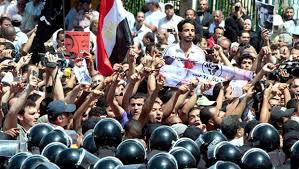
At this writing, Egyptian elites with grievances, including Nobel-prize winner, Mohamed ElBaradei, have lined themselves up with the people in the streets–vigorously.  The risks of doing so appear much smaller as the regime’s weakness is exposed, and the risks of not doing so, as the numbers in the streets increase, seem greater and greater.

At the same time, Egypt’s President Mubarak is throwing his Cabinet over the side, hoping to offer enough in the way of reforms to get at least some of the people out in the streets to go home–or into government.  (If press reports are accurate, the Obama administration is
Egyptian protests, 2011

encouraging him, privately and publicly, to do exactly this.)  The promise is that the dictatorship of the past three decades will end, but not just yet, and not this way.  The question is whether this reform is just too little and too late.

And the news of the revolutionary movements in Tunisia and Egypt has spread across the Arab world, encouraging authorities, dissidents, and bystanders to make new judgments about what’s possible.

Posted in Uncategorized | Tagged , , , , , , , , | Leave a comment

Beck and Piven, II

The ballad of the pundit and the professor continues to add verses as the story of Glenn Beck’s demonization of Frances Fox Piven hit the blogs, professional and activist networks and mass media.  It raises interesting questions about what a vigorous and honest political debate could look like.

As we’ve discussed recently, Beck has pointed to two of Piven’s articles, published forty-five years apart, to identify her as a great enemy of the Constitution and America more generally.  This new exposure has led to a rash of electronic insults, and scarier: detailed threats on her life.

Many of the mainstream reports have noted Piven’s age, as if to emphasize Beck’s hyperbole.  And she is, after all, a professor, so get a grip, such reports suggest.

Academics and others have called Beck out on tone.  An online petition directed to Fox News head, Roger Ailes, demands that the network rein Beck inThe American Sociological Association issued a statement with a similar appeal, although (thankfully) not emphasizing her age.  The academics call for a better informed and more civil debate.  (Of course, this isn’t the strong suit of cable news programming.)

Meanwhile, some conservatives have pitched in on another side, agreeing that she’s really awful, and her supporters are too.  Ron Radosh, a conservative historian, remarks with snark:

The editors of the leftist magazine The Nation, where Piven’s writings have appeared consistently since the 1960s, call her “distinguished professor, legendary activist, writer and longtime contributor to this magazine.” The last characterization is the only correct one, although, I’m sure she is “legendary” in their circles.

But this is nonsense.  “Distinguished professor” is Piven’s job title at the City University of New York.  “Distinguished” is surely a fair adjective anyway for someone who has been elected Vice President of the American Political Science Association and President of the American Sociological Association, and someone who has published many articles and books is certainly a writer.  C’mon.  The ad hominem (ad feminem?) stuff is ridiculous.

In the old days of network news, anchors and networks sought mass audiences, and policed themselves rhetorically for fear of alienating a large segment of the market.

The economics of cable are completely different.  Beck can make a lot of money for Fox News and for himself by serving an audience of around 3 million–a tiny fraction of the American public.  There’s no fiscal reason to temper the rhetoric–and every incentive to steer away from an informed discussion (bor-ring!).  Going after Piven (or random and marginal bloggers, as Bill O’Reilly often does) is a way for Beck to lean into his most aggrieved polemics without worrying that his audience might have an alternate understanding of the target.  And working politicians and commentators with other media outlets can get a lot of attention for themselves when they hit back.  In this way, his recurrent attacks on Woodrow Wilson–a former president of the American Political Science Association, as well as the United States, make a lot of sense.  Wilson is, uh, dead.

An academic, even a visible and prolific one like Piven, starts with access to a much smaller audience.  Beck enjoys the freedom to define her mostly unchallenged.

But do we want to shut down a debate on Professor Piven’s work in general or on her recent writing on the politics of unemployment? Piven has been trying to influence public debate and public policy for the better part of the last fifty years, at least.  Getting broad discussion–even vigorous argument about–and arguing about–the ideas she advances–is what she’s been after.  And, as they say in Boston, politics ain’t beanbag.

Mostly, however, the politics has dropped out of the discussion, and this is actually far more interesting and important than the bullying blowhard versus the pedantic professor.

The unemployed march in Minneapolis, 1934

Barbara Ehrenreich tries to bring back the issues in a piece in the LA Times, asking why it’s okay to call people into the streets to protect gun rights and the extraordinarily expensive hybrid health care system in the US, but not to advocate for policies that promote employment.

I’m going to be waiting on the answer to this one.

Posted in Uncategorized | Tagged , , , , , , | 2 Comments

Roe v. Wade commemorations

Visitors to Washington, DC can choose either an anti-abortion or abortion rights demonstration this week.

The March for Life started with a rally on the

National Mall, then activists marched to the Supreme Court to protest Roe v. Wade, praying for the health of the justices.  Abortion rights activists started at the Court, and sponsored sympathy demonstrations around the country; they also prayed for the health of the justices.

Thirty-eight years ago the US Supreme Court announced its  Roe decision, establishing a Constitutional right for women to have access to legal abortion s, and finally resolving an issue that had become increasingly contested in the previous decade.  Uh, not quite.

Roe nationalized the abortion debate, and within a few years abortion politics became a critical issue in party politics, mobilizing new activism and demonstrating–and exacerbating–deep divisions in American life. Anti-abortion and abortion rights activists stoked increased interest in existing political organizations, established new movement groups, and mobilized several new generations of activists on the issue.  Politicians have played to one side or the other, often emphasizing the threat represented by their opponents.  The politics of abortion access are more contested in the United States than anywhere else in the world.

And every year, on the anniversary of the decision, activists on both sides assemble by the Court, in varying numbers and varying degrees of civility.  It’s an opportunity for a show of strength, a chance to demonstrate commitment and resolve, and an event to organize and fundraise around.

It’s hard to remember that Roe didn’t generate wide interest in 1973, especially as it’s become the rhetorical and political centerpiece for both sides in the abortion battle.  But changes in national politics made abortion a valuable issue for activists and politicians.  Fundraising and electoral reforms meant that individual candidates gained increasing responsibility to do their own fundraising, cobbling together issues that had traction in the body politic.  Jimmy Carter first demonstrated the value of evangelicals of a political constituency in campaign leading up to his election in 1976, and Ronald Reagan played to that constituency far more effectively in his 1980 campaign.

In the meantime, the anniversary of the decision became an unavoidable event for activist organizations.  The commemorations, of course, generate far more attention each year than the decision did in 1973.  When anti-abortion activists started the commemorations, abortion rights activists responded by putting their side in the streets–and in the news–as well.  Now, locked in a perverse symbiotic stalemate, neither side can give up and cede the day–and the battle–to its opponents.  Looking at the other side each year, sometimes across barricades, sometimes in the news, inspires activists to keep up their efforts, including going to meetings, attending events, and sending money.

The March for Life organizes its efforts around this demonstration every year, doing a little better when there’s a Democratic president committed to abortion rights.  A coalition of women’s and reproductive rights groups organizes in support of the decision, doing a little better when Republican presidents work to erode abortion rights.

Of course, each side mobilizes throughout much of the rest of the year, outside clinics, in state electoral campaigns, and particularly when there’s a vacancy on the Supreme Court.  But the Roe anniversary is the most predictable moment each year when you know that the other side and the mass media will be watching.

Here I predict there will be large demonstrations on both sides next year as well.

Posted in Uncategorized | Tagged , , , , | 1 Comment

Beck and Piven

Glenn Beck has spent a lot of air time over the past year attacking Frances Fox Piven, a distinguished professor of political science at the City University of New York.  Beck’s spotlight has brought Piven to the attention of a larger–and different–audience than she normally reaches: Fox viewers.  Some small fraction of those who have heard Beck describe her as a threat to the Constitution have responded by issuing death threats.

Full Disclosure: I know Piven, not that well, but certainly much better than I know Beck.  I’ve also read much more of her writing than his.  In my, rather limited, experience, I’ve found Frances to be smart, committed, unfailingly gracious, and extremely kind.  Many years ago, when I was finishing my first year of graduate school, she took the time to meet with me and give me some very good advice about academia–which I (foolishly) ignored.  Over the years, we’ve occasionally appeared together on panels at sociology or political science meetings, and have disagreed about how movements work.  What I’ve seen is her keen interest in engaging with people who disagree with her, as if she might learn (and/or teach) something through civil dialogue with people who have a different understanding of the world.  It’s an old model of academia, one that is terribly attractive.  I’ve also heard her praise the engagement of conservative academics who likely agreed with her on little beyond this model.

And I’ve always admired Piven’s willingness to take her ideas seriously enough to work with the activists she writes about.  Unlike Glenn Beck, she’s appeared before all kinds of audiences without demanding large payments, and–to my knowledge–doesn’t travel with a paid security detail–as Beck does.

For more than a year, Beck has periodically described Piven’s work (much of it with Richard Cloward, her husband, who died nearly ten years ago), as an effort to bring down American capitalism in the service of a vision of “social justice.”  [In Glenn Beck’s world, “social justice” is less a moral and political aspiration than codes words for a totalitarian state.]  You can find Fox transcripts of some samples here and here.

In real life, Piven’s work has mostly been concerned with the politics of poor people.  Her argument: government doesn’t do anything for the disadvantaged unless they represent a political threat to governing coalitions.  She’s promoted activism in general and voter registration in particular, because when poor people have the potential of making a political difference to someone, she thinks they’re more likely to get attention when policies are made.  This idea, that squeaky wheels are more likely to get greased, is hardly that radical.  It makes sense to me, and is surely one reason that Glenn Beck organized a rally at the Lincoln Memorial last year.

Piven and Cloward have had more moments of political influence than almost all other political science and sociology professors, but there haven’t been that many of them.  Cloward briefed Attorney General Robert Kennedy on juvenile delinquency in the early 1960s, inspiring some of the programs that became the War on Poverty.  Piven worked hard–and effectively–to get the Motor Voter Bill passed in 1993, which allowed people to register to vote when they were receiving government services.

It’s hard to see comparable influence in the last decade and a half, a period that’s included President Clinton’s welfare reform, President Bush’s efforts to privatize Social Security, and President Obama’s trade and business oriented efforts to address the recession and the deficit.

I don’t know whether there is more than a media strategy in Beck’s attacks on Piven, whether he intends to discredit other political figures by implication, or whether this just makes for good tv.

But words matter.  Even though the overwhelming majority of Beck’s viewers know that his rhetoric of threat is theater, he knows that there are always people on the periphery who take things more seriously.  The larger and more diverse your audience is, the  more you have to think about how your message comes across. (Really:  While most of Bill O’Reilly’s viewers may have seen his “Tiller-baby killer” diatribes as rooted in a clever rhyme, at least one took it seriously enough to murder a doctor at church services.  I can’t imagine the language doesn’t haunt the speaker, years later, at odd moments late at night.)

In our current moment of ostensibly searching for civility, targeting a Professor Piven seems particularly ill-conceived.

Of course, it’s now all over the news and the web, with both charges and countercharges circulating, with more–and far less-civility.

Peter Dreier posted an excellent summary of Beck’s reports on two of her articles–and the actual content of those articles–at Huffington Post, as well as a disturbing collection of the threats she’s received.

And you can see a range of reports: here, here, here, here, here, and here.

Posted in Uncategorized | Tagged , , , , , | 1 Comment

House Repeals Health Care (Symbolically)

The new Republican majority in the House of Representatives voted to repeal President Obama’s health care reforms, which have just begun to come into effect.  It was a big victory for the Republicans and the Tea Party, but it’s unlikely to move any further through the legislative process.  The Democratic Senate leadership is extremely unlikely to let the bill come to a vote, and President Obama would surely veto it if it somehow did.

The Republican leadership in the House is well aware of this, which made wrangling the votes for a repeal, as a symbolic statement, much easier to do.  It also gives the Republicans an issue for the 2012 elections and delivers something to the Tea Partiers who were so strong in opposition to Obama’s health care policies.

Does it matter?  Sort of, maybe.

Nearly thirty years ago, in 1982 the nuclear freeze movement pushed the Democratic Party to large gains in the House of Representatives, responding to what activists described as President Reagan’s egregious departures from previous mainstream policies on national security.  Reagan had increased military spending dramatically–much of it on big ticket nuclear weapons systems, spoke casually about nuclear wars, and denigrated the arms control process.

[I wrote a dissertation and a book on this.  Alas, you can read much much more.]

The freeze was far more popular than the Tea Party, and much easier to link to concrete policy demands.  A call to end the technological arms race–bilaterally–it consistently polled upwards of 70 percent support among the general public, was the stick activists use to attack President Reagan on defense policy and much else.

The larger Democratic majority in the House passed the nuclear freeze in May, and the proposal never came close to the floor in the Senate.  [Knowing that this would happen, House Democrats who were dubious about the freeze as policy could vote for it and then vote for contradictory policies.]

President Reagan responded, however, first rhetorically; he learned the sentence, “nuclear war cannot be won and must not be fought,” and delivered it effectively and frequently.  He then sought to reopen arms control negotiations with the Soviet Union.  By the time he ran for reelection in 1984–against nuclear freeze supporter, Walter Mondale, Reagan had become an advocate of arms control and disarmament.  Reagan said that these apparent shifts were actually completely consistent with his long past as a critic of arms control and supporter of nuclear modernization, but this is a hard case to make.  He found a way to change his mind–or to express long-held views that he’d somehow been able to keep well-hidden.

None of it was pretty or neat, but by the middle of the 1980s, both US military spending and the number of nuclear weapons had begun to decline, and in 1989 the world changed forever with the fall of state communism and the Soviet Union.  In effect, the freeze exercised some serious influence, but in ways that were indirect and hard to trace.

Now the question is how much and how seriously President Obama responds to the political pressures of the Tea Party.  There will surely be rounds of amendments to the Health Care bill passed last year.  If Obama follows the Reagan model, he will back away from his reform effort, piece by piece, denying that he is doing so.  This won’t be what the Tea Party wants, but it will be significant.  But Reagan faced far greater pressures from the freeze–and from allied antinuclear movements around the world–than Obama has yet faced from the Tea Party.

There are other possibilities. If Obama is committed, skillful, and lucky, he will use the calls for repeal as excuse to improve the program already passed.  This also won’t be what the Tea Party wants.

Posted in Uncategorized | Tagged , , | 3 Comments

Dead Heroes, Martin Luther King, and Original Intent

In the fall of 2001 I sat on a committee charged with planning the program for Martin Luther King Day here at UC Irvine.  American armed forces were then just entering Afghanistan, seeking Osama Bin Laden, and fighting to oust the Taliban and, we were told, establish democracy.  The theme of the day was to be: “What would he say?”

I suggested that we talk about the war.  I thought that a discussion about how a Christian pacifist makes sense of a war would make people uncomfortable, and maybe make them think.  (By profession and disposition, I spend a fair amount of time trying to generate discomfort.)

King opposed war, I said, pointing to his courageous and very unpopular opposition to the war in Vietnam.  A student of Christian theology and Gandhi, King thought a lot about nonviolence more generally.   For the civil rights movement, he advocated nonviolence as both a political strategy and a moral necessity.  In his autobiography, he explained:

True pacifism is not unrealistic submission to an evil power…it is rather a courageous confrontation with evil by the power of love, in the faith that it is better to be the recipient of violence than the inflicter of it, since the latter only multiplies the existence of violence and bitterness in the universe, while the former may develop a sense of shame in the opponent, and thereby bring about a transformation and change of heart.

Of course, embracing suffering in pursuit of moral redemption is a tough road for any nation to take.  “But they attacked us,” protested another member of the committee, “He would have seen the difference.”

King was pretty clear in his writing and in his actions, but he couldn’t have anticipated the terrorist attacks of September 11.  A Martin Luther King with forty additional years of life experiences might have rejected his earlier views and endorsed the war.  We can’t know.  Seeking a more cuddly consensus–something Martin Luther King was unlikely to have done–we avoided the issue.

But whether King himself would have (hypothetically) supported or opposed the war is less important, of course, than the moral and political judgments we have to make as we confront a world that keeps changing.  The lives and words of our heroes should help us think through those judgments, not make them for us.

If Christian pacifist Martin Luther King can’t tell us what to do in difficult circumstances decades after his death, what about the Founders, who are much in vogue in contemporary movement politics, where Tea Partiers wearing tri-cornered hats like to haul out the Constitution?

Finding Martin Luther King’s position on new wars, as difficult as that might be, seems far easier than discerning what the framers of the Constitution would think about Federal health care reform nearly 250 years later.

Adams, Franklin, Madison, and the boys didn’t mention health insurance in the Constitution, a topic neglected along with abortion, airports, the internet, nuclear weapons, and women.

The Constitutional convention was filled with pragmatic politicians, not ideologues.  I’m reasonably confident that, were we somehow able to haul them into the present health care debate, they would want to know how medicine worked in contemporary America, whether bleeding was still a preferred treatment, who funded medical care, and how much it cost.  Bold experimenters with government, they would certainly also want to know how other countries managed their own health care programs.

Posted in Uncategorized | Tagged , , | 1 Comment

Martin Luther King Day and Dead Heroes

MLK Statue, St. Louis

Martin Luther King died young enough and dramatically enough to be turned into an American hero, but it was neither his youth nor his death that made him heroic.

In his rather brief public life, beginning in Montgomery at 26, and ending with his assassination at 39, King consistently displayed rhetorical brilliance (on the podium and the page), strategic acumen, and moral and physical courage.

The effort to honor Martin Luther King with a holiday commemorating his birthday started at the King Center, in Atlanta, in the year after his assassination.  States began to follow suit, and by 1983, more than half celebrated King’s life with a day.  In that year, Ronald Reagan signed a bill making Martin Luther King day a national holiday expressing ambivalence, acknowledging that it was costly, and that King may have been a Communist.

The King holiday was about Martin Luther King, to be sure, but it was meant to represent far more than the man.  King stands in for the civil rights movement and for African-American history more generally.  I often wonder if the eloquence of the 1963 “I have a dream” speech winds up obscuring not only a man with broader goals, but a much more contested–and ambitious–movement.

The man and the movement are ossified into an iconic image, like a statue, which locks King and the movement into the politics of 1963-1965.  We accept King’s dream, that little children will play together, and that people will be judged by “the content of their character” (a favorite phrase on the right).

The image, like a statue, is available for appropriation to advocates of all political stripes, and the establishment of the holiday itself represents an achievement of the civil rights movement, winning the holiday if not broader economic and social equality.

Before the transformation of the man into an icon, King transformed himself from a pastor into an activist, a peripatetic crusader for justice.

But the pastor didn’t disappear; rather this role grew into something larger, as King himself transformed himself from a minister into a an Old Testament prophet, one whose primary concern was always the people on the margins, the widows and orphans, the poor and hungry.  In standing with those on the margins, King courageously used–and risked–the advantages of his privilege, pedigree, and education.  He also knew that he risked his safety and his life.

In his writing, King used his education and his vocation to support his political goals.  In the critically important “Letter from a Birmingham Jail,” he cited both the Constitution and the Bible in support of Federal intervention in local politics to support desegregation and human rights.  (We know that other activists now use the same sources to justify pushing the Federal government out of local politics.)

King explained that he was in jail in Birmingham, Alabama, because he had nonviolently defied local authorities in the service of higher laws, the Constitution and the Gospel.  This was not like making a provocative statement on one’s own [profitable] radio or television show.  There were real costs and severe risks.

King was never less than controversial during his life, under FBI surveillance during his political career, and vigorously criticized by opponents (for demanding too much and too strongly) and allies (for not demanding more, more vigorously).

When he was assassinated outside a Memphis motel in 1968, he was standing with sanitation workers on strike, straying from a simpler civil rights agenda.  He had also alienated some civil rights supporters by coming out, strongly, against the war in Vietnam.  And Black Power activists saw their own efforts as overtaking King’s politics and rhetoric.  By the time he was killed, Martin Luther King’s popular support had been waning for some time.

Posterity has rescued an image of Martin Luther King, at the expense of the man’s own broader political vision.

Ironically, in elevating an insurgent to a position in America’s pantheon of historic heroes, we risk editing out the insurgency.

Posted in Uncategorized | Tagged , , | Leave a comment

Where’s the Peace Movement?

On the fiftieth anniversary of President Eisenhower’s military-industrial complex speech (his farewell address), it’s worth asking just where the peace movement is these days.  Eisenhower, a vigorous cold warrior and internationalist, sounded an alarm about making decisions about foreign and military policy that served the interests of contractors and the Pentagon, rather than the nation as a whole.  He warned that:

Only an alert and knowledgeable citizenry can compel the proper meshing of the huge industrial and military machinery of defense with our peaceful methods and goals, so that security and liberty may prosper together.

Fifty years on, it’s hard to find that alert and knowledgeable citizenry.  Activist antiwar groups remain, to be sure, doing all the things that peace groups do: education, lobbying, demonstrations.  But they lack the reach, visibility, and broad appeal of earlier waves of peace activism.  Why?

The United States supports the only truly global military, and spends more on the military than all other countries put together.   Here’s an inflation-adjusted “topline” of US military spending since the origins of the Cold War.  It’s hard not to notice that we’re spending more than previous peace and war time peaks of spending since World War II.  In the simplest calculations, military spending comprises more than one-fifth of all Federal government spending.  Yet when we talk about the deficit, cuts to military spending rarely appear on the hypothetical table–outside the speeches of (very) liberal Democrats and libertarian conservatives.

And we remain engaged in two wars on foreign soil.  The wars in Iraq and Afghanistan have produced more than 5,800 deaths for American servicemen and women, and many times that number of injuries; the wars have cost the lives of many many more lives of civilians in Iraq and Afghanistan.  But, since 1973, the United States has run an all-volunteer military, allowing young men and women so-disposed to ignore the risks and human costs of war.  (The service burden on those volunteers has been onerous in the past decade.)

Candidate Obama challenged the Bush administration on military spending and the war in Iraq, and defeated his Democratic opponent, Hillary Clinton, partly because he hadn’t voted to support that war.  He promised to end both wars, close Guantanamo Bay’s prison camp, and reduce military spending.

He’s almost kind of delivered a little, committing to reductions in deployments of combat troops in Iraq and, eventually, Afghanistan, and continuing to talk about closing Gitmo.  The White House has also ordered cuts in the military budget over the next five years.  (Libertarian think tank, CATO, emphasizes how relatively small these cuts are.Fred Kaplan’s analysis of the cuts planned so far stresses what a big change it is for the military, while agreeing that the military budget still far exceeds what the US is prepared to pay for.

In December, the lame duck Congress ratified the New START Treaty negotiated by the Obama Administration.  The treaty would limit the US and Russia to about 1,500 strategic nuclear weapons each.  That’s more than enough to produce plenty of gratuitous rubble-bouncing, but you’ll note (Federation of American Scientists chart on the right) the downward trajectory of the totals, and that the total of nuclear weapons hasn’t been this low since the middle of the Eisenhower administration.

Paradoxically, the peace movement is least likely to grow when it would most likely be effective.  The Obama administration is moving, ever so slowly, in the general direction that antiwar activists would prefer, and this slight movement is enough to make it extremely difficult to mobilize broad activism.

In the same way, anti-tax and anti-deficit activists mostly sat on the sidelines during the George W. Bush administration, cutting their allies a great deal of slack.

Movements are blunt instruments, built around coalitions of people with very different ultimate aims.  Those coalitions grow broad and strong only with big, clear targets.

Movements of the middle-class emerge in the face of gross provocation, that is, threats to depart from previous mainstream consensus policies.  They end up making change more difficult, effectively preserving a status quo that their partisans don’t find all that attractive to begin with.

Posted in Uncategorized | Leave a comment