Petitions, virtual and otherwise

The First Amendment to the Constitution of the United States guarantees “the people” the right to assembly and “to petition the Government for a redress of grievances. ”  Do petitions matter?  How?

Signing a piece of paper is one of the easiest and cheapest ways to make your opinion known.  The obvious goal is to accumulate a large number of names, and then deliver them in some dramatic fashion to an authority who will then be so impressed by the numbers and sincerity that he changes policy.  The delivery can create a powerful image, but generally authorities can avoid responding if they don’t want to.  At right is a photo of boxes of petitions requesting clemency for Troy Davis, sentenced to death in 1991 for killing a police officer.  Amnesty International, which opposes the death penalty in general, mobilized on Davis’s behalf, noting that the prosecution’s case was based on testimony of nine witnesses, seven of

250,000 signatures protesting Apple’s overseas employment practices delivered to Grand Central Station store

whom had signed affidavits recanting their testimonies.  In addition to filing legal appeals, organizers delivered 600,000 signatures to the Georgia Board of Prisons and Paroles on September 15, 2011 (20 years after the conviction).  Georgia executed Davis less than a week later.

But the petition campaign was still a way to raise larger issues about race and justice in the American legal system, and certainly about the death penalty more broadly.  In the old civics textbook style of politics, volunteers take the petitions door to door, talking to their neighbors, educating the public, and building organizations.

And sometimes, the petition process is built into the law.  In many states, including California, initiative petitions can place a referendum on the ballot.  In Wisconsin, a successful petition campaign triggered the upcoming recall election for Governor Scott Walker.  Activists gathered more than a million signatures, far more than legally necessary, and delivered them by the truckload.  Gathering signatures was one important stage in building support and infrastructure for the election.

Surely some petition campaigns can still work that way, but:

Professional signature collectors are more reliable than volunteers.  Paid by the signature, they work longer hours than volunteers, camped in front of shopping centers or government buildings.  To diversify their efforts, they often carry many petitions, so there is something of interest for anyone who walks by.  (I’ve been approached by a petitioner who asked me if I wanted to raise or lower taxes in California.  He had a petition that would help me either way.)  The expression was there, but certainly not the education or organization building.  In California, at least, initiative petitions and referenda are routes increasingly taken by well-funded interests, whose connection to “the people” may be tenuous.

New social media have made signing petitions even easier–and more detached from actual organization building.  Since last year, Change.org has provided anyone with interest the opportunity to create a petition campaign quickly.  Each month the site adds one million users and starts 15,000 campaigns.  (Have you been contacted by one or another?  Every day?)  Signing a petition online takes even less effort than doing it in ink.  Someone told me she signs 20-30 at a clip when she feels like civic engagement.  Obviously, it’s not so much engagement.

Almost all of the petitions wallow in the e-ther without doing much of anything, but the organization claims some successes:

Ultimately, the measure of our community’s success is our collective impact — our ability to identify problems, mobilize people, and create real change.

From the first day we launched, Change.org members have won hundreds of campaigns in their neighborhoods, towns, and cities. Each victory doesn’t just overcome an isolated case of inequality or injustice — it allows people to view important issues through a tangible, often personal lens, inspiring them to take further action and helping to build the deep commitment, connections, and momentum necessary to make ever-larger change possible.

Bank of America Cancels Plans for $5 Debit Card Fee

Verizon Drops Online Payment Fee Within 24 Hours After Immediate Online Backlash

Dallas VA Medical Center Removes Homophobic Nurse for Harassing Lesbian Marine Veteran

Universal Pictures Lets the Lorax Speak for the Trees!

Ecuador Ministry of Health Investigates and Closes Ex- Gay Torture Clinics

Of course, Change.org, which supports 44 staffers and generated an estimated $5 million in revenues last year (non-profits pay a fee for each campaign they start), has an interest in demonstrating (and claiming) influence.

And then there’s Trayvon Martin.  Weeks after Martin was shot to death, with no charges or arrests forthcoming, Martin’s parents and supporters took to the e-petition.  It went viral and global quickly, generating 2.2 million signatures, national attention, and the appointment of a special prosecutor.  Sometimes, the petition can be at the core of a successful organizing campaign.

But here’s another question:  After signing a petition, do you feel inspired to do more?  or satisfied for discharging your duty?

Posted in Uncategorized | Tagged , , , , , , , , , | Leave a comment

The Tea Party versus the Republican Party

The Tea Party and the Republican Party have been forced into a marriage of inconvenience.  Republican candidates need Tea Party support to win many contested elections.  And Tea Partiers, to their dismay, know that the Republican Party, which has disappointed them again and again (take immigration and the deficit, for starters) is still their best bet for getting what they want in terms of policy.

A few purists will probably stay home or vote for a third party in November, rather than pull the lever for Mitt Romney, but I’m confident that most will see the Republican candidate, whatever his deficiencies, as infinitely preferable to Barack Obama.  That’s not so complicated.

Nominating Republican candidates for office, however, is another matter.

The nomination process (caucus or primaries) is a good place for movements to do some damage.  There’s much lower participation than in a final election, and much less visibility.  A smaller group of committed people really can effect influence.  This year, Tea Partiers went after three Republican senators: Olympia Snowe (Maine), Orrin Hatch (Utah), and Dick Lugar (Indiana)Senator Snowe elected not to run for reelection, severely compromising the prospects of Republicans retaining the seat–and making it more difficult for them to gain control of the Senate.  But Senator Snowe sometimes voted with Democrats.

Senators Hatch and Lugar have always been reliable conservatives.  They are, however, proud of being professional politicians, determined to govern.  This is anathema to Tea Party purists.  Both targets tacked right in response to Tea Party challengers.  It looks like Hatch will survive–and win reelection, but Tea Party enthusiast Richard Mourdock handily defeated Senator Lugar, and probably made the Indiana Senate race newly competitive.  Serving as State Treasurer, Mourdock is no political novice, like, say, Christine O’Donnell; he’s been running for office, often successfully, for more than two decades.  He has, however, clearly articulated a disdain for working with people who disagree with him, claiming to value principle over pragmatism.  He was endorsed by Tea Party favorites, Michele Bachmann, Rick Santorum, and Jim DeMint.  This all sounds great on the campaign trail, but makes governance extremely difficult, ultimately disappointing supporters.

Whether or not the Mourdock for Lugar exchange is a good deal for the Tea Party or the Republican Party is very much an open question.

Senator Jim DeMint (Republican, South Carolina), who has raised and spent millions of dollars on conservative challengers to Republican incumbents, has explicitly argued that having more conservatives in the Senate is far more important than winning Republican control of the body.  (Here, he responds to Christine O’Donnell’s loss in the Delaware senate race.)  He has publicly welcomed new conservatives to the Senate, urging them not to compromise nor to harbor personal ambitions for titles or institutional influence.  Yet he has also used his money and his new allies to improve his own prospects for a leadership position in the Senate.

But professional politicians, including Republican regulars, want to win elections so they can govern.  The battle within the Republican Party, between those who value purity and those who want to govern, is well underway, and likely to get nastier if Republicans make large gains in the next election.

Strict ideological litmus tests sometimes produce candidates who can’t win a general election.  Senator Snowe couldn’t pass such a test, nor could Republican Senators Scott Brown (Massachusetts) or Susan Collins (Maine).  And if Lugar and Hatch don’t pass muster, soon there will be others.

A Republican Party completely captured by the Tea Partiers will be a smaller party.

Ultimately, the resolution will depend upon the voters.  Most Americans quickly grow impatient with movements and politicians who take pride in not delivering.

Posted in Uncategorized | Tagged , , , , , , , , , , , , , , , , | Leave a comment

Presidents, opinion, and activism

Last week President Obama announced that his evolution on gay marriage had culminated in his decision to support it.  This statement was a milestone for the gay and lesbian rights movement and for America, especially as it came when same sex marriage is prohibited in most of the United States.

Pundits–and indeed most Americans–thought that Obama’s shift was politically motivated.  After all, public opinion on same sex marriage has shifted dramatically in the past few years.  More Americans support same sex marriage than oppose it now (see Pew’s poll series), and the difference is dramatic among younger people–who might vote.  Should we be disturbed if Obama, like most politicians, weighed the political payoffs of the policies he advocates?  That’s supposed to happen in a democracy; it’s called accountability.  And one way movements exercise influence is by giving politicians good political reasons for embracing the policies activists advocate.

President Obama’s statement will surely galvanize opponents of same sex marriage, heightening the threat they see and provoking more anti-marriage activism.  It gives more visibility to the issue, and provides a ready focus for mobilization–Obama.

Endorsing gay marriage is also likely to increase the enthusiasm and participation (including financial contributions) of some of the people who already support President Obama.  It’s not clear whether President Obama will lose the support of anyone who otherwise would have voted for him.

It is likely to promote more acceptance for gay marriage.  The President, even one you don’t like, is a powerful symbol in America.  It’s not a trivial endorsement.  And when we vote for someone who disagrees with us on some issues (as we always do), we make a decision that the antagonistic position just isn’t significant enough to throw out everything else.  Often, we find ways to justify the dissonant position, sometimes by rethinking our positions.

It’s also worth thinking about what President Obama didn’t do.  Immediately after North Carolina amended its constitution at the ballot box (61 percent!) to prohibit same sex marriage (AND civil unions), Obama offered an alternative view in an informal interview on television, but proposed no legislation.  Marriage remains the concern of state governments.  Obama did not issue an Executive Order prohibiting government contractors from discriminating against gay people, nor did he suggest that the IRS might offer to treat gay couples the same way it treats couples who are legally married.  The words aren’t unimportant, but there’s more that could be done.

For an idea of what a president might do, think about Lyndon Johnson’s evolving stance on civil rights.  In 1965, a week after police had violently prevented non-violent civil rights marchers from crossing the Edmund Pettus Bridge in Selma Alabama, President Johnson seized the moment to promote the Voting Rights Act.  And, by all accounts, he used every resource at his disposal to beg and bully Congress into passing it.

President Johnson didn’t reveal his evolution on civil rights in an informal interview.  Instead, he made a televised speech to the entire Congress announcing his intent.  It’s an eloquent and ambitious text; every American should read it.

In it, President Johnson explicitly described the Voting Rights Act as one significant step in a much longer and larger struggle for justice:

But even if we pass this bill the battle will not be over. What happened in Selma is part of a far larger movement which reaches into every section and state of America. It is the effort of American Negroes to secure for themselves the full blessings of American life. Their cause must be our cause too. Because it’s not just Negroes, but really it’s all of us, who must overcome the crippling legacy of bigotry and injustice.

And we shall overcome.

Unlike President Obama, President Johnson did not enjoy a reputation for eloquence, but read the speech.  Johnson wanted to do more than share his evolution; he wanted to promote America’s progress.

And think about President Obama’s discussion as one small step in a much longer, uh, evolution.

Posted in Uncategorized | Tagged , , , , , , , , | 4 Comments

Notre Dame honors Pam Oliver

I’m pleased to be at the University of Notre Dame, participating in the third annual conference for young scholars in social movements (I’m not one of the young ones).  Notre Dame’s Center for the Study of Social Movements will also be honoring Pam Oliver, a wonderful scholar and mentor, with the John D. McCarthy Award for Lifetime Achievement in the Scholarship of Social Movements and Collective Behavior.  A professor of sociology at the University of Wisconsin, Madison, Pam’s scholarly contributions are numerous and diverse.

Posted in academic, Uncategorized | Leave a comment

Occupy on May Day

Occupy didn’t end when police cleared out most of the Occupations, but the sprawling movement became even harder to define.  And mainstream media that could cover the campaigns by strolling to a local park and running tape now had a much harder time figuring out what the movement was.

Can Occupy exist without Occupations?

In fact, Occupiers continued a range of efforts to make claims about political and economic inequality, some detailed in Politics Outdoors.  Some Occupiers organized runs for elective office.  Occupiers in Oakland seized the City Hall and burned a flag.  Activists slept out on the sidewalk on Wall Street.  Occupiers challenged corporate practices and profits at annual shareholder meetings.  Students protested against tuition hikes and budget cuts and called it Occupy.  Activists squatted to prevent foreclosures and called it Occupy.  And politicians started talking about inequality, tax justice, health care, and education—but didn’t always call it Occupy.

Although activists didn’t all agree on every claim and every tactic, they could see every effort as part of something larger, a movement that contained contradictions, to be sure, but also immense possibility.

May Day, which is Labor Day everywhere but the United States, is traditionally a day to demonstrate the strength and solidarity of organized labor.   (It’s also a chance to dance around a May pole–but that’s another colorful story.)
Activists have worked to organize post-Occupation events for the last several months, building to something bigger and collective starting on May Day (tomorrow).  Unsurprisingly, mainstream media have published numerous scene setters or updates on Occupy.

Here’s Sanden Totten at KPCC.

Here’s Brian Montopoli at CBS News.

Jennifer Schuessler at the New York Times spotlights academics studying Occupy.

Meanwhile, organized through phone conferences and online forums, Occupiers are planning all kinds of things all over the country.  Occupy Wall Street has published a May Day directory reporting on general strikes planned in 135 cities.  As Occupy moves to define itself less by a tactic and more by a set of goals, its politics become sharper.  In Los Angeles, for example, there will be separate, but sympathetic protests, on behalf of organized labor, immigrants rights, and Occupy more generally.

Occupy Together summarizes much of the action and offers smaller-scale suggestions at the same time:

If you are inspired by the day of action but don’t live near any organized events you can still take part. If you can’t strike, take the first step. We can work to shift the balance of power back into the hands of the people little by little in our everyday lives.

Here are some examples to get you thinking:

      1. Move Your Money: If you haven’t already, May Day is as good as any to move your money out of a national, corporate bank into a local bank or credit union. Support your local community and break up the “too big to fail” Wall Street banks that threaten our economic system. Learn more about moving your money here: www.moveyourmoneyproject.org
      2. Have a Potluck: Share a meal with others and and talk about subsidized agriculture and factory farming or make a meal with friends to serve to local homeless people a la Food Not Bombs.
      3. Start a Personal/Community Garden: On May Day, start or pledge to start a personal or community garden. Growing our own food means independence from corporate farms. This is one more way to take your self out of a system bent on keeping us complacent.
      4. Have a Free Store/FairGet together and share your unwanted items with others. As they say, one man’s trash is another man’s treasure. You could be helping someone who was about to go out and buy a (fill in your item here) anyway.
      5. Ride your bike to work/carpool with friends: Ride your bike or arrange a carpool to work. When you do this you are lessening our country’s dependency on outdated, unclean energies.
      1. Screen a Movie: Invite your friends or neighbors over to watch a documentary. After, have a discussion about how it relates to your values or the ideas of Occupy. You can watch political documentaries online at the following links for free:
        http://http://crimethinc.com/movies/
        http://topdocumentaryfilms.com/category/politics/

        http://www.documentarytube.com/category/political-documentaries
        http://freedocumentaries.org/
      2. Have a Skill Share: Give a free class to share your skills and knowledge. This could be as simple as giving a knitting demonstration or as complex as teaching someone a new language.

We have the power in our hands to change the course of our day to day realities if we are willing to participate and reach out to our neighbors and communities. In the words of Steven Biko, ”the greatest weapon in the hands of the oppressor is the mind of the oppressed.” Big business should not be in control of us, we are the many and they are the few.

The May Day events might be dramatic; they might be disappointing.  They will provide a chance for the rest of the world to remember that those making claims on behalf of the 99 percent are still out there.  More important than May Day, however, is what activists carry on afterward.

Posted in Uncategorized | Tagged , , , , , , , , , | 2 Comments

Occupy challenges corporate America directly

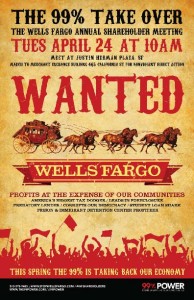
When Wells Fargo holds its annual shareholder meeting today, Occupy protesters will be there, both inside and out, arguing against corporate greed and for some kind of corporate responsibility.

This will be the first in a series of at least three dozen protests at shareholder meetings this Spring, the latest wrinkle in the diversifying Occupy portfolio of activism.  Fifty people demonstrated last night outside the bank’s corporate headquarters, nearly half of them camping out overnight.  Organizers–and Wells Fargo–are expecting a couple of thousand today.

Corporate campaigns are nothing new for American activists.  Any shareholder can attend a public company’s annual meeting to press concerns.  In the past, one activist strategy has been to buy a share of target companies just to get to make a speech during the open mike session of the annual meeting.  Anti-apartheid activists did this in the 1970s and 1980s, as have environmentalists and others since.*

I don’t know of any case where the activists won a policy change in the annual meeting, but the directors watching from the front of the room are really less important than a much larger audience outside.  The protests draw unusual attention to a company’s annual meeting, and give activists a chance to lodge their challenges against corporate policy.

For Occupy, the charges are general AND specific.  At right is a downloadable leaflet charging the banking industry with perpetrating wrongs on the American people, including foreclosures, underwater mortgages, record profits and payouts, tax evasion, and unemployment and underemployment.

There are also specific charges against Wells Fargo.  Occupy Oakland describes the bank as:

America’s Biggest Tax Dodger – Hoarding billions of tax dollars that should be paying for public services and putting America back to work
Leads in Foreclosure – Continuing to foreclose on families in an economy it helped to ruin
Predatory Lender – Targeting those who can least afford it with exploitive mortgages and payday lending,especially low-income communities of color
Corrupting our Democracy – Protecting its profits by quadrupling spending on lobbying since the financial crisis began
Prison Profiteer – Profiting from increased incarceration by investing heavily in for-profit prison corporations and anti-immigrant legislation

The campaign to demonstrate at corporate meetings follows on many, generally much smaller, protests at banks across the country.  It’s one strand in an  Occupy campaign that has diversified to include candidacies for office, sleep-outs on Wall Street in New York, protests against foreclosures, demonstrations against cuts in state spending on education, and much much else.
A new coalition, 99 percent power, is at the head of the corporate campaigns, supported by roughly two dozen groups, including labor unions, environmentalist groups, and liberal activists.  Surely all of these people weren’t sleeping out in public spaces a few months ago, but no one owns the right to mobilize against political and economic inequality.

If Occupy succeeds, there will be many diverse campaigns invoking its name, and mainstream political figures responding to its ideas–even without giving the activists credit.

But I guess the lack of access to fair credit is what spurs this campaign anyway.

* On movement challenges to corporate policies, see Sarah A. Soule’s excellent book, Contention and Corporate Responsibility.

Posted in Uncategorized | Tagged , , , , , , , , , | Leave a comment

Tea Party and Occupy paths to invisibility

A new NBC/Wall Street Journal poll asked 1,000 adults about their thoughts on the usual political stuff, including Barack Obama and Mitt Romney.  (Most coverage focused on President Obama’s current 6 point advantage over Governor Romney.)

But the poll also asked about the Tea Party and Occupy Wall Street.  Each movement garnered less support than either major presidential candidate, or either the Democratic or Republican Party.  Adding the totals for “very positive” and “somewhat positive” for each, we get:

Barack Obama          48%

Mitt Romney             33%

Democratic Party     39%

Republican Party      33%

Tea Party                  27%

Occupy Wall Street  25%

The survey reports a margin of error of 3.1 percent, which would be somewhat higher for the Tea Party and Occupy questions, as half the sample was asked about each movement.  We shouldn’t make anything, then, of the tiny difference in approval for the two movements.  But that each movement polls less support than the parties or their candidates is an interesting development.

Also interesting: 51 percent of the respondents agreed that Occupy had pretty much run its course and was no longer very important, in contrast with 43 percent of the respondents saying the same about the Tea Party.  (David Weigel noticed this as well.)

In both cases, most people seem to think that the movements have peaked and passed.  Note the different routes they took toward seeming irrelevance:

The Tea Party marched into the Republican primaries at the presidential level and below, and is having difficulty getting much out of that effort.  The presumptive nominee, Mitt Romney, is surely the next to last choice of most Tea Partiers.

Occupy, working hard to avoid being coopted by institutional politics, has had a great deal of difficulty in maintaining a national profile–particularly after the Occupations ended–even though a great deal of activity is continuing on a variety of issues, including foreclosure, education, and taxation.

Two movements, two strategies, so far, pretty similar outcomes.   Is this inevitable?

Of course, this may change if the Tea Party succeeds in knocking off Richard Lugar and Orrin Hatch, and/or if Occupy is able to stage large events on May 1 and afterward.

Or not?

Posted in Uncategorized | Tagged , , , , , , , , | 3 Comments

Risks and realities of media boycotts

Rush Limbaugh’s ad feminem assaults on Sandra Fluke, who testified before Congress in support of requiring health insurance to cover birth control, provided an opportunity for his long time opponents to go after the radio host through his sponsors.  They did, but despite some visible successes, the boycott isn’t near driving Limbaugh off the air nor toward political moderation or even civility.

A little more than a month ago, following three days of sustained verbal attacks on Fluke, a few of Limbaugh’s sponsors deserted, not wanting to have their products and services associated with his style and politics.  The list of companies soon included: Geico, Netflix, Service Magic home contractor, Goodwill, Amberen menopause medication, PolyCom web conferencing, Hadeed Carpets, Accuquote Life Insurance, Vitacost vitamin supplier, Bonobos clothing company,  Sensa weight- loss program, Thompson Creek Windows, AOL, Tax Resolution Services, ProFlowers, Legal Zoom online document creator, Carbonite web security firm, Citrix software maker, Sleep Train Mattresses, Sleep Number mattresses and Quicken Loans.

You’ll note the list of sponsors includes companies smaller and less famous than those who support ALEC or command your attention otherwise.  The economic model of syndicated radio is very different.  Limbaugh’s own network, Excellence in Broadcasting, has some slots each hour to sell on its own.  Local radio stations get other slots to sell, while Premiere Radio Networks, his syndicator, also sells and barters ads.  Premiere stopped doing so for about two weeks.  As Limbaugh’s daily show airs on some 600 stations, one analyst estimated there could be as many as 18,000 sponsors, once local businesses are taken into account (See Forbes analysis).

Limbaugh is in the middle of an eight year contract which pays at least $50 million a year; it expires in 2016–a lifetime away.  As long as he maintains his audience, sponsors are going to see value in paying for access to his listeners, numbering about 20 million people.

There are other challenges: Arkansas governor/presidential candidate turned talk show host, Mike Huckabee, has launched his own conservative radio show, running directly opposite Limbaugh’s program.  Promising a less confrontational approach and a more affable personality, Governor Huckabee is already appearing on 200 stations.  If he succeeds in peeling off some Limbaugh listeners–and outlets–who want a more genial conservative approach, Limbaugh will have every incentive to double down on his own distinctiveness, holding tight to the audience that responds to his hostile hyperbolic humor.

Conservative websites proclaimed the Limbaugh boycott a failure (e.g.), but so have more mainstream outlets (e.g.).  The tempest associated with the boycott will pass –as these things do (note that Don Imus is still on the air!).  Those who would boycott Limbaugh probably weren’t listening to him in the first place, tuning in only to take down the names of advertisers.  The segmented media landscape means that anyone who can reliably deliver a definable audience will be able to make a living on air.

Posted in Uncategorized | Tagged , , , , , , , , , | 3 Comments

ALEC, impact, and markets

ALEC, the American Legislative Exchange Council, backed down in the face of the defections from its corporate members.  As we discussed,  activists targeted ALEC’s support of Voter ID and Stand Your Ground laws to pressure corporations to stop giving money to the conservative legislative advocacy group.

Facing protests, petitions, and questions from investors wondering about corporate priorities, a number of companies have announced that they’re through with ALEC, including Coca-cola, PepsiCo, Kraft, Intuit, and Wendy’s.  The Gates Foundation also announced that it would no longer support ALEC.  Although state legislators pay a membership fee to ALEC, virtually all of its funding comes from these corporate sponsors.  Responding to these defections, bad publicity, and certainly the threat of more of the same, ALEC pared its legislative agenda.  In a statement released yesterday, ALEC announced:

Today we are redoubling our efforts on the economic front, a priority that has been the hallmark of our organization for decades. Fostering the exchange of pro-growth, solutions-oriented ideas is precisely why ALEC exists.

To that end, our legislative board last week unanimously agreed to further our work on policies that will help spur innovation and competitiveness across the country…

We are eliminating the ALEC Public Safety and Elections task force that dealt with non-economic issues, and reinvesting these resources in the task forces that focus on the economy. The remaining budgetary and economic issues will be reassigned.

This is a sharp turnabout for ALEC, which just a week earlier had proclaimed its refusal to be intimidated by “the coordinated and well-funded intimidation campaign against corporate members of the organization:…. We are not and will not be defined by ideological special interests who would like to eliminate discourse that leads to economic vitality, jobs and fiscal stability for the states.”

I guess there’s a fine line between economic intimidation (consumers choosing not to buy products from companies that work against their interests) and responding to market conditions.  ALEC has flourished for nearly four decades, at least partly because it’s been able to serve its sponsors.

Groups including Color of Change and the NAACP are clearly responsible for this victory, but it’s a hard win to claim.  ALEC is certainly going to continue its efforts on taxes, regulation, spending, and unions, perhaps more effectively.  It’s not clear whether any of the defectors will return, but surely ALEC has kept other supporters within its ranks.  This is exactly the kind of incremental victory that characterizes successful movement efforts in the United States.

Posted in Uncategorized | Tagged , , , , , , , | 1 Comment

Tax day protests, 2012

Watch who takes to the streets tomorrow, the day federal taxes are due.    Tax day is a predictable occasion for protest.  Indeed, the Tea Party protests in April 2009 were the first visible signs of that powerful movement emerging.

In obvious ways, protesting against taxation is almost too too easy. No one likes to write large checks without thinking that he’s getting something worthwhile for his money.  And absolutely any American can find some federal spending that he finds completely appalling: environmental protection, Medicare, meat inspection, GSA parties in Las Vegas, aircraft carriers, oil subsidies, foreign aid, Social Security, intercontinental ballistic missiles, and so and so on.  Of course, most Americans also view some of those services as absolutely essential for civilized life.  (Listen to Californians complain about taxes then pivot to talk about inadequate freeway maintenance.)

Like Roe v. Wade, Tax Day is an occasion to demonstrate a show of strength, mobilizing the faithful in the service of a partial understanding of the American revolution.  (In 1776, the cheerleaders chanted: “No Taxation without Representation,” not “No Taxation.”)

The 2009 protests were a sign that the Tea Party had arrived.  Once you turn out large crowds, however, there is an ongoing pressure to keep growing.  By 2011, after large Republican gains in the 2010 elections, the large Tea Party groups decided to avoid a Washington demonstration altogether, lest a lower turnout seem a sign of the movement’s fading.  (At left, see the 2011 anti-tax protest in Sacramento.)

Herman Cain has brought his suspended presidential campaign to Washington, DC, to rally support for his 9-9-9 tax plan.  He’s announced plans to start a movement in support of the plan, which would radically distribute the burden of taxation downward to people who earn and spend less money.  Let’s see what kind of turnout he can generate.

In Wisconsin, Americans for Prosperity rallied against taxes–and in support of embattled Governor Scott Walker.  Their opponents were also out in force.

Of course, both sides can use the same opportunities.  People who aren’t vehemently anti-tax also plan to use the occasion for their own purposes.

Gay and lesbian activists are challenging the federal tax code, which doesn’t recognize same sex marriages.  Peace activists will use Tax Day to draw attention to the hundreds of billions that the United States spends on the military, announcing demonstrations across the country. 

And in Oakland–and elsewhere–Occupy sympathizers are using tax day to raise the question of fairness.

Tax day is a moment when people are frustrated, perhaps ready to pay attention.  The effectiveness of any of these protests, however, is a function of what follows.

Posted in Uncategorized | Tagged , , , , , , , , , | 1 Comment