A protest is a threat (the Komen debacle)

It’s never just the demonstration that brings about change.  Rather, it’s the larger actions that demonstrators promise (and authorities fear) that lead to concessions.  Demonstrators threaten to storm the barricades, stop paying taxes, or vote, or contribute money.  Their targets assess how credible those threats are and how damaging such action would be.

The recent rapid reversal of a new funding policy by Susan G. Komen for the Cure demonstrates how this works very clearly.  It also shows the different strategies that opposing social movements can employ to try to get what they want–little bits at a time.

Komen raises and spends about $93 million a year to fight breast cancer.  It runs races, promotes pink, funds researchers and service providers, and maintains a large bureaucracy to keep the machine moving.   (Just over 1/5 of its budget goes to fundraising and administration.) It is explicitly non-political.

Last week, Komen announced a decision made weeks earlier, not to fund organizations that are under investigation.  This excluded 1 of the groups it funded, Planned Parenthood, which received just under $700,000 a year to provide breast examinations and referrals for mammograms.  (Jezebel has covered this flare-up comprehensively.)

Among other things, Planned Parenthood also provides birth control and abortion services.

The investigation rationale was, at best, an obvious bow to political pressure.  Congressman Cliff Stearns (R-FL) launched an investigation to discover whether Planned Parenthood was using federal funds to support abortion services (No public evidence on this).  It’s very easy for any member of Congress to launch an investigation.

Much more likely, however, the investigation rationale was a transparent ruse.  After all, Komen ditched it quickly.  Numerous reports noted that Komen’s new senior vice president for public policy, Karen Handel, had pushed for an end to its association with Planned Parenthood.  Handel, who had served as Secretary of State in Georgia, and run an unsuccessful campaign for the Republican nomination for governor, is staunchly anti-abortion.   The decision was in the works months ago.  Last December, when Ari Fleischer, former press secretary to President George W. Bush, was interviewing candidates for a high level public relations position for Komen, he made it clear to candidates that Komen would be cutting its connection to Planned Parenthood.

Once the decision was announced, the reaction was intense and viral, aided by social media.  Runners, contributors, and many many others announced that they were done with Komen, tweeting and posting facebook notifications of their decisions.  (Social media allowed all of this to happen very quickly.)

They also started sending checks to Planned Parenthood.  Most visibly, New York City Mayor Michael Bloomberg announced a $250,000 matching grant for new money Planned Parenthood raised to make up the difference.  In short order, Planned Parenthood raised $3 million.  Politicians who supported Planned Parenthood weighed in, publicly pressuring Komen to scrap the new policy.

Komen held the line on its policy, very briefly, shifting rationales and explanations quickly.  In short order, however, Komen’s founder and CEO, Nancy Brinker, announced that Planned Parenthood would get the money and would continue to be eligible for grants in the future.

Komen executives realized that their offices, their jobs, their reputation, and their cause were dependent upon public support.  It was all to easy to imagine women foregoing the Race for the Cure and for Planned Parenthood (or someone else!) to start raising its own money to fight breast cancer.  They couldn’t back peddle fast enough.

But it’s not over.  Opponents of abortion are angry that Komen caved to the political and financial muscle of Planned Parenthood supporters.  Presidential candidates Rick Santorum and Newt Gingrich released statements of disappointment, while grassroots activists announced their own boycott of Komen.  Komen executives will now have to assess how credible those threats are and how damaging those boycotts might be.  It’s awfully hard to be non-political on abortion when people start paying attention.

Posted in countermovements, Uncategorized | Tagged , , , , , , , , , | 2 Comments

Methods and movements: how to study social movements

I was part of an online roundtable of researchers discussing how to study social movements.  It’s at The Society Pages, and includes Jeffrey Alexander (Yale), Neal Caren (University of North Carolina, Chapel Hill), Nathan Clough (University of Minnesota, Duluth), Myra Marx Ferree (University of Chicago), Sarah Gaby (University of North Carolina, Chapel Hill), and Fabio Rojas (Indiana University).

Thanks to Sinan Erensu, Kyle Green, and Sarah Lageson for putting it together.

Posted in academic | Tagged | Leave a comment

How the Tea Party produced candidate Romney

This essay is part of a larger dialogue at Mobilizing Ideas, which also includes pieces by

Neal Caren, University of North Carolina, Chapel Hill
Tina Fetner, McMaster University
Richard Lloyd and Steven Tepper, Vanderbilt University
Chris Parker, University of Washington
Jenni White, Tea Party activist, R.O.P.E

Protest movements sometimes have perverse effects, hastening outcomes they don’t want. The contest for the Republican presidential nomination has to be scored as a disappointment for the broad Tea Party movement, and perhaps a sign of its dissolution. Social movements capture the imagination of participants and audiences, engaging and enlarging our sense of the possible. But, particularly in liberal systems, movements that succeed in reaching mainstream public discourse are ultimately consumed by it.

The American political system makes lots of space for social and political movements. It’s set up to enable challenges, then to water down, distort, and tear them apart. When Newt Gingrich won the South Carolina Republican presidential primary, we saw just how the system works to dissipate the energy of a social movement, in this case, the Tea Party.

The Tea Party, a powerful movement that captured the imagination, for good and ill, of Americans during the first two years of the Obama presidency, exercised visible influence on political debate, public policy, and politics. It grew and developed in the wake of a Democratic rout in 2008, when Barack Obama won the presidency and his party control of both houses of Congress. Conservatives lacked a visible institutional route to influence, and took to the streets in an attempt at redress. An alliance between populist and plutocrat dissatisfaction with President Obama, the Tea Party coalesced just after Obama took office, and focused early on opposition to his effort to reform and extend health insurance in the United States. Proposed health care reform provided a focal point for economic and social conservatives who had been trying, for many years, to advance their vision of limited government, regulation, and taxation.

Beltway groups like FreedomWorks and Americans for Prosperity, funded primarily by large corporate interests, most famously the billionaire brothers Charles and David Koch, needed Barack Obama as president and the Patient Protection and Affordable Health Care Act to reach a broader audience. Of course, the Tea Partiers at the grassroots had many grievances beyond Obama and health care reform, but the proximate provocation of an ambitious reform that would affect virtually all Americans provided the leading edge and unifying issue for their efforts.

Grassroots mobilization, in conjunction with funding and direction from national groups, and in the context of a severe recession, allowed the Tea Party to shape the public debate in 2009 and 2010. After the Democrats (and only Democrats) passed a health care bill, Tea Partiers shifted their attention to debt and taxes.

Although many Tea Partiers shared socially conservative views, the national leadership of the movement urged them to focus on economic issues to avoid divisive debates. Taking advantage of the relatively frequent legislative elections built into the American system, Tea Partier worked with—and through–the Republican Party. Tea Party energies helped the Republican Party make huge gains in the midterm elections, picking up 63 seats to win control of the House of Representatives. (Ah, but the Tea Partiers also beat several mainstream Republican candidates in primaries, nominating candidates less suited for the general election and undermining Republican chances to win the Senate.)

As the Tea Party entered campaign politics, the dramatic, costumed, confrontational, and Constitution-quoting events of its heyday disappeared, as Tea Partiers watched Republican legislators carry their program—or at least one version of it. The American political system, however, makes it hard to get anything done, and what the House leadership wanted to do, mostly obstruct the President and make strong statements against taxes and borrowing, wasn’t enough for the Tea Party—but far too much for many Americans. Once in office, the Tea Party became a target and provocation for an opposing movement, saddled with the responsibility of governance, but not the capacity to govern. (This is a recurrent American movement story.)

Now, another irony of American politics, Obama’s most likely opponent in the general election signed the legislation on which Obama’s health care reform is based. Mitt Romney, who has campaigned the longest, raised the most money, and led in most polls, is preparing to run a campaign in which he will advocate taking health insurance away from tens of millions of Americans–but not the residents of Massachusetts, whom he’s already taken care of. Tea Partiers, and many Republicans, are understandably uneasy about this prospect.

The potentially viable alternatives to Romney also represent, at best, a partial and distorted vision of the Tea Party’s claims. Indeed, the Republican primary field now offers three distinct personifications of Tea Party politics. Representative Ron Paul has hewed to a libertarian line for decades, and appears as a sincere and consistent advocate of extremely limited government. But a government that doesn’t criminalize drugs or engage in active foreign and military policies is an anathema to most Republican voters. Former Senator Rick Santorum consistently articulates the social and religious conservatism of many Tea Partiers, but not their vision of limited government, nor a focus on the fiscal. His long record offers ample evidence of a willingness to use government to promote and police Christian values. And former Speaker Newt Gingrich, an inconsistent advocate for conservative economic or social policies, has captured only the Tea Party attitude, vigorously expressing a sense of anger and entitlement. Any of these three offers only a partial version of a Tea Party platform, and none is likely to be stronger in a general election than Romney.

But it’s worse than that. The Tea Party captured the imagination of conservative activists around the country, and was an immense aid in firing up Republican voters in 2010. It buoyed up the aspirations of several prospects who proved far from ready for presidential prime time, crowding out more mainstream–and credible–candidates for office. Thus, the Republican field came to include Representative Michele Bachmann, a vigorous campaigner and fundraiser, but a back bencher in the House Republican caucus, and Herman Cain, a radio host who had never won an election. It did not include Tim Pawlenty or Mitch Daniels, who had served as governors of Midwestern states (Minnesota and Indiana). Republicans who were dubious about Governor Romney, including Tea Partiers, flirted with a series of alternatives who, for various reasons, were found wanting: Bachmann, Governor Rick Perry, Cain, former Speaker Newt Gingrich, the last of which has turned into an intermittent attraction/repulsion relationship. A longer list of prospects could include flirtations with Sarah Palin and Donald Trump as well. And it may not be over yet. Tea Partiers seeking both a strong advocate and a strong candidate are likely to find neither.

So, the successful mobilization of the Tea Party has produced exactly what most Tea Partiers didn’t want. It’s a common movement story in America.

Posted in academic | Tagged , , , , , , , , , , , | Leave a comment

Korematsu Day (2nd)

Today is the second Korematsu Day.  Reposted below is last year’s entry.  It’s also a time to recognize the passing of Gordon Hirabayashi (this past January), another critically important resister of Japanese internment.  After the war, Hirabayashi invested in his own education, and had an important career as a sociologist.

Today Californians celebrate the first Fred Korematsu Day of Civil Liberties and the Constitution.  Represented by the American Civil Liberties Union, Korematsu challenged the constitutionality of relocating and interning Japanese Americans during World War II.  Three Supreme Court Justices agreed with him; six did not, finding that the emergency of a World War justified allowing Congress to put civil liberties on the back burner (Korematsu v. US, 1944).

Korematsu’s challenge exacerbated rifts within the Japanese American community; large organizations like the Japanese American Citizen’s League were eager to prove their patriotism by cooperating with internment.

Maybe the arc of history really does bend toward justice; it’s certainly long.  In 1980, President Jimmy Carter established a commission to investigate the internment of Japanese Americans during the war; in 1983, Korematsu’s conviction was vacated.   In 1988, Congress apologized to the Japanese Americans for the internment, and the government paid (modest) compensation to those interned.  In 1998, President Clinton awarded Korematsu the Presidential Medal of Freedom.  More than fifty years later, we recognized courage and heroism in what we first saw as a crime.

We should derive more benefit from the vindication of Fred Korematsu more than he did.  To do so, we need to draw lessons from the cause and the case that extend beyond Japanese Americans in World War II.  This means, I think, paying close attention to discrimination on the basis of race justified by appeals to national security.

We should tell Fred Korematsu’s story in New York City, where the construction of an Islamic Center in lower Manhattan draws opposition.  We should recall the history in Arizona, when the state passes a law mandating that police demand proof of citizenship from people who look like they might be undocumented.

And we should all think about how people learn.  California Attorney General Earl Warren pressed for interning Japanese Americans immediately after Pearl Harbor, arguing that their presence in California represented a threat to civilian defense.  Thirteen years later, as Chief Justice of the US Supreme Court, Warren organized the Court to issue unanimous decisions prohibiting racial segregation in the public schools.  I want to think he learned from the past, including his own past.

Apparently, one of the justices Earl Warren had to persuade was Robert Jackson, one of the three dissenters in Korematsu.  In dissent, Jackson wrote:

But once a judicial opinion rationalizes such an order to show that it conforms to the Constitution, or rather rationalizes the Constitution to show that the Constitution sanctions such an order, the Court for all time has validated the principle of racial discrimination in criminal procedure and of transplanting American citizens. The principle then lies about like a loaded weapon, ready for the hand of any authority that can bring forward a plausible claim of an urgent need.

Justice Jackson took a leave of absence from the Court to serve as as the chief US prosecutor during the Nuremberg war crimes trials, putting him in a very good position to think about a government’s use of race politics as a means of mobilization during moments of crisis.

Perhaps Korematsu Day will be an occasion for fireworks and picnics one day.  Today, it seems like a good time for reflection.

Posted in Uncategorized | Tagged , , | Leave a comment

Occupy Oakland and the militant wing of a movement

Occupiers burn flag

Occupy, like all large and successful social movements, includes people with a broad range of political viewpoints and a very diverse range of action strategies.  While some activists are working to move inside the political system by lobbying or contesting elections, others are trying to escalate the disruption and the conflict.

Occupy Oakland activists tried to take control of a vacant convention center, pledging to move-in to the unused building and turn it into a functioning social center.

Erik K. Arnold reports at Oakland Local that activists envisioning re-establishing an Occupation indoors that could serve as a center for activism and service:

Organizer Adam Jordan outlined the vision of what Occupy Oakland had hoped to accomplish. “The move-in day is hypothetically and hopefully going to be a multi-use center with free school workshops, free food, free meals, and a meeting place to have for Oakland, for the people, by the people. We see the need to help other people. Going through the system has not been working for a lot of people.”

Mayor Jean Quan and local officials ensured that police, wearing riot gear, were prepared to respond quickly and in full force, and avoid the erratic management that had characterized the City’s approach to the first Occupation.  The police were quick to respond with force and arrests (more than 400), and the confrontations continued as activists redirected their efforts to City Hall.  Several Occupiers broke into City Hall and, according to the City, burned flags, broke glass, and damaged property.  Mayor Quan estimated the damage from the Occupation since its onset in millions of dollars.

Mayor Quan has, for months, voiced her support for Occupy’s goals, even as she has been increasingly willing to use police force to counter their efforts.  The Occupiers focused on police conduct, criticizing the City for wasting money on stopping the activists from putting a vacant building to use and doing some good.

The Occupiers staging direct action face the same sorts of challenges as those trying to move into more conventional politics.  First, no organization has exclusive control over an Occupy trademark.  Anyone can claim to be acting in the spirit of Occupy, and whether or not either the people who supported Occupy or actually stayed in the encampments will sign on is an open question.

Second, different tactics demand different resources and appeal to distinct constituencies.  Occupiers running for office need to appeal to majorities, but don’t necessarily demand much of them.  This means a moderation in rhetoric and tactics.  Occupiers who want to seize buildings don’t need such broad support, but depend upon intense commitment and partisans who are ready to take serious risks.

Third, Occupiers trying different strategies for influence encounter authorities in very different ways.  There are clear rules for running for office that channel activists in fairly predictable ways.  They need to collect signatures, can participate in debates, and put poll watchers at voting sites.

Direct action engages another element of government power: the police, who are better armed and better trained than the activists who challenge them.  While the police are bound to rules of engagement and the law (and activists and their lawyers will try to hold them to those strictures), they are not committed to nonviolence.

Fourth, activists compete to define the movement and its concerns to a much broader audience.  Running for office doesn’t usually generate powerful images for the media, and it is often easy to ignore.  Burning a flag, to take another example, makes for a powerful image and projects a vision of Occupy that most Americans are likely to find, uh, unappealing.  While Occupiers will blame Mayor Quan and the police for brutality, they know that many who watch the same videos will blame them instead.

And here’s something else: Social movements do best when there is a connection between the margins and the mainstream, between direct action and institutional politics.  Such connections are extremely difficult to maintain.  Candidates for office and civil disobedients will have to make statements on each other, and it’s hard not to criticize other activists with alternative strategies for being naive or out of touch.

Meanwhile, Occupy Oakland has called for sympathy demonstrations across the country, spreading their message and extending the activist dilemmas far beyond the Bay area.

Posted in Uncategorized | Tagged , , , , , , , , , , | Leave a comment

Occupy elected office

Is incumbency another word for occupation?

Today two self-identified Occupiers announced candidacies for local office in Northern California.  Jeff Kravitz, a lawyer who has represented Occupy Sacramento activists, is running for a county board seat.  So is Gary Blenner, a high school teacher who has  previously served as an elected member of a school board.*

In Philadelphia, Nate Kleinman, a legislative assistant to a state representative, has announced that he intends to challenge Democratic Rep. Allyson Schwartz for her seat in the House of Representatives.  He has experience working in Democratic campaigns, but emphasizes his Occupy Philadelphia connections and commitments.  Berkeley Professor George Lakoff has written that contesting elections is the logical step toward influencing policy for Occupy, while others have argued that Occupiers should focus on the initiative process, rather than particular candidates.

Electoral politics is a natural next step for a growing social movement, but it’s not easy or uncontroversial.  In real life, activists need to take a position on each election, even if that position is to opt out.  But just because one doesn’t want to take institutional power seriously doesn’t mean it will go away.  Activists and advocates neglect electoral politics at their peril.

For Occupy, which has created a broad political umbrella uniting a broad range of claims about political and economic inequality, there is no trademark protection.  Anyone who wants to call themselves an Occupier–or a supporter–can try to do so, and can try to campaign on this identity.  Whether or not the people who camped out in urban parks–or the much larger group of people who sympathized with them–will support them is quite another matter.

The American political system, offering many elected offices and frequent and routine elections, works to bring movement politics indoors.  It forces aspirants for office to build broad coalitions, address multiple issues, and work with people who are at least a little different from them.

The Occupy candidates will have to figure out stances on issues that matter directly to their voters, and come up with ways to finance campaigns.  They’ll have to deal with the two-party system, either by working through the Democratic Party (as the Tea Party has worked with Republicans), or staging third party campaigns that are unlikely to succeed in winning office  (Gary Blenner, referenced above, had most recently run unsuccessfully for reelection to school board as a Green–and lost.)*

Far more important than the first Occupiers to run for office will be the electoral choices that the much larger number of activists and supporters make.  Surely some will eschew electoral politics altogether, reasoning that the terminally corrupt system forces compromises that make meaningful change impossible.  They’ll say: “Don’t vote, it only encourages them.”  But elected officials can operate without our encouragement.  They’ll call self-identified Occupy candidates sell-outs–or worse.
I suspect the electoral abstainers will be a sliver of the broad movement, and that most Occupy advocates will haul themselves out to the polls and make a choice from the options in front of them.  Call it the lesser of two evils, or call it doing the best you can in a real, rather than imagined, world.

Remember, things can always be worse.


* Corrected, January 27, 2012.

Posted in Uncategorized | Tagged , , , , | 12 Comments

The Tea Party’s disappointment with the Republican field

In seeking both a powerful advocate or a strong candidate for the Republican presidential nomination, the Tea Partiers are likely to get neither.

Elections channel and dilute social movements.  This was James Madison’s design, and it works pretty much as he expected.  It fragments and filters social movements, and produces a great deal of frustration.

The Tea Party’s strong influence in the Republican Party has paradoxically produced an extremely weak and damaged field of contenders.  Tea Party enthusiasm and money encouraged a few very weak candidates (including Herman Cain and Rep. Michele Bachmann), and crowded out a few potentially strong ones.  And all of the hopefuls, with the partial exception of Jon Huntsman, were eager to pander to some version of the Tea Party to make progress in the primaries.

Of course, it’s hard to tie the Tea Party to a specific set of policy demands or issues.  Activists initially united on opposition to President Obama’s health care reforms.  Although there was shared language on the Constitution, limited government, deficits, and taxation, Tea Party groups differed greatly on how to pursue these goals and on their priorities.  In the early part of the Tea Party, there was a general agreement to put social issues, specifically abortion and same sex marriage, on the back burner.

In pursuit of the Republican Party’s presidential nomination, all of the candidates have brought those issues to the fore, and have fought to distinguish themselves by the vigor and authenticity of their commitment to those social issues.

And now, the most charitable interpretation is that Tea Party still has three candidates who appeal to its agenda, but partly and poorly.

Rep. Ron Paul, who has espoused a vision of limited government for decades, plausibly stands for the libertarian stream in the Tea Party, with a notable exception for his opposition to abortion.  But Rep. Paul has also alienated the party establishment, which ignores him when possible, offering occasional denigration of his vision of a very restrictive vision of foreign and military policy.

Former Senator Rick Santorum has a history as a social conservative, in Congress and since, and has championed the issues Tea Partiers initially decided were too divisive to organize around.  On fiscal matters, he politicked just like a regular Republican.

Finally, former Speaker Newt Gingrich, whose record offers little consistency on any set of issues, has effectively channeled a Tea Party attitude: anger and entitlement.  Thus far, he has been able to win support by railing against the media and Washington elites, while deflecting attention from his past, political or personal, or coherent positions on issues.  This might be able to carry him a long way, but the obvious reluctance of mainstream Republicans to have Speaker Gingrich top their ticket makes it unlikely.

So, Tea Party efforts are likely to help former Governor Mitt Romney, not a real Tea Partier on any dimension, emerge as the the Republican nominee.

It’s an American story.

Posted in Uncategorized | Tagged , , , , , , , | 4 Comments

Roe v. Wade commemorations, 2012

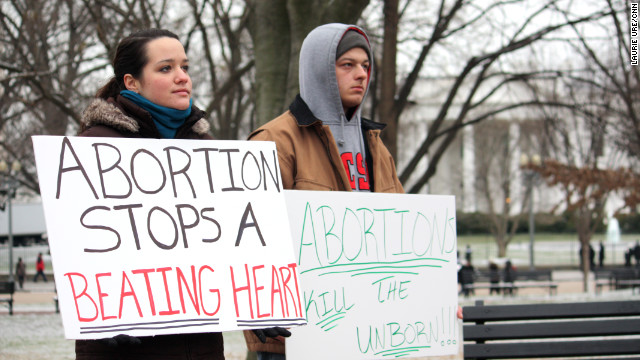
Last year, anti-abortion and abortion rights activists staged demonstrations commemorating (or protesting) the 1973 Supreme Court decision, Roe v. Wade.  Below is last year’s post, which ends with the prediction of large demonstrations next year. 

That’s today.  And today: both sides staged demonstrations in Washington, DC.  The March for Life turnout is reported to be somewhat larger.  This makes sense; as long as abortion remains legal, their grievance will seem a little less desperate. 

Perhaps the biggest story here is that the anti-abortion forces are firmly established with in the Republican Party, and all of the Republican presidential hopefuls have staked out strong anti-abortion positions.  Newt Gingrich, Ron Paul, and Rick Santorum all signed a pledge demanded by the Susan B. Anthony list, committing themselves to appointing only judges who have committed to an anti-abortion stance.  Mitt Romney wouldn’t sign the pledge, but made the same promise. 

House Speaker John Boehner was among the Republican leaders to address the crowd, promising to stop funding for Planned Parenthood and focusing activists on the election.  Last year’s report is almost like this year’s, save for the strong focus on the presidential election.  Republican officials urged the demonstrators to rally behind the eventual Republican nominee, putting other issues on the back burner.  Later, Democrats will do the same with abortion rights activists.

Visitors to Washington, DC can choose either an anti-abortion or abortion rights demonstration this week.

The March for Life started with a rally on the

National Mall, then activists marched to the Supreme Court to protest Roe v. Wade, praying for the health of the justices.  Abortion rights activists started at the Court, and sponsored sympathy demonstrations around the country; they also prayed for the health of the justices.

Thirty-eight years ago the US Supreme Court announced its  Roe decision, establishing a Constitutional right for women to have access to legal abortion s, and finally resolving an issue that had become increasingly contested in the previous decade.  Uh, not quite.

Roe nationalized the abortion debate, and within a few years abortion politics became a critical issue in party politics, mobilizing new activism and demonstrating–and exacerbating–deep divisions in American life. Anti-abortion and abortion rights activists stoked increased interest in existing political organizations, established new movement groups, and mobilized several new generations of activists on the issue.  Politicians have played to one side or the other, often emphasizing the threat represented by their opponents.  The politics of abortion access are more contested in the United States than anywhere else in the world.

And every year, on the anniversary of the decision, activists on both sides assemble by the Court, in varying numbers and varying degrees of civility.  It’s an opportunity for a show of strength, a chance to demonstrate commitment and resolve, and an event to organize and fundraise around.

It’s hard to remember that Roe didn’t generate wide interest in 1973, especially as it’s become the rhetorical and political centerpiece for both sides in the abortion battle.  But changes in national politics made abortion a valuable issue for activists and politicians.  Fundraising and electoral reforms meant that individual candidates gained increasing responsibility to do their own fundraising, cobbling together issues that had traction in the body politic.  Jimmy Carter first demonstrated the value of evangelicals of a political constituency in campaign leading up to his election in 1976, and Ronald Reagan played to that constituency far more effectively in his 1980 campaign.

In the meantime, the anniversary of the decision became an unavoidable event for activist organizations.  The commemorations, of course, generate far more attention each year than the decision did in 1973.  When anti-abortion activists started the commemorations, abortion rights activists responded by putting their side in the streets–and in the news–as well.  Now, locked in a perverse symbiotic stalemate, neither side can give up and cede the day–and the battle–to its opponents.  Looking at the other side each year, sometimes across barricades, sometimes in the news, inspires activists to keep up their efforts, including going to meetings, attending events, and sending money.

The March for Life organizes its efforts around this demonstration every year, doing a little better when there’s a Democratic president committed to abortion rights.  A coalition of women’s and reproductive rights groups organizes in support of the decision, doing a little better when Republican presidents work to erode abortion rights.

Of course, each side mobilizes throughout much of the rest of the year, outside clinics, in state electoral campaigns, and particularly when there’s a vacancy on the Supreme Court.  But the Roe anniversary is the most predictable moment each year when you know that the other side and the mass media will be watching.

Here I predict there will be large demonstrations on both sides next year as well.

Posted in Uncategorized | Tagged , , , , , , , , , , | 1 Comment

Occupy Congress

Sooner or later activists in any American movement confront the possibility of trying to adjust the thermostat, and not just the climate.

On Tuesday, January 17, when members of Congress return to Washington, DC, they’ll be met by Occupiers.  There will be demonstrations, certainly, and I’d be astonished if at least some activists don’t try to pitch tents.  And there will be a range of issues: an end to “corporate personhood;” a push for affordable health insurance and college educations; general concern with using taxation and spending to ameliorate growing economic inequality.  Occupy groups are also taking on statehood for Washington, DC, cutting defense spending, and ensuring open access on the internet.  The news angle on these events is that Occupiers are also going to try to meet with members of Congress, conducting politics indoors as well as outdoors.

Even as Occupiers try to schedule, there’s no indication that they’re trying to ingratiate themselves or their movement with members of Congress. From Occupy Wall Street, we get a clear view of an Occupy take on taking on Congress:

At 9 am on the opening day of Congress, Occupy Congress will convene for a day of action against a corrupt political institution. Actions include a multi-occupational General Assembly, teach-ins, an OCCUParty, a pink slip for every congressional “representative” and a march on all three branches of a puppet government that sold our rights and our futures to the 1%.

This is an illegitimate system. Around half of the nation’s population doesn’t participate in electoral politics. More than 6 million Americans who want to vote are disenfranchised, including the entire populace of the District of Columbia. There is consensus that we are on the wrong track and that our “leaders” do not have our interests at heart.

All “elected” officials bought their way into gerrymandered seats with Wall Street money. These bankers’ henchmen have shown themselves both unwilling and unable to take on the tremendous, systemic issues in our country, our place in this world…We came to show the 1%’s Congress what democracy looks like.

Our nation, and our world, is in crisis and our “elected” officials have failed us. They refused to hold their bankrollers—Wall Street—responsible for the financial crimes that bankrupted our nation and destroyed the global economy. This last legislative cycle was the least productive in recorded U.S. history; 90% of the country disapproves of these “elected” officials.

There’s an obvious tension between the strong rhetoric proclaimed in Zuccotti Park–and on websites everywhere–and an actual–and possibly productive–conversation that may take place in an elected official’s office–even if you put quotation marks around “elected.”

Congress, you see, is already occupied.  Pretending this isn’t the case–or that it doesn’t matter–dooms a movement to a marginal place in American politics that most activists won’t accept.  It’s a tension built into the system.

While activists in the streets rail against inequality, unfair taxation, health care, and debt for housing and education, there are people in Washington DC making decisions that affect relevant policies.  Ignoring them doesn’t make them go away, nor does it make them less powerful.  Some legislators might be affected by the quality of an argument, or strengthened in their convictions when they find some citizens who see things as they do.  The argument might become more persuasive if a legislator believed it came with help in the next election, financial or otherwise.  This might mean tapering off on the sarcasm and the scare quotes.

The problem for activists is the distinct possibility that more conventional politics might matter, and the ongoing question is whether it could matter enough.  While activists who lobby see the potential in pragmatism, their allies in the streets smell the prospects of a sell-out.

There’s not a formula for negotiating this balance, and activists supporting different strategies can develop every bit as much antipathy for each other as their political opponents.  But savvy demonstrators know that they do better when allies explain the demands in longer and more nuanced sentences.  And citizen lobbyists think they’ll get a better hearing when the voices outside turn up the volume.

Posted in Uncategorized | Tagged , , , , , , | 2 Comments

Martin Luther King and dead heroes (King Day again)

Martin Luther King died young enough and dramatically enough to be turned into an American hero, but it was neither his youth nor his death that made him heroic.

In his rather brief public life, beginning in Montgomery at 26, and ending with his assassination at 39, King consistently displayed rhetorical brilliance (on the podium and the page), strategic acumen, and moral and physical courage.

The effort to honor Martin Luther King with a holiday commemorating his birthday started at the King Center, in Atlanta, in the year after his assassination.  States began to follow suit, and by 1983, more than half celebrated King’s life with a day.  In that year, Ronald Reagan signed a bill making Martin Luther King day a national holiday expressing ambivalence, acknowledging that it was costly, and that King may have been a Communist.

The King holiday was about Martin Luther King, to be sure, but it was meant to represent far more than the man.  King stands in for the civil rights movement and for African-American history more generally.  I often wonder if the eloquence of the 1963 “I have a dream” speech winds up obscuring not only a man with broader goals, but a much more contested–and ambitious–movement.

The man and the movement are ossified into an iconic image, like a statue, which locks King and the movement into the politics of 1963-1965.  We accept King’s dream, that little children will play together, and that people will be judged by “the content of their character” (a favorite phrase on the right).

The image, like a statue, is available for appropriation to advocates of all political stripes, and the establishment of the holiday itself represents an achievement of the civil rights movement, winning the holiday if not broader economic and social equality.

Before the transformation of the man into an icon, King transformed himself from a pastor into an activist, a peripatetic crusader for justice.

But the pastor didn’t disappear; rather this role grew into something larger, as King himself transformed himself from a minister into a an Old Testament prophet, one whose primary concern was always the people on the margins, the widows and orphans, the poor and hungry.  In standing with those on the margins, King courageously used–and risked–the advantages of his privilege, pedigree, and education.  He also knew that he risked his safety and his life.

In his writing, King used his education and his vocation to support his political goals.  In the critically important “Letter from a Birmingham Jail,” he cited both the Constitution and the Bible in support of Federal intervention in local politics to support desegregation and human rights.  (We know that other activists now use the same sources to justify pushing the Federal government out of local politics.)

King explained that he was in jail in Birmingham, Alabama, because he had nonviolently defied local authorities in the service of higher laws, the Constitution and the Gospel.  This was not like making a provocative statement on one’s own [profitable] radio or television show.  There were real costs and severe risks.

King was never less than controversial during his life, under FBI surveillance during his political career, and vigorously criticized by opponents (for demanding too much and too strongly) and allies (for not demanding more, more vigorously).

When he was assassinated outside a Memphis motel in 1968, he was standing with sanitation workers on strike, straying from a simpler civil rights agenda.  He had also alienated some civil rights supporters by coming out, strongly, against the war in Vietnam.  And Black Power activists saw their own efforts as overtaking King’s politics and rhetoric.  By the time he was killed, Martin Luther King’s popular support had been waning for some time.

Posterity has rescued an image of Martin Luther King, at the expense of the man’s own broader political vision.

Ironically, in elevating an insurgent to a position in America’s pantheon of historic heroes, we risk editing out the insurgency.

Posted in Uncategorized | Tagged , , , , | 3 Comments