McTerror: Finnish activists behead a plastic icon.

The Food Liberation Army, a new activist group in Finland, took a statue of Ronald McDonald hostage, demanding that the McDonald’s corporation answer a series of questions about how they produce and serve their food.   The online demand, a kind of ransom note, starts:

We love burgers, fries and McDonald’s, but we can no longer watch silent when the food we love is being destroyed and brought to shame because of greed and indifference. Because of your short-sightedness your burgers have become nearly inedible.

That is why we want to help McDonald’s to save food. We made you a list of questions we want you to answer. We hope that your answers will make you understand the dilapidation of the food culture we love and the appropriate measures.

When McDonald’s refused to engage with them, they executed the plastic statue by guillotine. You can see some satirical videos on their website.

The Mckidnapping is the first action by the group, but the website expresses very broad aims:

As citizens we have lost faith in the political system and its values; politicians who are allowed to do anything and still remain in power. As consumers, we are tired of making a difference by our purchasing decisions, as well as faceless companies whose only value is money. We want our lives back.

We gathered a group of people who think alike.
And Food Liberation Army was born
It has a simple task:
To liberate man from systems bigger than him or her.
Fight the power where the power does not belong.
Return decisions on our own lives back to us.
To move from words to deeds.

Satire can be powerful.  Activists stage events to get attention for themselves and their causes, to bring their ideas to the larger public, and to activate people who might agree with them.  And McDonald’s, big, rich, and everywhere, is an obvious target. But how does satire work?

Morgan Spurlock’s film, Supersize Me, covered the nutritional issues of fast food in an entertaining, polemical, and disgusting way in 2004.

McDonald’s responded by issuing a series of statements that explained that their sandwiches could be part of a healthy diet, as long as you didn’t eat them every day.  They eliminated the supersizing pricing promotion (more food for not much more money), emphasizing that they’d been planning to do so anyway.  (We should always be suspicious when the targets of activism repeatedly emphasize that they are not responding to it, particularly when they change policies.)  And they put up a very informative website which allows anyone to calculate the nutritional value of a Mcmeal online.

The Food Liberation Army is talking about nutrition, but also fair labor practices and sustainable agriculture.

I’m loving it.

Posted in Uncategorized | Tagged , , , | Leave a comment

Egyptian revolution: Who won what?

It looks like President Hosni Mubarak has acquiesced to domestic and international pressure in leaving office after thirty years.  Even so, there were a number of stutter steps over the past few days.

The colorful, dramatic, and diverse demonstrations in Tahrir Square are definitely the most interesting visuals coming out of Egypt.  We want to cheer for people power and hope for some kind of democratic outcome–that still maintains a relatively stable role in international politics.  But what’s most visible isn’t always the whole of what’s important.

We can see the people pressure on President Mubarak, and we’re likely to see these pictures for a very long time.   But that’s only one component of domestic pressure.  It’s very clear that Mubarak also lost the support of (at least some significant segments of) the military and the Egyptian political elite, but we don’t know what kinds of threats and incentives were bandied about in discussions leading up to the moment of his departure.  It’s also very clear that Mubarak was in contact with leaders of other countries, including the United States, but we have only slight inklings of what kinds of pressures and inducements he faced, nor how they changed as the revolution developed.  This doesn’t mean they weren’t very important–and they are likely to be extremely important in shaping what happens next.

So, in the last few days a vast range of interests inside and outside of Egypt could agree that getting rid of Mubarak was a necessary first step in achieving their larger goals.  For all of them, this is a moment of triumph and celebration.

What happens next, however, is about the battles over next steps that will certainly emerge.  For the United States, for example, stability has virtually always trumped democracy in foreign policy.  Helping Mubarak leave office can be seen as a way to prevent broader and more destabilizing changes in the future.  In Egypt, it’s hard to think that the advocates of democracy will agree with the military on much of what will happen next.

The point: Mubarak united a very large coalition in opposition.  When he leaves, the critical glue that held that coalition together disappears, and the whole range of activists and interests will find new opponents–and maybe enemies–among their recent allies.

Right now, we have one clear loser, Hosni Mubarak, but just who the ultimate winners will be–and what Egypt will ultimately look like–is pretty much unknown.

In the next round of political battles, which has surely already commenced, there will be winners and losers–and who falls into each camp will matter.

Posted in Uncategorized | Tagged , , , | Leave a comment

DA’s indictment gives Irvine 11 another chance

What was Orange County District Attorney Tony Rackauckas thinking?  Pressing criminal charges against the students who disrupted an invited talk by Israel ambassador Michael Oren gives them a political opportunity that they were completely unable to create for themselves.

Recall that the Irvine 11 (as we’ve discussed) staged a “popcorn” protest during Ambassador Oren’s talk, as one student after another stood and yelled at predetermined intervals, before being escorted out.  The students faced discipline from the University of California, Irvine (details of which are not public), and the Muslim Student Union was temporarily banned from recognition as an official organization.

The DA’s public pondering and then pursuit of criminal charges has, predictably, opened a large window for debate through which many people have jumped:

A group of 100 UCI faculty signed a letter urging the DA to drop the charges, arguing that further prosecution will do more harm than good to dialogue and civility on campus–and elsewhere.  Organizers gathered signatures hastily through odd email networks; I’m sure many more faculty would like to have signed.  (You’ll find my name among the list of signatories.)

Jewish Voice for Peace, a liberal activist group based in San Francisco, says the charges are racist.  They report that they have staged identical protests against Israeli officials and not faced criminal prosecution.  According to Rachel Roberts, a Southern California member of the group:

We did exactly what the Irvine kids did. We criticized Israeli policy…We did it as part of like a popcorn action with one person disrupting, then another person disrupting to emphasize our outrage and we were escorted out. And then nothing happened.

Of course, groups have weighed in on the other side as well.  The Simon Wiesenthal Center supports the OCDA’s office, and posted a very friendly interview with Rackaukas on its website.

Expect more groups to weigh in on both sides as this case develops.

And local activists have started a new group, Stand with the Irvine 11, with the express goal of supporting the students.  Expect petitions, protests, public education, and–if a trial actually takes place–fund raising.

The first thing to remember is that the initial protest was incredibly unsuccessful.  Ambassador Oren gave his speech; all the media coverage emphasized the rudeness of the protesters, not their political concerns–or even the content of Oren’s talk.  Assume that the protesters made their own sense of the event as they faced sanctions against themselves and their group.  While some surely were fortified in their convictions, others turned their attention to other issues, including their educations.

District Attorney Rackaukas’s prosecution flattened out their individual concerns and turned them into a group, the Irvine 11.  Supporters and opponents have rallied around, turning them into heroic martyrs or intolerant thugs.  And people with very different views about Israel/Palestine have rallied around their cause;  in political rhetoric, they have become the victims, rather than the violators, of intolerance of free speech.  The individuals can’t now escape the cause.

And if DA Rackaukas allows the case to come to trial, the defendants will have a chance to project their political views to a broader audience.  Certainly, they will prepare some version of a “necessity defense,” focusing on the greater harms they see Israel committing.  I don’t expect an Orange County judge to allow such a defense in Court, but I’m confident that the defendants will find an outlet in the media coverage of the trial.

In effect, the students will get more coverage for their views by virtue of being criminal defendants than they did as disruptive activists.

If DA Rackaukas thinks this through, I expect he’ll want to negotiate plea bargains quickly to make the issue go away.  But if he had thought it through, he probably wouldn’t have charged the students in the first place.

Repression doesn’t always work the way those who use it expect.   I believe the sage, Arnold Schwarzenegger once said, “What does not kill me makes me stronger.”

Posted in Uncategorized | Tagged , , , , , , | 1 Comment

Charging the Irvine 11

Students demonstrate against charging the Irvine 11

It’s astonishing to learn that the Orange County District Attorney’s office opted to charge 11 young people with “conspiring to disrupt a meeting” (LA Times Report here).  In filing the charges, the DA is resurrecting a failed event and giving many people a cause to rally around–including people, like me, who did not support the initial protest.

It’s not that the students didn’t plan to disrupt a speech given by Israeli Ambassador Michael Oren at the University of California, Irvine (my school) last year.  It seems very clear that a group within the Muslim Students Union planned to attend Oren’s speech and, one at a time, interrupt the speaker by trying to shout him down.  You can find numerous clips of the event on youtube (here’s one), mostly posted by people who were offended by the action.

One after another, each disrupter was escorted from the room, and Oren ultimately delivered his speech.  I think the action overshadowed the demonstrators’ cause, and in no way advanced any kind of understanding of politics in the Middle East.  The sporadic shouts took attention off Israel and kept it firmly on the UCI campus.

It was very much like the Tea Party shout-downs at town meetings on health care the previous summer, but the Muslim students didn’t have large media outlets weighing in to portray their rudeness as understandable frustration.  Either way, it’s an awful model for democratic change.

Publicity was widespread.  I was at a conference far away when the event took place, but a relative emailed me a youtube link, asking what would happen to the students.  I hoped that the University would make it clear to the disruptive students that such conduct was unacceptable on a college campus, and that whatever sanction conveyed this message be mild enough so as not to disrupt the students’ education or careers.  (My colleague, Erwin Chemerinsky, figured all this out much faster and made the argument I was stumbling toward in an op-ed at the LA Times.)

Whatever sanctions were meted out to individual students are confidential, but the Muslim Students Union, which was found to have coordinated the event, was temporarily banned from campus.

I was involved on the periphery of the event.  I am currently Associate Director of the Center for the Study of Democracy here, one of the groups that cosponsored Ambassador Oren’s visit.  I drafted a letter of apology on behalf of the Center, published on the Center’s website, which stated:

We apologize that the tempest at the event temporarily overshadowed the much more important issues that your talk addressed. As scholars concerned with democracy, we believe it is critical to question—and listen to—people with whom you have even the most substantial differences.  Sitting down and talking with opponents is always preferable to trying to silence them.

I’ll stand by this, and wish that the governments in the Middle East, including Israel, would as well.

As an event, the protest at the Oren speech was, uh, sophomoric and counterproductive.  The actions overshadowed the issues.  By shifting discussion from occupation and settlements in Israel and Palestine to the lack of civility in Irvine, the activists lost the battle.  Very little of the massive coverage addressed what they really cared about.  But stupid and boorish isn’t necessarily criminal.

In taking on this prosecution, the Orange County DA has given the students attention as a collective, generating sympathy for them in the process.  Protecting the campus as a site for open speech means making allowances for mistakes and overstatements, and finding ways to bring people back into the dialogue.  Criminal prosecution, fines, and time in jail don’t do this.  And every weekend on college campuses across the country students make worse–and potentially more damaging– mistakes without even a wisp of a political motive–or lesson.

OCDA Tony Rackauckas should rethink how he wants to use the strained resources of his office, the Courts, and the prison system.  While the university’s discipline gave each individual student the chance to rethink his conduct, the DA has turned them collectively into a symbol, the Irvine 11, a cause for others to rally around.  He should be reluctant to turn student activists into martyrs for free speech.

And where is UCI on all of this?  Well, the interim director of communications at UCI has issued a statement explaining that the University thought it was done with the issue, and this is all the initiative of the OCDA.

The District Attorney’s announcement reflects action independent of the University. He has subpoena power and access to information that we do not. From our perspective we thoroughly and fairly investigated and adjudicated the matter last year. Conduct violations were addressed fully, consistent with the guidelines of the Student Code of Conduct.

Since the university’s resolution of this matter in the summer of 2010, our campus community continues to build bridges of understanding and foundations for respectful and meaningful dialogue.

How’s that for tepid?  If the DA has additional information that merits such a charge, he hasn’t yet shared it with the public.

It’s time for a statement from our Chancellor.  I do not understand why he would let the opportunity to take a moral position for tolerance and civil discourse pass by.

Posted in Uncategorized | Leave a comment

Rosa Parks’s Birthday

Happy birthday, Rosa Parks!  Born on February 4, 1913, Parks was not a tired old lady in 1955, when she refused to move to the back of the bus.  She was an experienced and committed activist, deeply tied into the civil rights activist networks.  She wasn’t the only one who took a risk to challenge segregation laws in the South, but that hardly makes her less heroic.

Activism in the civil rights movement was hardly a career move for Rosa Parks; her  recognition as an American hero came eventually.  In 1996 President Clinton awarded her the Presidential Medal of Freedom.

Posted in Uncategorized | 7 Comments

Follow the money: find it first.

Nearly 1,000 activists marched in Rancho Mirage, California this week, protesting outside an invitation-only strategy meeting of leading conservatives inside and outside government.  The demonstration, organized by labor and environmental activists, targeted the meeting’s hosts, billionaire brothers Charles and David Koch.

For the better part of the past few decades, the Kochs have put serious money into funding the ideas and activities of the conservative movement, sponsoring think tanks, like the Cato Institute and the Heritage Foundation, and activist groups, including Citizens for a Sound Economy and Americans for Prosperity–and many others.  The Kochs have put their money in support of their ideals (low taxes, limited government, minimal regulation) and their interests: they control the second largest privately held company in the United States, which holds several large energy companies.  Unsurprisingly, they’ve been particularly aggressive in attacking any effort to respond to climate change with regulation, activism, or taxation.  The Kochs have, over a long period of time, built the intellectual and organizational infrastructure of much of what became the Tea Party.  [Jane Mayer’s portrait of the Kochs, published last summer in the New Yorker, is an indispensable source on their political efforts.]

The protesters mean to expose the influence of big money in American politics.  And, to some degree, their effort worked.  Their demonstration, punctuated by the arrest of 25 protesters, brought more attention to the Kochs and their political efforts–exactly the visibility the brothers have worked hard to avoid.  But some serious money clearly went into opposing the Kochs.  Although I haven’t priced them recently, I don’t think blimps come cheap.

Conservative critics respond, what could be more American than investing in the politics of your ideas?  And they charge anti-Koch activists with a double standard, reflexively pointing to George Soros, the billionaire currency speculator who has put a great deal of money into causes he supports, many of them on the left of the political spectrum.

Reflexive charges of symmetry, accurate or not, are a staple of contested politics, going back, at least, to the school yard (no, you have cooties) and the back seat of the car (he hit me first).  But at least two differences between the billionaire activist funders are worth noting.  First, the Kochs’ ideology aligns very well with their business interests.  Disparaging climate change science and opposing environmental regulation, for example, is a good business strategy–at least for the short term, for companies invested in the oil industry.  I haven’t seen any reports about Soros’s politics working in the service of his business: currency speculation.

Second, Soros has hardly been a shrinking violet about publicity.  The groups he funds, including the Open Society Foundations, use his name and the websites often display his picture.  Soros lectures on his ideas frequently, sits for interviews with reporters, and has published several books detailing his ideas.

In contrast, while the Kochs are not shy about taking credit for their philanthropic contributions to museums or the arts (for example, at the Smithsonian), they’ve tried to keep their political efforts, their ideas, and their interests, out of the public eye.  (Take a look at Americans for Prosperity‘s website and see if you can find Koch brothers’ support.  I couldn’t.  Perhaps they fear that some people would be less likely to buy Bounty towels if they knew their political provenance?)

In the short term, at least, getting mass media reports on Koch politics is a victory for the activities.  But last year’s 5-4 Supreme Court decision, Citizens United v. Federal Election Committee (2010), makes it harder to follow the money trail.

Meanwhile, according to Kenneth Vogel at Politico, the Kochs are coming to terms with inevitable visibility, hiring public relations experts to shape their public profile, and filing lawsuits against activists who tried to use satire, in the form of fake press releases, to draw attention to Koch Industries’ environmental policies.

Posted in Uncategorized | Tagged , , , , , | 1 Comment

The Egyptian Revolution: Tipping Points Tip Both Ways

When Egyptian President Hosni Mubarak promised to stay out of the next election, for the moment anticipated in the fall, he figured to change the balance of power in the streets.  Knowing that Mubarak was ostensibly committed to leave office, people out in the streets are recalculating how urgent their grievances are.  Military officers who promised not to fire on peaceful protesters are now telling the crowds to go home, while Mubarak supporters are trying to take to the streets themselves.

Mubarak’s promise to leave office plays out differently for the people who have been agitating for his departure.  While some factions see his promise to depart in September as far too little (and too unreliable), and want to escalate their efforts to get him out–now.  Others see his promised exit from the national stage as the opportunity to plan a transition and focus on what kind of regime replaces him.  For the moment, Mubarak’s commitment not to run presents the opposition coalition with a dilemma about what to do next.

At the moment, the commitments of the political elite and the military are completely unclear, and they will certainly matter.  While the military stands back, Mubarak supporters and opponents have been fighting in the streets, threatening to undermine any hope of a peaceful transition.  The mobilization of Mubarak supporters will make it harder and harder for Army officers to postpone their decisions about which side to tip.

Meantime, authorities and dissidents throughout the Arab world are watching and planning their own efforts.  Ali Abdullah Saleh, President of Yemen, has promised that he will leave office in 2013, and that his son will not try to succeed him.  Such reforms are intended to take the wind out of at least some of the sails that are tacking against the regime, making it possible to govern–and to repress some critics.

Authoritarian leaders in the Middle East are surely trying to figure out how to avoid the unfolding (but unwanted) fates of Mubarak and Saleh.  Reforms as concessions are one strategy; another is repression.  These are not mutually exclusive.

Posted in Uncategorized | Tagged , , , , | Leave a comment

Korematsu Day: The Politics of Vindication

Korematsu Day

Today Californians celebrate the first Fred Korematsu Day of Civil Liberties and the Constitution.  Represented by the American Civil Liberties Union, Korematsu challenged the constitutionality of relocating and interning Japanese Americans during World War II.  Three Supreme Court Justices agreed with him; six did not, finding that the emergency of a World War justified allowing Congress to put civil liberties on the back burner (Korematsu v. US, 1944).

Korematsu’s challenge exacerbated rifts within the Japanese American community; large organizations like the Japanese American Citizen’s League were eager to prove their patriotism by cooperating with internment.

Maybe the arc of history really does bend toward justice; it’s certainly long.  In 1980, President Jimmy Carter established a commission to investigate the internment of Japanese Americans during the war; in 1983, Korematsu’s conviction was vacated.   In 1988, Congress apologized to the Japanese Americans for the internment, and the government paid (modest) compensation to those interned.  In 1998, President Clinton awarded Korematsu the Presidential Medal of Freedom.  More than fifty years later, we recognized courage and heroism in what we first saw as a crime.

We should derive more benefit from the vindication of Fred Korematsu more than he did.  To do so, we need to draw lessons from the cause and the case that extend beyond Japanese Americans in World War II.  This means, I think, paying close attention to discrimination on the basis of race justified by appeals to national security.

We should tell Fred Korematsu’s story in New York City, where the construction of an Islamic Center in lower Manhattan draws opposition.  We should recall the history in Arizona, when the state passes a law mandating that police demand proof of citizenship from people who look like they might be undocumented.

And we should all think about how people learn.  California Attorney General Earl Warren pressed for interning Japanese Americans immediately after Pearl Harbor, arguing that their presence in California represented a threat to civilian defense.  Thirteen years later, as Chief Justice of the US Supreme Court, Warren organized the Court to issue unanimous decisions prohibiting racial segregation in the public schools.  I want to think he learned from the past, including his own past.

Apparently, one of the justices Earl Warren had to persuade was Robert Jackson, one of the three dissenters in Korematsu.  In dissent, Jackson wrote:

But once a judicial opinion rationalizes such an order to show that it conforms to the Constitution, or rather rationalizes the Constitution to show that the Constitution sanctions such an order, the Court for all time has validated the principle of racial discrimination in criminal procedure and of transplanting American citizens. The principle then lies about like a loaded weapon, ready for the hand of any authority that can bring forward a plausible claim of an urgent need.

Justice Jackson took a leave of absence from the Court to serve as as the chief US prosecutor during the Nuremberg war crimes trials, putting him in a very good position to think about a government’s use of race politics as a means of mobilization during moments of crisis.

Perhaps Korematsu Day will be an occasion for fireworks and picnics one day.  Today, it seems like a good time for reflection.

Posted in Uncategorized | Tagged , , | Leave a comment

Tunisia, Egypt, and Revolutions

Like most everyone else, I’ve been transfixed by the historic revolutionary efforts that may be sweeping the Arab world.  Most of the little I know about Tunisia

Tunisian protests, 2011

and Egypt, I’ve learned in the past few days, but there are general patterns in the long history of successful and unsuccessful revolutionary movements that help to understand what’s going on.

Revolutions are about coalitions.  They succeed when people who care about overthrowing the government more than anything else in the world are able to mobilize and unite with people who care about lots of other things.  The zealots are important, to be sure, but you’ll get a better sense of how things will turn out by watching those who are not normally committed to revolutionary change.

Evey day when we wake up, we decide how to spend the day.  Mostly, there’s not a lot of agonizing about big changes on food, work, family–and the state of the government, for most of us, is off far in the distance.   Yesterday’s decisions create momentum; the world around us creates constraints and change is always risky.

Risk is relative: not going to work might lose you your job; the other donut shop might not be so good; opposing the government could get you killed.  Obviously, this depends upon context, and upon your position in the world.

Most people take to protest when they believe that there is an urgent problem, that change is possible, and that their efforts might matter.  Each day’s news can change how we think about urgency, possibility, and our own potential efficacy.

A few brave and committed people–and a few crazy people–care less about whether their efforts will be effective than about living up to their values.  These are people who are willing to starve or burn themselves to make their lives their arguments, hoping to inspire others.  Most of us, however, think about tomorrow as well, and are more likely to take action when we think it’s a little less risky or a little more likely to be effective.  Or, they come to a judgment that whatever the risks, inaction is now impossible.

We watch for signals from others about their prospects and their judgments.  These signals affect our judgments, and whether insurgents protest, whether loyalists defect, and whether passersby get involved altogether.  Signals spur others to actions which send signals to others, creating cascades of action, and ostensibly stable regimes fall or powerful insurgencies falter.  Everyone figures out who they can trust–and how much.  Dissidents decide whether they’ll be alone or with friends when they take to the streets.  Generals calculate whether they are more likely to keep their commands–or even their lives–with loyalty or defection.

So, when masses of people took to the streets in the Philippines to protest President

Corazon Aquino and the People Power Revolution, 1986

Ferdinand Marcos’s claim to have won re-election, Marcos decided that he could not count on the Army to defend him.  US Senator Paul Laxalt, speaking on behalf of President Reagan, told him that he couldn’t count on the United States either.  Marcos left for Hawaii, and the insurgents claimed the state.

Likewise, across Eastern Europe in 1989, state Communist governments learned that they could not count on their own armies, nor on the Soviet Union, to repress dissent.

Romanian revolution, 1989

Dissidents learned as well, and flocked to the streets.  Mainstream political figures defected.  In some countries, like Hungary, the lessons were quickly learned and the transitions non-violent.  Watching the Soviets stay out warned the ruling authorities and emboldened the opposition.  In other countries, like Romania, there were dramatic moments of truth when the military refused orders to put down the rebellions.

Tanks in Tiananmen Square, 1989

And sometimes governments facing insurgencies can find loyal bureaucrats and soldiers willing to fire on their countrymen.  Democracy activists in Tiananmen Square in 1989 didn’t anticipate that the government would be willing and able to successfully mobilize the military against them.  They guessed wrong.

When governments respond to dissent with reforms hope to break a movement coalition, bringing some opponents the prospects of political influence, and making it possible to repress or ignore others.   Well-crafted reforms can lower the urgency of protest, but reforms can also lower the risks of taking to the streets.

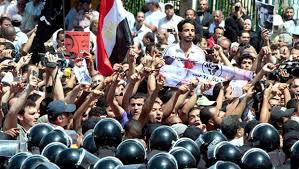
At this writing, Egyptian elites with grievances, including Nobel-prize winner, Mohamed ElBaradei, have lined themselves up with the people in the streets–vigorously.  The risks of doing so appear much smaller as the regime’s weakness is exposed, and the risks of not doing so, as the numbers in the streets increase, seem greater and greater.

At the same time, Egypt’s President Mubarak is throwing his Cabinet over the side, hoping to offer enough in the way of reforms to get at least some of the people out in the streets to go home–or into government.  (If press reports are accurate, the Obama administration is
Egyptian protests, 2011

encouraging him, privately and publicly, to do exactly this.)  The promise is that the dictatorship of the past three decades will end, but not just yet, and not this way.  The question is whether this reform is just too little and too late.

And the news of the revolutionary movements in Tunisia and Egypt has spread across the Arab world, encouraging authorities, dissidents, and bystanders to make new judgments about what’s possible.

Posted in Uncategorized | Tagged , , , , , , , , | Leave a comment

Beck and Piven, II

The ballad of the pundit and the professor continues to add verses as the story of Glenn Beck’s demonization of Frances Fox Piven hit the blogs, professional and activist networks and mass media.  It raises interesting questions about what a vigorous and honest political debate could look like.

As we’ve discussed recently, Beck has pointed to two of Piven’s articles, published forty-five years apart, to identify her as a great enemy of the Constitution and America more generally.  This new exposure has led to a rash of electronic insults, and scarier: detailed threats on her life.

Many of the mainstream reports have noted Piven’s age, as if to emphasize Beck’s hyperbole.  And she is, after all, a professor, so get a grip, such reports suggest.

Academics and others have called Beck out on tone.  An online petition directed to Fox News head, Roger Ailes, demands that the network rein Beck inThe American Sociological Association issued a statement with a similar appeal, although (thankfully) not emphasizing her age.  The academics call for a better informed and more civil debate.  (Of course, this isn’t the strong suit of cable news programming.)

Meanwhile, some conservatives have pitched in on another side, agreeing that she’s really awful, and her supporters are too.  Ron Radosh, a conservative historian, remarks with snark:

The editors of the leftist magazine The Nation, where Piven’s writings have appeared consistently since the 1960s, call her “distinguished professor, legendary activist, writer and longtime contributor to this magazine.” The last characterization is the only correct one, although, I’m sure she is “legendary” in their circles.

But this is nonsense.  “Distinguished professor” is Piven’s job title at the City University of New York.  “Distinguished” is surely a fair adjective anyway for someone who has been elected Vice President of the American Political Science Association and President of the American Sociological Association, and someone who has published many articles and books is certainly a writer.  C’mon.  The ad hominem (ad feminem?) stuff is ridiculous.

In the old days of network news, anchors and networks sought mass audiences, and policed themselves rhetorically for fear of alienating a large segment of the market.

The economics of cable are completely different.  Beck can make a lot of money for Fox News and for himself by serving an audience of around 3 million–a tiny fraction of the American public.  There’s no fiscal reason to temper the rhetoric–and every incentive to steer away from an informed discussion (bor-ring!).  Going after Piven (or random and marginal bloggers, as Bill O’Reilly often does) is a way for Beck to lean into his most aggrieved polemics without worrying that his audience might have an alternate understanding of the target.  And working politicians and commentators with other media outlets can get a lot of attention for themselves when they hit back.  In this way, his recurrent attacks on Woodrow Wilson–a former president of the American Political Science Association, as well as the United States, make a lot of sense.  Wilson is, uh, dead.

An academic, even a visible and prolific one like Piven, starts with access to a much smaller audience.  Beck enjoys the freedom to define her mostly unchallenged.

But do we want to shut down a debate on Professor Piven’s work in general or on her recent writing on the politics of unemployment? Piven has been trying to influence public debate and public policy for the better part of the last fifty years, at least.  Getting broad discussion–even vigorous argument about–and arguing about–the ideas she advances–is what she’s been after.  And, as they say in Boston, politics ain’t beanbag.

Mostly, however, the politics has dropped out of the discussion, and this is actually far more interesting and important than the bullying blowhard versus the pedantic professor.

The unemployed march in Minneapolis, 1934

Barbara Ehrenreich tries to bring back the issues in a piece in the LA Times, asking why it’s okay to call people into the streets to protect gun rights and the extraordinarily expensive hybrid health care system in the US, but not to advocate for policies that promote employment.

I’m going to be waiting on the answer to this one.

Posted in Uncategorized | Tagged , , , , , , | 2 Comments