The Klan is back (it never went away), in Memphis

Riding the bus to the rallyMembers of the Ku Klux Klan staged a protest rally in Memphis on Saturday.

They were protesting the City’s decision to rename three bridges.  The New York Times reports:

The old names were Confederate Park; Jefferson Davis Park, named for the Confederacy’s president; and Nathan Bedford Forrest Park, named for a Confederate lieutenant general and the Klan’s first grand wizard. The new names are Memphis Park, Mississippi River Park and Health Sciences Park, but the council may change those, too.


At first glance, it’s kind of amazing that the old names lasted as long as they did; the majority of Memphis’s population is black.

But it makes sense that the Klan would try to use this occasion to turn out its faithful.  The lost Confederate names are concrete symbols of exactly what drives Klan membership: white fears of the loss of status and privilege.  And perhaps citizen groups would turn out to counter protest, generating conflict and perhaps far more visibility to the Klan.  Clashes, arrests, and violence would generate national news and stoke that sense of threat that aids in mobilization.

But it was an overcast day.  The Times reports a turnout of about 75 demonstrators.  Police were determined to keep the event contained and non-violent.  Police cordoned off a section of the Downtown, and stationed officers in riot gear all around the contained area.  They bussed the Klansmen in from a local basketball arena, where they were asked to gather, searching the marchers before they could board the buses.  Although local authorities arranged for three buses, the Klan could only fill two.  The sound equipment they brought didn’t work very well, and even reporters had a hard time hearing the demonstrators as they marched in a fenced off protest pen.

Police asked residents to avoid the Downtown area, and promoted an Easter egg event on the other side of the city as an alternative.  A few counterdemonstrators came out to chant, but were separated by fences and a considerable distance from the Klansmen.  Klan chants, apparently, couldn’t be heard outside the immediate protest area.

The Commercial Appeal reports:

One Klan member who only identified himself as “Edward” wasn’t pleased with the event. “I wish it hadn’t rained on us, and that we hadn’t picked Easter weekend. We’d have had a lot bigger turnout,” he said.

Maybe.

The right to free speech, apparently, doesn’t include access to an audience.

Before you take too too much satisfaction in the KKK’s sad soggy mini-rally, think about what such police practices do to the causes you care about.

Posted in Uncategorized | Tagged , , , , | Leave a comment

Cesar Chavez birthday, Cesar Chavez holiday

Today, March 31, is Cesar Chavez’s birthday; the holiday was celebrated Friday.  In commemoration, I’m reposting some thoughts on the holiday, originally posted 2011.

On my campus, we commemorated Cesar Chavez Day early, yesterday, rather than March 31 (his birthday), by closing.  The state established the holiday in 2000, and six other states have followed suit.  In California, the legislature calls upon public schools to develop appropriate curricula to teach about the farm labor movement in the United States, and particularly Chavez’s role in it.

A campaign to establish a national holiday has stalled so far (The Cesar Chavez National holiday website seems to have last been updated in 2008), but last year President Obama issued a proclamation announcing a day of commemoration, and calling upon all Americans “to observe this day with appropriate service, community, and education programs to honor Cesar Chavez’s enduring legacy.”

Political figures have many reasons for creating holidays, including remembering the past; identifying heroic models for the future; recognizing and cultivating a political constituency; and providing an occasion to appreciate a set of values.  Regardless of the original meaning, the holidays take on new meanings over time.  Columbus Day, for example, is celebrated as an occasion for pride in Italian Americans (e.g.), and commemorated and mourned as a symbol of genocide  and empire (e.g.).

Cesar Chavez’s life and work is well worth remembering and considering, particularly now.  His career as a crusader was far longer than that of Martin Luther King discussed (here and here) and he was far more of an organizer than Fred Korematsu (discussed here).  Chavez’s Medal of Freedom was awarded shortly after his death in 1993, by President Clinton, but many of his accomplishments were apparent well before then.

As a young man, Chavez was an agricultural worker; by his mid-twenties, he became a civil rights organizer, working for the Community Service Organization in California.  With Dolores Huerta (at left), in 1962 Chavez founded the National Farm Workers Association, which later became the United Farm Workers.  Focusing on poor, mostly Mexican-American workers, Chavez’s vision for activism was right at the cornerstone of racial and economic justice.  Establishing an organization, however, is a long way from winning recognition and bargaining rights as a union.

Chavez was a tactician, a public figure, a charismatic, and something of a mystic.  Modeling his efforts after Gandhi’s successful campaigns, Chavez was an emphatic practitioner of active nonviolence.  He employed boycotts, strikes, long fasts, demonstrations, long marches, and religious rhetoric in the service of his cause.  He also registered voters, lobbied, and worked in political campaigns.  He was a tireless and very effective organizer for most of his life.

But holidays are best celebrated with an eye to the future, rather than the past.

On Cesar Chavez Day this year, we can think about the large and growing Latino community in the United States.  The 2010 Census reports that Latinos now comprise roughly 1/6 of the American population, and more than 1/3 of the population in California. This is the youngest and fastest-growing population in America today, and they are severely underrepresented in the top levels of politics, education, and the economy.   The civil rights map is at least as complicated as at any time in American history, but not less important or urgent.  (The struggle about the DREAM Act is reminiscent of the debate about Voting Rights 45 years ago.)  The future of American Latinos is very much the future of America.

And Chavez saw the civil rights struggle as a labor campaign.  When Chavez and Huerta started their campaign, nearly one third of Americans were represented by unions.  The percentage now is now just about 10 percent, and less in the private sector.

And public sector workers, even if represented by unions aren’t doing so well.  The ongoing conflict in Wisconsin is all about weakening unions that are already making very large concessions on wages and pensions.  The campaign in Wisconsin is part of a larger national effort, which is playing out in Indiana, Ohio, Florida, and elsewhere.  Even in states where anti-union forces are weaker, state employees face lay-offs, wage cuts, and increased health and pension costs.  Importantly, we need to remember that you can’t attack teachers, nurses, police officers, and firefighters without hurting the people they serve: us.

Or should I say, US?

Cesar Chavez’s birthday is an opportune time for thinking about Latinos, civil rights, and American labor, and not just the start of Spring.

Posted in Uncategorized | Tagged , , , , , , , | Leave a comment

Coming out and digging in

Public opinion data provides strong support for the coming out strategy that has been at the core of gay and lesbian activism for decades.

The graph on the left (right), where the lines cross, is a familiar one for anyone following the gay and lesbian movement.  More recent polls show support for same sex marriage as high as 58 percent–although, as marriage equality opponents note, turnout matters a great deal.

The generational break-down, at the right of the figure, should also be fairly familiar.  Younger people are far more likely to support same sex marriage.  This bodes well for the gay and lesbian movement over time.  Both same sex marriage supporters and opponents will be getting older over time; more of the opponents will, uh, no longer be engaged in the political debate.

But it’s not just generational replacement.

Pew also asked people who have changed their minds why they did so.  Although you should always take such results with more than a grain of salt, the most common explanation for shifting to support marriage equality was knowing a gay person.

When more people come out as gay or lesbian, or as the friend or relative of someone gay or lesbian, fewer people will be able to avoid knowing a gay person.

A little coda: popular culture matters here.  American television viewers know Ellen DeGeneres or those sweet snarky fellows on Queer Eye for the Straight Guy.  The friendly folks on television may spend more time in your living room, sort of, than any of your neighbors.

When GAY seems less odd, it’s increasingly difficult to justify discrimination.

Posted in Uncategorized | Tagged , , , , , , | 3 Comments

Supreme Court spectacles, football, and same sex marriage

No one should think that the oral arguments conducted today and tomorrow in the Supreme Court–or the decisions the Court will issue this spring–will resolve the evolving politics of gay marriage, and gay rights more generally.  The spectacle of the argument, however, gives advocates the opportunity and spotlight to weigh in on the issue.

On the steps of the Supreme Court building, activists for and against marriage equality demonstrated, holding placards, chanting, and arguing about the Constitution.

It’s unlikely that the demonstrators will influence the Constitutional interpretations of the nine justices who will decide the cases.  (Also interesting, but probably not influential, will be Jean Podarsky’s attendance at oral argument.  She’s a lesbian who wants to get married; Chief Justice John Roberts is her cousin.) But there are other audiences: reporters walking through the crowds to get a whiff of the arguments will have colorful footage of people who care a great deal about the upcoming decisions; there will be great pictures in newspapers online and off, and video all over the web.  Activists across the country will see their side fighting for them, know that they’re not alone, and hear about how important their efforts are.

Everyone else will get the opportunity to hear activist arguments about same sex marriage, which are less likely to emphasize Constitutional scholarship than personal stories and public values.  The Court argument gives activist a chance to make those arguments in a spotlight that isn’t always available.

Over 100 groups, USA Today estimates, filed amicus curiae briefs.  Ostensibly, this is about providing the justices with additional perspectives on the cases–beyond the voluminous briefs filed by the parties to the cases.  More significantly, the amicus briefs gives a range of interests a chance to weigh in publicly on the issue.  Briefs in support of marriage bans came from religious organizations and conservative political groups while briefs supporting marriage equality came not only from gay and lesbian groups, but also from business interests.  Don’t expect anyone to give up after the Court issues rulings.

The oral arguments also give mainstream media an excuse to cover the issue–again.  The Sunday political tv shows featured segments on the upcoming arguments, which offered not only speculation, but space for advocates to rehearse their arguments.  Baltimore Ravens linebacker Brendan Ayanbadejo  appeared on CBS News’ Face the Nation (http://www.cbsnews.com/video/watch/?id=50143470n ) explaining why he has long supported marriage equality; growing up as a multi-racial child and witnessing prejudice, Ayanbadejo says, he thinks it’s important to be attentive to civil rights and discrimination.  He’s pretty good on tv, particularly for someone who makes his living doing something else.  (But have you seen anyone more effective than Evan Wolfson, who’s been practicing his arguments for decades?)

Scott Fujita, another linebacker, got a prime spot for an opinion piece in the Sports section of the New York Times.  Like Ayanbadejo, Fujita also makes the analogy to racial discrimination, noting that his father’s internment during World War II raised his awareness of prejudice.  And he notes the far more recent, and awful, experiences of gay men and lesbians denied access to the legal and social benefits of marriage.  Fujita concludes:

I don’t ever want to explain to my daughters that some “versions” of love are viewed as “less than” others. I’m not prepared to answer that kind of question.

Instead, in just a few short years, and in the same way we now sometimes ask the previous generation, I hope my daughters will ask me: “What was all the fuss about back then?” I’m looking forward to hearing that question.

Ayanbadejo, Fujita, and punter Chris Kluwe, along with a couple of dozen other current and former players, filed their own amicus brief. The court case gives them, and many others, the chance to take an extremely visible public stand.  (At this moment, the football players have a chance also to offer an alternative view of football’s gender politics.  See Philip Cohen for an overview of a less attractive view.)

When the Supreme Court considers a case, it also provides many others not wearing judicial robes an opportunity to make a decision as well.  Senators Rob Portman (Republican, Ohio) and Claire McCaskill (Democrat, Missouri) and Mark Warner (Democrat, Virginia) made a point of weighing in before arguments were heard.  They’re all speaking to a broader audience than the nine justices.  Ultimately, that broader audience is likely to be far more significant.

Posted in Uncategorized | Tagged , , , , , , , , , , , , , , | Leave a comment

Coming out and opinion change

Senator Rob Portman, a Republican from Ohio, has announced a change of position on same sex marriage, presumably following a change of heart.  (Of course, it could go the other way as well.)  Senator Portman, formerly President George W. Bush’s budget director, and before that a Congressman who voted for the Defense of Marriage Act, says that he began reconsidering his stance when his son Will, then nineteen and at college, told his parents that he was gay.

The story asks us to think about how people change their minds and their positions, and also provides yet more evidence on the importance of the strategy of “coming out.”  (I’ve been thinking about this for a while….)

Senator Portman took two years to digest his son’s news and think about what it meant to Will, to America, and to his own political career. He spoke with other prominent Republicans, including those who had come to support same sex marriage, like former vice president Dick Cheney, also the parent of an openly gay child.  He finally decided that he wanted his son–and people like him–to enjoy the same opportunities that he enjoyed, including the chance at a marriage recognized and supported by the US government.  He wanted to go public before the Supreme Court considered a pair of cases on same sex marriage, but apparently not soon enough to sign onto an amicus brief submitted to the Court by a few dozen somewhat prominent Republicans.

I’m fascinated by the processes through which people change their minds, and surely, experience should matter.  Parents should be able to learn from their children–although there are more than a few stories of prominent figures who are unable to come to terms with their children’s sexual orientation.  (The sad stories of well-known conservative parents, including Phyllis Schlafly, Pete Knight, and Alan Keyes, who are estranged from their gay children, make for a long and melancholic read.)

Of course, we’d like to be able to develop empathy for people facing troubles that we haven’t personally encountered, whether discrimination, poverty, disease, or even crappy schooling.  (See Matthew Yglesias’s thoughtful commentary at Slate.)  And experience and empathy don’t always translate into political sympathy.  (Is Clarence Thomas still reading Politics Outdoors?)  No church should dismiss the slow converts.

Publicly changing position is another matter.  Senator Portman hasn’t exactly been a leader here; more people support same sex marriage now than oppose it.  But he’s stepped toward the leading edge of the Republican Party; certainly, he risks alienating key Republican constituencies.

Given the composition of their respective parties, it’s somewhat easier for President Obama to “evolve” on gay rights than Senator Portman; indeed, it’s pretty costly not to do so.  Evolution is dependent upon environment, as Darwin observed.  When Obama announced his evolution, Americans who valued his opinion on other issues were encouraged to evolve as well.  Portman will be part of a similar, but likely slower, process in the GOP.

Coming out brings a distant grievance closer, person by person.  Everyone who comes out makes it a tiny bit easier for the next person to do so, and a little bit harder for others to deny the issue–or the people attached to it.  Calling it safety in numbers is too simple, but larger numbers of people coming out does reduce the risk for all of them.

The coming out strategy for gays and lesbians is decades old, but it is not limited to them.  Undocumented young people who publicly announce their status are coming out, and taking substantial risks to do so.  People who put on a button announcing their politics, for a candidate or against a war, are coming out too, even if it’s usually easier to cover or remove a badge than a racial, sexual, or legal status.  Wearing a crucifix is also coming out.

Those who come out tell people who agree with them that they are not alone.  Those who don’t agree, well, at least they can no longer say that they don’t know anyone in that group.

Cabell Chinnis was one of Justice Lewis Powell’s clerks in 1986 when the Court considered Bowers v. Hardwick, a case about Georgia’s law criminalizing sodomy.  By all accounts* Justice Powell liked and respected him, and, while considering the case, told him that he didn’t think he’d ever met a gay person.  He didn’t know that Chinnis was one of many gay clerks who had worked for him, and Chinnis didn’t offer that easily available evidence to enlighten the justice.  Years afterward, he spent a lot of time wondering whether such a revelation would have made a difference.

Will Portman won’t have to wonder.

*A particularly good one is Joyce Murdoch and Deb Price, Courting Justice: Gay Men and Lesbians v. the Supreme Court.

Posted in Uncategorized | Tagged , , , , , , , , , , , , , , | 6 Comments

Template blinders: the where’s the movement question?

Anti-austerity protests have reappeared across Southern Europe.  Citizens are taking to the streets to protest cuts in services and high unemployment.  Where’s the protest in the United States, where we are embarking on new cuts in government spending (call it sequester) and unemployment remains high.

To ask the question suggests a misunderstanding.  There’s plenty of protest in the United States, although it is surely taking different forms than the demonstrations in Spain or Greece.

When most of us talk about protest movements, we have some kind of example in mind.  It

Madrid, February 23, 2013 (Reuters)

might be the Arab Spring events that ran across the Middle East and North Africa or the Occupy encampments, or, probably more commonly, the civil rights movement of the 1960s or labor organizing in the 1930s.

A signal movement becomes a template for each of us, and while we search to see it repeated, we risk missing what’s happening around us because what comes next is different.  This happens all the time.  Really.  It happened the other day:

Europeans have protested in dramatic and disruptive ways about austerity policies their governments are trying to impose.  You’ve seen the pictures of massive demonstrations, sometimes veering into confrontation with police and destruction of property.  HuffPost Live invited me to participate in  a discussion that was on the absence of such protests in the United States.  You can watch it here (discussion online).

The host kept asking why Americans don’t protest, but that’s wrong.  This was just days after 35,000 people turned out to protest the Keystone Pipeline, a month after the annual Right to Life March, and in the wake of the Tea Party and Occupy movements.

The complicated and perhaps unsatisfying answer is that austerity programs–and unemployment–are worse in Southern Europe than in the United States, and that we lack strong institutional actors invested in supporting such protests (look for a labor movement, to start).

The larger, perhaps more interesting point, is that tomorrow’s movements won’t be just what we expect, and if we focus only on what we call a movement in the past, we’ll neglect the meaningful politics of the present and future.  People will protest on the issues they care about and in ways that they think will be effective, and not follow old scripts or analysts’ directives.

The movements that spring up to challenge tomorrow won’t follow the recipes laid out by analysts or activists.  Every day, new campaigners demonstrate anew what democracy looks like.

Posted in Uncategorized | Tagged , , , , , | Leave a comment

Bloody Sunday and the uses of history

History isn’t just telling stories about the past; for most of us, it’s about making sense of the present.  Politicians, pundits, and activists invoke their understandings of the past to try to affect the future.

This Friday, March 7, marks the 408th anniversary of Bloody Sunday, when 600 civil rights activists attempted to cross the Edmund Pettus Bridge (which still stands, at left), leaving Selma, Alabama for a planned march to the state capital in Montgomery.  Representatives of virtually all of the major civil rights groups had been trying to organize for voting rights in Alabama–and throughout the South, and met little success.  Would-be voters were turned away from the courthouses when they tried to register, and activists were beaten by police.  One young man, Jimmie Lee Jackson, 26, was shot by a police officer, and died of an infection from the wound.

Activists set out from Selma to take their case (for justice for Jackson and voting rights for everyone else) to Governor George Wallace in Montgomery.  They didn’t get there quickly or easily.

Sheriff Jim Clark deputized every white man over 21 he could find, and massed them on the bridge, along with state troopers and local police.  The police ordered the demonstrators to disperse, and quickly attacked the activists.  Mounted police rode through the crowd, tear gassing and beating the demonstrators.  (At the bottom of the picture on the right you can see a brave, young, John Lewis, then leader of the Student Nonviolent Coordinating Committee.  He’s the one without a helmet or billy club.  He’s now a Congressman from Georgia.)

Supported by a court order from federal judge Frank Johnson, a march resumed weeks later, with 8,000 activists ready to cross the bridge.  By the time they arrived in Montgomery, on March 25, there were 25,000 civil rights activists.  Months later, in response to both continued activism and the energetic efforts of President Lyndon Johnson, Congress passed the Voting Rights Act.

It wasn’t only Jimmie Lee Jackson who paid a heavy price for this effort.  Seventeen people were hospitalized after the first march.  Days later, opponents of the march savagely beat three white clergymen who had come to support the civil rights effort, killing a young Unitarian minister, James ReebViola Liuzzo, a white activist from Detroit, was shot and killed by members of the Ku Klux Klan shortly after the march arrived in Montgomery.   In 1965, three men were indicted, but acquitted, for Reeb’s murder.  After being acquitted of state charges, three Klansmen were convicted of federal conspiracy charges and sentenced to ten years in prison for Liuzzo’s murder.  And on November 15, 2010 (!!!), James Bonard Fowler, formerly a state trooper, plead guilty to manslaughter for Jackson’s killing, and was sentenced to six months in prison.

The events leading up to the Voting Rights Act, long long ago, are worth remembering as the Supreme Court is now considering the Constitutionality of its pre-clearance provisions.  Last week, the Court heard arguments, and most observers saw five solid votes to strike down Section 5 of the Act, which requires designated districts to submit any proposed changes to voting rules and procedures to the Justice Department to certify that they won’t adversely affect the voting rights of minorities.

But all the action isn’t in the Court.  John Lewis returned to Selma again, as he has manytimes in the past, to commemorate the march and push the issues, and to weigh in on the Supreme Court case.  As you can see, at left, he wasn’t alone.  Just over Rep. Lewis’s right shoulder is House Majority Leader Eric Cantor, whose record on civil rights is somewhat less developed than that of his colleague.

And Vice President Joe Biden was there as well, warning about the coming court decision, and praising the 1965 activists for their courage, for their role in shaping his political attitudes, and for making it possible for a black man to be elected president.

When we retell these stories, we make the past live today–and it’s always about the future, surely as the Selma demonstrators, including Jimmie Lee Jackson, James Reeb, and Viola Liuzzo, would have wanted.

Posted in Uncategorized | Tagged , , , , , , , , , , , , , , , | 2 Comments

Civil disobedience and the Keystone to change

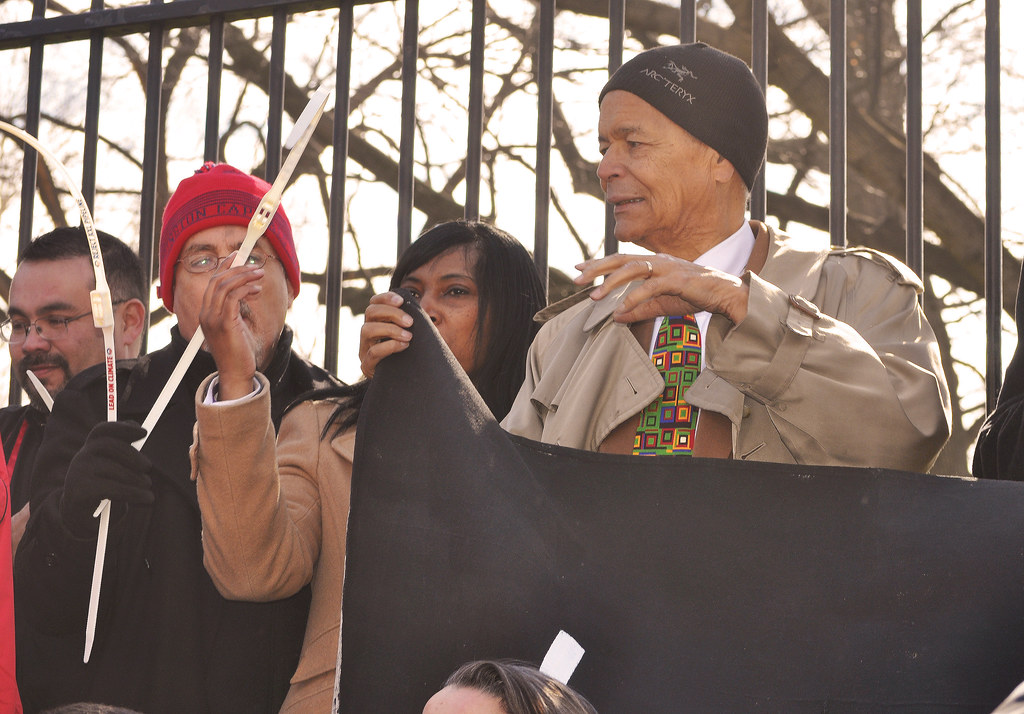
I was surprised that Robert F. Kennedy (at right) was the most tempting celebrity hook in coverage of the most recent civil disobedience outside the White House.   About 50 people handcuffed themselves to the gates out front and were arrested, and the story generated international attention.

The protestors, including Bill McKibben (350.0rg), Julian Bond (NAACP), actress Daryl Hannah (who probably would have been in most of the photos years ago), and Michael Brune of the Sierra Club.   The cause is the still unresolved status of the proposed Keystone XL pipeline, which will carry heavy crude oil from the Tar Sands in Alberta, Canada, to refineries on the Gulf Coast, where it can be processed, then transported, sold, and burned around the country.

Jim Hansen, the NASA scientist who has been sounding the climate alarm for decades, was arrested as well–but he decided several years ago that he needed to add civil disobedience to all else he was doing to address climate change.

President Obama mentioned the need for action in his State of the Union address, as he has before.  He was forceful enough to generate opposition from the Republican Party and the Oil Industry, but that doesn’t take much force or specificity.  Climate change activists say that stopping the Pipeline would be a first, modest, step in actually doing something.  As Bill McKibben, the writer and activist who’s been on this issue for decades, put it, “he Keystone pipeline project is the purest test of whether the president is serious about doing something about climate change or not.”

None of these people is getting arrested instead of taking other action on climate change.  Hansen has been writing academic papers and giving speeches and testimony, for example, while McKibben has been organizing groups, campaigns, and writing thoughtful and elegant books.  And Robert Kennedy Jr. has been working as an attorney for the National Resources Defense Council, seriously engaged with environmental issues for more than twenty years.

So, why spend a cold morning putting on handcuffs, only to have Washington police cut them off and replace them with a pair of their own?

It’s a mistake to think that this Keystone protest, one among many, will provide the critical moment that will change policy.  Instead, civil disobedience is a way to put climate change back on the political agenda in Washington (which is crowded with discussion of guns, immigration, jobs, and sequester, sequester, sequester).  The arrest, and Daryl Hannah helps here, is a way to get attention that yet another scientific paper or policy proposal will not.  But civil disobedience is effective only to the extent that it mobilizes others to take a range of additional actions.

A couple of interesting twists deserve comment here:

Historically, the environmental movement has been predominantly white and middle-class (and up).  Julian Bond (left), long ago the Communications Director of the Student Non-Violent Coordinating Committee, is no stranger to civil disobedience.  Most recently he was the longtime chairman of the NAACP.  Bond’ s presence represents an attempt to broaden and diversify the coalition of people active on climate change.

Michael Brune, the Executive Director of the Sierra Club, had his participation and possible arrest authorized in advance by his Board.  This is news because it’s the first time in the Club’s 120 year history that the group has participated in civil disobedience.  Why now?  Perhaps, as for Jim Hansen, the problem of climate change is so critical and the progress so slow, that dramatic action became more attractive.  There’s something else as well: choreographed arrests at the White House gates is now hardly so disruptive or alienating to potential supporters as it once may have seemed.

We watch now to see whether the action will affect the people who work inside the White House, or, more likely, whether the stories inspire people who see the pictures and read online, to do something else.

Posted in Uncategorized | Tagged , , , , , , , , , | 1 Comment

Remembering more of Rosa Parks

At The New York Times, columnist Charles Blow is promoting a new biography of Rosa Parks.  Jenane Theoharis’s The Rebellious Life of Mrs. Rosa Parks (Beacon) extends the story of the civil rights icon, undermining the myth of spontaneity surrounding the Montgomery Bus Boycott.

The popular version of the story recounts Mrs. Parks as a tired old lady who unexpectedly decided to resist a bus driver’s order to move to the back of the bus.  Citing Theoharis, Blow emphasizes the deep roots of Mrs. Parks’s activism: she was raised by a grandfather who supported Marcus Garvey, married to a long time civil rights crusader, and had served for more than a decade in a leadership role in the local NAACP.  In the summer of 1955, she attended a workshop on civil rights at the Highlander Institute, where she read about civil disobedience and the Brown v. Board of Education decision.  She says that she had decided to resist any directions to the back of the bus long before the opportunity presented.

Many years later, on a television game show, for example, or–more significantly–when she accepted the Presidential Medal of Freedom from Bill Clinton, she could be described as an old lady.  But that was 1996–forty years after refusing to move to the back of the bus.

The popular story makes activism seem like something that comes suddenly, out of nowhere, and unpredictably.  The fuller tale, just like the one about the Greensboro sit-in, shows that it generally takes long and focused efforts to create those seemingly spontaneous moments.

Posted in Uncategorized | Tagged , , , , , , , , , | Leave a comment

Lunch counter sit-in anniversaries

There was once a store called Woolworths.  It sold dry goods, mostly cheap stuff, including paper and pencils.  Many Woolworths also included a cheap restaurant where you could get coffee and a grilled cheese sandwich, also cheap.  Fifty-three years ago today, a Woolworths in Greensboro, North Carolina, was the site of a new phase in the civil rights movement, the beginning of the sit-in campaign.

On Monday morning, February 1, 1960, Ezell Blair, Jr., Franklin McCain, Joseph McNeil, and David Richmond, wearing their best clothes, went shopping at the Woolworths, bought some school supplies, then sat down at the lunch counter and tried to order coffee.  The four young men, freshmen at North Carolina Agricultural and Technical College,  knew the store wouldn’t serve food to black people, so they waited.  Woolworths shut the lunch counter down.

The next day, black and white students filled the lunch counter at Woolworths, and by the end of the week, every lunch counter in downtown Greensboro was filled with students protesting segregation–and organizing a boycott of the downtown businesses that practiced segregation.  Over the next weeks, sit-ins spread across the segregated South, led by student activists.

The four freshmen, no not the singing group, had all been active in the NAACP’s youth council, but none of them saw the large organization as a good foundation for a more activist and confrontational phase in the civil rights struggle. Pushed by the heroic Ella Baker, the NAACP launched an initiative to create a new student-based civil rights organization, the Student Nonviolent Coordinating Committee (SNCC), which staged dramatic education and direct action campaigns across the South for most of the rest of the decade.

Today is a great day to commemorate the sit-in movement, but anniversaries can be slippery.  When I tell the story to my classes, I usually start with the long Sunday night conversation when the brave young men talked themselves into action.  You could start the story much earlier, with the sit-ins organized by the Congress of Racial Equality (CORE) organized decades earlier, or with the sit-down strikes organized by the Industrial Workers of the World at the start of the 20th century, even before the founding of the NAACP.  You could also start the story with the Montgomery Bus Boycott and Rosa Parks, or the Brown v. Board of Education decision in 1954.  The Greensboro students knew all those stories.

Anniversaries help us remember important events and twists in history, but they invariably simplify longer and more complicated stories.  The drama of the Greensboro sit-in makes for a good entry into thinking about the civil rights movement, and into thinking about how regular people sometimes make history.  The names of Baker, Blair, McCain, McNeil, and Richmond are not particularly well-known today, not like those of Rosa Parks, Martin Luther King, John Lewis, or Thurgood Marshall.  The names of the thousands of young people crusading against segregation with them are even lesser known.  But movements are only possible and potentially effective with people willing to take risks without counting on seeing their names in the history books.

The lunch counter itself, or at least a portion of it, has been reassembled at the American Museum of National History (Smithsonian) in Washington, DC.  There are only four seats on display.  When we think about the civil rights movement, however, we need to extend the counter a long way.

Posted in Uncategorized | Tagged , , , , , , , , , , , , , , , , , , | 5 Comments