What Occupy Wall Street Learned from the Tea Party

This appears in the Washington Post’s Sunday Outlook Section.

[I’m fascinated by the range of responses in the comment section.]

The Occupy Wall Street movement, three weeks strong and gaining momentum, reminds us that tea partyers aren’t the only people unhappy with the state of the nation.

The two groups are angry about some of the same things, too, especially the government bailouts for big banks — a similarity that Vice President Biden observed in remarks on Thursday. They’ve taken different tacks for expressing their anger. The Occupiers are camping out in New York’s Financial District, while tea partyers have elected people to fight against government spending and deficits — and against regulations or oversight of businesses, small and big.

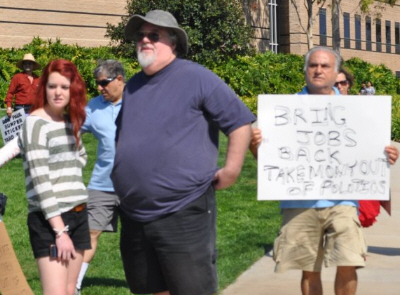
It’s not something they’re likely to claim credit for, but members of the tea party cleared the way for protesters on the other side of the political spectrum. The tea party demonstrated that protest works, even when government doesn’t.

Most people take to protest only when they believe it is their best hope for getting what they want. It doesn’t have to be extremely promising, just more likely to work than anything else. Nearly three years into President Obama’s term, the Occupiers have little reason to believe that their government is going to respond to their concerns. Washington seems stalemated, and the protesters’ priorities — addressing economic insecurity and political inequality — aren’t high on the agenda. So they’ve gone to Zuccotti Park in Lower Manhattan, camped out in front of Los Angeles City Hall and marched in Washington’s Freedom Plaza.

Not very long ago, this is essentially what the tea party was doing. Supporters started to appear at town meetings and rallies in 2009, demanding a more responsive government. Our political institutions, they said, no longer worked the way they were supposed to, and the concerns of regular people were being ignored. The Occupiers agree, although the regular people they represent look a little different.

The tea partyers’ success at the polls, ironically, made it even harder for the government to get anything done, as clearly demonstrated by last summer’s debt-ceiling debacle. The Occupiers watched, and learned.

One lesson was the virtue of audacity. The tea partyers who shouted down members of Congress at town hall meetings during the health-care debate in the summer of 2009 got massive media attention and built a national movement. The Occupiers went after the capital of capitalism, Wall Street, promising a long-term encampment and, more generally, to create a movement that would speak for the “99 percent” of Americans whose interests neither Wall Street nor the government is taking seriously.

Less than two months ago in these pages, I wondered where the movement on behalf of those suffering most in this stagnant economy was. I argued that for a powerful protest movement to emerge, large, established progressive organizations and labor unions had to invest heavily in organizing one. The Occupiers have so far shown otherwise.

The call to occupy Wall Street didn’t come from any of those well-funded and experienced groups, but from Adbusters, an activist magazine in Canada, and it was endorsed quickly by the hacktivist collective Anonymous. At first, the turnout in Lower Manhattan was small, far less than the 20,000 that the organizers predicted. Coverage from mainstream media was slight. Yet news spread online through many activist networks, and the protest continued, with dozens of demonstrators sleeping out on rainy nights, holding open a space for broader participation.

And it came. Activist celebrities and celebrity activists visited, and much larger crowds turned out for events including a march across the Brooklyn Bridge that disrupted traffic and led to more than 700 arrests. That made news around the world, and as mass media began to cover the protest and the stories of the people involved, new allies signed on to the campaign. Organized groups and individuals who couldn’t get to New York started other Occupy campaigns around the country, often relabeling events they had already planned.

The Occupation became a place where diverse groups could bring their grievances, as when hundreds of pilots marched, in uniform, against the very slow progress in their contract negotiations — and corporate greed more generally. National progressive groups and trade unions, which were initially wary of the Occupy effort, issued statements of support. This past week, Occupy Wall Street staged a much larger demonstration, its numbers swelled by the support of unions representing nurses, teachers, transit workers and others.

Just what the movement is is controversial. Stressing the need for consensus, the Occupiers haven’t settled on demands, expressing general criticism of inequality and telling personal stories about health-care problems, student loan and mortgage debt, and — over and over — unemployment and underemployment. Individual demonstrators have offered remedies, from tax reform to global revolution, but the Occupy movement has refused to settle on a narrow set of demands; instead, participants are demanding that others come up with answers to their problems. And it’s not hard to see a familiar left-liberal agenda offering solutions.

The Occupiers can’t control what happens next. As larger, more established groups join them, they are staking their own claims about what needs to be done, trying to contribute and ride the surge of discontent that the Occupiers have launched. MoveOn.org endorsed the protest, and Van Jones, whose brief, controversial tenure as an environmental adviser in the Obama administration eventually led to his national campaign to “take back the American dream,” credited the Occupiers with starting what might become a liberal counterpart to the tea party.

Politicians have begun to respond, as well. In Los Angeles, several City Council members visited the Occupation in front of City Hall before the council introduced a resolution of support. Mayor Antonio Villaraigosa sent 100 ponchos to the Occupiers’ tent city when rain came. Soon, the activists will want more than rain gear.

As with all social movements in America, this one will evolve as it grows. Some issues will come to center stage while others get crowded out. How the Occupiers are defined will determine their influence. Calls for progressive taxation or serious investments in education and jobs, for example, are likely to make for a larger coalition than a vague call to end global capitalism.

And what’s happening with the tea party? For the first two years of the Obama administration, it was the political right that was staging the colorful and visible demonstrations that made the news. In relatively short order, it marched into the Republican Party, invigorating electoral campaigns — at the expense of the grass-roots mobilization that first made headlines. National tea party groups, such as FreedomWorks and Americans for Prosperity, have raised more money than ever before and have been fully engaged in the Republican presidential primaries.

The large demonstrations that put the movement on the political map have tapered off. Tea party activists are struggling with how to reconcile their vision with the actual candidates for office, who will always be imperfect messengers. FreedomWorks, for example, protested outside a presidential forum sponsored by the Tea Party Express because Mitt Romney was participating. What’s best for the movement? A purist who won’t be elected? A well-funded, pragmatic candidate who, they fear, will sell them out once in office?

Obama is not being challenged for the Democratic nomination, so Occupy activists don’t face that same dilemma. They can press for what they believe in and watch as politicians try to deliver. They’re already trying. This past week, Senate Majority Leader Harry Reid (D-Nev.) proposed financing a jobs program with a surtax on millionaires. This might or might not be good policy; the Occupiers have shown, though, that it’s good politics.

But this movement is just beginning, and this is only the first political response. If the mobilization continues and grows, the offers will only get better.

Posted in Uncategorized | Tagged , , , , , , | 1 Comment

An Agenda for the Occupiers?

One of the gripes, cautions, criticisms of the emergence of a movement of Occupiers is the lack of a coherent agenda.  (I’ve also made these points.)

But take a look at We are the 99 percent

http://wearethe99percent.tumblr.com/

and see if you don’t think there’s a common agenda underneath the stories.

People report on unemployment and underemployment, student and housing debt, health care and insurance woes, and a general frustration with their perceived lack of political influence.


At this moment, there are 49 web pages of photos and personal stories.

Posted in Uncategorized | Tagged , , , , | Leave a comment

Report from Occupy LA

Erin Evans, a graduate student here at UCI, attended Occupy LA, and offers this report:

Like most activists who attended the Occupy LA protest on Saturday, October 1st, I was posting about the experience there on facebook throughout the day. Someone wrote on my “wall” the next day, “How was yesterday?” I replied, “Lots of people. Lots of good signs. Marching on the sidewalks, only. Lots of community, not so much anger. But I think things will rev up as the NY folks keep staying ground.”

We started in Pershing Square where the organizers had activists congregate and rally before marching to City Hall. Some friends of mine from the United Auto Workers, the union representing graduate students UC Irvine, were well accompanied by other unions, such as the Industrial Workers of the World. The IWW brought several large red and black flags that stood out amongst the pieces of cardboard most of us used, with slogans written in felt pens. It was a diverse group from the start, all of us mingling around looking for friends amongst the hundreds of demonstrators. It was a little surreal being around so many people from such different walks of life. Folks from Anonymous wore Guy Fawkes masks to signal their affiliation or solidarity with this otherwise clandestine, un-networked group of hackers. There were middle-aged folks with signs stating that “It’s not a crisis, It’s a scam,” and senior citizens with signs reading, “Not Too Old To Be Angry.” A very well dressed man held a sign with, “I am the 1% who supports the 99%,” and he appeared timid and nervous, for good reason. He was amongst a majority of signs slamming Capitalism. Like many mass demonstrations, the group that seemed most present was what Olbermann called “The over-educated and under-employed.” Peace punks with home made patches and mohawks.  “Hipsters” with mustaches, tight pants, deliberately messy hair, and charmingly dismissive demeanor.  People who looked like they just returned from Burning Man and were extending the affair into the protest realm. And people in themed costumes planning variations on street theater, like female reporters with death-mask face paint doing mock interviews throughout the day.

At 10:30am speakers, without megaphones, had the crowd chant instructions on remaining peaceful, remaining on the sidewalks, and remaining obedient to instructions given by organizers and police. It was difficult to hear what they were saying with so many people chatting and milling around, but most of the crowd chanted along and followed their instructions carefully along the march to City Hall. By the time we left around 11:30am there were 500-1000 people walking out of Pershing Square, on the sidewalks, only. This made the march a long and clumsy affair. (It felt like 500-1000, but I’ve read reports about it being more like 4000.)

We stopped at stoplights. We stopped for cars. At one point someone started chanting “Whose streets?! Our Streets!!” The crowd didn’t keep up with the call back, probably because it didn’t make sense. A friend walking behind me called out, “Whose sidewalks?! Our sidewalks!!” A humorous way to illuminate the frustrating irony of our obedience, especially in the face of what was happening in New York. We marched slowly and chanted peacefully down the sidewalks for about an hour towards City Hall. Once we arrived the crowd split into two entrances to the building, one on the North side and one on the West. They kept shuffling us around when thoroughfares got clogged.

There was a drum circle with dancers on the West side for most of the afternoon. A young guy with piercings gave me a sticker that said “Support Zombie Banking: Green, Selfishness, Excess, Indulgence, Gluttony” and asked me to put it on my sign. Two artists worked on an amazing painting for hours and drew wandering crowds of protesters as the picture evolved. Some people laid on the grass, some held signs for hours on end on the sidewalk, most took bottled water from volunteers, some bought food from a street vender, others left to buy food and come back. There was a massage train at one point that turned into a string of 20 people or so rubbing each other’s shoulders. Every once in a while an enthusiastic activist would hop on a bullhorn and rant for a few minutes, trying to get folks excited and chanting.

It felt like an outdoor festival, with a purpose. There was an agenda posted on the first aid booth with the afternoon of speakers and various events that seemed like a hodge-podge of activity to keep us from getting restless. At the end of the agenda it read that activists would leave City Hall, but the activists I talked to shared a common understanding that this one rule would be undoubtedly be broken. I was there with a few other grad students from UC Irvine. For most of the afternoon we sat and chatted, then got restless and decided to walk around the building to see what the police presence was like. We came across what I think was a conversation between a police liaison and an officer. “We’re expecting the crowd to stay about the same, but we moved people around the last two times you asked us to.”

The organizers, whose affiliation I couldn’t pin down concretely, were eager to keep the police placated, and the activists mobilized. That is a very, very difficult endeavor. On the opposite side of the building it looked like personnel were cleaning up after a police training of some sort. A bomb squad vehicle was in the middle of one of the blocked off streets, and on the lawn they were taking down a buffet table. They didn’t seem concerned with the protesters, which made me think they weren’t overtly there for the occupation. But it was an ominous display and, I suspect,  intentional. When we got back to the West side we sat in the grass and talked. A person in black-block (a method of disguise) sat with us and said some folks who were “more direct action oriented” were meeting later in the afternoon to plan something. I didn’t attend the meeting, but heard that some folks used chalk to write slogans on the City Hall walls. Before we left I saw two people scrubbing chalk off the side of City Hall. The leash was tight on militancy.

We talked about the Occupations in my discussion sections for an undergraduate Political Sociology course today. As most teachers know, students have sparks of exception insight that come when you’re bogged down in theory and jargon. I mentioned how the LA event seemed more symbolic than the New York event, and how that could be due to a number of factors. Maybe because there isn’t a location where the target is concentrated, as there is with Wall Street? Or perhaps because it was an event meant for solidarity, as opposed to causing affective disruption? Maybe it was something as simple as it being on a Saturday, when City Hall is closed? A student said, “Los Angeles’ bread and butter is symbolism, of course it’s gonna be a bunch of people putting on a show!”

I thought that was rather astute.

Posted in Uncategorized | Tagged , , , | Leave a comment

Wall Street, mass arrests, and media

Mass arrests on the Brooklyn Bridge are a good way for a protest campaign to break into mainstream media nationally.  Although Occupy Wall Street got some coverage in national outlets over the past two weeks, international news provided more extensive coverage.  Of course, movement sites, blogs, and Twitter provided even more coverage.

But upwards of 700 arrests near a national landmark is newsworthy everywhere.

And here’s the dilemma for activists: conflict, drama, celebrities, and novelty make news.  Alas, it generally doesn’t make for coverage of issues, and the things demonstrators do to get noticed may not bring them the kind of attention they want; they may look foolish, provocative, or deviant.  But polite, informed discussion of important issues by regular people isn’t so interesting to cover.

In one way, the New York Police Department’s mass arrest did the emerging Occupy movement a favor.

So, who was responsible?

The New York Times City room blog posted official police videos which clearly show police with megaphones warning demonstrators that failure to clear the traffic lanes will lead to arrest.

But it’s also very easy to find other videos on line that show police officers appearing to lead demonstrators into the roadway.

Watch a few videos and you’ll probably conclude, as I did, that police warned demonstrators and that many demonstrators thought they were following a safe demonstration route and received no warning of impending arrests.

These days, most large demonstrations are negotiated, even choreographed, in advance by the organizers and the police.  They permit locations, arrange for sound, and even identify zones where protesters can be arrested.  The leaderless Occupy Wall Street group hasn’t been negotiating with the police, and the open source ethos has allowed many competing messages to flourish within the ranks of the protesters.

This means less predictability–and more risk–for everyone involved.

Posted in Uncategorized | Tagged , , , , | 1 Comment

Off Wall Street and onto the police

A demonstration’s organizers win when media cover their issues as well as their events.  As the events in New York reach a broader audience, they also focus increasingly on policing.  Is this a victory?

Occupy Wall Street has inspired support across the country and drawn locals to events elsewhere in New York City, but the visible focus, always fuzzy, has moved from economic inequality to the police.   On Friday, more than 1,000 people marched on police headquarters in New York, protesting the videotaped pepper spraying of several demonstrators earlier in the week.

Yesterday, more than 1,500 set off across the Brooklyn Bridge; more than 700 people were arrested for blocking traffic when they veered into the traffic lanes.  The demonstrators say they were following the police.  There’s some credible suggestion that they were entrapped.  The New York Times (one of its freelancers was among the arrested) reports confusion, with some demonstrators thinking that the police were protecting them, while others wanted to claim the bridge:

There were no physical barriers, though, and at one point, the marchers began walking up the roadway with the police commanders in front of them – seeming, from a distance, as if they were leading the way. The Chief of Department Joseph J. Esposito, and a horde of other white-shirted commanders, were among them.

After allowing the protesters to walk about a third of the way to Brooklyn, the police then cut the marchers off and surrounded them with orange nets on both sides, trapping hundreds of people, said Mr. Dunn. As protesters at times chanted “white shirts, white shirts,” officers began making arrests, at one point plunging briefly into the crowd to grab a man.

With no authorized leaders, police can’t broker deals with the group, and the mass of demonstrators make their own choices about where to go and what to say without much in the way of guidance.

In the bigger picture, the Occupy Wall Street group, which includes considerable diversity in terms of goals and approaches to social change, can all agree on protesting pepper spray and mass arrests.  The question is whether this focus is good for an emerging movement?

Posted in Uncategorized | Tagged , , | Leave a comment

Occupied Wall Street

Some of the demonstrators who promised to stay at the protest on Wall Street until their one demand was answered nearly two weeks ago are still there.  Several dozen are camping out in Zuccotti Park, a private park nearby, and many others are coming to visit.  Among the famous (at least to left-liberal activists) visitors are Michael Moore, Susan Sarandon, and Cornel West.  Noam Chomsky has sent an endorsement, which is now posted on Occupy Wall Street’s website.

Just what that one demand is remains completely unclear.  The organizers are vigorously committed to some kind of grassroots democracy, and this has made settling on any one thing–or even agreeing on a menu of policy remedies–practically impossible.  (Prove me wrong on this one.)  There is a consistent general concern with growing income inequality in America and the grossly disproportionate political power of the rich.  The communiques from the demonstrators are said to speak for the “99 percent.”

Meanwhile, the business of business on Wall Street (and elsewhere) has continued, apparently uninterrupted.  Surely, some people who work downtown have stopped by for education, entertainment, or to express support, but the markets are unaffected.

So, what is it all about?  The protesters who’ve issued statements or appeared in interviews report on a range of individual and collective grievances with America, and sometimes with their lives.  The Wall Street action is the first chance they’ve seen to try to take collective action to make their worlds better.

The continued encampment has become a holder for grievances about inequality, the best site many people can find to stake their claims.  While some of the first protesters mean to start a nonviolent revolution to bring capitalism down, many other activists come with, uh, more modest goals.

More than 700 airline pilots marched in uniform, protesting the proposed merger between United and Continental Airlines, and stalled negotiations on their union’s contract.  In recent days, other unions have made appearances, showing support for the demonstrators and the action, and expressing their own spin on the political problem of inequality.

The persistence of the protesters, along with their resistance to settling on a small list of demands, has provided all kinds of other people with an opportunity to speak to broader audiences and to ride the anger and momentum of the protest–and public concern with inequality.  What the Wall Street action means, however, is still being negotiated through action.

There have been a few instances of very rough treatment by police, including aggressive use of pepper spray by a Deputy Inspector, all documented on videos that have gone viral–internationally.  The demonstrators are trying to balance ongoing protest against police brutality with efforts to reach  out to, recruit, and represent, the police.  It’s a difficult balance to manage, and longstanding local grievances with the police could overshadow the broader claims most demonstrators want to make.

A few issues that merit more attention:

1.  The Wall Street protesters have complained about being ignored or dismissed by mainstream media.  Although this may be a little overstated (see New York Times reports, for example), the protest has gotten much more attention overseas.  Most of the links above are from international media, and activist sites–and sympathetic amplifiers on Facebook and Twitter, have been much better at getting the word out.

2.  On Wall Street, activists have compared themselves to the Egyptian demonstrators in Tahrir Square, but this seems more than a little bit of overreach.  It’s certainly not clear that many want to bring the government down, for example.

3.  The Wall Street protest is already spreading, as allies around the country are staging their own occupations in Boston, Chicago, Los Angeles, and Philadelphia.  These aren’t yet massive groups, bu there are efforts in many many places.  See Occupy Together for an inventory of actions and links to sites and campaigns around the world.

4.  On the right, a great deal of activist attention has been sucked up in the Republican primary campaigns.  On the left, however, with President Obama unchallenged for the Democratic nomination, the Wall Street-style protests are the best bet that activists can see.  Expect more–for months.

Posted in Uncategorized | Tagged , , , , , , , , | 1 Comment

Irvine 11 verdict vindicates poor protest strategy

An Orange County jury found 10 students guilty of two misdemeanor offenses for disrupting a speech by the Israeli ambassador, Michael Oren, at the University of California, Irvine (my school), more than a year ago.  Superior Court Judge Peter A. Wilson sentenced the students to three years of unsupervised probation.  If the students each complete 56 hours of community service within the year, the probation will be suspended.

Orange County District Attorney Tony Rackaukas’s foolish choice to charge and prosecute the students for an uncivil disruption of a campus activity stretched the news cycle for the event over more than a year, gave a name and a public profile to a group of young activists, and created a national audience for their views.  It’s hard to think that this is what he had in mind when he decided to charge them.  (A cynical view would suggest that the District Attorney saw this as a good issue for building his own political career.)

In contrast, the DA’s decision helped the protest succeed far beyond what the activists could have reasonably expected.  Members of the Muslim Students Union wanted to challenge Ambassador Oren’s visit in particular, and Israel’s policies toward the Palestinians in general.  The “popcorn protest” (staggered fits of shouted denunciations) interrupted the talk, as one after another of the protesters was escorted out of the auditorium.  The Ambassador ultimately delivered his remarks and took questions.

Take a look at the video of the disruption, and see if you think the students’ arguments got out clearly:

The university disciplined the disruptive students (individual penalties are not public), and banned the Muslim Students Organization from campus for one quarter for organizing the protest and concealing its efforts.

It could have ended there, but the DA rescued the students’ cause by charging them.  A simple Google search for news of the Irvine 11 verdict generates nearly 500 hits at this moment, across the country and around the world.  The students got to make their claims about Israel and its ambassador in court, getting far more attention than they would have otherwise.  The trial provided a focus for organizing for the past eighteen months or so, as supporters forged ties with sympathetic lawyers, the American Civil Liberties Union, and journalists, and made their case broadly.  With an appeal on the horizon, this will continue, as activists plan next steps in response to the verdict.  (See http://www.irvine11.com/ for details.)  I expect that they will organize around the selective prosecution of this protest, which surely looks to be based on the ideas, rather than the actions, of the protesters, and make extremely credible charges about the DA’s political motivations.  In short, DA Racklaukas did more for the protesters’ cause than they were able to do on their own.

DA Rackaukas should have to answer questions about his office’s resources, when there are quite serious crimes (one recent example) that demand his office’s attention.  Judge Wilson’s sentence, taking into account the actual magnitude of the crime and the sincerity of the students’ beliefs, hardly justifies the past year’s effort by the DA’s office.

[We’ve discussed this case before, here, here, here, and here.]

Meantime, we should wait a second before signing onto all the claims the defendants are making about their actions and the law.  Just because DA Rackaukas is wrong, it doesn’t mean that the Irvine 11’s supporters are all right.  Free speech, as my colleague Erwin Chemerinsky has noted, doesn’t mean unrestricted freedom to shout down another speaker.  (Were the proto-Tea Party shout-downs at health care town meetings the best expression of American democracy?)  Sincere beliefs don’t immunize a person from criminal prosecution–even if we agree with those beliefs.  Stop for a second and think about someone whose views you despise who could make exactly those arguments.

And calling an action “civil disobedience” doesn’t protect the disobedient from trial or penalty.  (Henry Thoreau went to jail before someone paid his poll taxes; Martin Luther King went to jail dozens of times.)

I think the American Civil Liberties Union’s reaction, as reported by the Daily Pilot, was only partly right:

The executive director of the American Civil Liberties Union of Southern California said he is “deeply troubled” by the conviction and by the district attorney’s decision to charge the students with a crime.

“If allowed to stand, this will undoubtedly intimidate students in Orange County and across the state, and discourage them from engaging in any controversial speech or protest for fear of criminal charges,” Hector Villagra said.

“The extraordinary resources required for the criminal prosecution and trial of these 10 young men — including having the head of the district attorney’s homicide division leading the effort — would have been better used to fight crimes that endanger the residents of Orange County than to chill speech and discourage student activism,” he said.

Will the prosecution and sentencing have a chilling effect on free speech on campus, as Mr. Villagra suggests?  I’m not convinced.  Student activists for any cause will have learned that a small splash on campus can garner national (and international) attention and provide a stable platform for their ideas and organizing efforts.

Posted in Uncategorized | Tagged , , , , , | 1 Comment

Framing capital punishment

The execution of Troy Davis, a convicted murderer who proclaimed his innocence to the moment of his death, gave us a window on the practice of the death penalty in the United States.  But Davis was not the only person executed yesterday.

The state of Texas killed Lawrence Russell Brewer, a white supremacist convicted of killing a black man by chaining him to the back of his car and dragging him along a bumpy road.  Brewer didn’t make a statement before his execution, but reporters noticed a tear at the edge of one eye.  Brewer’s execution was in the news, largely as contrast to that of Davis, but the anti-death penalty movement did not trumpet the disturbing facts of his crime.

Advocacy groups pick their examples to dramatize the claims they want to make.  (See our discussion of poster children for the DREAM Act.)  Troy Davis, a black man convicted of murdering a white police officer, Mark MacPhail, helped the anti-death penalty movement make many points sharply.

There was no physical evidence in Davis’s case, and all but two of the non-police eyewitnesses from the trial recanted their testimony, reporting that they were pressured to implicate Davis.  Nine people have sworn affidavits that one of those who did not recant,  Sylvester Coles, was in fact responsible for the murder.

Davis’s case helps advocates raise issues of wrongful conviction, procedural fairness, and race–all in addition to general concerns about the death penalty.

Troy Davis won support from those who oppose the death penalty in general, like Amnesty International and Pope Benedict XVI, but also from those who generally support the death penalty, including former FBI Director William Sessions. The facts in the Davis case were so egregious that one didn’t have to oppose the death penalty to oppose his execution.

The Davis case became a focus for organizing against the death penalty, and groups protested and held vigils, while advocates explored every route for redress offered by the legal system.  They tried to stop the execution, organizing around the slogan, “too much doubt,” but–without doubt–many activists at the core of the campaign would oppose the death penalty in any case.

The advocacy point is that advocates for abolishing the death penalty could build a broader coalition with Davis’s case than with most of the people who are executed each year.  (Indeed, there are likely some people who generally oppose the death penalty prepared to make an exception in Brewer’s case.)

There is a moral case to be made against the death penalty, one that has never commanded a majority of public support in the United States–and indeed, probably not in most of the long list of countries that have abandoned the death penalty (list).  All other rich countries have done so.

Advocates haven’t abandoned the moral argument, but spend more time focused on additional arguments that might win additional support: the high cost of administering the death penalty; the possibility of wrongful conviction; and the racially disparate sentencing of people accused of crimes.

The death penalty has been on its last legs in the United States since the 1970s, when it was banned by the Supreme Court for four years.  (See the Death Penalty Information Center for comprehensive information on the practice of capital punishment in the United States.)  What’s not clear is how many executions will take place in the interim.

Full disclosure: My opposition to the death penalty began when, as a preschooler, I watched an episode of Superman in which Clark Kent, using his clandestine superpowers, conducted his own lie detector test of a man on death row who was, in fact, innocent.  That possibility, of wrongful conviction, was enough for me at 5, to be wary about government executions.  Although I’ve learned a fair amount about the practice of capital punishment since, nothing has shaken this view.

Posted in Uncategorized | 2 Comments

Roseanne takes it to Wall Street

Roseanne, the comedian, actress, producer, and a sort of populist progressive, dropped in on the Wall Street occupation, and delivered brief prepared remarks, then improvised.   I got the link from someone on Facebook, because her appearance didn’t make much of an impact in national news.

It’s hard to get a sense of just what’s going on in the Wall Street occupation, which has clearly drawn far smaller numbers than the initiators called for.  I got a brief report from a veteran of the 1979 protest, who expressed disappointment with the event and the state of progressive politics in general.  He said the numbers were small, the event disorganized, and the demands completely unclear.  The demonstrators projected entitlement, naivete, and political isolation, he said (I paraphrase).  To the extent the occupation has appeared in mainstream media, this evaluation seems common (Business Insider has published updates.)

These days, we don’t have to wait for a newsletter or memoir to hear what the activists say and think.   Occupy Wall Street has been publishing updates at least daily.  (I bet they tweet more frequently.)  And Global Revolution has been providing a livestream feed of events.  The story I’ve gotten is that a few people have continued the occupation, generating numbers in the low hundreds for events during the week, and a few people have been arrested.  Police haven’t allowed the demonstrators to put up anything resembling protection from the elements, like tarps and tents, and a few additional protests have sparked here and there.  Note that both Roseanne and Occupy Wall Street stress that the police, working people not big bankers or capitalists, are not the enemy, but potential allies.  It doesn’t look like that yet.

So, what are we to make of all this?  I’d note the critical importance of old-fashioned organizing, recruiting organizations and people, arguing about demands, and working the media, in getting a coherent event organized and a message out.  The attractive promise of base democracy and spontaneous events that the new media suggests practically means that all kinds of people with all kinds of politics can claim to speak for the protest, and those not yet deeply committed are unlikely to find ready handles to latch onto.  Meanwhile, bloggers working laptops powered by small portable generators can get their word out, reporting events that larger media outlets are well-prepared to ignore, but the audiences they reach are, uh, limited.

Wall Street has long seemed an attractive target for protesters, but it’s hard to go beyond the event.  In 1967, for example, the Yippies asked for a tour of the exchange and threw a few hundred (real and fake) dollar bills over the side of the gallery to watch the traders scramble; some did.  It’s good street theater–and there must be some good photos somewhere–but what was the political demand?  or impact?

It’s tough for activists to figure out a piece of global capitalism to challenge effectively.  (Meetings of supranational institutions like the World Bank, the G-20,  or the IMF have been great for events.)  Wall Street is a tough target, conceptually as well as physically.  All sorts of businesses go to the stock exchange to raise capital, including companies that claim to be green and humane.  Increasingly, with more and more training online and brokers offices scattered out to New Jersey and beyond, even making a show of trying to interrupt the practice of global business is more elusive.  And explaining what you want can seem inordinately vague–which is even worse than utopian.

Posted in Uncategorized | Tagged , , , , | 1 Comment

Took it to Wall Street

The financial capital of the United States is an attractive and difficult target for activists.  Nearly 32 years ago, on Sunday, October 28, 1979 (the anniversary of the great stock market crash), the antinuclear Clamshell Alliance staged a legal demonstration.  On Monday, activists staged a large civil disobedience action.  I was there.

To my surprise, I found little on the web about the demonstration and civil disobedience event (blog posts, archives, The Harvard Crimson, which was part of an antinuclear campaign which enjoyed significant successes (no nuclear plants licensed in the United States since that time.)  What follows are some recollections.  I welcome corrections from veterans and people who have better files.

Protests at nuclear plants and construction sites became common in the 1970s and, partly as a result, became less visible.  The movement against nuclear power was coordinated largely by regional coalitions, and was based around small local affinity groups of 10-30 people, who trained together and came to trust each other.  There was a radical democratic ethos that prized consensus, which made it very difficult for the movement as a whole to innovate.

The Wall Street campaign, coordinated by a “Manhattan Project” group, was an attempt to do so.  Cindy Girvani Leerer explains the thinking underneath the effort:

The time had come to move toward more decentralized actions that would target the economics of nuclear power and the funding of the Seabrook nuke in order to make the building of nukes less profitable and attractive, to make explicit connections with other movements to combat the “divide and conquer” strategy of corporate capitalism, and to promote conversations about building a nuclear free future and a better society. If money swears, we would swear back. This economic focus occurred on several fronts, including legislative challenges to passing “construction work in progress” charges onto consumers (see article on CWIP) and direct action educational campaigns.

This was the rationale behind the Wall Street Action, a direct action campaign focusing on both nuclear power and weapons as a symptom of an economic and energy system that exploited people for profit.  A group of Seacoast, NH Clamshell activists joined with activists from the War Resisters League in NY to develop the campaign which emphasized educating participants and the public about the economics of the nuclear industry and connections with other struggles. Organizers met with diverse groups to build a coalition for the campaign, eventually receiving endorsements from women’s, labor, Native American, African American, socialist, nonviolent, and anti-nuclear and environmental groups.

The Sunday demonstration (I recall a quote of 20,000 attendees) was much like other large events, with a stage, entertainment, and speeches.  The tight space made it feel more

Pete Seeger singing at Barack Obama's inauguration

intimate and intense.  Pete Seeger was there, as he often was, playing banjo and singing songs from the labor, peace, and civil rights movements.  (He was an old-timer then, with more than thirty years in cultural activism.  At right, he’s still doing the same thing.)  I remember somewhat better a younger singer, who wrote a song for the Wall Street event.  Here’s the chorus:

Take it to Wall Street, New York Town

Just ride right up in your limousine and sit yourself right down.

Grab a seat on the exchange with the Bulls and the Bears

It’s the Capitol of Capital, the Buck Stops there.

(It was a catchy, easy tune as well; readers will be glad that my technical ignorance will spare them my rendition of it.   I can find absolutely no trace of this clever song on the web. I think the singer/writer’s name was Al Giordano.  If this is right, he’s been an activist journalist for decades now.)

The protesters had all engaged in nonviolence training exercises, but the police were better prepared.  They closed off most access points, but allowed people who looked like they belonged walk through to work.  They filtered most of us out easily, but a few people in suits walked through and sat down on the street, awaiting arrest.  Daniel Ellsberg was one.

Some groups had come with chains and locks.  The police came with bolt cutters and buses.  They carried demonstrators who wouldn’t walk away on stretchers, and put them on buses to arraignment.  Most of the police were focused, purposeful, and polite.  On the buses, some even put on antinuclear buttons.  Over 1,000 people were arrested, and those who cooperated, providing names and contact information, were out of jail by nightfall.  Those who refused to cooperate spent several days in jail.  I believe most charges were dismissed.

The presidential campaign was already taking off, and both candidates announced their support for nuclear power.  Ronald Reagan won in a landslide, and the movement shifted most of its efforts to campaigns against nuclear weapons.

Remember, no nuclear plant has been licensed since.

Posted in Uncategorized | Tagged , , , , , , , , , | 5 Comments