Occupation is a tactic; violence demands innovation

Police and Occupiers in Atlanta and Oakland have engaged in violent confrontations, with the protesters getting the worst of it.  What’s all this mean?  What happens next?

Arrests at Occupy Atlanta

Let’s start at the beginning.  Protesters are occupying Wall Street–and hundreds of other public spaces around the country–to try to get something, although they differ on what.  The original call from Adbusters asked for Occupiers to focus on one demand, and to stay until it was met.  Now supporters suggest a variety of goals, ranging from drawing attention to economic and political inequality (score a check mark) to building a new kind of democratic political life from the ground up (more elusive).  Regardless, the Occupation was a means, not the end itself.

Local officials have varied motives for wanting to end the Occupations.  Surely, some don’t like the politics.  They also may not like the mess, the wear and tear on public facilities, the increased costs for police overtime, and the seemingly omnipresent threat of disruption.   But clearing them out isn’t simple or easy.  When New York’s Mayor Bloomberg gave notice of intent to clean Zuccotti Park, thousands of people, including members of several unions, poured into the site to defend the Occupation.  Brookfield Office Properties and/or the mayor backed off, and someone must have realized that the costs of using police to clear the area with mass arrests were just too high.

Officials in Oakland and Atlanta watched and learned something: they didn’t give much notice.  Late last night in Atlanta, police gave Occupiers who didn’t want to be arrested time to clear out, then hauled off the 50 plus demonstrators who remained.  Occupy Atlanta massed at the Courthouse, where the protesters were released on $100 signature bond.  Meanwhile, Woodruff Park is blocked off and Occupy Atlanta is planning a response.

Oakland was worse.  Early yesterday morning, well before dawn, police in riot gear cleared a few dozen Occupiers and their tents out of Frank Ogawa Plaza.  They set up a chain link fence around the park, and kept people away from the vigorous cleaning effort that started afterward.  Some of the protesters remained throughout the day, parking across the street, and a wide range of people and organizations issued statements condemning the closure of

Tear gas at Occupy Oakland

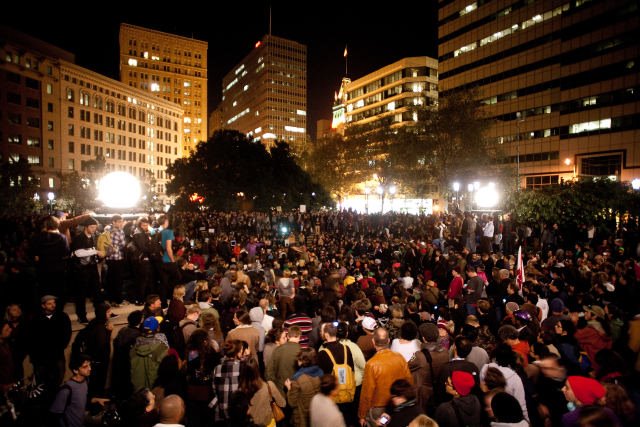
the Occupation.  By late afternoon, large numbers of people began to mass in an effort to take back the park, with at least 1,000 demonstrators assembling.  Police used tear gas, batons, and bean bag rounds (at least) in dispersing the crowd, and the demonstrators fought back, reportedly throwing rocks and breaking windows.  Occupy Oakland wants to take the park back.

The Occupy effort now enters a new phase.  All along, it’s been clear that police in most cities have the capacity to clear the Occupations whenever they were ordered to do so.  The demonstrators everywhere have consistently espoused an ethic of non-violence, but certainly not quiescence.  They’re not equipped to fight police effectively, even if they wanted to do so, but savvy public officials have been wary of …well, exactly what happened.

But what’s next?  While Occupiers have committed to resurrecting their camps, focusing on the Occupations now appears as a distraction from the claims that animated the movement in the first place.  Police action will intensify the commitments of some of the demonstrators, but some large portion of the 50-60 percent of Americans who express support for the movement are going to be reluctant to go to their downtowns and fight the police who, by many accountings, are part of the 99 percent anyway.  Meanwhile, be assured that critics of Occupy are downloading images and videotape furiously to deploy in their ongoing efforts to marginalize the effort to talk about inequality.

Occupy, or at least the broader emergent movement, needs to find new tactics for advancing its efforts.  I suspect some Occupations will remain for quite some time, but activists have to offer supporters other things to do in support.  The movement needs to innovate and diversify.  A few weeks ago, I noted the necessity of having an “exit strategy”, so that Occupy could continue as something larger than the Occupations.  This is how a movement grows, and it means bringing the core issues, inequality and justice, back to the front of the discussion.  Police action in Atlanta and Oakland has forced the issue: an effective movement can’t be only about building encampments in urban parks.

Posted in Uncategorized | Tagged , , , , , , , , , | Leave a comment

Pete Seeger’s on Wall Street

Ninety-two years old, Pete Seeger walked nearly forty blocks to join Occupy Wall Street and sing.    He needs canes to walk these days, but he played the banjo, sang, and brought along Arlo Guthrie, grandson Tao Rodriguez-Seeger, and other musicians.

For Seeger, this isn’t unusual at all.  I can’t think of a progressive movement since the Great Depression that hasn’t benefited from his participation.

In 1979, when I marched on Wall Street, Pete Seeger was there, conveying the blessings of a much older generation of activists on the antinuclear movement  (Here’s Al Giordano’s account.)

Of course, Seeger’s story is much longer, and much more complicated, too much to tell here.  He was a banjo player, a leader of sing-a-longs, a Communist, a Billboard hit-maker, and an American hero.  Here are some notes:

The son of a musicology professor and a classical violinist, Seeger dropped out of Harvard University to commit to activism and music in the 1930s.  He played to promote trade unions and civil rights, and served in the Navy during World War II.  Later, he would play for the civil rights movement, the antinuclear movement, and the antiwar movement.  In 1955, when called to testify before the House UnAmerican Activities Committee, he refused to name names, citing the first amendment to the Constitution, rather than the fifth amendment.  Blacklisted for a decade, he made a living playing at schools and summer camps, indirectly sending his take on folk music into the New Left.

Martin Luther King, Pete Seeger, Rosa Parks, Ralph Abernathy, and Charis Horton at Highlander Institute, 1957

All the while, he built institutions to promote folk music and an exceptionally democratic ethos of politics.  On the left, see a civil rights snapshot from the Highlander Institute, * where Seeger was a frequent visitor.  He was a key player in establishing contemporary folk archives, through the magazines Sing Out! and Broadside, and produced an easy introduction to the five-string banjo.

In 1967, the Smothers Brothers invited him to play an antiwar song on their variety show, adding to CBS’s grievances with them.  Network censors cut the song, so the hosts invited Seeger back to sing it again.  It’s below:

If there was a large demonstration, Pete Seeger was there; if there was a dramatic civil disobedience effort, not so visible, well Pete Seeger was there too.  When I start listing appearances, it’s hard to believe that he was only one person.

In the late 1970s, when I helped organize a benefit concert for an anti-hunger group, popular singer-songwriter Harry Chapin told us to get Pete Seeger to come out for the cause; he won’t be around forever, you know, Chapin said.  Chapin was killed in a car accident a few years later.

But Pete Seeger stayed around.  In 1994, he was recognized by the Kennedy Center for his contributions to the arts.

In 2009, he sang at President Obama’s inaugural.

I can’t guess what percentage of the Occupiers knew about Pete Seeger before his appearance this week.  When I ask people about him, I’m generally surprised by what small bits, if any, most people know.

I’m certain, however, that everyone who was there will remember it for a very long time.  The visit was a real link between a new movement and a much longer tradition of political activism in America.

* William Roy’s new Reds, Whites, and Blues: Social Movements, Folk Music, and Race in the United States, tells the story of the link between the protest music of the 1930s and the protest music of the 1960s.  Pete Seeger is a key figure.

Posted in Uncategorized | Tagged , , , , , , , , | 2 Comments

Occupy and the politics of blame

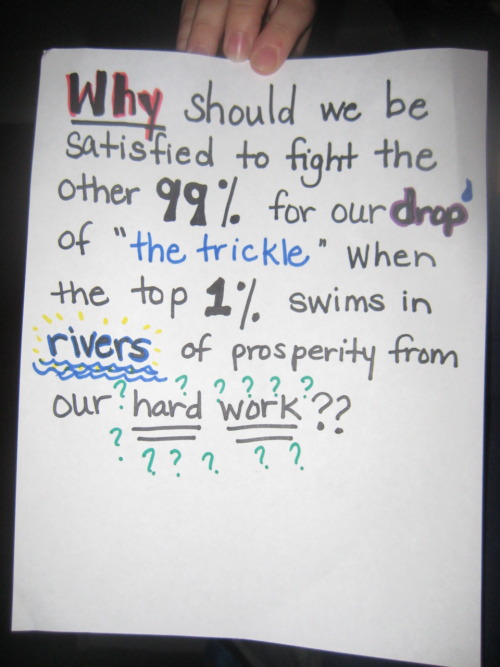
In wanting to speak for the “99 percent,” Occupy Wall Street–and its allied campaigns around the country–has defined a constituency and a target.  The argument is that the economy and government work for only a small percentage of Americans, and that things could be different.

To succeed movement campaigns identify a base and a target, framing their core constituency as worthy–and preferably numerous.  The target should be identifiable too.  Deciding whom to blame is a key task of all politics, including movement politics.

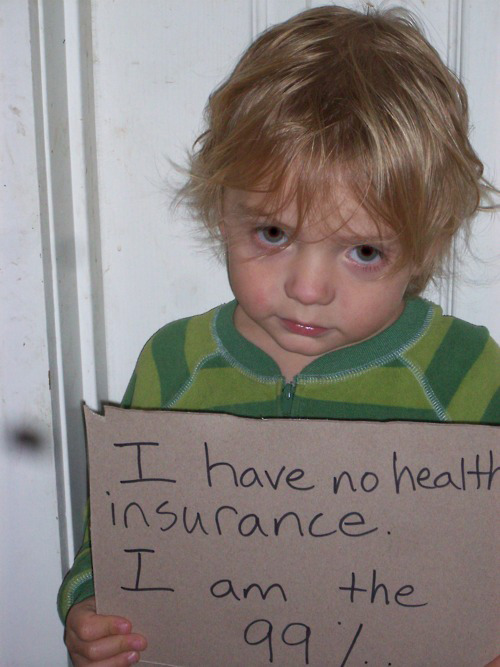
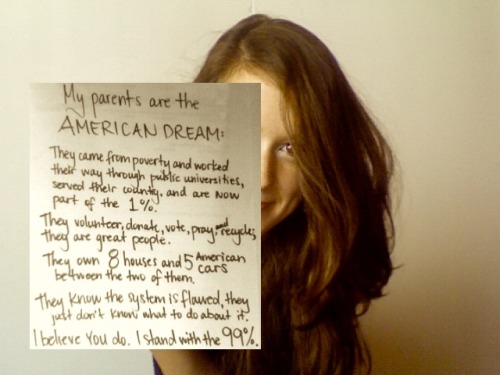
To embody the 99 percent, activists set up a website, “we are the 99 percent,” comprised of simple pictures and stories.  Mostly, it’s about hardship.  People who post tell about owing money for a house or an education, needing health insurance, unemployment and underemployment.  Although critics charge that Occupy doesn’t have a clear program, it’s very easy to look at these stories and see a set of policies that respond rather directly to their concerns; government can spend money to produce employment, access to education, offer health care, and even aid in personal debt relief.  At this posting, there are 146 pages of stories.  You may be able to dismiss one or another as telling stories of foolishness or selfishness, but the cumulative impact of story after story is powerful.  Together, the individual stories push blame up to those who are wealthy and powerful.

The site invites contributions, but some people who supported Occupy saw themselves as privileged.  “We stand with the 99 percent” tells stories of people who are not suffering personally, but believe that it’s good and right for the United States to find a way to provide work and health care for everyone.

This follows Warren Buffet’s call for higher taxes on the wealthy, endorsed by many others.  Wealth for the Common Good organizes the advantaged to press for government policies that promote employment and, more generally, spread the benefits of the economy more broadly.  (The incredible Chuck Collins has been working these politics for a long time.)

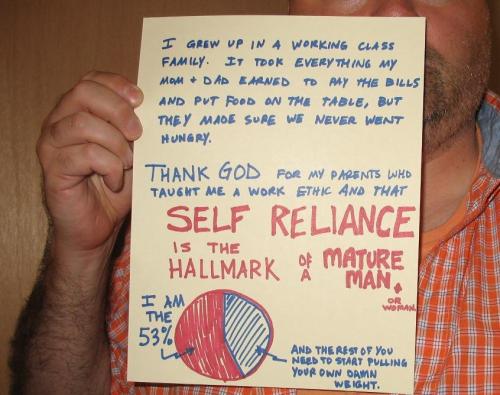
But opponents of the Occupy campaign, understandably, don’t want to let this pattern of blame stand unchallenged.  To counter Occupy rhetoric, conservatives started “We are the 53 percent,” which also invites individual contributions.  Fifty-three percent refers to the Americans who currently earn enough to pay federal income taxes–in addition to the payroll taxes that everyone pays, plus excise and local government taxes. This is an attempt to push blame down to the less fortunate, rather than upward.

Using the same format and colors as the 99 percent site, there are now 30 pages of 53 percent stories.  I read two basic types: people who are doing well, although they can trace humble origins, because they–or someone in their family–worked very hard; and people who are doing very badly, lacking jobs and/or health insurance.  Both take responsibility for their circumstances and hate whining.  They think those who claim to be the 99 percent are lazy and have an undue sense of entitlement.

So a group of Occupy campaigners, noting that many of the self-proclaimed 53 percenters don’t really earn enough to pay taxes, started “Actually, you’re the 47 percent,” which reprints the pictures from the 53 percent site, along with snarky and dismissive comments (3 pages at this moment).

An entire rhetorical battle about blame is playing out on these sites, offering plenty of stories to make any argument you want to make.  The stories strengthen the resolve of the committed, but more important, is the reaction of a broader public as the crystallized arguments hit mainstream politics.

The early returns are in recent polls, and the Occupiers are winning.  Fifty-four percent of Americans support the Occupy Wall Street campaign, according to Time magazine, about twice the percentage who support the Tea Party.  A slightly more recent National Journal poll shows Occupy with 59 percent support.

Don’t expect opponents to give up, however.  Look for new campaigns to discredit the Occupiers as lazy, violent, privileged, ignorant–or so many other attempts.

Activists for any cause wan to demonstrate their worthiness, unity, numbers, and commitment (WUNC, according to Charles Tilly).  Look for their opponents to try to dismantle each of those claims.

Posted in Uncategorized | Tagged , , , , , , | 16 Comments

How movements work: David Letterman

Social movements succeed by raising issues and giving other people the opportunity to address them.  We call this agenda setting, but it’s not just the agenda in Congress or a state legislature; it’s also what people talk about.

Bill Clinton appeared on David Letterman’s show last week and Occupy Wall Street was an obvious topic for humor and discussion.   President Clinton expressed some sympathy, reviewed how government could–and should–pay for what it does, noting that deficits exploded when President Bush engaged in two wars and cut taxes at the same time.  (It was self-serving, but everything he said was true.)

Letterman noted that it would make sense for people who were having a hard time to ask others, like President Clinton and himself, to pay more in taxes; it seems fair, he said. Clinton replied: no one should pay more taxes now, but once we’re really out of the recession, wealthy people should pay more.

President Clinton’s comments got more attention than Letterman’s, interpreted on conservative sites (e.g.) as an attack on Obama.

But think about what a shift the entire conversation represents.  Letterman doesn’t do politics routinely.  The Occupy campaign gave him encouragement to do so, and provided the former president with a chance to endorse the concept of progressive taxation, something that used to be well-accepted in American life.

Movements work when they change the boundaries of acceptable talk about policy options.  The Tea Party did this when it helped put the federal debt at the center of almost every debate–or rant–in Washington.  President Obama and Congressional Democrats talked the talk as well.

Now, Occupy Wall Street is now shifting the focus, and employment and fair taxation are now back in the conversation.  When House Majority Leader Rep. Eric Cantor has gone to promote his program for tax and regulatory cuts, he has suddenly had to respond to concerns about jobs, albeit not very effectively.

By no means is this enough for the people who are protesting, but it’s not over.

This is one way movements work.

Posted in Uncategorized | Tagged , , , , , , , , | Leave a comment

Occupy Irvine

I took my seven year old daughter to Occupy Irvine, a part of Occupy Orange County, on the lawn in front of City Hall on Saturday.  What follows is just one report on one relatively small event out of nearly 2,000 in the United States–with many larger and more volatile ones around the globe.

I expect that the protests are playing out somewhat differently everywhere, depending upon  what the place is like, how the police react, and who is organizing the effort.  Simply, the character of Occupy isn’t something created from nothing, but rather, will be connected to the political history of the relevant actors.

Irvine, where I live, sits in the heart of Orange County, the political birthplace of Richard Nixon and Ronald Reagan, and more recently, of the Minuteman Project, an organizing effort against undocumented immigrants.  My Congressman, John Campbell, is a conservative Republican, determined to cut government spending of all kinds; a strong Democratic candidate will poll 40% running against him–or any Republican.  Irvine is represented in the state senate and state assembly by equally conservative Republicans.

Although Orange County has changed over the years, mostly a function of immigration, it still isn’t a place you’d expect to be particularly fertile for a movement from the left end of the political spectrum.

Irvine is a planned city of just over 200,000 people, incorporated in1971, and comprised of 17 community associations.  It’s a mostly affluent community, known for its extremely low crime rate and the exceptionally high test scores public school students post on state-wide

Occupy Irvine

exams.  Irvine is home to numerous national corporate headquarters, as well as the branch of the University of California where I work.  There is little public transportation, and the City is laid out to avoid providing demonstrators with visible and disruptive places to protest; there is  no downtown.

In short, Irvine is a tough test for a movement from the left.

I  was surprised to see a large number of people (local newspapers estimated 600-1000); I knew several people were going to Los Angeles instead (about 75 minutes driving time), where they expected more interesting activities (this is the general plight of the suburbs).  More significantly, they looked like the range of people I see in grocery stores and at sporting events in Irvine all the time.  There were young people, to be sure, some with the Anonymous Guy Fawkes mask, but plenty of people who looked like whatever suburban stereotype you carry around.  There were older women wearing tee-shirts with political slogans, and gray-haired men with good haircuts and pastel polo shirts.

Organizers, some from Moveon.org, brought markers and cardboard, and people made signs.  (My daughter couldn’t find many kids her age, and organizers offered to let her draw.)  The sentiments looked like other Occupy protests (list): we are the 99%; banks got bailed out, we got sold out; time for an American spring; we’re not from the left, we’re not

Irvine City Hall

from the right, we’re from the bottom and we’re coming for the top.  And many many more.  Some focused on local targets, calling for an oil extraction tax to fund  public schools, for example.  (This was my favorite.)  There was a band, and a large drum, but only one, and I didn’t hear anyone play it.

The notes making up the Occupy chord were a little too diverse to offer a clear tone.  I noticed perhaps a half-dozen Oath Keepers (a group of current and former military, police, and firefighters determined to defend their vision of the Constitution, a similar number supporting Ron Paul’s presidential campaign, and a couple of LaRouchies with a very large banner covering the most visible corner.  Someone was handing out leaflets about ending the fed, while another was handing out leaflets advising people about how to deal with the police (don’t talk!).

It’s not odd to see counter-protesters at a large event, or marginal efforts seeking an audience.  What seemed different here was that both the majority of activists and the conservative contingents treated their simultaneous presence as something of a momentary populist alliance.  I don’t believe an alliance this broad is sustainable or potentially influential; I don’t think many of the activists do either.  But this was a different kind of politics day.

Drivers going by honked out support, but it was hard to tell who they were supporting.  Most of the demonstrators at the  first rally walked a long march on a major thoroughfare on a hot autumn day.

On Saturday night, Occupy Irvine’s Facebook page reports, a much smaller group of a few dozen held their first General Assembly meeting, making plans for a long camp-out at City Hall.  They stayed the night, but local police prevented them from sleeping, and they await a ruling from the City Council about their planned Occupation.

The most vigorous organizers seem committed to figuring out how to stage a long time occupation.  More interesting, at least to me, was the broad swath of support for the general Occupy claims about inequality, and the eagerness of many people to try to do something.

Posted in Uncategorized | Tagged , , , , , , | 3 Comments

Wall Street still occupied!

Maybe it was the petitions to stay the eviction bouncing around the internet (Moveon.org had one) and gathering tens of thousands of signatures in short order.  Maybe it was the Occupiers’ new Good Neighbor program–accompanied by vigorous cleaning efforts.  Maybe it was the strong support from the AFL-CIO, which included encouraging thousands of union members to join the Occupiers to make eviction more difficult and costly.  Maybe the management at Brookfield suddenly realized that this current use for Zuccotti Park was an even better contribution to the quality of life in New York City than an open urban space.

Maybe Mayor Michael Bloomberg assessed the costs, financial and otherwise, of a contested mass eviction, accompanied by hundreds (at least) of arrests, and thought about alternative ways of dealing with the Occupation.  Whatever else he is, Mayor Bloomberg is a smart and pragmatic politician.   If the Tahrir Square analogy commonly thrown around is mostly inappropriate, he certainly didn’t want to make Tiananmen Square an analogy that fit better.

In any case, this morning Mayor Michael Bloomberg announced that the cleaning would be postponed and that police would not be removing Occupiers–unless they broke the law.  Delighted, the Occupiers claimed a victory.

You can see the delight–and relief in the video above.

But the postponement is a small tactical victory.  The point can’t just be to maintain a semi-permanent outdoor campground in New York’s financial district.  To the extent public consideration of the Occupy effort focuses on tents, trash, and toilets, certainly understandable at the moment, the campaign is missing the moment.

Occupy Wall Street has opened a much broader consideration of economic and political inequality in the United States, and the campaign succeeds only as much as it feeds this emerging debate.

Posted in Uncategorized | Tagged , , , , , , , | 1 Comment

Pushing out Occupy Wall Street

Political and practical opponents to the Zuccotti Park Occupation are now visible on the horizon.

The political opponents probably help.  National Tea Party organizations have begun to use Occupy as an occasion for fundraising (as Robin Pravender and Kenneth P. Vogel report in Politico).  Sal Russo, of Tea Party Express, the most effective electoral arm of the Tea Party, has dismissed comparisons with the Occupiers, calling them “laughable.”  FreedomWorks’ Brad Steinhauser has focused on the Occupiers’ tactics, comparing them to Malcolm X and Stokely Carmichael, while reserving Martin Luther King as a better comparison for the Tea Party.  (This is OBVIOUSLY so ridiculous on so many levels that I will leave it to you.  My first comparisons are here.)

Although Occupy may help these groups raise money, this effort will encourage a broader public to polarize–and the Tea Party just isn’t that popular with most Americans.  There will also be a battle about defining just which movement represents real America. You’re known by your enemies as much as by your friends.   (This “real America” label is also silly.  The retired pharmacist who’s never engaged in politics; the young woman with a fresh college degree and student debt unable to find more than minimum wage work; the thin and bearded anarchist rambling on about democracy; the armed woman railing on about illegal immigration—they’re all American.  The lists–it’s just like Walt Whitman said.)

The practical threat is more dangerous.  Mayor Michael Bloomberg has announced that Zuccotti Park needs to be cleaned, and that activists have to clear out by Friday morning.  The demonstrators can return, he’s said, but not with tents and sleeping bags.  (Yes, Mayor Bloomberg said a few days ago that the protesters could stay indefinitely.)

Conservative media hype the mess

Releasing a letter from Brookfield Office Properties, which owns Zuccotti Park, the Mayor says that this maintenance is necessary to preserve the park.  The Occupiers view their removal and the cleaning as an effort to get them out, and thus, a threat to their survival.

Three thousand miles away, I’m prepared to believe that they’re both right.

Occupy Wall Street has responded on two fronts.  First, the group has announced a resistance campaign that will include non-cooperation with the police, as well as letter-writing, phone calls, and public engagement.  Second, the Occupiers have announced their new Good Neighbor Policy:

OWS has zero tolerance for drugs or alcohol anywhere in Liberty Plaza;

Zero tolerance for violence or verbal abuse towards anyone;

Zero tolerance for abuse of personal or public property.

OWS will limit drumming on the site to 2 hours per day, between the hours of 11am and 5pm only.

OWS encourages all participants to respect health and sanitary regulations, and will direct all participants to respectfully utilize appropriate off-site sanitary facilities.

OWS will display signage and have community relations and security monitors in Liberty Plaza, in order to ensure awareness of and respect for our guidelines and Good Neighbor Policy….

Note: In conjunction with local community members and their representatives, OWS is also working to establish off-site sanitary facilities such as port-a-potties.

The Good Neighbor Policy is unlikely to satisfy Brookfield or many of the local merchants.  More significantly, the New York Police Department is certainly capable of evicting hundreds, even thousands, of non-violent protesters and blocking off the park–even if it means mass arrests.  This will be a story for a few days, but if Occupy Wall Street becomes focused only on Zuccotti Park, the emergent movement loses.

The Occupiers need to find a way to maintain their efforts absent the first Occupation.

Posted in Uncategorized | Tagged , , , , , | 2 Comments

Occupy Wall Street needs an exit strategy

Starting a large enterprise without having a clear idea of how it could end is risky and dangerous.  (Ask George W. Bush about the wisdom of plotting an exit strategy.)  Now that Occupy Wall Street has succeeded in getting public attention and spurring like-minded efforts across the country–and maybe the world–activists need to think about how they want to get out of Zuccotti Park.

New York’s Mayor Michael Bloomberg, no friend of the occupation, and not a member of the “99 percent” by any accounting, is not the immediate problem.  Bloomberg has announced that the Occupiers can stay as long as they obey the law, suggesting that when the weather gets colder, they’ll want to drift off.  My hunch is that many of the Occupiers are heartier, more committed, and experienced enough in winter camping to hold on.

But is a democratic community based on using toilets at local fast food restaurants sustainable–or even desirable?  (See Samantha Bee’s Daily Show piece on the Occupiers and their neighbors.  The Christiania encampment in Copenhagen, which has mostly survived for forty years, provides a cautionary tale.)

Adbusters’ initial call to Occupy Wall Street asked for demonstrators to agree on one demand, and then stay until it was met, but it’s hard to see how that’s relevant–or even possible at this point.  The Occupiers’ intense focus on inclusion and democracy will make coming to any one consensual demand–aside from allowing the Occupation to continue–much less one that could actually happen–could emerge.

So, what could happen?  Complaints from neighbors or from Brookfield Office Properties, which owns Zuccotti Park, could bring the police in to break up the encampment.  Activists would then have to find a way to resurrect the Occupy movement without an occupation, arguing all the while about their right to stay in the park.

Alternatively, a few stalwarts can remain encamped near Wall Street while many others move on to other projects.  Those who stay will work to maintain a community, and their concerns will, unavoidably, focus on that goal, which means talking about their own self-governance, food, shelter, and power (electrical more than political).  This will become less and less interesting to mass media or the rest of America.

Ongoing protest outside the Lorraine Motel

Think, for example, about Jacqueline Smith, who has maintained a vigil outside the National Civil Rights Museum since 1988, when she was evicted from the Lorraine Motel, which now houses the museum.  Smith said that Martin Luther King, who spent the last night of his life in the motel, would have wanted the money and space used for something more than commemoration, like affordable housing.  She calls for a boycott of the museum, which claims more than three million visitors.

More than twenty years on, local passersby rarely raise an eyebrow at her encampment and signs; the protest continues, but without much attention, and even less visible impact.

Protest is powerful when it breaks through routines to draw attention to a set of issues, but new routines can cloud those issues again.  The Occupy campaign has already been spectacularly successful in putting the issue of economic and political equality square in the middle of policy discussions.  When this moment passes, however, activists need to find a way to maintain that focus without relying on a presence in a small public private park near in the financial district.

It’s worth thinking about this now.

Posted in Uncategorized | Tagged , , , , , , , | 4 Comments

Managing the fringe

When an estimated 100-200 antiwar activists marched on the National Air and Space museum this weekend, they took the Occupy DC name.  Occupy DC, in turn, was a name claimed by already organized groups of activists who wanted to demonstrate solidarity with Occupy Wall Street.

In fact, Stop the Machine, the antiwar group, had planned this demonstration well in advance, and had displayed a tighter focus, on the war in Afghanistan, than most of the Occupy efforts.

Some of the demonstrators tried to rush the guards, and to get into the museum to protest an exhibit on unmanned aircraft (drones), like those the armed forces are now using.  The ensuing standoff led to guards pepper-spraying somewhere between one and twenty of the demonstrators, and shutting down the museum for the rest of the day.

The shutdown was a great opportunity for opponents of the Occupy effort to discredit the campaign, emphasizing its disruptive intent and its aggressiveness.

The most aggressive and disruptive of the protesters, by his own account, was Patrick Howley, an assistant editor at the American Spectator, an extremely conservative magazine.  Howley explains that he had (easily) infiltrated (read: joined) with the express intent of getting them to confront the police and discredit the larger movement.  Howley explains, and recounts his vision of the event on the Spectator’s blog.

According to Howley, the siren song of the radical left is strong, particularly when carried by large numbers of attractive young women.  Alas, as he tells us, the demonstrators were timid about confrontation, but he was able to demonstrate his protesting virility by getting past the guards and provoking pepper spray.  Whether the museum would have been closed without his efforts is an open question, but I’d think that anti-Occupiers would be wary about using this particular example in their rhetorical campaigns.

With our without Howley, however (and I’d guess the Spectator will consider continuing without him–isn’t it, after all, a journalistic enterprise?), one problem he demonstrates is a common one for movements in the United States.

Every social movement draws up some people so intensely committed that they will say–or do–something that would offend the great majority of people in that movement.  Sometimes those word–or an action–can discredit the movement as a whole.  But movements, particularly those with a democratic ethos, have a hard time policing their boundaries.  You “join” by showing up at something or doing something, claiming the name or cause.

Tea Party activists worked to purge their rallies of racist signs, and I can’t believe that most of those demonstrating outside the Capitol approved of throwing racial epithets at members of Congress, much less spitting at them.

The first defense is denial: there were no racial slurs, there was no spitting.  Political opponents will lie about you to discredit you–even if they’re members of Congress.  (Take a look at the video below and see if you can explain Rep. Emmanuel Cleaver’s walk up the steps without a screaming spitter’s intervention.)

The second denial defense is that the offender really wasn’t one of us, but was operating on his own.  The antiabortion movement, for example, worked hard to disown Paul Hill, particularly after he shot a doctor who performed abortions.  (Hill was convicted of murder, and executed in 2003).

But movements are stuck with their crazies–at least politically.  Although they want to tuck in or cut off the fringe, this is far easier said than done.  And the  larger a movement grows, the more likely it is to engage at least some zealous people who, uh, don’t help.  This is particularly true for an effort like Occupy, which is so determined to remain open and democratic, and, they would add, nonviolent.

Whether the Occupiers will be tarred by the museum protest, legitimately or otherwise, be assured that something else will happen, that their opponents will point to in order to discredit, dismiss, and marginalize the emergent movement.

The very difficult response, particularly for a democratic movement, must be taken in advance: it is to put forward, consistently, a clear focus on issues and sharp parameters on acceptable political tactics.

Posted in Uncategorized | Tagged , , , , , , | 2 Comments

Occupy Wall Street versus the Tea Party (I)

Perhaps predictably, the comments section of the Washington Post in response to my op-ed has provided a space for typists to rail against me in making their own political points.  The notion that I would dare to compare the Occupiers and the Tea Partiers, particularly, has appalled respondents on the left and right.

Tea Partiers are angry that I would compare a bunch of unwashed and lazy moochers, ready to disrupt and break the law with upstanding employed people who are petitioning, sometimes with their feet, to reign in government.

Politico comparison of Tea Party and Occupy movement

Sympathizers with the Occupiers report that I don’t understand how the Occupy effort is an effort to build democracy–while the Tea Party is bought and paid for by large money, and is essentially a surrogate for the right wing of the Republican Party.

The protesting people you like are authentic and provoked; those you disagree with are deceived, doing someone else’s bidding (big business or ideologues), stupid, and/or selfish.   It’s too hard to recognize the possibility of sincerity and good will from your political opponents.  (I must confess, however, that I don’t believe that I’m getting flack from both sides means I’m right.)

What’s the same?  Both movements, one well-developed and institutionalizing, another emergent, represent substantial groups of people, angry about governance and the economy, who’ve taken to the streets as their best hope of effecting influence, taking politics outdoors.  To make an impact, they will have to inspire and/or coerce support from people fully engaged in more institutional politics, where they each have allies.

That said, the differences are significant: Two lines that the editors cut from the Post piece:  While the Tea Partiers dragged lawn chairs to large rallies, the Occupiers carried sleeping bags, planning for a longer stay. Images from the Occupy Wall Street movement show a younger and more colorful America than Tea Party projects.

Neither point is as trivial as it might seem.  Tea Party supporters ARE older, whiter, and more affluent than the rest of America.  We don’t have comparable data–yet–from the Occupy movement, but the pictures and issues clearly show a larger share of people in the early stages of their working life, and a larger share of people who aren’t white.  The Occupiers are strongest in large cities.

America is changing demographically, something that at least some of the Tea Party is fighting, trying to appeal to an imaginary past, rather than recognizing the world as it is.  The Occupiers are deeply steeped in the travails of the present (see the grievances at we are the 99 percent), and at least some visible portion of those at Wall Street are heavily invested in an imagined (democratic) future that appears utopian.

The inspired visions, of a strict Constitution without the baggage of the real historical Constitution (slavery, for example), or decentralized democracy with grassroots participation and widespread engagement, animate the action–and especially the rhetoric–of many protesters, but movements operate in the present, with extremely pragmatic constraints.  History doesn’t end either way.

With the Republican establishment largely out of power at the outset of the Tea Party, party operatives and organized groups were quick to invest in the emergent Tea Party.  Freedom Works trained organizers across the United States and produced scripts for disrupting the town hall meetings of 2009.  The support of large business interests, most dramatically represented by the billionaire Koch Brothers, provided a deep pocket to invest in one set of ideas and a social movement strategy.  Recall the surge in sales for Saul Alinsky’s Rules for Radicals, as conservative activists promoted the virtues of organizing.

Well-established groups rebranded themselves as Tea Party campaigns to raise money and their public profile.  Sal Russo’s Tea Party Express was a conservative PAC called Our Country Deserves Better; the movement changed the names, but the activity–funneling money into political campaigns–stayed the same.  And national Tea Party groups have been incredibly successful at raising money.

The Tea Party also enjoyed the active support of a segment of mainstream media, most obviously, Fox News, which promoted its events and consistently offered a favorable interpretation of Tea Party activism.  There is no comparable analogue on the left.

I do not mean to suggest there isn’t real grassroots activism out there on the right.  The Tea Party appeals found strong support from frustrated Americans, and the passionate endorsement of a significant minority of Americans.  Real money and organizational skill couldn’t produce a movement without some public resonance, which the Tea Party demonstrated.

Now, however, Tea Party efforts have moved to focus on electoral politics and Washington lobbying–at the expense of the grassroots.  Tea Party Express chair Amy Kremer explained that shift as reflecting the Tea Party’s growing up: “The movement has matured, and we have learned that having a rally, it’s great, it attracts people but it doesn’t affect change just because you’re out on the lawn or 20 days and 20 nights.”

The move to conventional politics helped the national groups make the movement’s apparent focus the debt and deficit, and channel opposition to taxes and regulation–and not issues many local groups preferred, like immigration, social concerns, or the Federal Reserve.  The battle to define the Tea Party continues, now through the Republican primary season.

Occupy Wall Street came from outside of virtually all of the large left and liberal groups, which were initially wary about offering support–or even publicity.  Only when activists demonstrated the potential appeal and staying power of their effort did larger groups, like Moveon.org and the unions jump on.  The organized groups insist that they don’t want to take over, but rather, to endorse the activists.

The struggle to define the Occupy movement is just beginning.

Posted in Uncategorized | Tagged , , , , , , , , , | 2 Comments