Coming out and burrowing in: Gay marriage in New York

When New York’s legislature approved same sex marriage last week, we saw the acceleration of a well-established trend: growing acceptance for recognizing the participation of gay and lesbian people in every aspect of American life.   It’s not that everything is equal or okay, but it’s clear that we can read this arc of history bending toward justice a little more quickly.

New York made a space for same sex marriage through the legislature, not a judicial edict or a referendum.  In essence, this was regular politics pushed by a powerful social movement.  What we think is important in producing social change reflects how far back we’re willing to trace the story.

In the shortest run, newly elected Governor Andrew Cuomo ran on marriage equality, and followed through in office, twisting legislators’ arms and pushing the issue through his bully pulpit.  This is a story of political muscle.  Roll the tape back a little bit, and you can see the influence of big money from Wall Street supporting the policy change.  At Huffington Post, Sam Stein reports on Governor Cuomo and the power of money:

“Cuomo was able to convince people — both Democrats and Republicans — that they were more likely to get reelected if they supported marriage equality than if they didn’t,” said Richard Socarides, of gay rights organization Equality Matters and the chief aide on LGBT issues in the Clinton White House. “The right-wing threatened these guys and the Catholic Church threatened them.”

“Wall Street interests who supported marriage equality were an important counter to that,” he said. “So yes, money played a role.”

Money was also critical in building the type of grassroots campaign that played a big role in the legislation’s passage. More than $2 million was spent on the campaign organized by progressive groups and labor organizations, the “most aggressive field campaign in state legislative history for a gay right issues across this country,” according to the Human Rights Campaign’s Fred Sainz. Republican donors gave $800,000 of that.

But money doesn’t spontaneously show up on its own.  People donate when they believe there is some important issue at stake, and when they think their efforts are likely to make a difference.  (See our report on the Koch brothers.)

A critical part of the GLBT movement’s strategy was encouraging gay men and lesbians to come out, acknowledging their sexual orientations and personal aspirations to family, friends, and even the general public.  Developing over decades, this approach was critical in helping the rest of the world get over whatever prejudices and preconceptions they had about homosexuality.  It’s far easier to discriminate against abstractions rather than real individuals.

When Supreme Court Associate Justice Lewis Powell voted to uphold a Georgia law criminalizing sodomy to stand [Bowers v. Hardwick 1986], he believed he had never met a gay person.  In fact, one of his clerks at the time was in the closet; looking back, Powell later said he thought he got the case wrong.

Just 25 years later, it’s harder and harder to find Americans who think they have never met a gay person.  When your neighbor comes out, it’s a tiny bit safer and easier for a co-worker to make a similar decision.  And seeing Ellen DeGeneres or Carson Kressley or Chris Colfer’s Kurt on television erodes the old stigma a little bit more.

Individuals who came out 40 years ago took great risks with their families, friends, careers, and personal safety.  As increasingly numbers of people came out, the risks diminished, at least a little, so it was a bit easier for others to come out.  And this is, obviously, cumulative.

At the New York Times, Frank Bruni emphasizes the importance of personal ties, demystifying gays and lesbians and pushing their friends and families to recognize–and fight–discrimination.  offers another explanation: increased recognition of gay lives on a person by person basis.  When we know the people who are excluded from marriage as individuals, rather than abstractions, it’s easier to recognize the nature and consequences of marriage inequality.

And the personal politics cross ideological and party lines.  Shortly after leaving office, two years ago Vice President Dick Cheney announced his support for same sex marriage (reported by Sam Stein at Huffington Post:

I think that freedom means freedom for everyone…As many of you know, one of my daughters is gay and it is something we have lived with for a long time in our family. I think people ought to be free to enter into any kind of union they wish. Any kind of arrangement they wish.

Would Cheney or Cuomo or former Solicitor General Ted Olson or Mayor Michael Bloomberg or Barbara Bush (George W’s daughter) have engaged this issue altogether if they didn’t think it mattered to someone they cared about?

The political became personal.

The change took place suddenly, but it was decades in coming.

Posted in Uncategorized | Tagged , , , | 1 Comment

A movement is a market

Every year when I do my taxes I go through my credit card receipts looking for deductions for work and charitable contributions.  In the past few years, I’ve found a disturbing number of payments for “Justice.”  The payments are disturbing because Justice is a store that sells in clothing for preteen girls.  (Note to IRS: I know these charges are NOT deductible, and have never claimed them.)  Money spent on Justice doesn’t actually promote any vision of justice.  It does, however, promote fashion.

The Justice fashion is all about using the peace symbol on colorful clothing, often accompanied by words like “peace” and “joy.”  It’s hard to quarrel with the style or the sentiment, but I can’t imagine that many of the girls trundling off to grade school each day realize they are wearing a symbol commissioned by the British Campaign for Nuclear Disarmament to promote its efforts against nuclear weapons.  A symbol deeply tied to a political viewpoint became a style to sell products, supporting a company, but not a cause.

Social movements promote ideas.  They talk, sing, chant, buy ads, and hand out flyers.  They post opinions on websites, and encourage others to consider their opinions.  Activists write books and articles and try to get people to read them.  Activists wear buttons and tee shirts with slogans, and sometimes even carry placards.  Organizers sell the buttons and tee shirts (it’s also one way to make money for the cause), but they also give them away to promote the ideas.  They hope the style promotes the movement and the ideas.

Ultimately, however, the apparel business requires different skills and focus than political organizing, and they have to be more concerned with the popularity of the style than whatever meaning is designers intend to promote.

Entrepreneurs pick up the symbols of a movement when they think it will be profitable.  Every great symbol or slogan can become someone’s business.

And there are businesses that make money by serving movements, making tee-shirts and buttons and bumper stickers.  (Here’s one from the left:  http://www.donnellycolt.com/catalog/core.shtml.)  But they don’t make money unless they serve a market–and themselves.

The Tea Party has appropriated symbols of the American revolution, the Constitution, and patriotism in general, grafting them onto activists’ current concerns.  This makes for a colorful and dramatic movement.  It also creates (and demonstrates) a market for a set of symbols safely in the public domain, providing an immediate boost for business.  And entrepreneurs have responded, producing shirts and buttons and mugs and more, and offering them for sale at a hefty mark-up.

Given the diversity and the range of issues running around inside the Tea Party, plus the unabashed enthusiasm for free enterprise, we’d expect that market to develop more quickly and fully than those of movements around, say, climate change.  On the left, there’s some shame and rationalization about making a living off this.  There should be no reason for similar reluctance on the right.

Does selling the movement mean selling it out?

Posted in Uncategorized | Tagged , , , , , | 1 Comment

Dieter Rucht and Social Movement Outcomes

I’m off to Berlin today.


I’m honored to participate in a conference on the outcomes of social movements, celebrating the work of Dieter Rucht.  Dieter is officially retiring, which will mean devoting a larger portion of his time to making films.  He’s a great person and a great scholar; I look forward to the flicks.

Posted in Uncategorized | Tagged , | Leave a comment

Money, mergers, and mobilization

Jarrett Barrios resigned as president of the Gay and Lesbian Alliance against Defamation this past weekend.  GLAAD had received $50,000 from AT&T, and then filed a letter supporting the phone giant’s merger with T-Mobile.  The appearance of impropriety (read: corruption) is so great here that the resignation came quickly, but there is a much larger problem underneath the incident.

Advocacy takes money.  Organized groups pay for office space, computers, stationery, staff, and even advertising and product placement.  Any organization that doesn’t devote a substantial amount of time and effort to maintaining an active inflow of financial support will not be around for very long, and a successful president or executive director will be good at raising funds.

Groups have developed a wide range of strategies for raising money: cultivating rich donors, contracting services, selling products, running ads, maintaining membership, writing for grants, running a door-to-door canvass–and on and on and on.

The most fortunate groups, often faith-based, develop endowments that provide a stable base of support.  But living donors are fickle.  The savvy director has an eye on the political goals of her group–but also a finger in the shifting winds of donors’ priorities.

The challenge is finding ways to secure funding without selling anything–at least anything important.

AT&T insists that its donations to advocacy and arts groups, including GLAAD, the NAACP, and the NEA, were not contingent upon any of those groups taking a position on its proposed merger.  And all of the groups emphatically announced that they did not make political decisions based on financial contributions.  And all of the groups weighed in publicly in support of the merger.  (See Eliza Krigman’s Politico report.)

Making the case that the proposed merger represents a substantial step forward for civil rights or public education requires, minimally, some heavy lifting and conceptual stretching.  But it’s not immediately obvious that the merger would hurt those causes.  Is there something intrinsically wrong with working to curry favor with funders on issues that don’t seem to matter that much–so you can work more effectively on issues that do?

According to the Board of GLAAD, and according to gay and lesbian activists across the nation, there is.  Any group–or individual–that seems to sell its endorsement devalues the positions that it takes for free–that is, on principle.

Posted in Uncategorized | Tagged , , , , , | Leave a comment

Politics as product placement

We now learn, thanks to a great piece by Kenneth P. Vogel and Lucy McCalmont (Politico), that political groups are not only buying ads, but product placement as well–at least on the right end of the political spectrum.

The largest and wealthiest conservative groups have been spending millions to buy air time on conservative radio shows.   Americans for Prosperity sponsors Mark Levin, who touts their effectiveness, while Glenn Beck receives a fee for promoting FreedomWorks.  Meanwhile, the Heritage Foundation “invests” in Rush Limbaugh and Sean Hannity, who praise, defend, and fund raise for the groups on the air.  Vogel and McCalmont report:

The Heritage Foundation pays about $2 million to sponsor Limbaugh’s show and about $1.3 million to do the same with Hannity’s – and considers it money well spent.

“We approach it the way anyone approaches advertising: where is our audience that wants to buy what you sell?” Genevieve Wood, Heritage’s vice president for operations and marketing. “And their audiences obviously fit that model for us. They promote conservative ideas and that’s what we do.”

This doesn’t mean, of course, that Beck and Limbaugh and all don’t actually believe the things they say about conservative causes in general, and their sponsors in particular, but it’s worth remembering that they get paid to say those things.

Entertainers on commercial radio, regardless of their politics, are in the business of selling.  The more popular they are, the more they can sell ads for, and drawing lines between the content of the show and the advertisements is dicey business.  We all know when a local disc jockey talks about his good friends at a restaurant, insurance agency, or gym, that there’s a commercial component to this friendship.

Advocacy groups have been buying advertisements for some time now; it’s one way to get their message and their organization out to a broader audience, and this phenomenon has reached across the political spectrum.  With an ad, the group doesn’t have to depend upon an event or a reporter to get the message exactly right.  Money, if you have it, can provide an easy answer to those challenges.  PETA has been buying provocative ads in college newspapers (and elsewhere) for years, and generated real news coverage by doing so.

While PETA trades on provocation, the Alliance for Climate Protection has virtually obscured its politics promising consensus in a series of high profile ads in slick magazine and on television, including this one (left) featuring Nancy Pelosi and Newt Gingrich sitting together.  They are, ostensibly, talking about the need to protect the earth from climate change, suggesting that there can be political alliances on the environment that cross the partisan divide.  (This seems fanciful now).

So, what’s the difference between an advertisement and product placement?

A simple start is that commercials and ads are designated as such.  The radio or television program or magazine editor has no influence on content, and doesn’t explicitly endorse the product.  We can ignore ads; if we pay attention, we can do so critically, knowing they are commercial speech.

This creates at least two problems for advertisers today: viewers are sophisticated and cynical–at least they think they are; and technology keeps making it easier to avoid even noticing the ads.  A viewer with quick reflexes and a DVR can watch an hour of television in 44 minutes, skipping all the ads without even getting up for a snack.

So advertisers have been skillfully sneaking into the programs.  When lifeguard David Hasselhoff opens his fridge to offer a new lifeguard a cold drink, be sure that you’ll see a case of whatever root beer anted up the most money.  When Wayne goes for pizza, Mike Myers is financing his movie.
Morgan Spurlock, in Pom Wonderful Present: The Greatest Movie Ever Sold, has had more fun with this than I’m capable of.  Suffice it to say that product placement is so ubiquitous that grade schoolers watching tv enjoy playing “Who paid for that?”

Is there something different about politics?  It’s not like Limbaugh et al. are selling their shows (much less their souls) to causes they despise.  Organizations on the left, according to Vogel and McCammon, haven’t been playing this game–and they would be unlikely to go after the conservative radio audiences anyway.  But groups on the right, even as they agree on matters of public policy, compete with each other for attention and donations, and general primacy in the larger conservative movement.

Americans for Prosperity (funded by the Koch Brothers) and FreedomWorks (led by Dick Armey) grew out of Citizens for a Sound Economy, splitting because of differences on leadership and political priorities.   Are Glenn Beck’s political commitments so strong that he wouldn’t allow the two to bid against each other for time on his show?  Is his integrity so developed that he would discuss controversies within the organization? Do his audiences know that he’s paid to tout organizations that he says impress him?

Are some rhetorical questions too obvious to ask?

Posted in Uncategorized | Tagged , , , , , , , | 1 Comment

How the courts disappoint

American politics has provided some updates on our concerns about the courts and social movements (see: “You can’t count on the courts”).  Be sure that activists will be disappointed–and that they are extremely unlikely to give up.

In Wisconsin, the State Supreme Court overturned the ruling of a lower court judge who struck down the anti-union provisions of the dramatic state budget.  She had ruled that the budget process, which included the flight across state lines of all the Democrats in the State Senate, violated Wisconsin’s open meetings law.  The State Supreme Court divided 4-3 on the question, and the majority included David T. Prosser, Jr., who has only recently survived an unusually contested re-election campaign.  Often uncontested, Prosser’s re-election was the first chance for disgruntled Democrats–and others–to voice their opposition to Governor Scott Walker and the budget bill at the polls.

It won’t be the last. 

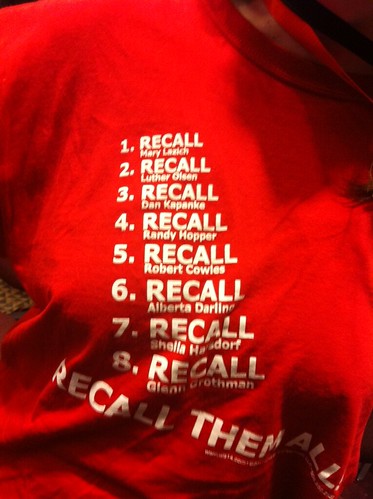
Democrats and organized labor have launched recall campaigns for eight Republican state senators–all those eligible for recall.  If they win three, the Democrats will gain control of the body.  Clearly, the recall campaigns will consume both activist attention and a great deal of money from organized labor in Wisconsin–and across the nation.  Expect conservative and Republican money to flow into the state at the same time.  It will be like a mini-economic stimulus plan focused on media and political consultants.

Meanwhile in San Francisco, Federal Judge James Ware upheld Judge Vaughn Walker’s decision to strike down a ballot measure prohibiting same sex marriage in California.  Now retired, Judge Walker has acknowledged a long-term intimate relationship with another man, and supporters of the marriage ban argued that Walker’s sexual orientation compromised his objectivity in the case.

Disappointed by the decision they were, nonetheless, undaunted, and plan to continue appeals which could ultimately end in the Supreme Court of the United States.  Of course, this isn’t all of it; they’ll also be engaged in ongoing battles with advocates of same sex marriage across the states.

I don’t claim to be expert on reading the courts–on the same sex marriage issue, all the experts seem to fixate on Justice Kennedy as decisive.  By the time a case reaches the Supreme Court we’ll be reading dispatches on the movies he watches, his exercise regime, and what he has for breakfast each day.

On same sex marriage, the tides of history are somewhat easier to read, and they favor the advocates of marriage equality.  Although same sex marriage is available in only a few states, public opinion has changed quickly, and continues to move toward acceptance of extending the institution.  Most notably, the polls suggest a deep generational divide, with young people overwhelmingly in support of same sex marriage.

I have a harder time reading the tides on labor in Wisconsin–and across the country.  The mobilization against the budget was dramatic and invigorating for Labor and the left.  But organized labor has just lost similar battles in Indiana and Ohio.  Wisconsin has become a test case for assessing whether new Republican majorities have overstretched their mandate–and if their opponents can take advantage of it.

Much rides on the outcome.  And the answer won’t come from the courts.

Posted in Uncategorized | Tagged , , , , | 1 Comment

A second cut on circumcision, politics, and rhetoric

Crusaders against circumcision (intactivists) face the same sorts of challenges as activists on a wide range of other causes.  They want parents to choose not to circumcise their sons AND they want the government to prohibit circumcision–and punish adults involved in circumcisions.

[This really is a recurrent movement story: Think about animal rights activists who want to promote vegetarianism as a personal choice–as well as legal restrictions on the use of animals; think about anti-abortion activists who wish to promote adoption–as a personal choice–while simultaneously limiting legal access to abortion.]

It looks like the intactivists are making progress on the first front, individual choice–or at least riding some sort of wave of history: the percentage of newborn boys circumcised in the US has declined substantially in the last few years.  All the physicians I’ve seen quoted in the run of news accounts have emphasized parents’ choice.  With parents making different choices, boys and men are far less likely to face social stigma or discrimination on the basis of foreskin status.

Promoting non-circumcision means making that choice attractive–and making a very widely accepted choice–problematic.  Here, rhetoric matters, and strategic choices about images and language are consequential in mobilizing support–and provoking opponents.

Jena Troutman, the Santa Monica activist who abandoned her referendum campaign, pushes non-circumcision as healthy, natural, and attractive.  Her website is chock full of pictures of happy baby boys–diaperclad.

Matthew Hess, the author of the Foreskin Man comic, projects more alarm–and more vitriol.  He, literally, demonizes those who perform circumcisions, thus far, a doctor and a mohel.   On the left, you’ll see his hero battling a physician who takes sadistic pleasure in performing a procedure that is, by all other accounts, quick and routine.  The rhetoric is provocative and polarizing–hardly peculiar for social movement activists–but maybe not the smartest strategy.

Most of us are not inclined to see physicians treating children as monsters who derive pleasure from a baby’s pain.  We might distrust someone who offered a portrayal at odds with our own understanding of the situation.  The portrayal of the mohel–understandably–spurred a debate about anti-Semitic imagery.  (But Hess is clear that he has nothing against Jews or Muslims–only those who circumcise.  Arrgh.)  Identifying and demonizing an enemy is likely to inspire–and mobilize–those who already agree with you.  It’s likely to be off-putting to others, and may well provoke your opposition.

I’m ill-inclined to offer psychological explanations for why someone believes what he does.  That said, Hess’s description of his analysis and his commitments is likely to stir pause among would-be supporters.  San Diego’s City Beat reports, quoting Hess:

“I was in my late 20s when I just started to notice a slow decline in sensation,” Hess says. “Year after year, it started to get a worse and worse after sex. I went to a urologist, and he didn’t have much of an answer. It struck me that my circumcision could have something to do with this. I researched online and quickly found a lot of information about what’s lost. That made me pretty angry.”

City Beat reports that Hess has been engaged in therapies to restore sensation–and, for nearly a decade, working on legislation to ban circumcision.

The extraordinarily committed are at the heart of any social movement, and opponents will look to counter a movement by disparaging its champions.  Successful movements are always comprised of coalitions, and the recurrent question is how rhetoric, tactics, and personnel aid or hinder in recruiting allies.  The controversy over Foreskin Man led Jena Troutman to put her referendum campaign on the back burner, suggesting that Matthew Hess brings energy, commitment, and liabilities to his cause.

Posted in Uncategorized | Tagged , , , | 2 Comments

Anti-circumcision campaign cut short

Male circumcision dates back to a deal that Abraham made with God, as far as I know; most Jewish and Muslim parents still circumcise their sons to show that they’re keeping their end of the bargain.  Of course, in many rich countries, lots of other people circumcise sons.  There’s some scientific evidence of some health benefits, particularly reduced transmission of AIDS, and some vigorous debate about adverse consequences.  Meanwhile, the percentage of newborns circumsized has declined over the past couple of decades.

But the cut itself is provocative, particularly when you think about it absent religious context.  In Santa Monica, Jena Troutman (above), a lactatation consultant, launched a campaign to ban circumcision in her town, making the cutting of foreskins a crime.  She started to collect signatures to get a proposition on the ballot for the November election, following a similar effort in San Francisco–where voters will address the question in November.

Initiatives and referenda are good tools for campaigns that can generate broad soft support, and good places for majorities to restrict what minorities can do.  (Witness the repeated referenda campaigns on same sex marriage.)  The populist legacy of voters making policy directly requires even more dramatic oversimplification of issues than regular politics.  Hyperbole and polemic are required elements of such campaigns, and the ballot initiative is a blunt instrument for making policy.

And activists against circumcision (“inactivists” is their preferred term) have a variety of reasons for their campaigns.  Ms. Troutman says that she’s just trying to save babies from harm, and explains her ideas, with music, on her website.  Baby boys, the argument goes, are born perfect, and the cut is cruelty.  By analogy, ritual circumcision of boys is very much like female circumcision, now almost universally called Female Genital Mutilation (FGM) and recognized as cruel, dangerous, and misogynistic.

But there’s a longer history of campaigns to ban circumcision, and it’s less about protecting babies than protecting society—from Jews.  Over hundreds of years, some states have banned the practice intending to isolate, stigmatize, and ultimately eliminate Judaism.   Jewish leaders were ready to see the referendum as a continuance of this anti-Semitic tradition, despite Ms. Troutman’s protestations:

For me, this was never about religion. It was about protecting babies from their parents not knowing that circumcision was started in America to end masturbation (Fox News report).

But Troutman was not alone in her campaign, and in movement politics, as elsewhere, you are judged by the company you keep.  Troutman’s ally, Matthew Hess, wrote the bill she was pushing, as well as the measure in San Francisco.  Hess is committed to the issue, and his comic book series that advances his position, Foreskin Man.
We expect movements to sharpen their arguments, often at the expense of complexity, and the comic book form isn’t the most suitable for nuance, but:  Hess’s books are filled with images that push obvious anti-Semitic buttons.    On the left, see Hess’s villain, Monster Mohel, sporting stylized beard, hat, and prayer shawl.  The heroes look conspicuously Aryanized.
The images, rhetoric, and Hess himself made the charge of anti-Semitism very credible.
So Jena Troutman backed off, abbreviating her campaign.  She and her allies will look for new opportunities to advance their claim without the encumbrance of Matthew Hess’s apparently broader agenda.
Posted in Uncategorized | Tagged , , | Leave a comment

Politics, Power, and Movements: Sidney Tarrow at Cornell

I’m honored to participate in a conference recognizing the work of Sid Tarrow, who has been a major force in developing the study of social movements in political science and sociology–and a major force in my development as a scholar.

The Einaudi Center for European Studies at Cornell has posted the conference agenda, along with links to the papers, for interested readers.

Posted in academic | Leave a comment

How Repression Works, American-style

Scott Crow (right), an anarchist who has organized anti-corporate and animal rights events, used the Freedom of Information Act to get his FBI file; he received 440 pages, with much of the material blacked out (NY Times report).

Crow reports being subjected to ongoing surveillance, from both cameras and large men in large air-conditioned cars.  The file also reports that the FBI asked the Internal Revenue Service to investigate Crow’s tax returns, but the IRS said that he earns so little money that it wasn’t appropriate.  (It’s not legal either.)

Domestic surveillance is back!  The Times reports:

Other targets of bureau surveillance, which has been criticized by civil liberties groups and mildly faulted by the Justice Department’s inspector general, have included antiwar activists in Pittsburgh, animal rights advocates in Virginia and liberal Roman Catholics in Nebraska. When such investigations produce no criminal charges, their methods rarely come to light publicly.

In the wake of the September 11 attack on the World Trade Center, Congress rushed to pass the Patriot Act, which allowed the government new liberties in investigating potential threats.  In the public debate, the image of these threats was always young Arab men with Saudi Arabian passports who might fly planes into buildings in pursuit of a divine pay-0ff.

But there aren’t so many such people.  It’s easier to track domestic activists who organize openly–and in English.  Most of the anti-terror action we’ve seen from the US government has been targeted at environmental and animal rights activists.

Scott Crow says that virtually all of the organizing meetings he sets up include police and FBI informants, identifiable because they have obviously eaten more protein and spent more time in the weight room than the other attendees.

The Constitutionality, justice, and wisdom (is this a good way to spend police time and money?) is all subject to question.  I’m interested in what you think; here, however, I just want to talk about how this kind of repression is supposed to work in a liberal democratic country like the United States.

Repression is all about setting boundaries of acceptable political conduct.  In authoritarian states, which use a panoply of tactics to limit activities, assembly, and speech, very little is permitted, and all kinds of people end up sharing common grievances against the government.  That’s why, when such states open up a little, they encounter far more dissent than they imagined.

In liberal democratic states, effective repression targets a narrower band of people, and it’s usually justified in terms of limiting particular tactics (violence!), but Crow’s surveillance suggests that the US government views some ideas as more likely to lead to violence.  This should be scary.

Repression works in the United States when most Americans are convinced that those subject to prosecution are crazy and/or dangerous–that is, not like them.  It’s all about maintaining a border between “radicals” and more mainstream activists who might make more moderate claims more moderately.  In disparaging and distancing themselves from those people, the moderates effectively maintain the boundaries set by the government.  Thus, labor unions and civil rights activists in the 1950s and early 1960s steered clear of people who might have a Communist past, sometimes explicitly and proudly.

Repression falls apart when those moderates become convinced that the targets of government scrutiny aren’t so dangerous or different after all, and make common cause with them, at least in challenging the government.  They like to say that it’s like the canary in the coal mine, the more radical, committed, and sometimes less coherent, are the easier targets for repression, but someone else is always next.

Activists struggle to find ways to protect their own radical flanks, without necessarily throwing in with them.

Posted in Uncategorized | Tagged , , , , , , , | Leave a comment