Same as it ever was, May Day is an international day of protest for workers rights. Below is a picture of a march in France, where people are protesting against raising the national retirement age to 64.
In France, protests against Prime Minister Macron’s reform plans, have stretched on for months–with no signs of influence on anything yet, except encouraging more protest.
In the United States, where by design we have a different day for workers (Labor Day), May Day always seems like an opportunity to organize and demonstrate around a somewhat related cause, with or without the support of organized labor.
Workers, organized and otherwise, have plenty of issues in the United States these days. Hollywood screenwriters are about to go on strike in response to their worsening prospects in a stream-centric entertainment world. Campaigns for raising the minimum wage at the state level have met with some success in some states. Unionization campaigns have succeeded at a couple of Starbucks and Amazon sites, but every subsequent site is a battle. Graduate student researchers and teaching assistants have launched unionization campaigns and strikes for better contracts with some success–including at the University of California. Here at UC-Irvine, the unions won substantial raises, and the University is responding by cutting the number of graduate students admitted and teaching assistants assigned. There are no easy battles.
Successful campaigns have increased the number of unionized workers in the United States, bucking the trend of the past 70 years or so, but the percentage of American workers in unions continues to decline.
The graph below charts the rate of union membership since 1983. It’s hard to miss the trend line–and it’s worse for private sector workers.
May Day is an obvious time to take stock. Journalists look for labor stories that are normally undercovered on May Day (and even on Labor Day), and organizers work hard to fill the space.
May Day is an opportunity to organize and say something, reminding the rest of the world that constituencies and concerns remain vital and potentially volatile.
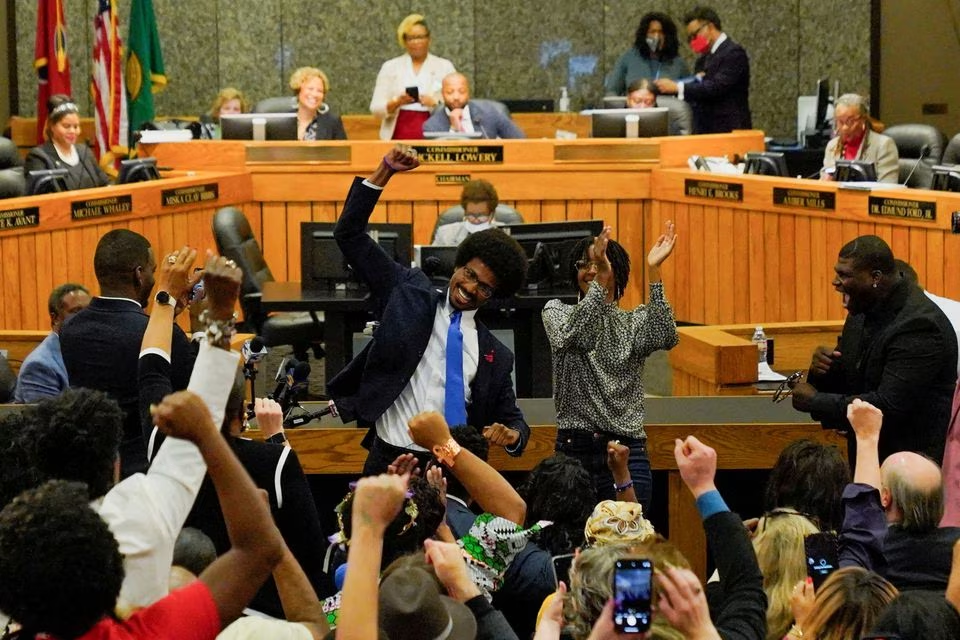
Now that Justin Pearson has (again) taken the oath of office, the Tennessee Three is reunited in the state House of Representatives. On Wednesday, the Shelby County Council voted on appointing an interim representative to replace the one who was expelled last week (Pearson). Seven of thirteen members showed up to a special session and voted unanimously to put Pearson back in office.
Like his colleague, Justin Jones, Pearson wasn’t just waiting for the vote. He and his supporters staged a demonstration at the Civil Rights Museum located in the former Lorraine Motel–where Martin Luther King spent the last evening of his life–and then a large march to the Memphis Council, where Pearson gave a stemwinder of a speech. My favorite sign: “No Justin, No Peace.” The next day, he returned to Nashville and the state legislature, expressing determination to continue the fight for sensible gun regulation.
The modest disruption the Three (Jones, Pearson, and Rep. Gloria Johnson) caused by bringing a megaphone to the podium turned into a tactical tour de force, aided by a significant and unwitting boost provided by the Republican majority.
But they didn’t get all that much closer to their expressed goal, pushing for sensible gun regulation in Tennessee. The Republicans still enjoy a massive advantage in the House, holding 75 of 99 seats, with legislators still elected in heavily gerrymandered districts. Upon reaching the age of 21, any Tennessean can carry a gun, open or concealed, without having to get any kind of permit. The governor and the majorities in each house of the legislature are quite clear that they have no interest in making it much more difficult to get any kind of weapon. Although the Three and their supporters were masterful organizers and tacticians, the road to reform lies ahead, and it looks like a long haul.
We always want shorter stories about movement influence, in which the heroes win meaningful battles quickly enough that we can connect policy changes to protest. But that’s not the way the world works. Rosa Parks on a bus in Montgomery makes for a shorter simpler story if we edit out more than a decade of organizing she did beforehand, and a decade of organizing afterward to get to Voting Rights legislation. That story isn’t over either.
In addition to the road ahead, there’s a long backstory that’s worth telling. Before fixing on the confrontation in the well of the Tennessee House of Representatives, take a glance at how much time the Three spent getting ready for that moment.
Gloria Johnson had a career as a teacher in Knoxville, before first running for the state house in 2012. She organized in Barack Obama’s presidential campaign, and worked at the grassroots for educational funding and health care reform. She first clashed with House Speaker Cameron Sexton a couple of years ago, when she was the lone representative who refused to vote for him as speaker. He gave her an office in a windowless conference room, and she moved her desk into the hallway.
Jason Pearson had organized a campaign against the siting of the Byhailia oil pipeline that was to be routed through poorer Black neighborhoods in South Memphis. The pipeline, opposed by a broad coalition of interests, was cancelled. Pearson’s parents (dad a preacher, mom a teacher) say he’s been a powerful orator and committed crusader forever–he’s still not thirty. He got to make his case for activism and politics in an op-ed at the New York Times.
The first point is that it took a long time to become the Tennessee Three; the protest about guns and democracy built on long histories of advocacy and organizing, and a couple of identifiable wins.
To win even a modest policy reform like limiting access to assault-style weapons will take a lot more work, which will include many meetings, protests, lobbying, and electoral campaigns. Alas, it will probably take more horrific shootings as well.
In the meantime, Governor Bill Lee has announced his support for “red flag” legislation, strengthening background checks for gun purchasers, and spending $140 million to “harden” schools and funding armed guards stationed at schools. Of course, these aren’t the remedies gun safety advocates were demanding, but there’s no reason to believe Gov. Lee would have gone even that far without the pressure and the national exposure. Lee didn’t acknowledge the influence of the protesters, also of course.
A few days after suffering expulsion from the Tennessee House of Representatives, Justin Jones (again)
took the oath of office and reentered the legislative chamber. Rep. Gloria Johnson, the unexpelled member of the Three, enthusiastically accompanied him on his return to the floor, but many colleagues appeared less enthusiastic.
The Republican majority was certainly far less joyful than the cheering throngs of activists crowded into the gallery.
Tennessee law allows local officials to fill a vacancy with a temporary appointment, and the Nashville’s Metro Council, in very short order, voted to appoint Jones to temporarily fill the vacancy his expulsion had created. The vote was 36-0. Later, Jones will have to run for the full term, with Nashville’s voters more committed than ever. The Memphis council is scheduled to vote on who will fill Pearson’s vacancy. (The smart bet is Pearson.)
It’s not just that efforts to purge the chamber of two young Black men were so clearly unsuccessful; even more important was the attention the Three generated nationally, and the solidarity and enthusiasm they tapped into in parts of Tennessee. Everyone in the state house will be back in the same seats they had a week ago, but it really won’t be the same.
Prior to the protest, the Three were part of a small and easily marginalized Democratic minority in a heavily gerrymandered state moving further to the right. They could not speak about guns on the floor (mics cut off when they tried), much less pass legislation.
Protest works when it alters the scope of a conflict and maybe even the balance of power, and it’s the losers in any battle who have an interest in bringing others into the fight (thanks, E.E. Schattschneider.)
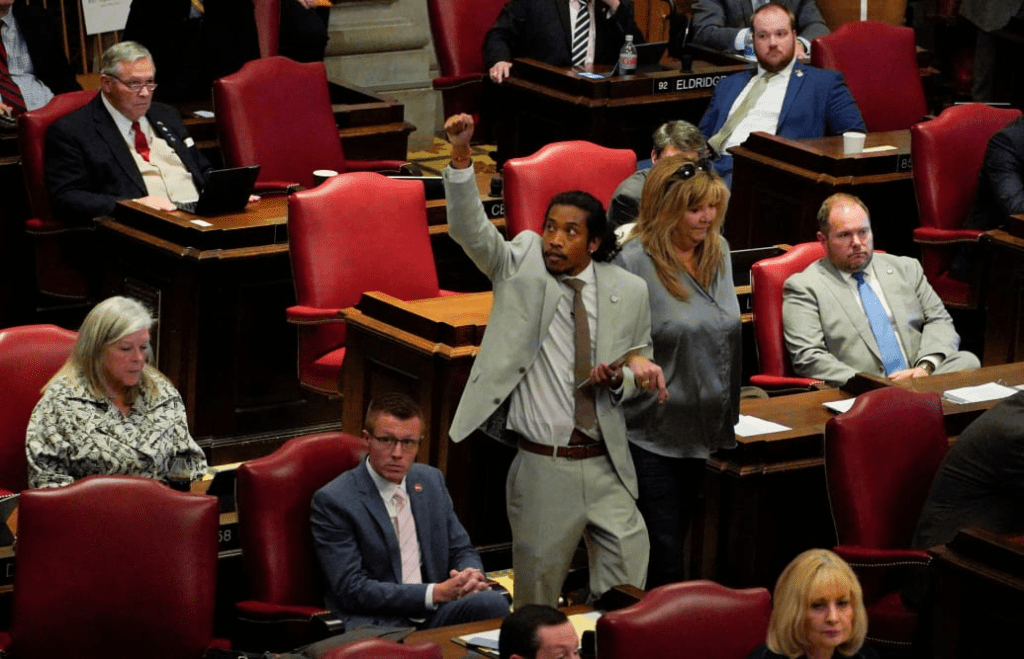
When Tennesseans, especially young Tennesseans in the cities reacted to yet another horrible school shooting–this time at a Christian school in Nashville, the Three decided to amplify the calls from the marchers outdoors and take them indoors. Brandishing a megaphone, they came to the podium, and chanted for less than a minute until the Speaker ended the session. That’s not much of a win.
But the Republican majority overreacted, spotlighting its opposition and displaying its own, mostly unpopular, politics. The extremely unusual decision to expel members guilty of a breach in protocol won the Three national exposure, speaking invitations, and far more vigorous local support. Johnson, Jones, and Pearson proved to be more than ready for prime time, focusing on democracy, children, and public safety. The Justins, in particular, were adept at dropping in bits of Scripture at the just the right time. (Pearson’s father is a Christian minister, and Jones has started a divinity degree.) And they all kept coming back to gun violence, the issue they were silenced on.
The Republicans in the House made a tactical mistake, one bred of overconfidence that may come from living in an apparently safe and relatively homogenous supermajority. Sometimes effective advocacy is all about giving the opposition a chance to show itself–and make mistakes. The GOP rose to the bait and the Three mastered the moment. After years of trying a range of strategies to get attention, suddenly each enjoyed a national audience. They filled broadcast and social media, and engaged and mobilized political allies far from Tennessee. Coupled with an Easter break and news from yet another horrific mass shooting, this time in neighboring Kentucky, the Three had more support, and more attention to their issues and their efforts.
At the Nashville Newark* airport, Jones and Johnson even ran into–of all people–Joan Baez, who started singing for civil rights more than a half century ago. She sang with Justin Jones, and the videos went viral.
Meanwhile, the offended House majority was on the defensive. They’d hoped to teach insurgent legislators a lesson, and instead they were schooled.
Hundreds of Jones’s supporters surrounded the Nashville Metro Council when it met to decide to send him back to the House. And more supporters joined Rep. Jones as he walked to the state capitol and took the oath of office on its steps.
Now, think about the message clever and committed activists will take from the travails of the Tennessee Three. Standing up against what they saw as the arbitrary exercise of authority and the blatant neglect of an urgent public safety issue, they broke some rules, and irritated members of the party that controlled the legislative agenda. They returned with allies and attention.
Representative Jones showed that he’d learned his lesson. Upon his return, he took the mic and announced, “I want to thank you all. Not for what you did, but for awakening the people of this state, particularly the young people.” He then called upon the Speaker to resign.
The Republican Party had nothing to gain by voting to expel two Democratic state reps (Justin Jones and Justin Pearson), and just barely deciding not to expel a third (Gloria Johnson).
The expulsions were about the dumbest thing the Republicans could have done, and they did it about as badly as possible.
Remember, democratic politics works when most people believe their beliefs can be represented, and might ultimately convince a majority and carry the day. Political losers accept defeats because they can imagine that they might one day be victors. Political winners have a strong interest in nurturing their opponents’ dream of influence through mainstream politics.
The Republican Party enjoyed a massive majority, 75-24, in the state house, partly a result of political preference, but also a reflection of residential sorting and aggressive gerrymandering. They could pass anything they wanted, while the Democrats were left to complain…ineffectually. Not only couldn’t the Democrats pass legislation, they couldn’t even get their proposals considered on the House floor. The Republicans gained no new advantages by cutting the Democratic caucus to 22. But they were able to deprive 2 districts of their representatives in government, effectively telling large parts of Memphis and Nashville that they would get no hearing in the House…at least for the moment. Both districts are overwhelmingly Democratic and Jones and Pearson won their seats handily–and they are certainly more visible and more popular now.
Expulsion put the Tennessee 3 on a much larger map. In the days leading up to the event, they were all interviewed everywhere, and proved themselves to be effective communicators and pretty charming as well. They’ll get more practice, and they’ll all get better, and surely win fans and followers across the country. In every interview, they talk about government inaction on gun violence, the issue that got them expelled. Each is now well-positioned to raise more money for an electoral campaign than any candidate for the state house has ever raised before. (By the way, that job pays just over $24,000 a year, plus a per diem.)
On the eve of the expulsion, young people in Nashville and across the state were already outraged about legislative inaction after a school shooting, and were protesting at the capitol and even staging walk-outs at their schools. None of this is likely to stop. Indeed, the expulsion creates more issues and opportunities, as Jones and Pearson seek to regain office, stage campaigns, and remind their constituents that they were thrown out for protesting about gun violence. Both in their twenties, they look like they could have long political careers.
Clearly frustrated by the Tennessee 3’s protest, the majority had many options for punishment, but buoyed by a supermajority, went right for the extremely rare remedy of expulsion. And they tried to do it as quickly as possible, bypassing any kind of committee process, fact-finding, or considering a formal defense. Instead, in a jury-rigged quick fry, each targeted member got to answer questions before a final vote. Discussion was high stakes and high stress, and–appropriately–none of the 3 demonstrated a bit of contrition. Video highlights are circulating all over the internet.
She explained (quote from Snopes), “I’m a 60-year-old white woman and they are two young Black men. In listening to the questions, and the way they were questioned, and the way they were talked to… I was talked down to as a woman, mansplained to, but it was completely different from the questioning they got. And this whole idea that […] you have to almost assimilate into this body to be like us.”
She added that she felt the two Black men were spoken to in a “demeaning way” and told “if you’re going to come into this body, you’re going to have to act like this body.”
That majority looks mostly like older white men.
So, the Republican majority created new heroes of their opponents, drew attention to their largely unpopular position, and invited a spotlight that the other side was better prepared to use. They also sent a signal to young Tennesseans that their capitol was no place for debate about the issues they cared about.
Whoops.
And the kicker: The leadership said it wasn’t about the issues or politics, but about House rules and decorum. It’s hard to believe that even the foot soldiers in Donald Trump’s Republican Party see any gains in preserving decorum.
Tennessee state representatives Tennessee State Representatives Justin Pearson, Justin Jones, and Gloria Johnson (l-r above) broke the rules. In the wake of the mosta recent mass shooting at a Christian school in Nashville, protesters filled the chamber’s galleries and surrounded the state capitol. Unarmed and nonviolent, they were nonetheless vigorous, demanding legislative action on gun safety, and yelling at the legislators who were determined not to give them what they wanted. The Tennessee 3 amplified the protesters, moving to the well of the chamber and chanting through a megaphone. They didn’t wait to be recognized.
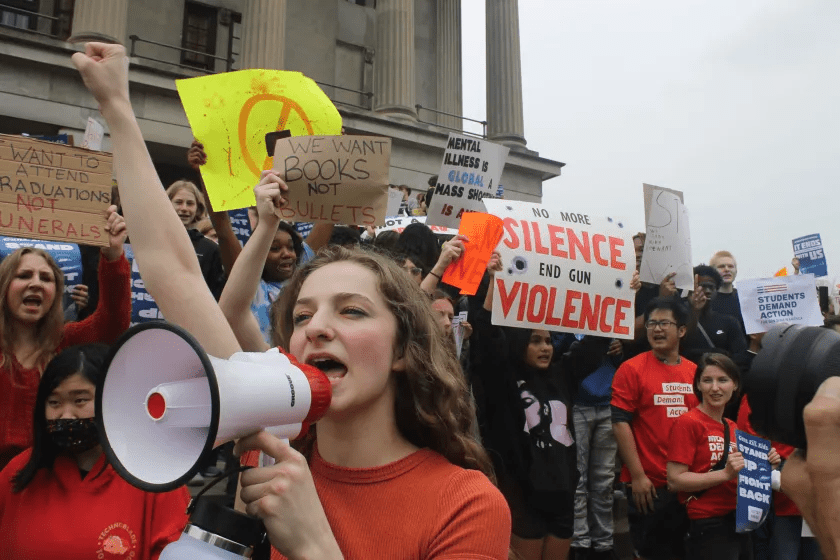
The protesters outdoors included many young people, students from local high schools and universities, and they were well aware that a large majority of the House was far more likely to make it easier for Tennesseans to get guns rather than impose any restrictions. Just two years ago, Tennessee passed a law allowing anyone over 21 to carry a handgun (openly or concealed) without a license; the legislators are due to consider a reform that would lower the age of permitless carry to 18, and include more weapons.
The protesters said they were scared, but they looked angry.
They were particularly angry at their three Democratic colleagues who, absolutely, violated rules of procedure and decorum. Members of the Republican majority were determined to respond to protect their vision of the legislature. It’s important to remember that the Republicans enjoy a huge advantage in the House, with 75 Republicans and 23 Democrats. The majority in any legislative body has many options for punishing members who offend:
Individuals can talk with their colleagues privately, and express their opinions.
A majority can pass a resolution of disapproval or censure and formally rebuke a member.
The House leadership can strip a member of committee membership, staff, or office space.
Or the majority can kick a member out, although it’s difficult. It takes a 2/3 majority to expel a member, and it doesn’t happen much. The New York Times reports:
“Six lawmakers were expelled from the Tennessee House in 1866, immediately after the Civil War, for seeking to prevent the ratification of the Fourteenth Amendment, which granted citizenship to formerly enslaved people. Since then, the House of Representatives in Tennessee has voted only twice to oust a lawmaker. Both votes were bipartisan: in 1980, after a sitting lawmaker was convicted of soliciting a bribe, and in 2016, after the House majority whip faced allegations of sexual misconduct while in office.”
On April 6, after a long and contentious debate, the majority voted to expel Reps. Pearson and Jones, but came one vote short of kicking Rep. Johnson out. It is lost on absolutely no one that, unlike Johnson, Pearson and Jones are young Black men.
I don’t know if the Republican majority meant to send a message, but they surely did. If they didn’t realize it at the time, they will certainly be schooled and reminded–again and again.
All of this matters, not just for school safety or gun regulation or racial politics in America. Democracy depends upon the losers continuing to participate in the system, albeit not necessarily happily or with optimism, and certainly not politely. But they must stay engaged. The system depends upon minorities keeping faith that they might someday win.
Reps. Pearson and Jones may well be back in the legislature soon, appointed by county committees or reelected by constituents who value the passion and commitment they displayed.
Or they, or some of their supporters, may decide that the institutions of their state government are so inaccessible and unresponsive that stronger measures must be taken.
New Yorkers laughed at Donald Trump when he came to vote in 2016. (Okay, some booed.) Trump had the next laugh, who gets the last one is still up in the air.
The next episode is Trump’s return to New York City, this time to surrender himself to police for arraignment. He has repeatedly proclaimed that criminal charges against him are a plot to destroy America, and has called on his supporters to protest. And he’s warned of violence and general mayhem if prosecution proceeds. Someone will listen and respond, but just who, how many, and how will matter a great deal.
Social movement power comes from connections with the political mainstream. Organizers and activists can get played and exploited by regular politicians, but sometimes they can win significant victories. This is a common American story. Ambitious politicians calling on their supporters to take to the streets is a far less common story in American politics–but it’s certainly not the first time.
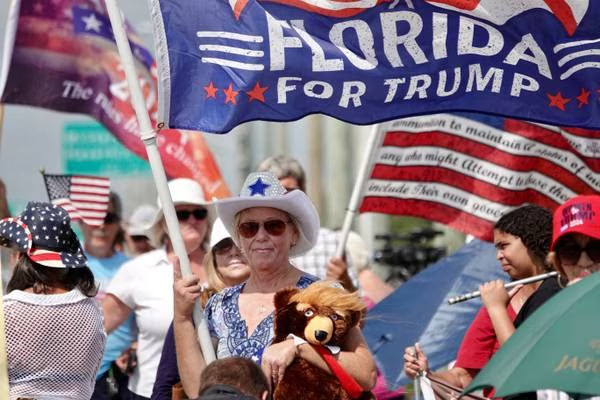
So, along with national media, Trump supporters have recorded the long trek from Palm Beach to Manhattan–a 1,200 mile perp walk. Trumpians frame the shots to emphasize their passionate supporters. But wider angle shots show sparse attendance.
Larger sustained protests take organization, not just an appeal from leaders, and organization is not Trump’s strong suit. But, as with January 6, others may be organizing to create disruption and make local and federal prosecutors pay for doing their jobs.
Mainstream media will cover the minutia of Trump’s arraignment in excruciating details. Expect a report detailing modern fingerprinting techniques that don’t leave ink on those tiny hands.
And the next day, Trump has promised to deliver a speech that frames his prosecution as persecution that somehow translates to an existential threat to *real* Americans. It’s worked so far largely because only a smattering of institutional Republicans have been willing to stand up against it–against Trump and now, for the rule of law.
At some point, maybe soon, someone will realize the mileage to be gained out of actually speaking to the material concerns of those Trump claims to represent.
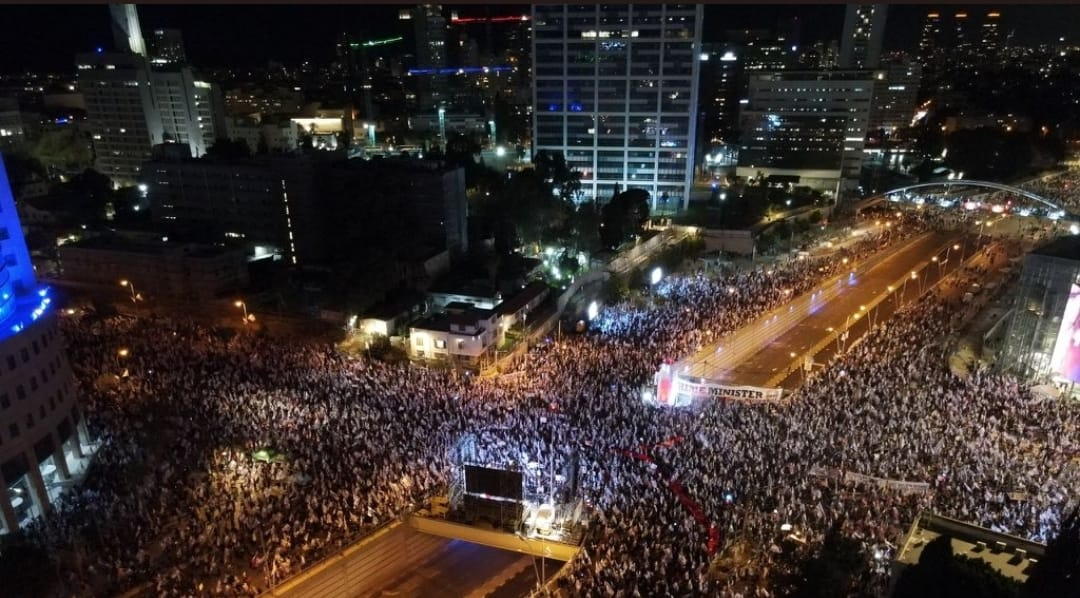
The massive extended protests against Prime Minister Benjamin Netanyahu continued, even as protesters claimed credit for a victory. Netanyahu postponed consideration a plan to severely limit the independence of the judiciary, frustrating hard right allies within his coalition and, for the moment at least, emboldening the opposition, as seen above in the streets of Tel-Aviv.
The size and number of protests matters, of course, but it’s not enough. In any kind of democratic system, protesters need allies in government willing to listen to them. Protesting Israelis had to mount a political threat to the Netanyahu government, which means signaling the capacity to disrupt the governing coalition. On the surface, this shouldn’t have been so difficult: Netanyahu’s far-right government was supported by 64 of 120 members of the Knesset–oddly, the largest majority a government had enjoyed in years. But the people protesting didn’t appear to include anyone the governing parties needed.
Netanyahu’s proposed reform would have allowed the government to appoint judges and to ignore their rulings–an essential demand for some of the far right and religious parties–and a massive provocation to their opponents, who viewed it as a threat to democratic governance altogether. The scope of this threat, coupled with longstanding antipathy to Netanyahu, helped sustain large protests.
But there was more: Military service in Israel is extremely common, if not quite universal, with exemptions for Arabs and ultra-orthodox Israelis. Broad conscription means that the Israeli Defense Force includes men and women from across the political spectrum who are prepared to participate in campaigns they might oppose as matters of policy (for example, harsh policing of Palestinians; relocating resistant religious settlers). For better and worse, democratic legitimacy makes this possible.
Netanyahu was prepared to push ahead regardless, but his Minister of Defense, Yoav Gallant, was not. Netanyahu fired Gallant immediately, but furtive negotiations within his coalition suggested that Gallant was not the only one prepared to leave the government to preserve an independent judiciary. Remember the narrow margins–it would take just a few defectors to bring the government down. Political unrest within the government made the street protests possible, and the prime minister announced that he would return to judicial reform later.
Stalling on judicial reform, while making additional concessions to the far right he disappointed, allowed Netanyahu to survive the moment, but he’d announced a postponement, not an end. Netanyahu plans to bring it back when, he hopes, political circumstances will be more favorable. The opposition’s victory could be short-lived. It wouldn’t be the first time. Surely, some protesters remembered that Hong Kong’s leadership suspended an unpopular law to stop a protest movement in 2019, only to institute far harsher reforms months later.
So, thus far, the protests continue, as a broad opposition evaluates broader goals, perhaps ousting Netanyahu, or adopting some kind of Constitution. It’s not over.
Meanwhile, on the outside, activists want to take inspiration from the successes of the moment. But we need to remember that the opposition didn’t succeed because they waved Israeli flags at the demonstrations, nor just because of their numbers, the tactics, or commitment. Tunnel vision on the actions in the streets leads to missing the importance of connecting protest to politics.
Commemoration of Cesar Chavez Day is an annual ritual in California–and in Politics Outdoors.
The day is a chance to reflect on Chavez, the movement he led, which continues, and the issues he and that movement addressed. (It also seems to be a good opportunity to return to writing here, with the chance to repost, reconsider, and update writing from past years.
In 2018, less than a week after Edna Chavez, the charismatic then-seventeen year old high schooler from South Los Angeles, electrified a national crowd with a demand to end gun violence, Californians celebrated the legacy of another Chavez.
On my campus, we commemorated Cesar Chavez Day today, rather than March 31 (his birthday), by closing. (This year, of course, the campus is barren. Once a week, I walk in to collect mail and remember that I have an office, routinely seeing just a couple of people in passing. It looks like it’s always closed.) The state established the holiday in 2000, and six other states have followed suit. In California, the legislature calls upon public schools to develop appropriate curricula to teach about the farm labor movement in the United States, and particularly Chavez’s role in it.
A campaign to establish a national holiday has stalled so far (The Cesar Chavez National holiday website seems to have last been updated in 2008), but last year President Obama issued a proclamation announcing a day of commemoration, and calling upon all Americans “to observe this day with appropriate service, community, and education programs to honor Cesar Chavez’s enduring legacy.”
Political figures have many reasons for creating holidays, including remembering the past; identifying heroic models for the future; recognizing and cultivating a political constituency; and providing an occasion to appreciate a set of values. Regardless of the original meaning, the holidays take on new meanings over time. Columbus Day, for example, is celebrated as an occasion for pride in Italian Americans (e.g.), and commemorated and mourned as a symbol of genocide and empire (e.g.).
Cesar Chavez’s life and work is well worth remembering and considering, particularly now. His career as a crusader was far longer than that of Martin Luther King discussed (here and here) and he was far more of an organizer than Fred Korematsu (discussed here). Chavez’s Medal of Freedom was awarded shortly after his death in 1993, by President Clinton, but many of his accomplishments were apparent well before then.
Dolores Huerta, 2009
As a young man, Chavez was an agricultural worker; by his mid-twenties, he became a civil rights organizer, working for the Community Service Organization in California. With Dolores Huerta, in 1962 Chavez founded the National Farm Workers Association, which later became the United Farm Workers. Focusing on poor, mostly Mexican-American workers, Chavez’s vision for activism was right at the cornerstone of racial and economic justice. Establishing an organization, however, is a long way from winning recognition and bargaining rights as a union.
Chavez was a tactician, a public figure, a charismatic, and something of a mystic. Modeling his efforts after Gandhi’s successful campaigns, Chavez was an emphatic practitioner of active nonviolence. He employed boycotts, strikes, long fasts, demonstrations, long marches, and religious rhetoric in the service of his cause. He also registered voters, lobbied, and worked in political campaigns. He was a tireless and very effective organizer for most of his life.
But holidays are best celebrated with an eye to the future, rather than the past.
[2020: Through ill-advised, provocative, and racist policies, Donald Trump has done a great deal to make it easier to mobilize Latinos, and to forge a broader unity among the whole range of minority groups (racial, ethnic, religious, sexual, etc.). This organizing IS happening.]
[2021: The protests against racialized violence, particularly from police, which took off last summer, offered a promise of political unity among a vast range of Americans. But common cause among Asian Americans, Blacks, and Latinx people and allies require constant work.]
And Chavez saw the civil rights struggle as a labor issue. When Chavez and Huerta started
their campaign, nearly one third of Americans were represented by unions. The percentage now is now just about 10 percent, and less in the private sector.
And public sector workers, even if represented by unions aren’t doing so well. The ongoing conflict in Wisconsin is all about weakening unions that are already making very large concessions on wages and pensions. The campaign in Wisconsin is part of a larger national effort, which is playing out in Indiana, Ohio, Florida, and elsewhere. Even in states where anti-union forces are weaker, state employees face lay-offs, wage cuts, and increased health and pension costs.
[The previous Wisconsin governor, Scott Walker, was largely effective at hobbling organized labor in his state. Aided by an extensive organizing effort and backlash to many Walker policies, Tony Evers eked out a narrow victory in 2018. Wisconsin may now be a highly contested true swing state, but one without many swing voters.]
[Janus turned out exactly as union organizers fear, and continues to haunt the national landscape. But in 2023, labor organizers have found reason for optimism in ongoing unionization campaigns in the service sector, most notably at Starbucks and Amazon.]
[The longer term fallout from organized teachers demanding better salaries and treatment hasn’t hit yet. The conflicts about opening schools safely and vaccinating teachers have opened all kinds of political rifts, and there’s some evidence more teachers are leaving the field–while states have yet to step up and make the job more attractive.]
But, we need to remember that you can’t attack teachers, nurses, police officers, and firefighters without hurting the people they serve: us.
Or should I say, US?
We commemorate the past to help guide the future. Edna Chavez, working in an urban setting far from Cesar Chavez’s organizing, carries the legacy forward, and adds more.
January 16, Martin Luther King Day, falls the day after what would have been King’s 95th birthday, a reminder of how young he was during his ministry. It’s really not that long ago.
The holiday offers a good chance for politicians across the political spectrum to misquote or misinterpret King. Advocates have unsuccessfully tried to use the Federal holiday to drum up support for protecting Voting Rights–a strong commitment for King during his life. Others push for a day of service, really because it’s much harder to create a consensual feel-good moment out of a commitment to racial and economic justice and opposition to war–both severe challenges in the current moment.
And I’d bet that when the Supreme Court strikes down affirmative action in two cases brought by the front group, Students for Fair Admissions against Harvard University and the University of North Carolina–argued late last year, that patches of King’s most famous speeches will dot the final opinion.
Here I repost a slightly edited version of an older post on the holiday.
On the eve of the Martin Luther King Day holiday not long ago, the president of the United States announced, emphatically, that you can’t find anyone less racist than he is. If you’re suspicious of such proclamations, perhaps it’s just that you’ve learned to distrust people who laud their own honesty, their color-blindness, their respect for women, or concern for the poor. Like the salesman who claims the nickname, “Honest,” Donald Trump never succeeded in fooling most people, just enough to sell the next condo or secure the next loan. Then some large number of elected officials and voters who knew better chose to look the other way, and Trump won the 2016 election.https://www.nps.gov/media/photo/gallery-item.htm?id=b0488081-61a1-446e-b300-80362bc38f5d&gid=108379A9-3701-4049-ABB5-0F178044536F
The office of the presidency, however, starts with obligations to all Americans, and it doesn’t end there. Trump is hardly the first US president to harbor racist thoughts or sentiments, but he’s displayed less worry about revealing them to large audiences, often through words, and consistently through deeds.
We now have a new president, and an African-American vice-president, but white supremacy has hardly disappeared into a Florida estate without its most visible champion.
It’s worth considering the resources and possibilities Martin Luther King’s memory gives us in combating those who would restore what he fought against.
One of the hard-won achievements of the civil rights movement was the establishment of King holiday. This means that Americans expect any president to pay respects to the man, and even more, to the movement. Tradition really is powerful, and activists are wise to attend to establishing new ones.
If Donald Trump displayed less appreciation or enthusiasm for the King holiday than, say, pardoning Thanksgiving turkeys, that’s no mystery or surprise.
Each holiday event is a moment, unlikely to capture much attention in the White House during the rest of the year.
For the rest of us, however, the King Day reminder is an alert. Martin Luther King, Jr., and many many others, put work behind their words on social justice, often facing great risks and paying serious penalties. Their heirs continue today.
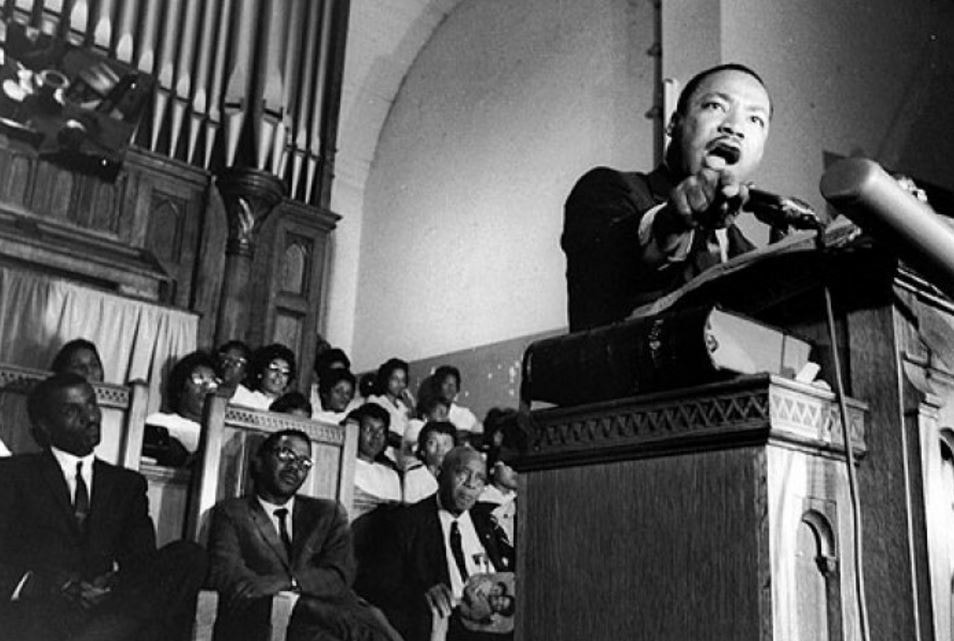
Martin Luther King died young enough and dramatically enough to be turned into an American hero, but it was neither his youth nor his death that made him heroic.
In his rather brief public life, beginning in Montgomery at 26, and ending with his assassination at 39, King consistently displayed rhetorical brilliance (on the podium and the page), strategic acumen, and exceptional moral and physical courage.
The effort to honor Martin Luther King with a holiday commemorating his birthday started at the King Center, in Atlanta, in the year after his assassination. States began to follow suit, and by 1983, more than half celebrated King’s life with a day. That year, Ronald Reagan signed a bill making Martin Luther King day a national holiday, while expressing ambivalence, acknowledging that it was costly, and that King may have been a Communist.
The King holiday was about Martin Luther King, to be sure, but it was meant to represent far more than the man. King stands in for the civil rights movement and for African-American history more generally. I often wonder if the eloquence of the 1963 “I have a dream” speech winds up obscuring not only a man with broader goals, but a much more contested–and ambitious–movement.
The man and the movement are ossified into an iconic image, like a statue, which locks King and the movement into the politics of 1963-1965. We accept King’s dream, that little children will play together, and that people will be judged by “the content of their character” (a favorite phrase on the right).
The image, like a statue, is available for appropriation to advocates of all political stripes, and the establishment of the holiday itself represents an achievement of the civil rights movement, winning the holiday if not broader economic and social equality.
Before the transformation of the man into an icon, King transformed himself from a pastor into an activist, a peripatetic crusader for justice.
But the pastor didn’t disappear; rather this role grew into something larger, as King himself transformed himself from a minister into a an Old Testament prophet, one whose primary concern was always the people on the margins, the widows and orphans, the poor and hungry. In standing with those on the margins, King courageously used–and risked–the advantages of his privilege, pedigree, and education. He also knew that he risked his safety and his life.
In his writing, King used his education and his vocation to support his political goals. In the critically important “Letter from a Birmingham Jail,” he cited both the Constitution and the Bible in support of Federal intervention in local politics to support desegregation and human rights. (We know that other activists now use the same sources to justify pushing the Federal government out of local politics.)
King explained that he was in jail in Birmingham, Alabama, because he had nonviolently defied local authorities in the service of higher laws, the Constitution and the Gospel. This was not like making a provocative statement on one’s own [profitable] radio or television show. There were real costs and severe risks.
King was never less than controversial during his life, under FBI surveillance during his political career, and vigorously criticized by opponents (for demanding too much and too strongly) and allies (for not demanding more, more vigorously).
When he was assassinated outside a Memphis motel in 1968, he was standing with sanitation workers on strike, straying from a simpler civil rights agenda. He had also alienated some civil rights supporters by coming out, strongly, against the war in Vietnam. And Black Power activists saw their own efforts as overtaking King’s politics and rhetoric. By the time he was killed, Martin Luther King’s popular support had been waning for some time.
Posterity has rescued an image of Martin Luther King, at the expense of the man’s own broader political vision.
Ironically, in elevating an insurgent to a position in America’s pantheon of historic heroes, we risk editing out the insurgency.
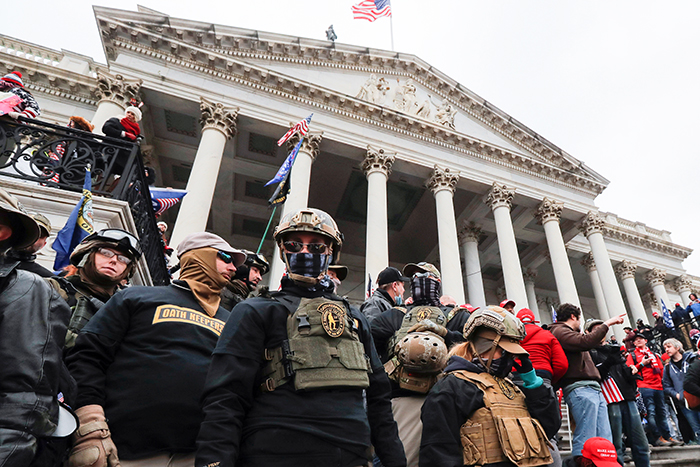
The Sedition trial of five Oath Keepers is just underway in Washington, DC. The government charges the leaders of the far right group with mobilizing and organized armed members to stop Congress from counting electoral votes to prevent Joe Biden from taking office.
Stewart Rhodes, the group’s leader, says they were counting on Donald Trump to invoke the Insurrection Act. Trump didn’t, and months after the Capitol insurrection, some were arrested. A federal judge found that Rhodes was a “clear and continuing danger,” and denied bail. Rhodes has been in jail since his arrest in January.
Conspiring to overthrow the government is a felony, and the defendants are at risk of prison sentences of twenty years or more. Arresting, trying and punishing criminals is a function of government, a means to keep social order.
But the line between crime and dissent can get fuzzy.
Right now, in Iran and in Russia, protesters are being arrested and jailed, with (maybe) some kind of trial in the future. The state strategy is not just to get them off the streets and out of the public eye, but to warn off others from joining them. The possibility of harsh punishment–maybe underscored with a beating in the streets–can be a powerful deterrent.
Repression works by separating out dissenters from broader political support. Punishment is one tool for isolating and stigmatizing criminals/reformers/patriots/activists from everyone else. But punishment that’s overly harsh or capricious can have exactly the opposite effect, garnering public sympathy. Governments try to punish criminals without creating public martyrs.
The Oath Keepers are only the most recent of the Capitol insurrectionists to face trial. (Even the label, “insurrectionists,” reflects a political judgment.) Since January 2020, more than 900 protesters have been arrested and charged with various crimes, and nearly 400 have entered guilty pleas. A few have gone to trial and been convicted, and are now serving time. Others are detained awaiting trial. (Here’s the long list from the US Attorney’s Office.)
Rhodes and his co-defendants are mounting a vigorous defense, claiming their conduct was lawful and their cause righteous, but three of his allies have already entered guilty pleas and are likely to be called to testify. In addition to the testimony of co-conspirators, the government will deploy videos, phone records, testimony from police and informants, and the defendants’ statements. The evidence that Rhodes and the rest were trying to overturn the election seems pretty overwhelming.
What happens in the courtroom is important, but what happens outside in response is even more important. Thus far, the Capitol protesters, including the Oath Keepers, have received (astonishing!) support from a few Republican politicians in office. Donald Trump has promised more, pledging to issue blanket pardons–plus apologies–if he is returned to the presidency.
So, the stakes are high, and the path forward is more difficult than it might initially seem. The government needs to convince a jury that the defendants broke serious laws. The prosecutor and judge must also show a much broader public that these Oath Keepers deserve what they’re getting, and certainly not the support of anyone who claims to be a patriot.
I'm a professor of sociology and political science at the University of California, Irvine. I've been thinking, and writing about, protest politics for almost ever. This site offers comments on contemporary events, informed (I hope) by knowing something about history and about the academic study of social movements.







/cdn.vox-cdn.com/uploads/chorus_asset/file/10519945/AP_18083604359368.jpg)