Polarization and the National Guard

https://www.cnn.com/politics/live-news/trump-presidency-news-06-08-25

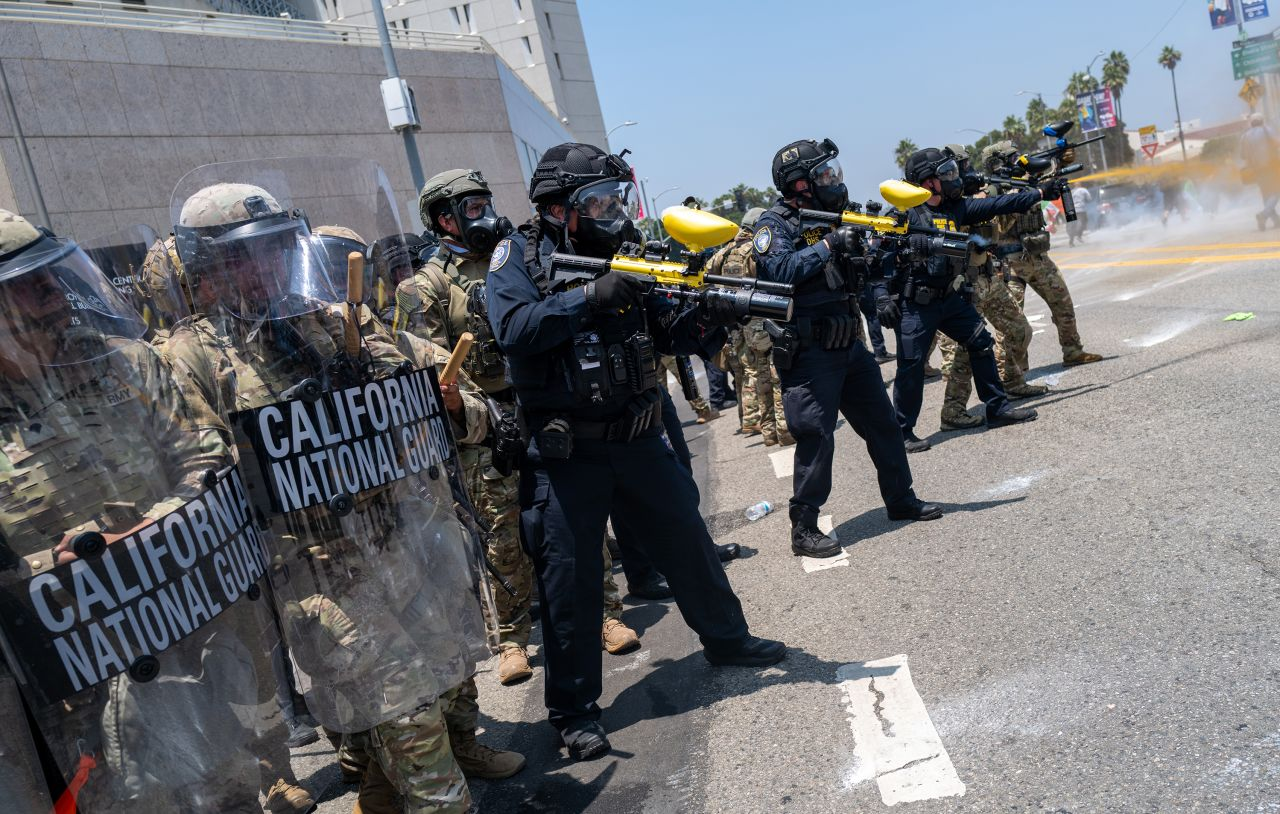
President Trump federalized the National Guard, promising to promote public order and protect Immigration agents in Los Angeles. You see, protesters had turned up to bear witness and maybe stop the wholesale detention (and deportation) of masses of people who might be undocumented immigrants. Activists assembled outside the Metropolitan Detention Center, initially on immigration, but crowds grew as ICE agents, then local police, and now guardsmen, confront the protests.

Virtually everyone predicted exactly this sort of confrontation when candidate Donald Trump promised mass deportations–focused on undocumented violent criminals. In real life, the Administration abandoned this fiction because it was impossible to find, much less process and deport, sufficient numbers of violent criminals to produce one million deportations annually. Instead, ICE cast an exceptionally broad net, snaring documented and undocumented migrants, US citizens, and student activists. The Administration abandoned the previous practice of avoiding courthouses and churches, refusing the modest nod to social order and law enforcement. Mass raids make for dramatic pictures and confrontations, and the kind of shock and awe the Administration thrives on.

Armed and uniformed forces fighting with protesters is the best bet that Trump now has to shift conversation off his feud with Elon Musk, an extraordinarily unpopular budget bill, an erratic trade regime, the ongoing wars in Gaza and Ukraine, and oh so many other provocations. Migration is Trump’s most popular issue, and video clips of battles in California streets are sure to force people to take sides. Outside of California, it’s likely to rekindle some support for the Administration. Confrontation polarizes, the more violent, the more polarizing.

It’s hard even to feign surprise that Trump would set up violent confrontations for his own political benefit. Mass raids in California serve his purposes very well. And battling with Mayor Karen Bass, a Black woman, is just a bonus for Trump. We’ll have to see if ICE stages similar raids in warehouses, slaughterhouses, or farms in states that generally vote for Republicans.

Under normal circumstances, governors command the National Guard in their states, but Trump federalized the troops. California Governor Newsom has been emphatic that there was no serious trouble until Trump stepped in, and has asked Trump to back off. Don’t hold your breath.

The Guard haven’t always been successful at keeping the peace in the United States–it’s an unusual request. You’ll remember the National Guard, called out by Ohio Governor James Rhodes, shot two antiwar protesters and two bystanders at Kent State in 1970. In no way did the shootings at Kent State (and Jackson State) spur national unity or stifle the antiwar movement.

https://apnews.com/article/360439e805eb4db180fbfd52a7a0f5bb

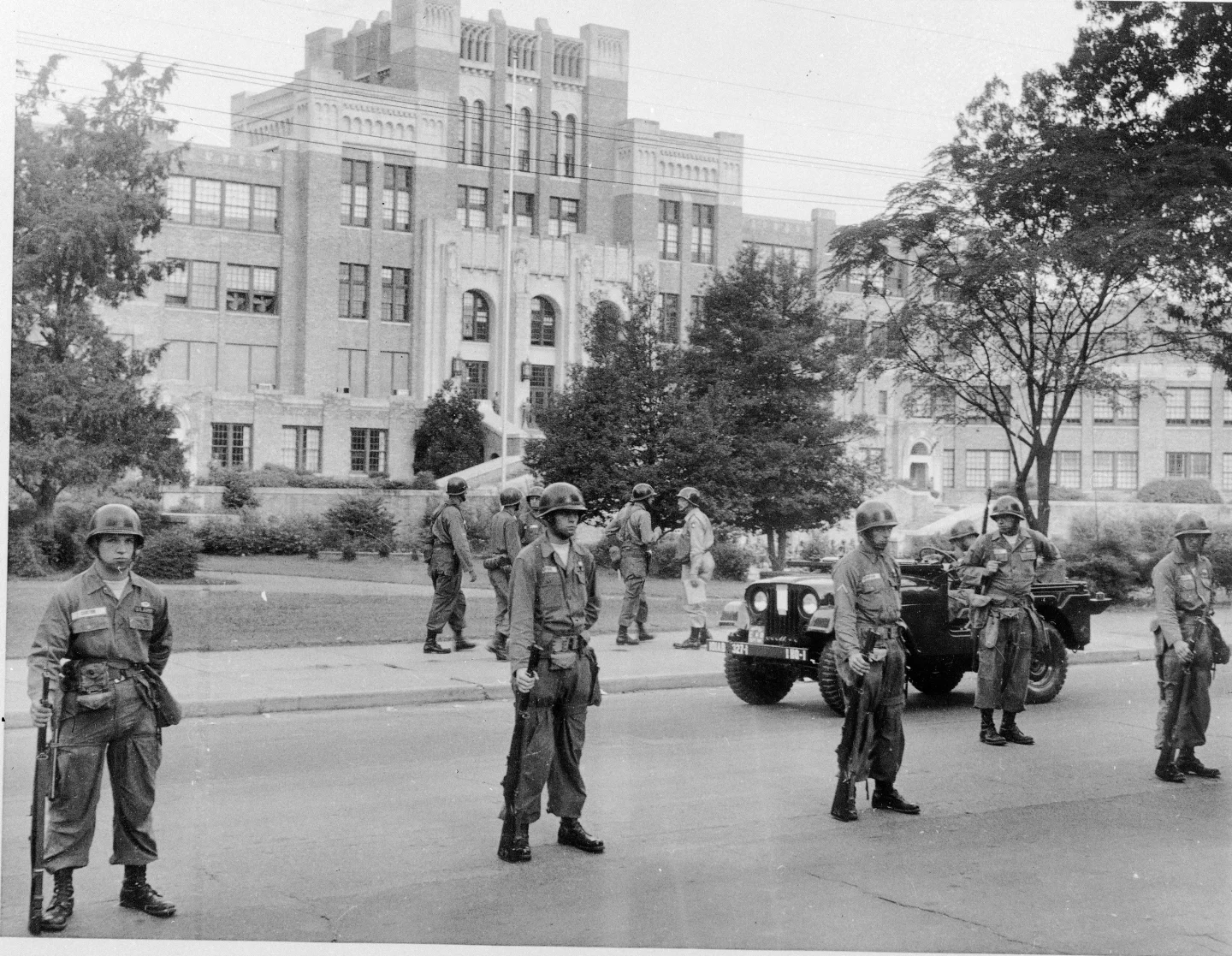
The federalized National Guard mobilized to Little Rock, Arkansas in 1957, over the strenuous objections of segregationist governor Orville Faubus, and secured the enrollment of nine brave Black students, in accord with President Eisenhower’s orders, Supreme Court decisions, and moral decency. But they didn’t resolve the issue or bring peace.

The Trump Administration’s bet is that the violence and disruption works to its benefit, regardless of the costs.

Posted in Uncategorized | Tagged , , , , , , , , , , , , , , , , , | Leave a comment

Kent State Anniversary (May 4, 1970, revised and reposted)

This is a repost of a report on the Kent State shootings, on occasion of an anniversary. At the end, I’ve added a bit on Neil Young’s emblematic song, which helped keep the memory alive.

As I write in 2025, we’ve seen more than sparks of student activism erupt, starting with the widespread protest encampments about the Gaza War and America’s role in supplying Israel with weapons used in war crimes. We’ve also seen the beginnings of a broader resistance on some campuses aimed at protecting international students who are being prosecuted for mostly orderly activism. There has been much less visible student activism on more immediate campus issues, including the end of diversity programs and severe budget cuts. Recalling Kent State raises questions about the special environment campuses are supposed to provide.

It’s the anniversary of the killing of four college students at Kent State University. Young National Guardsmen opened fire on students protesting the war on May 4, 1970, discharging more than 60 rounds in roughly 13 seconds. They killed four students: Allison Krause, 19, and Jeffrey Miller, 20, were part of a nonviolent protest that university authorities promised to ban; Sandy Scheuer, 20, and William Schroeder, 19, were walking to class. The Guardsmen also wounded nine other students, some severely.

The Kent State student actions were part of a wave of protests that swept across American college campuses on May 1, a Friday, the day after President Richard Nixon announced that he had already ordered American air forces to expand their bombing to Cambodia. (Roughly a week earlier, after operations had already commenced, Secretary of State William P. Rogers testified before Congress, explicitly denying any intention of expanding the war to Cambodia.)

In Kent, protest and disruption spread into the town that night, with bonfires set in the streets and altercations with police.  The mayor declared a state of emergency, ordered the bars closed, and asked the governor for help in getting everything back under control; the National Guard arrived at the University on Saturday. Students planned a demonstration for Monday to protest the presence of the Guard on campus.  University officials tried to cancel the demonstration, but students assembled anyway. The Guardsmen ordered the students to disperse, then used tear gas before opening fire.

It was terrible, and there is still a great deal we don’t know: why the National Guard was on campus in the first place? why the order to fire on unarmed students hundreds of feet away? Who gave the order? or, was an order even given?  There’s a lot of writing, and a lot of controversy, still.  A good start is a summary, including an annotated bibliography, by two emeritus professors at Kent State, Jerry M. Lewis (Sociology) and Thomas R. Hensley (Political Science).

The shooting of unarmed students on a public college campus fostered a sense that the country was coming apart.  It was followed by a police shooting of student protesters at Jackson State in Mississippi, killing Philip Gibbs, 21, and James Green, 17, and wounding 12 other students.

President Nixon established a commission, chaired by William Scranton (formerly governor of Pennsylvania), to report on campus unrest. Published in September, the Scranton Commission answered few of the pressing questions about Kent State or Jackson State, but observed that campus unrest seemed to decline when the war in Vietnam seemed like it was winding down, and escalated after the bombing in Cambodia started.

The war and the demonstrations continued for a while, tapering off when the draft ended the next year.  Authorities developed ways to control dissent, on campus and elsewhere, without using live ammunition against protesters involved in large demonstrations. Demonstrations generally became less threatening, less disruptive, and less dangerous.

The Kent State and Jackson State killings remain tragic exceptions to more routine protest politics. It’s a good sign that they stand out in our memories.

One reason the memory remains is a powerful and idiosyncratic protest song, recorded within just a few weeks of the event. Days after the Kent State shootings, Neil Young wrote, “Ohio,” a song mourning the deaths. Apparently, he was shocked by photos published in Life magazine. Crosby, Stills, Nash, and Young released the song, which called out President Nixon and ended with the repeated line, “Four dead in Ohio”  (lyrics). The song reached the top 20 in the United States and Canada, and appeared on several albums by Young and by the group; they often performed the song in their occasional reunion tours over the past half-century.)

Posted in Uncategorized | Tagged , , , , , , , , , , , , , , , , , , , , , , , , , , , , | 3 Comments

May Day 2025, it’s not just labor…

This is a repost and edit of an earlier post.

As always, May Day is an international day of protest for workers rights.  Below is a picture of a march at a courthouse in Philadelphia. CBS News has posted great photographs of May Day protests around the world, where protests are about wages, pensions, jobs, and so much more.

You’ll not from the signs that May Day protests, often animated by class, address all sorts of other issues, but economic inequality is a constant, and the protesters side with the workers. Welcoming immigrants and due process have not been the go to issues for workers during most of our history.

In the United States, by design we have a different day for workers (Labor Day), and May Day always seems like an opportunity to organize and demonstrate around a somewhat related cause, with or without the support of organized labor.

Workers, organized and otherwise, have plenty of issues in the United States these days, and President Donald Trump is on the other side of most of them. The budget plan about to drop is a proximate provocation for a whole range of other issues of inequality, now with racism, democracy, and the rule of law inescapable add-ons. Senator Bernie Sanders spoke at the Philadelphia demonstration, and you just know he was able to update the speech he’s been updating and refining for the past forty years.

Although it’s a desperate time, there are burning embers for optimism. Campaigns for raising the minimum wage at the state level have met with some success in some states. Unionization campaigns have succeeded at a couple of Starbucks and Amazon sites, but every subsequent site is a battle. Graduate student researchers and teaching assistants have launched unionization campaigns and strikes for better contracts with some success–including at the University of California. Here at UC-Irvine, the unions won substantial raises, and the University responded by cutting the number of graduate students admitted and teaching assistants assigned. There are no easy battles.

https://www.statista.com/statistics/195339/number-of-union-members-in-the-us-since-2000/

Successful campaigns have increased the number of unionized workers in the United States, bucking the trend of the past 70 years or so, but the percentage of American workers in unions continues to decline.

The graph below charts the rate of union membership since 1983. It’s hard to miss the trend line–and it’s worse for private sector workers.

https://www.statista.com/statistics/195341/percentage-of-emplyoyees-respresented-by-unions-in-the-us-since-2000/

May Day is an obvious time to take stock. Journalists look for labor stories that are normally undercovered on May Day (and even on Labor Day), and organizers work hard to fill the space.

May Day is an opportunity to organize and say something, reminding the rest of the world that constituencies and concerns remain vital and potentially volatile.

Posted in Uncategorized | Tagged , , , , , , , , , , , , , , , , | Leave a comment

Harvard fronts a defense of higher education

https://theonion.com/nation-cant-believe-it-on-harvards-side/

Not for the first time, the Onion’s headline said it all…almost.

Hang onto whatever personal or political gripes you might have with Harvard University; surely, they must be justified. Still, let’s recognize that the nation’s oldest and richest (endowment >$60b) has leaned into a leading role in the ongoing fight to protect higher education. With its extraordinary wealth, history, and status, Harvard can do more in this battle than almost any other institution, particularly in blocking for, and encouraging, the rest of America’s universities and colleges.

Faced with the Trump Administration’s threat to pause and reconsider some $9b in federal grants and contracts, Harvard entered into the same sort of humiliating and counterproductive negotiations that stained Columbia University. As the negotiations continued, the Administration demanded more and more, including oversight of Harvard’s admissions and hiring, and routine reports on protesting students. Quicker than Columbia, Harvard’s leadership saw where this was going. President Alan Garber announced that they were done talking, and that Harvard would manage its own reforms.

People in the Trump administration allowed that maybe they’d made mistake, and pushed too hard too fast. Whoops. But they didn’t back away from any of their demands.

The Trump administration immediately suspended about 1/4 of Harvard’s federal funding (mostly going to medical research), and Trump himself ordered the Internal Revenue Service (IRS) to rescind Harvard’s tax-exempt status, no simple matter. Harvard escalated as well, filing a suit against the Administration challenging the funding rescissions as a violation of free speech. It’s hard to think that there’s any institution of higher learning better provisioned to survive the long battles now joined. And, at least for the moment, Harvard is basking in positive attention AND alumni giving. The Crimson reports that Harvard’s fundraising spiked up when Garber announced that the school would not roll over for Trump.

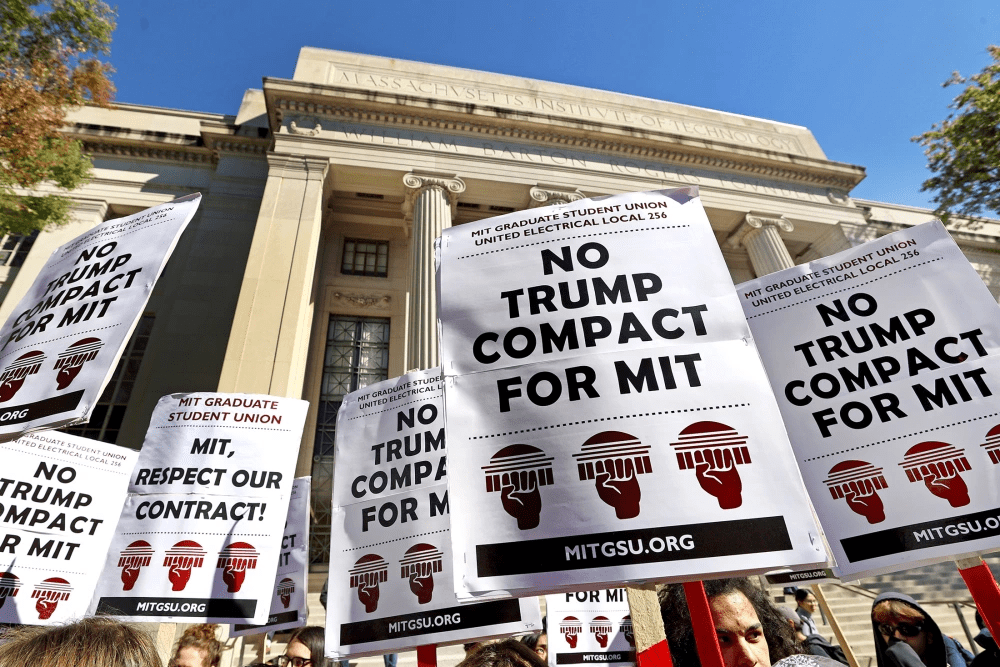
And Harvard isn’t alone. MIT joined with a coalition of other research universities, including major public and private institutions I’ve heard of, to sue the Department of Energy over unilateral cuts in indirect costs. Rutgers University’s faculty senate called for a mutual aid pact among Big Ten schools to provide for the common defense of higher education. Seeing something like a NATO for colleges armed with epistles rather than missiles, allied schools signed on.

Nothing will be resolved quickly, but it’s important for us to see that the academic defiance is coupled with the demonstrations in the streets. University administrators see there is support for standing up against the crazed demands of the Trump Administration, and recognize a strength in unity. Surely, they also realize that defending research on say, tuberculosis, is a winning political strategy for academic freedom and independence.

Protest works when it stiffens the spines of potential allies who aren’t necessarily marching or carrying signs.

Posted in Uncategorized | Tagged , , , , , , , , , , , , , , , | 2 Comments

Warriors Coach Steve Kerr supports….Harvard

https://www.mk.co.kr/en/sports/11293083

I’m not ready to reconfigure my wardrobe, but I’m impressed that Steve Kerr, coach of the Golden State Warriors, opted to wear a Harvard Basketball shirt to the post-game press conference.

Very successful as a coach, Kerr has a lot going on, although this is the first connection to Harvard University that I’ve heard of.

The t-shirt was a way to open the post-game press talk to other issues, like research and academic freedom. Kerr explained:

“I believe in academic freedom. I think it’s crucial for all of our institutions to be able to handle their own business the way they want to — and they should not be shaken down, told what to teach, what to say by our government. That’s the dumbest thing I’ve ever heard, but it’s kind of par for the course right now. Yes, this is me supporting Harvard. Way to go. Way to stand up to the bully.”

You’d expect Harvard’s resistance to the Trump administration’s demands to echo, although not necessarily in professional sports.

More to come.

Posted in Uncategorized | Tagged , , , , , , , | Leave a comment

Universities begin to resist the Trump administration

https://www.chicagotribune.com/2025/03/24/opinion-donald-trump-due-process-freedom-of-speech-trans-athletes/

So many people are angry at Columbia University. For whatever reason, the Trump administration went after Columbia first, pausing government grants and demanding concessions. Columbia complied quickly and appears ready to do more.

Many faculty at Columbia and many more across the nation were critical of the university’s administration’s solicitous response to the Trump Administration. The Faculty Senate published a report contending that the critical occupation of Hamilton Hall could have been managed and ended without resort to New York City Police. It’s not just that university administration energetically responded to all of the Trump Administration’s initial demands, but also that Columbia police helped ICE agent gain access to student residences.

Faculty and students at Columbia have protested, even as the Trump Administration, predictably, announced investigations and issued demands to a growing number of schools. Given the amount of money at stake, it’s understandable why academic administrators would genuflect to Trump, but it’s also intolerable. The AAUP (American Association of University Professors) was harsh in criticism, labeling its statement “Cowardice and Capitulation: Columbia has Sacrificed its own Students to Authoritarianism.”

Meanwhile, faculty and some administrators elsewhere are determined NOT to follow Columbia’s compliance. Nothing coordinated has emerged; after all, professors are notoriously bad at coordinating on anything. Still, administrators and others are prospecting approaches to protect their academic independence and their students.

Here’s what I’ve seen so far:

Tufts University president Sunil Kumar issued a statement of support for Rümeysa Öztürk, a doctoral student in psychology who had a student visa, who was picked up by masked ICE officers on the streets of Somerville, apparently for signing an article in the student paper criticizing Tufts’ president’s policies. Kumar filed a declaration in support of Öztürk’s legal team, certifying that she was in good academic standing and had violated no university rules. Kumar demanded due process.

In response to the Trump Administration’s demands of Harvard, including the threat to review $9 billion of federal grants and contracts, more than 600 Harvard faculty have signed a letter urging their administration to:

Publicly condemn attacks on universities.

Legally contest and refuse to comply with unlawful demands that threaten academic freedom and university self-governance. Freedom from political interference has allowed American universities to lead the world in scientific and medical innovation, from which our entire country benefits.

Work with other universities and Harvard’s own alumni networks to mount a coordinated opposition to these anti-democratic attacks.

Brown University president Christina H. Paxson, issued a long statement describing the long history of government support for higher education and research more generally, recommitting to “upholding…ethical and legal obligations under…the Civil Rights Act of 1964,” and announcing that Brown would continue to support its international students with resources “in the face of new challenges.” She also promised to protect academic freedom.

Princeton president Christopher Eisgruber, has already criticized the Trump Administration’s attacks on research financing and higher education more generally. More recently, Eisgruber committed to “principle and a willingness to do hard things…we have to be willing to speak up, and we have to say no to funding if it’s going to constrain our ability to pursue the truth.” Sitting on top of a massive endowment ($34 billion +.…at least until the markets crashed), Eisgruber floated the possibility of issuing bonds to backfill rescinded federal grants.

President Eisgruber, blessed with resources AND courage, may be the exemplar of the moment. The Trump Administration went after the biggest names in higher ed to intimidate everyone else. But those schools have reservoirs of support to fight back. Eisgruber, apparently, understands this fact.

Larry Summers, former Secretary of the Treasury and former president of Harvard University, understands it as well. Writing in The New York Times last weekend, he excoriated the Administration, underscored the threat to higher education and America, and urged resistance. And, as an aside to today’s Ivy League presidents, whispered,

“They should make clear that their formidable financial endowments are not there to simply be envied or admired. Part of their function is to be drawn down in the face of emergencies, and covering federal funding lapses surely counts as one. Believe me, a former president of Harvard, when I say that ways can be found in an emergency to deploy even parts of the endowment that have been earmarked by their donors for other uses.”

To this point, there are no signs of a unified response; like the Big Law firms, the lack of coordination makes each target more vulnerable. At some point, some of these people who demonstrated brilliance on standardized tests will realize it.

[Note: In 2015, in response to a student occupation of his office, Eisgruber began an examination of the careers of some of the notables Princeton had honored with building names; in 2020, he renamed some of those buildings and programs, stripping former Princeton President Woodrow Wilson’s name. (Wilson also served as president of the United States and left a record of white supremacy that was, in Eisgruber’s judgment, notable even for the time.) ]

Posted in Uncategorized | Tagged , , , , , , , , , , , , , , , , , , , | 1 Comment

What to make of the April 5 demonstrations

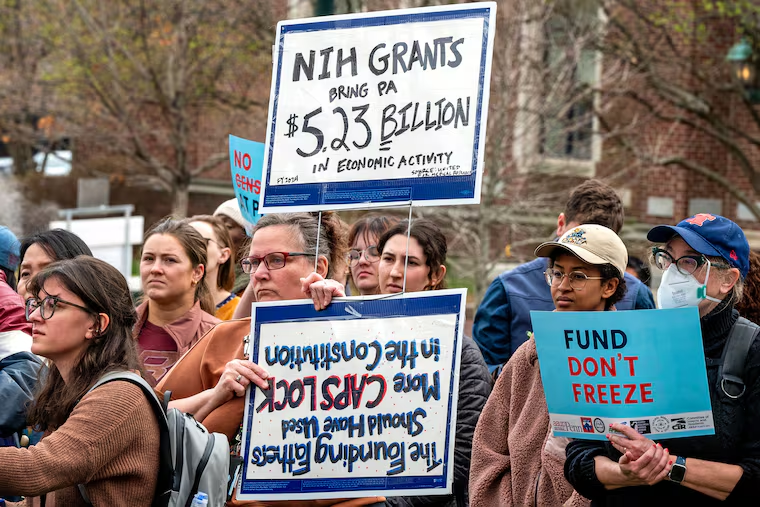
https://fullertonobserver.com/2025/04/06/thousands-gather-in-orange-county-for-hands-off-protest-against-trump-administration/

Hands Off announced the massive collection of demonstrations long before the stock markets crashed and analysts upped their odds of a national (or global) recession—and increased inflation. Even so, there was room to add yet another grievance to the anti-Trump/pro-democracy protests. Plenty of issues–including migration/rendition, free speech, government layoffs, climate, taxes, and Medicaid cuts–already had signs and picketers, but as long as there were markers and placards, there could be more. Donald Trump and the extraordinarily complaisant Republican Party, united them all..

Activists across the country staged protests everywhere, totaling more than 1,400 events. Many organizations pitched in with the organizing, producing varieties in tone. The inventory of grievances was capacious and inclusive, varying from place to place, but there was a unified message: opposition to the Trump Administration. Pictures from New York, Chicago, and Milwaukee showed impressive crowds–Boston media estimated nearly 100,000 protesters on the Boston Common. Organizers reported a cumulative turnout of more than 5.2 million people participating. That’s substantially more than turn up to watch Fox News nightly, or even CBS News.

Will any of it matter? How? Journalists, like Gal Beckerman at The Atlantic, wondered if the much larger number of smaller demonstrations would be more (or less) influential than the mass turnout events in Washington, DC that started with the Women’s March. Wrong question.

Demonstrations, large and small, don’t often exercise much influence by themselves, but by connecting and intensifying all sorts of other events, most of which never make it into the newspapers.

I saw a big turnout (5,000 people) in Santa Ana, California, with thousands assembled in Sasscer Park, where my new Congressman, Dave Min, aired out a slurry of Trump sins. If the protests worked, Rep. Min will stay committed, meet with constituents who share the concern, and continue his efforts in Washington. Protest stiffens the spines of supporters.

And I’ve been obsessed with Omaha, Nebraska, where thousands rallied in a park with a similar litany of gripes. Their Republican congressman, Don Bacon, didn’t speak at the rally, but he’s been critical about Trump’s policy in Ukraine and angry at the prospect of cuts to Medicaid. And just yesterday, he announced that he would introduce a bill in the House reclaiming Congressional authority on tariffs. Trump lost the city of Omaha in 2024, when Bacon narrowly won reelection. If the protest worked, Bacon will meet with some of those protesters and display at least a little less loyalty to the slight Republican majority in the House.

Demonstrations are the visible exclamation points in the longer stories of social movements, animating all sorts of less visible efforts. Demonstrations everywhere makes it a little bit easier for business leaders to express doubts about the tariff strategy. A local demonstration that a spouse or child attends could well be the last straw that encourages the partner at a large law firm to join 500 other firms and sign onto Perkins Coie’s lawsuit against the president.

Influence is about the accumulation of efforts and actions. If this Resistance grows, there will be a lot of attention to the Hands Off protests, but they’re just a part of the story.

Posted in Uncategorized | Tagged , , , , , , , , , , , , , , , , , , , , , , , , , | Leave a comment

Tesla protests and the Musk dilemma

https://www.vanityfair.com/style/story/tesla-boycott-mark-kelly-elon-musk

The influence of popular protests at Tesla dealerships is starting to play out as Republicans realize that Elon Musk is a mixed blessing, at best, for their political futures. We can get a good sense of the often indirect ways in which protests play out.

So, people with grievances about Trump administration initiatives–and there are plenty of them–are constantly looking for something meaningful to do. In 2017, during Trump I, the initial wave of opposition assembled in a parade of weekly protests in Washington DC, starting with the Women’s March. This time IS different.

We haven’t seen big national demonstrations on the National Mall, activists have staged more protest events than in 2017, scattered across the United States. (We can follow this with the help of the Crowd Counting Consortium, which has been tracking protest events across all sorts of causes since 2017. Jeremy Pressman and Erica Chenoweth started the project because they wanted to get reliable information on protest events that might escape coverage in mainstream media.) The events aren’t as big, but many people are involved, and they’re working with neighbors in local groups that can continue to stage events, attend candidate forums, and build a vital resistance.

While the logic of a protest in front of the Lincoln Memorial seems obvious: assemble large numbers on a national stage to show popular support for your position and watch everyone else respond.

But at the local level, there are more possibilities and more complications. The first issue is finding a target and a tactic. It’s fine to assemble at a City Hall, but lots of Trump opponents don’t have major grievances with their local governments. They payoff isn’t so clear.

In contrast, Elon Musk has made himself a big target for all kinds of gripes about the Trump presidency, particularly the massive lay-offs executed by the so-called Department of Government Efficiency (DOGE). Supported by some version of Artificial Intelligence and aided by a team of young coders processing spreadsheets, Musk has ended the jobs of tens of thousands of people, making conspicuous mistakes along the way. Maybe it’s even more important that he’s expressed apparent delight with every lost job, and has appeared gleeful and provocative in public. It’s almost as if he wanted to be a target.

Musk’s close association with Tesla, the electric vehicle company that he bought and promoted, made dealerships a particularly attractive target. They’re all over the place and visible. So are the protests. The demonstrators worked to stigmatize the cars, and also to signal Trump’s opponents that there were lots of angry people willing to take action. The protests showed people concerned about layoffs or Ukraine or reproductive rights or the budget or tax justice (and so on) that they were not alone. It matters.

The protests were also a signal to Trump’s supporters that their allegiance could have costs. Tesla’s stock price cratered after a post-election spike, which means that Musk and his investors lost money; a responsible Board of Directors, considering its fiduciary duties, would surely urge Musk to step back from politics a little. (Apparently, Tesla does not have such a Board.) The Secretary of Commerce (illegally) promoted the stock on television, while Trump himself turned the White House driveway into a showroom and himself into a shill for at least one kind of electric car.

Meanwhile, Musk has flexed, mostly with money, politically, attacking opponents and judges while promoting himself. He’s threatened elected Republicans who think twice before supporting whatever Trump wants, promising to find and fund primary opponents for each of them.

And he invested mightily in a high-profile election for the swing seat on the Wisconsin Supreme Court, dropping $25 million on conservative Brad Schimel’s candidacy. Susan Crawford defeated Schimel handily, winning by about 10 points. Even more important, Musk provided focus and publicity for Crawford’s candidacy. His presence in the race, and in a cheesehead, helped Democrats raise money from across the country and turn out voters in Wisconsin. Voting for Crawford was a way to vote against Musk.

This week’s election showed Musk is a political liability. Although Republicans still want Musk’s money, it would be better if they could get it without a personal handoff.

The challenge for Donald Trump and the Republicans is to find some way to push Musk off the stage without giving up access to the hundreds of millions he’s been willing to spend. It’s not clear they’ll be able to pull it off, but Trump has already announced that Musk will be leaving….soon. The question is whether he’ll leave some money in the cushions at the White House.

To hammer the point: The Tesla demonstrations focused attention on Elon Musk, all his assets and liabilities, and exposed the political risks associated with allowing him to front for the administration. That’s a win.

Posted in Uncategorized | Tagged , , , , , , , , , , , , , , , , , , , , , | Leave a comment

Quitting takes courage: Young attorneys make choices

https://www.bostonreview.net/articles/lawyers-face-an-existential-choice/

It’s sometimes hard to see a critical moral and political choice even when it lands in your lap. But some people are blessed (or cursed) with the vision to see it way in advance. When Paul Weiss negotiated a deal to provide Trump with $40 million worth of pro bono services, Rachel Cohen, a young associate at another very large and prestigious firm, saw what was coming–intense pressure on the most visible firms to abandon basic principles of legal ethics and responsibility to protect their bottom line. The Trump Administration was determined to punish firms that represented clients and causes that Trump didn’t like, and firms that employed people who had investigated Trump and his, uh, associates.

Lawyers claim to believe that everyone is entitled to zealous legal representation, even people they may not like. (John Adams famously represented the British soldiers who fired into the crowd at the Boston Massacre.) Certainly, American law is compromised if political authorities can deny people they don’t like effective legal representation.

Cohen, a finance associate with nearly three years in at Skadden Arps and a Harvard Law degree, saw that she was sitting on the tracks with a freight train full of moral dilemma approaching fast. She gave notice–conditionally, along with an explanation, and an ask. Alarmed that lawyers will be reluctant to represent anyone at odds with the administration, and she called upon Skadden and other large firms to stand up for the rule of law. She posted her revocable resignation on her LinkedIn page.

For an associate to threaten to quit is a big deal. Getting hired at one of these large firms is extremely competitive. Associates work long hours and make a lot of money, particularly helpful in paying off the expensive high status law degrees they earned (and paid for). Some work to succeed on a partner track and build a career in corporate law. Others work to develop expertise and make connections that provide the foundation for other legal careers. Giving up such a position is a serious cost.

Cohen called for Skadden to support Perkins Coie, which was fighting Trump’s punitive Executive Orders in court. She also posted a broader letter for big law, predicting that once one law firm cut an independent deal with Trump, others would follow. (This turned out to be correct.) The letter asked associates to pressure their senior colleagues, their employers, to fight back. At this writing 1,700 associates at large law firms had signed–at least identifying the firms that employed them.

Skadden responded pretty quickly, blocking Cohen’s access to the firm’s communications, as she explained on TikTok. Not long afterward, the firm negotiated its own deal with Trump, promising $100 million in pro bono services. No surprise, the Trump administration sought out additional big firms to shake down. Some law firms are fighting back, contesting the orders in court, and winning early procedural victories; others are cutting quick deals with the Administration to protect themselves.

It’s an ongoing battle, and it’s an open question whether pressure from young associates will affect the large firms’ decisions. A few other associates have left Skadden and other cooperating firms, and other letters of protest are circulating, including one signed by Harvard Law alumni who want to support the rule of law. Anna Bower, a senior editor at Lawfare, has been tracking different strands of resistance on her bluesky feed.

Meanwhile, Rachel Cohen is using the attention of the moment to explain, again and again, why this moment is critical and why lawyers have an obligation to do more. (Read the interview in ABAJournal.) Her resignation letter, recalling the flights of imagination and reflection that good teachers promote when teaching about historical horrors, should evoke a moral reckoning for lawyers, to be sure, but for the rest of us as well. We all imagine that we would have sided with the heroes when we page through texts about evils like slavery or genocide, but most people didn’t.

Most of us wouldn’t have thought powerful resistance would come from a finance associate at a large corporate law firm or, for that matter, an Acting US Attorney in the Federalist Society. But Rachel Cohen and Danielle Sassoon are heroes and exemplars at this point in resistance, even if they’re not marching or carrying signs. Effective activism takes many different forms. But the first step, they realized, is recognizing the moral dilemma that most of us have been able to ignore.

Posted in Uncategorized | Tagged , , , , , , , , , , , , , , , , , | Leave a comment

Cesar Chavez Day, 2025

Commemoration of Cesar Chavez Day is an annual ritual in California–and in Politics Outdoors.

The day is a chance to reflect on Chavez, the movement he led, which continues, and the issues he and that movement addressed. (It also seems to be a good opportunity to return to writing here, with the chance to repost, reconsider, and update writing from past years.) Recalling his career, organizing and mobilizing a mostly migrant Latino workforce, is particularly important now…just when the Trump administration wants to purge all the details from public notice.

Image result for edna chavez speech, stephon clark

In 2018, less than a week after Edna Chavez, the charismatic then-seventeen year old high schooler from South Los Angeles, electrified a national crowd with a demand to end gun violence, Californians celebrated the legacy of another Chavez.

On my campus, we commemorated Cesar Chavez Day on Friday, rather than Monday, March 31 (his birthday), by closing. The state established the holiday in 2000, and six other states have followed suit.  In California, the legislature calls upon public schools to develop appropriate curricula to teach about the farm labor movement in the United States, and particularly Chavez’s role in it.

A campaign to establish a national holiday has stalled so far (The Cesar Chavez National holiday website seems to have last been updated in 2008), but at one point President Obama issued a proclamation announcing a day of commemoration, and calling upon all Americans “to observe this day with appropriate service, community, and education programs to honor Cesar Chavez’s enduring legacy.”

That feels like a long time ago.

Political figures have many reasons for creating holidays, including remembering the past; identifying heroic models for the future; recognizing and cultivating a political constituency; and providing an occasion to appreciate a set of values. Regardless of the original meaning, the holidays take on new meanings over time.  Columbus Day, for example, is celebrated as an occasion for pride in Italian Americans (e.g.), and commemorated and mourned as a symbol of genocide  and empire (e.g.).

Cesar Chavez’s life and work is well worth remembering and considering, particularly now.  His career as a crusader was far longer than that of Martin Luther King discussed (here and here) and he was far more of an organizer than Fred Korematsu (discussed here). Chavez’s Medal of Freedom was awarded shortly after his death in 1993, by President Clinton, but many of his accomplishments were apparent well before then.

Dolores Huerta, 2009

As a young man, Chavez was an agricultural worker; by his mid-twenties, he became a civil rights organizer, working for the Community Service Organization in California.  With Dolores Huerta, in 1962 Chavez founded the National Farm Workers Association, which later became the United Farm Workers.  Focusing on poor, mostly Mexican-American workers, Chavez’s vision for activism was right at the cornerstone of racial and economic justice.  Establishing an organization, however, is a long way from winning recognition and bargaining rights as a union.

Chavez was a tactician, a public figure, a charismatic, and something of a mystic. Modeling his efforts after Gandhi’s successful campaigns, Chavez was an emphatic practitioner of active nonviolence. He employed boycotts, strikes, long fasts, demonstrations, long marches, and religious rhetoric in the service of his cause.  He also registered voters, lobbied, and worked in political campaigns. He was a tireless and very effective organizer for most of his life.

But holidays are best celebrated with an eye to the future, rather than the past.

On Cesar Chavez Day this year, we can think about the large and growing Latino community in the United States. The 2020 Census reports that Latinos now comprise 18.7% of the population nationally. This is the youngest and fastest-growing population in America today, and they are severely underrepresented in the top levels of politics, education, and the economy.  The civil rights map is at least as complicated as at any time in American history, but not less important or urgent. The future of American Latinos is very much the future of America.

And Chavez saw the civil rights struggle as a labor issue.  When Chavez and Huerta started

The Crusades of Cesar Chavez,' by Miriam Pawel - The New York Times
https://www.nytimes.com/2014/04/27/books/review/the-crusades-of-cesar-chavez-by-miriam-pawel.html

their campaign, nearly one third of Americans were represented by unions.  The percentage now is now less than 10 percent, and even less in the private sector. Donald Trump has issued an executive order, banning collective bargaining for many federal employees. This probably isn’t legal.

And public sector workers, even if represented by unions aren’t doing so well.  In 2018, the Supreme Court issued a ruling in Janus vs. AFSCME,that undermined the capacity of unions to organize and represent members by allowing workers to opt out of membership and paying dues.

Still, organizers and some observers find some encouragement in unionization campaigns at Amazon and Starbucks. Still, the larger picture is dark. In the moment, the Trump administration is vilifying teachers and firing other government workers

We need to remember that you can’t attack teachers, nurses, police officers, and firefighters without hurting the people they serve: us.

Or should I say, US?

We commemorate the past to help guide the future. Edna Chavez, working in an urban setting far from Cesar Chavez’s organizing, carried the legacy forward, and adds more.

Posted in Uncategorized | Tagged , , , , , , , , , , , , | 1 Comment