Strike the flag; direct action version

SALESOUT NARCH EUO MNDTYJust in case all those rainbow flags flying everywhere had obscured the Confederate flag still flying at the state capitol in South Carolina, Bree Newsome climbed the flag poll and took it down.  Police were on top of the situation, helping Newsome and the flag down, and arresting her and James Tyson, her spotter, in short order.

This was hardly the first project for the two activists from Charlotte.  Newsome, a filmmaker and musician, had been working in voting rights campaigns in North Carolina.   Tyson had been working in the environmental movement, and was also a veteran of Occupy Charlotte.

Image result for bree newsome james tysonThe viral video shows politeness and cooperation everywhere, but the activists were arrested, booked, and released by the end of the day.  Although their effort is unlikely to change a single vote in the state legislature, which is set to debate the flag next week, it did spur a wave of attention and support among flag opponents.

Michael Moore tweeted support, promising to pay legal fees and fines.  The NAACP issued a statement comparing their civil disobedience effort to those of Rosa Parks and Martin Luther King.  And viral campaigns on numerous sites raised far more money than their legal defense is likely to cost.  The attention was even greater.

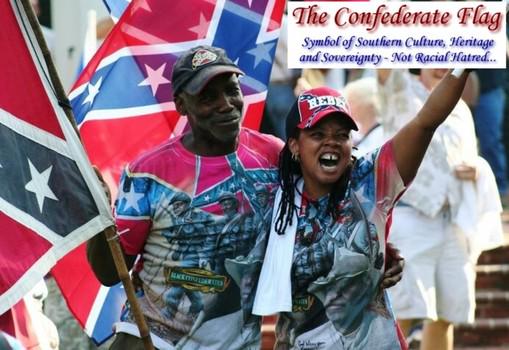
The  flag was back up on the monument within the hour; there wouldn’t have been a shortage of Confederate flags anyway. A few dozen demonstrators supporting the flag showed up shortly after Newsome and Tyson departed, demonstrating on behalf of heritage–whatever that means.

The pro-flag demonstrators proclaimed that they supported the honor of veterans, the traditions of the South, but most assuredly not racism or oppression.  Oddly, just this rationalization, however twisted, represents the very serious influence of the anti-flag campaigners. Having your opponents adopt your rhetoric and concede your claims, even if not quite accurately, is a part of victory.

Confederate Flag supporters rally at the South CarolinaMeanwhile Bree Newsome and James Tyson made sure the main story of the day was theirs, rather than that of their opponents, crowding the pro-flag demonstrators a little off to the corners of public attention.

Posted in Uncategorized | Tagged , , , , , , , , , , , , , | 2 Comments

Don’t stop with the flag. #blackvotesmatter

Politicians in the South, mostly Republicans (because it’s mostly Republicans in power in the South), have been rallying around the removal of the Confederate flag from government display.  South Carolina Governor Nikki Haley called her state legislature into a special session to vote on striking the flag.  Unconstrained by statute, Governor Robert Bentley ordered the Confederate flags removed from the state capitol grounds in Birmingham immediately.  Legislators in Mississippi and Tennessee are working to remove the symbols of the Confederacy.  And Texas just won a case in the Supreme Court to allow it not to stamp the flag on license plates.

Sixty years after the flag was resurrected to symbolize opposition to civil rights, these welcome moves were a long time in coming.  But they’re not too late.

They are, however, too little.

Removing the standard of an army seeking to maintain slavery, and the chosen symbol of a violent racist group, is a good first respoSefhahrtjrqv32eeimc6nse to #blacklivesmatter, a small step toward rectifying injustice.  The question is whether these politicians mean to be waving the flag at the end of the campaign, rather than the beginning.

There are many other things to do as well.  Here’s one:

Alabama, Mississippi, South Carolina, Tennessee, and Texas all tightened their Voter Identification requirements, starting in 2011–the reflection of a campaign sponsored by ALEC, the conservative policy shop.  Although there’s a smokescreen of talk about voter fraud, requiring a photo ID to vote has the clear effect of depressing black votes.  Sometimes, less savvy politicians even acknowledge this is the intent: black people are more likely to vote for Democrats.

Image result for voter id laws

In Alabama and in South Carolina the focus on tighter voter ID came right after Governor Bentley and Governor Haley were sworn into office.

If #blacklivesmatter, #blackvotes should matter too.  Governors Bentley, Haley, and their allies can demonstrate a commitment by making it easier to vote. It’s a clear next step in cleansing their states of a racist heritage.

I’ll bet they won’t do it on their own.  Social movement campaigns need to accept victories relatively gracelessly, and ask for more.  Meaningful access to the ballot has been on the agenda for a long time, and now’s a chance to make something more happen.

There’s nothing wrong with reevaluating names of bridges, schools, and streets named for racist Confederate war heroes, but that shouldn’t become a sideshow or distraction from much more important political work.

And we haven’t even begun to talk about guns….

Posted in Uncategorized | Tagged , , , , , , , , , , , , , , , | Leave a comment

Start with the flag

The tragic racist killing of nine people at Charleston’s African Methodist Episcopal Church, following a year of activism around #blacklivesmatter, drew unusual attention to a range of issues around political and economic inequality.  Striking the battle flag of the Army of Northern Virginia from government display is a welcome–and modest–response.  It offers us an opportunity to think about what such symbols mean to organizers and movements.

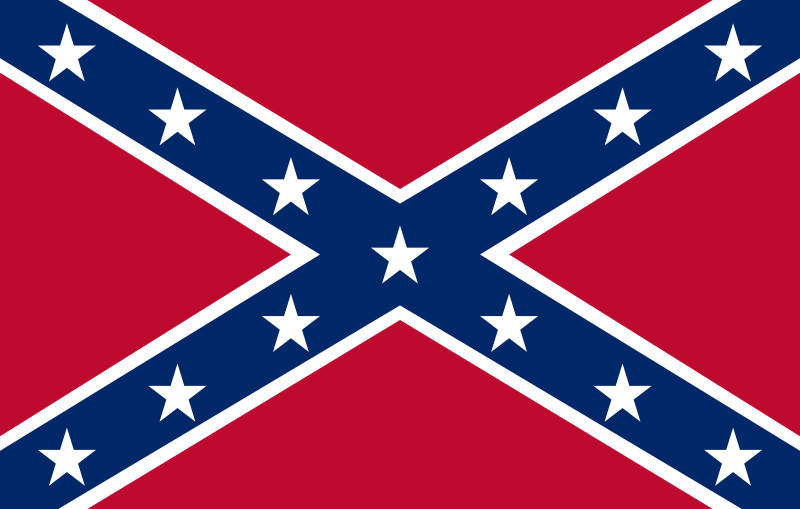
This Confederate flag came to represent the Confederacy as a whole only after the end of the civil war, serving as an evocative standard for the Ku Klux Klan in the years after the war.  Like all flags, this one was built around a myth.  This one was meant to inspire pride and loyalty from white Southern men, and to terrify and warn others.  Very few people will now claim the second purpose, but that’s one thing such symbols can do.

I can understand how this stuff matters at a visceral level.  As a boy, even seeing the Nazi Swastika Flag - NSDAPswastika made me tense and alert in an uncomfortable way, knowing that standard sanctioned unprecedented racist violence–directed at people just like me.  (Its ubiquity in movies and a stupid sitcom ameliorated this somewhat.)  In the service of an idea of free speech and democratic discourse, America allows people to deploy offensive speech and symbols.

The swastika symbol dates hundreds of years prior to the Nazis, and even the establishment of Germany, and a history of sacred connotations in several Asian religions.  But the Nazi regime, World War II, and the Holocaust crowded out alternative interpretations–at least in the West.

When the American Nazi Party was looking to resurrect itself, it boldly deployed the flag in a march through Skokie, Illinois, a community that was home to a large population of Jewish survivors of the Holocaust.  The flag was supposed to make the community scared or angry; it was supposed to provoke a reaction, and inspire young racists to rally around it.  Skokie wanted to stop the march; the state of Illinois wanted to constrain it.  The American Civil Liberties Union, which has always enjoyed substantial Jewish support, defended the Nazis’ right to demonstrate and display the flag.  Doing so was completely consonant with its values, but extremely risky in terms of support; the organization lost money and membership in the service of principle.  The actual 1978 march, when the Nazis were outnumbered by counterprotesters, was something of an anticlimax.  Maybe this is how free speech is supposed to work.

But government agencies in America never displayed the swastika.

The Confederate flag has been resurrected to unite the Klan, and then again in 1948 when Strom Thurmond led a breakaway faction of Southern Democrats (Dixiecrats) in a presidential campaign based on maintaining segregation and white supremacy.  The failed electoral campaign fed into a broader Southern resistance to civil rights, and pieces of the Confederate standard started appearing in counterdemonstrations and in government buildings and Southern state flags.  Framed as heritage or values or history, it was nonetheless rooted in racism.  Over not too much time, politicians of all stripes (and stars), sports teams, and entertainers grabbed that flag too, without necessarily endorsing separatism or white supremacy.

But if the flag were an innocuous symbol, no one would fight to keep it flying.  A troubled young man could find echoes of his beliefs not only the websites of hate groups, but in official displays of local governments.  And that flag meant the same thing to him as it did to millions of others who detested it, but had to learn to project tolerance.

Certainly, there are people who see that flag as a symbol of bravery on the gridiron; others see the American flag as a symbol of imperialism and oppression (Read the recent story about my campus).  And there may still be people who see the swastika as a holy Hindu symbol.  The broad public debate sorts all this out, somewhat, over time.

But government endorsement is quite another thing.  South Carolina Governor Nikki Haley had it right this week, when she called for the removal of the flag from South Carolina State House grounds: “Today we are here in a moment of unity in our state Image result for take the confederate flag downwithout ill will to say it is time to remove the flag from our capitol grounds.  This flag, while an integral part of our past, does not represent the future of our great state.”

It’s hard to see this as only the right thing to do morally.  Governor Haley, and the phalanx of politicians surrounding her, also understood the politics quite well.  A crazed gunman had made the toxicity of the symbol visible, and those who cared deeply about the old battle flag were no longer powerful enough to worry about too much.

Striking the flag isn’t nothing, but it is the least they can do.

Posted in Uncategorized | Tagged , , , , , , , , , , , , , , , , , , , , , | 2 Comments

Climate activists: Habemus papem

Pope Francis’s encyclical on the moral necessity of protecting the Image result for Pope francisearth is out.  You can read “On Care for Our Common Home” here (in English; translations in many other languages are readily available–but I couldn’t find the Latin version).  The concern about climate change and the recognition of a scientific consensus aren’t new in the Church, but the level of attention and vigor are.

This letter is clear that climate change is a threat to the earth, is caused by human activity, and disproportionately threatens the poorest and most vulnerable.  Although theological doctrine is featured far more heavily than scientific citation, Pope Francis touches on the carbon cycle, recycling, and public transportation, and lauds environmental groups working to promote awareness and policy change.

But the pope says we need more:

209. An awareness of the gravity of today’s cultural and ecological crisis must be translated into new habits. Many people know that our current progress and the mere amassing of things and pleasures are not enough to give meaning and joy to the human heart, yet they feel unable to give up what the market sets before them. In those countries which should be making the greatest changes in consumer habits, young people have a new ecological sensitivity and a generous spirit, and some of them are making admirable efforts to protect the environment. At the same time, they have grown up in a milieu of extreme consumerism and affluence which makes it difficult to develop other habits. We are faced with an educational challenge.

210. Environmental education has broadened its goals. Whereas in the beginning it was mainly centred on scientific information, consciousness-raising and the prevention of environmental risks, it tends now to include a critique of the “myths” of a modernity grounded in a utilitarian mindset (individualism, unlimited progress, competition, consumerism, the unregulated market). It seeks also to restore the various levels of ecological equilibrium, establishing harmony within ourselves, with others, with nature and other living creatures, and with God. Environmental education should facilitate making the leap towards the transcendent which gives ecological ethics its deepest meaning. It needs educators capable of developing an ethics of ecology, and helping people, through effective pedagogy, to grow in solidarity, responsibility and compassionate care.

A papal encyclical is a formal letter stating official positions on theological matters circulated broadly throughout the Church.  It’s circulated broadly to clergy, who then share it with their congregations.  More than 1.2 billion people identify as Roman Catholics–78 million in the United States.  Catholicism is the largest denomination in America.  Adherents include Scott Walker, Marco Rubio, Ted Cruz, Newt Gingrich, Rick Santorum, Jeb Bush.  Not a few of these people have been enthusiastic in bringing their moral and religious values to the practice of politics, at least on a range of other issues.  The Pope has issued a challenge.

Will it matter?

This pope is a resource for climate activists, who are already promoting the letter (e.g.), albeit with more concern for science and politics than theology.  Pope Francis is an extremely visible, respected, and well-resourced ally, affording environmentalists a boost in publicity and legitimacy.  The letter is a chance to reiterate arguments they’ve been making for years, and an opportunity to challenge opponents (see above) who profess fealty to the Church and its teachings.

And what about those opponents?  I suspect some discomfort, but only momentary.  They can say–and have said–that Pope Francis (like them) is not a scientist (despite an MS long ago), and that the Church is better on moral issues than scientific ones–explicitly denying the Pope’s claim that the environment is a moral issue.  Really, it’s not politically possible for an aspirant for the Republican presidential nomination to allow his moral concerns to produce a defection from Koch orthodoxy on climate.  Banning abortion or deploring gay sex, however, are other matters.

On religion most Americans pick and choose.

So, liberal activists in the 1980s enthusiastically embraced another pope’s teachings on nuclear weapons and poverty (against both), but mostly passed on abortion and birth control.

Religious authorities are invoked rather selectively by almost everyone in politics.  The overlap between opponents of abortion and opponents of the death penalty, for example, is much smaller than you’d expect if you only read encyclicals.


Posted in Uncategorized | Tagged , , , , , , , , , , , , , , , , | Leave a comment

Froze and reversed the arms race? Claiming credit on an anniversary.

Thirty(three) years ago today, one million people marched in the streets of New York City to protest the nuclear arms race in general and the policies of Ronald Reagan in particular.  Organized around a “nuclear freeze” proposal, the demonstration was a watershed for a movement that seemed to come out of nowhere, not just in the United States, but throughout what was then called Western Europe.

Of course, movements have deeper roots.  Relatively small groups of people have been protesting against nuclear weapons since the idea of nuclear bombs first appeared.  On occasion, they’re able to spread their concerns beyond the few to a larger public.  Such was the case in 1982, when Europeans rallied against new intermediate range missiles planned for West Europe, and when Americans protested against the extraordinary military build-up/ spend-up of Ronald Reagan’s first term in office.

The freeze proposal, imagined by Randall Forsberg as a reasonable first step in reversing the arms race, was the core of organizing efforts in the United States, which included out-of-power arms control advocates and radical pacifists.  Local governments passed resolutions supporting the freeze, while several states passed referenda.  People demonstrated and held vigils, while community groups in churches and neighborhoods organized freeze groups to discuss–and advocate–on the nuclear arms race.

The freeze figured in large Democratic gains in the 1982 election, and Ronald Reagan ran for reelection as a born-again arms controller.  Most activists didn’t buy it, but after Reagan won in a landslide, to the horror of his advisers and many of his supporters, he negotiated large reductions in the nuclear arsenals of the United States and what used to be called the Soviet Union.

US/ Russia nuclear warheads

The arms control agreements created the space in the East for reforms, reforms that spun out of control and eventually unraveled the cold war and the Eastern bloc.

The world changed.

It was both less and more than what most activists imagined possible.

Do you want to call it a victory?

Posted in Uncategorized | Leave a comment

Organizing (debt) forgiveness; Occupy continues

Occupy’s campaign against economic and political

inequality continues, although you have to look a little bit below the headlines to see its efforts and influence.

Secretary of Education Arne Duncan just announced that the Federal government would forgive student loans for some of the young people who funneled public money into Corinthian Colleges, Inc.  Corinthian operated a bunch of “colleges” under different brands, including Everest, Heald, and WyoTech for profit.  And Corinthian was only the most egregious practitioner in an extremely offensive and historically profitable sector of the American economy.

For profit schools recruit mostly underprepared and disadvantaged young people with promise of delivering highly marketable skills and status with flexible hours and standards.  Operating a lean business model, the for-profits invest heavily in recruiting students, both through wholesale marketing and direct sales; they invest nothing in student centers, interscholastic sports, libraries, and very very little in faculty.  They also charge a great deal–not compared to private research universities, of course, but much more than the community colleges that represent their most obvious competition.  This only works when students can borrow the tuition money; the federal government provides close to 90 percent of the revenue for most of the for-profits.  (Federal law requires that at least 10 percent of a school’s revenue comes from somewhere else, a law that’s often skirted.)  Understandably, the schools also invest heavily in politics, lobbying Congress effectively to keep the money coming.

About 12 percent of American students attend a for-profit college, which account for nearly 40 percent of the loan defaults. Students who graduate are extremely unlikely to be able to earn enough to afford their loan payments, and the graduation rate is awful (somewhere around 30 percent within six years).

Over the past year, Corinthian has been closing or selling its campuses, under fire from the Justice Department and many state attorneys general for predatory marketing and false advertising.  The bad press hurt Corinthian’s recruitment and its stock price.  To discharge its debts, it declared bankruptcy.  Note: Young people under similar pressures can’t use bankruptcy to discharge student debts.

So, students from the Corinthian schools holf serious debt they can’t discharge, having accumulated credits that won’t transfer, in pursuit of degrees that they can’t finish.

But this is all back story.

In March, organized and publicized by the Debt Collective, 15 Corinthian students announced that they would not pay those loans.  Others have joined them, and the number of resisters continues to grow.  In addition to financial exigency and moral outrage, they cite a provision of federal law which absolves them of debt to schools that broke federal law.  The Debt Collective also arranged for legal representation for the student debtors at Corinthian’s bankruptcy hearing.

The Debt Collective includes veterans of the Occupy campaign, who’ve moved to find other ways to tackle inequality.  When Secretary Duncan announced the settlement, Alexis Goldstein, a member of the collective, was all over the media explaining that Duncan’s deal was partial and crappy (explained here).  Ms. Goldstein is sharp and articulate, and relentlessly on message.  She took a circuitous route to this case, which included an Ivy league degree of her own, seven years working on Wall Street, and then a stint in Zuccotti Park.

Secretary Duncan’s announcement, and whatever modifications made to his program, are responding not only to the legitimate claims of Corinthian’s alumni (word choice?), but also to the politics that The Debt Collective is making.

And it’s hard to see a Corinthian settlement as the end of it.  Corinthian differs from the other for-profits in matters of degree–and there are plenty of graduates and not-quite-graduates of more conventional schools also struggling with debt.

Could forgiveness be contagious?

Posted in Uncategorized | Tagged , , , , , , , , , , , , , , , | Leave a comment

Activist social science

Like way too many social scientists, I’ve been overly obsessed with the LaCour/Green retraction. Partly, it’s the perverse attraction of watching the slow-motion crash of a career, but more substantially, it’s a chance to reflect on how social science is supposed to work, and where activism fits in–or not.

I’m glad that I try to read across the political spectrum, although I’m less happy that I drift into the comments sections of websites reporting on politics.  Anyway, one surprise is that many conservative sites have used the opportunity to rail against both same sex marriage and science, suggesting that the publication of the article reflects the inherently liberal bias of college professors (e.g.; e.g.).  This seems misplaced for a number of obvious social sciencey reasons:

1.  the study was about opinion change; gay marriage was a case to explore that process.  Whether or not you support marriage equality, those results–had they been real–should be of interest.

2.  The fraud was outed through normal social science procedures.

3.  The only principal to go public about sexual orientation or position on marriage equality was David Broockman.  He says he’s gay and supports same sex marriage, but was critical in debunking the study that he claims to have been hyper-enthusiastic about.

In summary, I don’t think the retraction story tells us anything about the political biases of academic social science.  To the extent that Michael LaCour displayed a visible agenda, it was about self-advancement, and not any apparent cause.  If he cared about the causes at stake, the story is even worse, for he convinced groups that he would have supported to embrace and fund strategies that were, minimally, unproven, and likely less effective than other approaches.  [Kieran Healey made this point effectively on his invaluable blog a week ago.]  It could be worse: might the strategy of long-form open ended conversations with gay canvassers have been completely counterproductive to causes he might endorse?  There is, in fact, non-retracted peer-reviewed social science that finds appeals coming from someone similar to the target are more likely to be effective than appeals from someone different.

Many researchers go wrong when they decide to research questions that they already know the answers to.  Mark Regnerus, a tenured sociologist at the University of Texas, provides an unfortunate example of how activist social science goes wrong.  Regnerus has been been clear about his moral and political commitments, particularly his opposition to same sex marriage.  With initially camouflaged support from a group that agreed with him, he assembled a large data set to find the downsides for children of growing up in a gay household.  To get to this finding, he had to squeeze and twist the data in ways that violate basic social science practicesHe gave his political opponents–and the federal judge he testified before–plenty of material to use in discrediting both his claims and his integrity. The work didn’t help his cause.

But lots of people go into social science with moral and political commitments.  You can serve both ends, but only by picking questions that you can’t answer without honest data and research.  (I have written more on this.)  If you know that gay marriage is bad for kids–or that universal pre-school is good, for that matter–you can’t really study those questions without gathering and evaluating your data from a distorted perspective.

Activist social science means seeking out answers that you don’t know, where you are completely invested in getting the right answer.  As analogy, think about the science behind developing an effective vaccine.  An outcome that works is more important, obviously, than any particular strategy.  The costs of compromising on research or evaluating the data inaccurately are obvious.  Bad science hurts the cause and maybe people.

Oddly, the retracted article asked the right kind of social science question: are people more likely to respond to a gay canvasser than a straight one?  Presumably, opponents and supporters of same sex marriage would both want to know the truth.  Actually, advocates of any cause would want to know.

Alas, we still don’t know.

Posted in Uncategorized | Tagged , , , , , , , , , , | 5 Comments

How do people change their minds? Others?

More from Columbia University:

Donald Green, a professor of political science, has asked Science to retract an article he and a UCLA graduate student, Michael LaCour, published last year.  The paper demonstrated that an extended and open-ended conversation with a gay canvasser could change an opponent of same sex marriage into a supporter–and the change was, if not permanent, at least long term. The publication had generated a huge amount of attention (see, e.g., This American Life) , at least partly because it seemed to offer a way out of what often seem to be intractable political conflicts: human conversation.

Impressed, two graduate students at Berkeley, David Broockman and Joshua Kalla, decided to try to extend the study, and found that many of the details of the published research didn’t exactly work.  People responded to an online survey, for example, at far lower levels than the publication reported.  They approached Green, who urged them to investigate further, recruiting Yale professor Peter Aronow as their collaborator.  They’ve posted a timeline detailing the discrepancies they found.  Green also asked his coauthor for documentation.  When LaCour responded that he’d accidentally deleted some files and maybe didn’t present everything accurately, Green asked him to prepare a letter to Science asking for the piece to be retracted.  When the letter didn’t appear, Green wrote his own.  LaCour has promised a comprehensive response to charges that he fabricated survey results, surveys, and grants to support his idea.

At this point, there’s no evidence to support the notion that an extended conversation can change someone’s mind on an important issue, but the question remains.

Obviously, American opinion has changed on same sex marriage, and a change of this size means that a lot of individuals also changed their minds.

This is important, and not just on this issue.  We know from both substantive research and personal experience that individual opinions tend to be way too stable, immune to both new information and rational argument.  But change happens, somehow.

On same sex marriage, we have some suggestions of what matters from individual stories, particularly from people who have to explain themselves.

Hillary Clinton, between 2008 and 2015, evolved on the issue, starting with support for civil rights, then civil unions (an orphaned notion), then state-by-state reforms, and finally a Supreme Court decision establishing marriage rights.  She hasn’t described a moment of epiphany, and it’s also true that her evolution has basically tracked that of American opinion; certainly, opposition to same sex marriage would be a terrible problem for her in Democratic primaries.  On the other hand, we respond to the values of our communities, as well as proximate incentives like trying to get a job.

Senator Rob Portman also evolved in roughly the same period of time, announcing his support for homogamy some two years after his son came out to him.  Although Portman was in the mainstream of American opinion, his position was not the mainstream of his party, but ongoing conversations with his son, and presumably serious reflection, led him to reconsider a position that prevented someone he loved from enjoying basic rights available to most Americans.

This makes sense too.  Exposure and emotional connections matter.

But both Secretary Clinton and Senator Portman changed their positions over much longer periods of time than an extended porch conversation, and their new positions were buttressed by personal relationships and popular culture.  We still want to know how typical their processes were, and how such changes translate to positions on other issues like vaccines, climate change, or the designated hitter rule.

Systematic research should help answer these questions.

LaCour let us down.

But science really didn’t.  There are all kinds of norms and institutional safeguards to protect against bad science winning acceptance; none are foolproof, but together they produce more reliable information over time than anything else we’ve got.  LaCour tricked his collaborator.  The peer reviewers at Science accepted the paper, taking the scholars’ word that they had conducted the surveys they said they collected.  Because the findings were so interesting and unusual–20 minutes can change your mind on a hot button issue–the publication was high profile and provoked subsequent research.  We work with a norm that a scientist (social or otherwise) will provide data to others who want to replicate, challenge, or build upon his findings.  When those data were unavailable, the findings are disregarded–and, at least in this case, retracted.  Science marches on.

It’s frustrating that we can’t get clear answers to lots of questions that we care about: how do people change their minds?  is it healthy to cook with cocoanut oil?  It’s exasperating that we can find serious peer-reviewed articles that offer contradictory answers.

The promise is that over time a serious scholarly professional consensus emerges.  The LaCour/Green affair supports that promise.


Posted in Uncategorized | Tagged , , , , , , , , , , , , , , , | 1 Comment

Take the degree, leave the mattress.

Emma Sulkowicz dragged her mattress across the Columbia University campus for the last time this week, when she participated in a Class Day graduation ceremony.  This day, several friends helped Sulkowicz carry the mattress across the stages, but mostly she’s been hauling it on her own since September.

She started the protest/performance piece/senior thesis after Columbia dismissed sexual assault charges that she’d filed against another student.  (Two other students filed similar charges against the same man.) Sulkowicz vowed to carry the mattress until her attacker left Columbia.  He did, marching across the stage to celebrate his graduation just moments before her.

The Sulkowicz protest was a pain for Columbia, where she was periodically urged to drop the mattress.  University officials warned her about bringing the mattress to the ceremony, and up until the moment she walked across the stage, pressed her to let it rest.

The mattress protest was a reminder about sexual assault that extended far beyond the walls of Columbia University.  By coming forward, Sulkowicz refused to accept the shame or secrecy more common in such events, and she also refused to accept the judgment of Columbia’s internal discipline procedure.  (It has become very clear that universities are ill-equipped to handle what is essentially a criminal charge.)  She also committed herself to reminding her classmates of not only the injustice she experienced, but also the much larger social problem of sexual assault.

Sometimes, others joined her.  At Class Day, allies taped a red X on their silly graduation caps.  Before that, “No Red Tape,” the group they had organized, had held some larger events, including one where 28 mattresses were piled in front of President Bollinger’s residence.

How does all this matter?

Sulkowicz absolutely didn’t win on her most specific demand, ousting her attacker, but his senior year was probably less fun than he’d expected.  Paul Nungesser, the accused, says their personal relationship was consensual, and claims that is he who is being harassed; he’s filed a federal discrimination suit against Columbia, its president, and the art professor who approved the senior thesis project.  Pending.

A protest like Emma Sulkowicz’s is often an invitation to dialogue, but after a few days surely everyone got the message.  Anyone at Columbia would have had to work very hard to miss the point, or not to know the names of all involved.  Even without conversation, it’s hard to think that the protest itself didn’t lead at least some young men and women to https://collegecandy.files.wordpress.com/2015/05/carrythatweightgraduation.jpg?quality=85&strip=all&w=640&h=360think a little bit more and a little bit differently about their social activities.  We won’t ever get an accurate count on how many sexual assaults the mattress protest prevented.

Then again, Sulkowicz’s protest may have led young women on campus to distrust Columbia’s discipline process, making it less likely for them to come forward after suffering similar assaults.  (I don’t know, and would welcome wisdom on this one.)

And Sulkowicz took her grievance with Columbia to a much broader audience.  Senator Kirsten Gillibrand hosted her at the president’s State of the Union address in January, in support of her own efforts to force universities and colleges to deal more aggressively with sexual assault.

President Lee Bollinger didn’t shake Emma Sulkowicz’s hand at the Class Day ceremony; it was nothing personal, a university spokesman later explained: the mattress got in the way.

Posted in Uncategorized | Tagged , , , , , , , , , , , | 2 Comments

Will the revolution be tweeted?

More than forty years ago, the talented and tragic poet/musician/activist Gil Scott-Heron rapped–before there was rap–that the Revolution would not be televised.  Television was controlled by big corporations and commercial interests, and social change would come from the streets.  But television isn’t the big medium for activists these days.

I’m still trying to figure out how the proliferation of new social media has changed the ways  protest movements organize and sometimes matter.  Jay Caspian King offers some help in a fine old-style piece of journalism in the New York Times Magazine. Looking at some of the intelligence infrastructure of the emerging campaign against police violence, King mostly focuses on DeRay McKesson, who is portrayed more than anything else as a vigilant and stalwart reporter.  [Note that Jenée Desmond-Harris was on this story earlier, publishing at Vox nearly four months ago.]

Since the killing of Michael Brown in Ferguson, Missouri last August, McKesson has been going to the protests all over the country and reporting on both the protests and the violence that provoked them. McKesson tweets the names of mostly young men killed, beaten, tear-gassed by police, protesters’ organizing efforts, and the confrontations in the streets.  The names matter, of course, but it’s not just the names.  McKesson tweets the events and the pictures from scores of allied campaigns across the United States, with a resolute focus on keeping police violence in the news.

McKesson’s persistence and ubiquity won him attention from mainstream media.  Below you can see CNN’s Wolf Blitzer repeatedly trying to get the activist to condemn the riots in Baltimore, while McKesson works hard to bring the conversation back to Freddie Gray’s killing.  His discipline in keeping the focus on the cause is admirable–and critical.  “You are suggesting…that broken windows are worse than broken spines…” McKesson repeats.  It’s a line he circles back to again and again, one he probably prepared to maintain a sense of perspective on recurrent injustice that seemed to disappear in coverage of the riots.

DeRay McKesson’s story is interesting: public schools in Baltimore, student government, student tour guide at Bowdoin College (a small, cold, elite liberal arts college in Maine), Teach for America, then an administrative position in Minneapolis Public Schools.  But it’s not just DeRay McKesson, of course; many other citizen reporter/activists, equipped with phones and laptops are covering the issue and uncovering police violence.  In addition to McKesson, King highlights the efforts of Johnetta Elzie, and Desmond-Harris published tweets from Antonio French. Reporters pick out individuals who make for good stories, but every identified hero stands in for many many more less recognized people doing the same work.

In the not too distant past, activists had to attract mainstream media to get their message out to a broader audience.  Now there are other routes to that audience, while waiting for the rest of the world to come around.

DeRay McKesson has 122,000 followers on Twitter.  You can join them @deray.

Posted in Uncategorized | Tagged , , , , , , , , , , , , , , , , , , | 4 Comments