Why the blanket J6 pardons are even worse than you thought

Don’t expect Donald Trump to follow through on all his campaign promises as quickly and thoroughly as he did for the insurgents who stormed the Capitol on January 6, 2020. Roughly 1600 people faced prosecution for their attempt to shut down Congress, block certification of Joe Biden’s election, and keep Trump in office.

Some trespassed in Congressional offices.

Some broke windows and vandalized the building; at least one took a dump in Nancy Pelosi’s office.

Some attacked Capitol police with sticks or flagpoles or police shields or Tasers; some were armed.

Some plotted grander strategies for overthrowing the government.

Many of the accused pled guilty to more and less modest charges and served time in jail, but the leaders of the Proud Boys (Enrique Tarrio) and the Oath Keepers (Stewart Rhodes) were convicted of seditious conspiracy and sentenced to roughly two decades in jail.

During the presidential campaign, Trump promised to treat the accused and convicted justly. His Congressional allies explained that would mean considering each case individually, and most assuredly not releasing people convicting of attacking police officers. But those allies misunderstood just why Trump was issuing pardons and commutations: it wasn’t about the details of what the convicted had done; it was because they had uncritically supported Trump and his claims, and demonstrated the willingness to suffer–and inflict suffering to advance the cause.

A bunch of insurgents were released. In addition to vindicating his allies, Trump sent a signal to other supporters–and to his opponents.

There’s certainly nothing new about protesters breaking the law to make a point. Civil rights and antiwar activists like John Lewis or Randy Kehler went to prison to demonstrate their sincerity and commitment; resolutely non-violent, they were prepared to suffer for their cause. (Gandhi’s explanation of this approach was to suffer and try to be convinced of your opponent’s position.)

Authorities punish lawbreakers for a few reasons: they uphold social norms; they take bad actors off the streets; they educate and rehabilitate wrong-doers; they deter others from taking similar actions.

In taking a blanket approach, not sorting among the various insurgents and their actions, Trump put at least a few very bad actors back on the streets. Some announced their plans, thanking Trump, calling for retribution to those who put them in jail, and pledging loyalty. The so-called QAnon shaman announced he was going to get guns. At least one protester was arrested again for violating gun laws.

Surely, some of the J6 insurgents reconsidered their actions and decided to abide by the law. Others, clearly, are undaunted, newly supported and committed to some kind of Trump agenda. This is scary.

Some of the released are out to demonstrate that they are dangerous; have no doubt that they will do so, possibly at the expense of people who had testified against them or crossed Trump in some way.

Trump’s blanket release/forgiveness signaled that the most important thing in making decisions was fealty to Trump. Most of the released got the message.

So, what happens next? Will Rhodes’s Oath Keepers, invisible since J6 revive? Will Tarrio’s Proud Boys, whose locals had been attacking gay people and Drag Queen story times accelerate their efforts? Why not? The big message is that Trump will protect his most committed and violent acolytes–even against the police. Message received.

More than that, Trump’s pardon humiliated Republican allies who had–until just now–explained that the J6 protesters who attacked the police deserved no sympathy, unlike someone who might have attended a rally and inadvertently gotten caught up in the moment. Now they have to pretend that they don’t know the details or just return fire by attacking Joe Biden’s poorly considered, but understandable, preemptive pardons for friends and relatives who might have angered Trump.

Trump made it clear that those Congressional allies were guided by no principle beyond loyalty to Trump. And if they go along with the pardons, they’ll go along with anything.

For now.
Posted in Uncategorized | Tagged , , , , , , , , , , , , , , , , , , , , , , , , , , , | 1 Comment

Martin Luther King Day, 2025; the arc of the moral universe bends back.

Is it irony or insult that Martin Luther King Day is the date of Donald Trump’s second inaugural, and the promise of an administration with little grace or charity on the horizon. It takes a lot of sophist gymnastics to make King’s famous axiom about the arc of the moral universe bending toward justice ring true.

But, there is the holiday, which offers a good chance for politicians across the political spectrum to misquote or misinterpret King. Advocates have unsuccessfully tried to use the Federal holiday to drum up support for protecting Voting Rights–a strong commitment for King during his life. Others push for a day of service, really because it’s much harder to create a consensual feel-good moment out of a commitment to racial and economic justice and opposition to war–both severe challenges in the current moment.

King is constantly reinterpreted and appropriated for a range of causes. For a much fuller consideration, keep an eye out for Hajar Yazdiha’s award-winning book, The Struggle for the People’s King: How Politics Transforms the Memory of the Civil Rights Movement.

Here I repost a slightly edited version of an older post on the holiday.

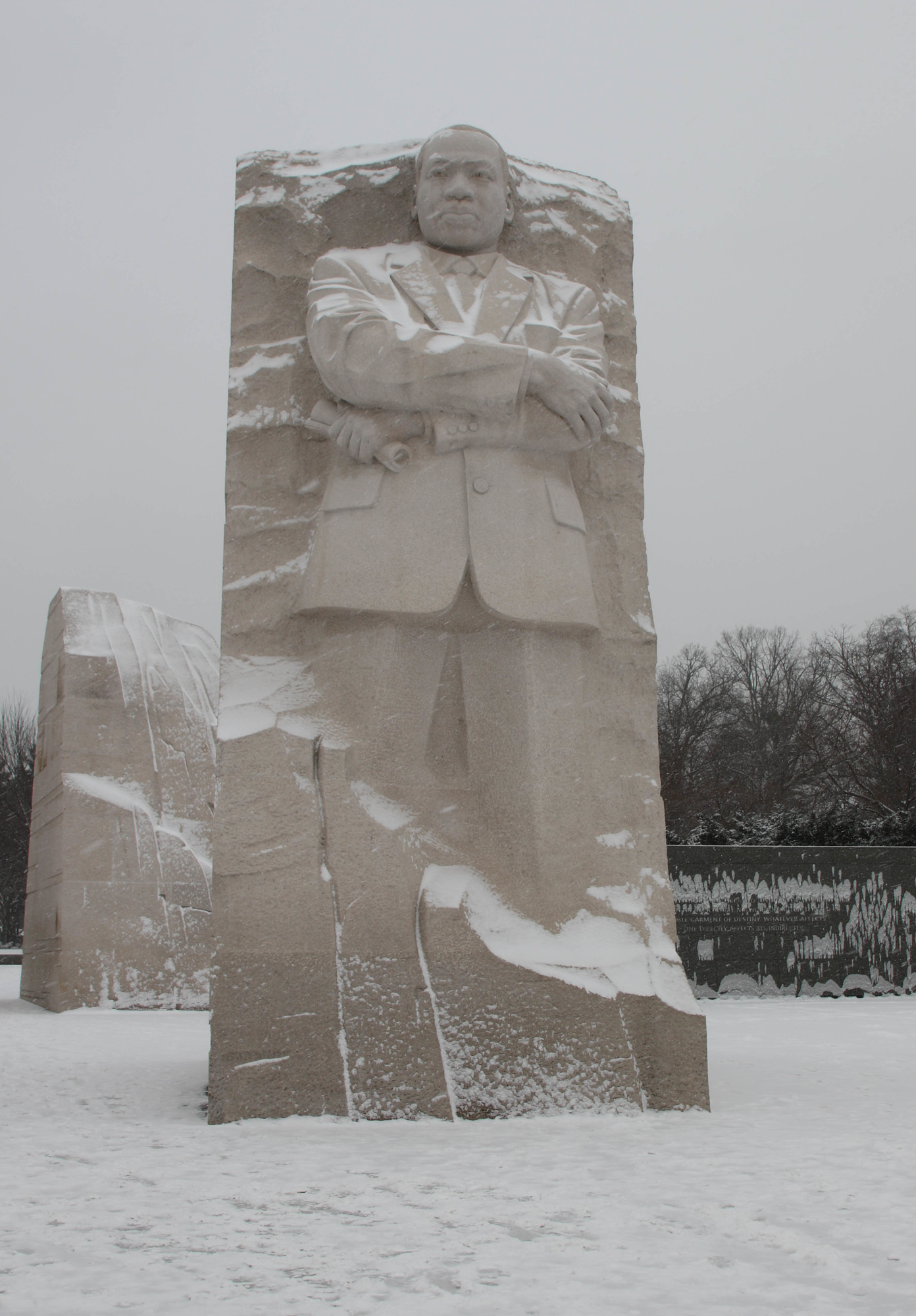
Statue of Martin Luther King, Jr. with a light snow-covering

On the eve of the Martin Luther King Day holiday not long ago, the president of the United States announced, emphatically, that you can’t find anyone less racist than he is. He’s back, and if you’re suspicious of such proclamations, perhaps it’s just that you’ve learned to distrust people who laud their own honesty, their color-blindness, their respect for women, or concern for the poor. Like the salesman who claims the nickname, “Honest,” Donald Trump never succeeded in fooling most people, just enough to sell the next condo or secure the next loan. Then some large number of elected officials and voters who knew better chose to look the other way, and Trump won the 2016 election. It’s somewhat more disturbing that Trump really won the 2024 election. https://www.nps.gov/media/photo/gallery-item.htm?id=b0488081-61a1-446e-b300-80362bc38f5d&gid=108379A9-3701-4049-ABB5-0F178044536F

The office of the presidency, however, starts with obligations to all Americans, and it doesn’t end there. Trump is hardly the first US president to harbor racist thoughts or sentiments, but he’s displayed less worry about revealing them to large audiences, often through words, and consistently through deeds.

It’s worth considering the resources and possibilities Martin Luther King’s memory gives us in combating those who would restore what he fought against.

One of the hard-won achievements of the civil rights movement was the establishment of King holiday. This means that Americans expect any president to pay respects to the man, and even more, to the movement. Tradition really is powerful, and activists are wise to attend to establishing new ones.

If Donald Trump displayed less appreciation or enthusiasm for the King holiday than, say, pardoning Thanksgiving turkeys, that’s no mystery or surprise.

Each holiday event is a moment, unlikely to capture much attention in the White House during the rest of the year.

For the rest of us, however, the King Day reminder is an alert. Martin Luther King, Jr., and many many others, put work behind their words on social justice, often facing great risks and paying serious penalties. Their heirs continue today.

Martin Luther King died young enough and dramatically enough to be turned into an American hero, but it was neither his youth nor his death that made him heroic.

To Build a Mature Society: The Lasting Legacy of Martin Luther King, Jr.'s  “Beyond Vietnam” Speech — The Gotham Center for New York City History

In his rather brief public life, beginning in Montgomery at 26, and ending with his assassination at 39, King consistently displayed rhetorical brilliance (on the podium and the page), strategic acumen, and exceptional moral and physical courage.

The effort to honor Martin Luther King with a holiday commemorating his birthday started at the King Center, in Atlanta, in the year after his assassination.  States began to follow suit, and by 1983, more than half celebrated King’s life with a day. That year, Ronald Reagan signed a bill making Martin Luther King day a national holiday, while expressing ambivalence, acknowledging that it was costly, and that King may have been a Communist.

The King holiday was about Martin Luther King, to be sure, but it was meant to represent far more than the man.  King stands in for the civil rights movement and for African-American history more generally.  I often wonder if the eloquence of the 1963 “I have a dream” speech winds up obscuring not only a man with broader goals, but a much more contested–and ambitious–movement.

Martin Luther King Jr. Memorial - Wikipedia
https://en.wikipedia.org/wiki/Martin_Luther_King_Jr._Memorial

The man and the movement are ossified into an iconic image, like a statue, which locks King and the movement into the politics of 1963-1965.  We accept King’s dream, that little children will play together, and that people will be judged by “the content of their character” (a favorite phrase on the right).

The image, like a statue, is available for appropriation to advocates of all political stripes, and the establishment of the holiday itself represents an achievement of the civil rights movement, winning the holiday if not broader economic and social equality.

Before the transformation of the man into an icon, King transformed himself from a pastor into an activist, a peripatetic crusader for justice.

But the pastor didn’t disappear; rather this role grew into something larger, as King himself transformed himself from a minister into a an Old Testament prophet, one whose primary concern was always the people on the margins, the widows and orphans, the poor and hungry. In standing with those on the margins, King courageously used–and risked–the advantages of his privilege, pedigree, and education.  He also knew that he risked his safety and his life.

In his writing, King used his education and his vocation to support his political goals.  In the critically important “Letter from a Birmingham Jail,” the activist and minister cited both the Constitution and the Bible in support of Federal intervention in local politics to support desegregation and human rights.  (We know that other activists now use the same sources to justify pushing the Federal government out of local politics.)

King explained that he was in jail in Birmingham, Alabama, because he had nonviolently defied local authorities in the service of higher laws, the Constitution and the Gospel.  This was not like making a provocative statement on one’s own [profitable] radio or television show.  There were real costs and severe risks.

King was never less than controversial during his life, under FBI surveillance during his political career, and vigorously criticized by opponents (for demanding too much and too strongly) and allies (for not demanding more, more vigorously).

When he was assassinated outside a Memphis motel in 1968, he was standing with sanitation workers on strike, straying from a simpler civil rights agenda.  He had also alienated some civil rights supporters by coming out, strongly, against the war in Vietnam.  And Black Power activists saw their own efforts as overtaking King’s politics and rhetoric.  By the time he was killed, Martin Luther King’s popular support had been waning for some time.

Posterity has rescued an image of Martin Luther King, at the expense of the man’s own broader political vision.

Ironically, in elevating an insurgent to a position in America’s pantheon of historic heroes, we risk editing out the insurgency.

Posted in Uncategorized | Tagged , , , , , , , , , , , , , , , , , , , , , , , , | Leave a comment

Trump Inauguration II: This time is different

Today’s People’s March, protesting Donald Trump’s second inauguration, numbered in the thousands, far shy of the millions mobilized by the Women’s March 8 years ago. There are always protests at presidential inaugurals, but the Women’s March of 2017, along with scores of sister marches, was the largest one day demonstration in American history. It’s hard not to compare, even though so many elements of the politics of the moment are radically different than 2017–many much worse.

Comparison, I’ve heard, is the thief of joy.

One reason organizers chose not to stage a national march–along with scores of sister marches–was knowing that the inevitable smaller turnout would show as a sign of weakness.

The Trump team also worked to avoid comparisons: in 2017, Trump sent his press secretary out to announce the biggest inaugural turnout ever–an astonishingly obvious lie that set the tone for the next four years. Mainstream media outlets quickly published photos comparing the Trump crowd with those attending the Obama inaugurations. Alternative facts indeed. This time, Trump moved the inaugural inside (blaming the weather) and took down the Jumbotrons on the mall so there would be no photographic comparisons showing a skimpy turnout.

The Women’s March of 2017 announced a clarion resolve to resist the new administration–and it worked. (I edited a book about this with Sid Tarrow.) Successful tactics communicate commitment, encouraging allies to do more, and giving pause to some of the less resolute opponents. People who opposed the new administration on civil liberties, immigration, reproductive rights, tax justice, climate change, and so much more, saw that they were not alone and continued their own campaigns. The following week, protesters (some wearing the emblematic “pussy hats”) surged to virtually every international airport in the United States to protest the first sloppy and hateful “Muslim ban.” And there was more: elected officials issued legal challenges, while activists offered shelter and service to travelers caught in the chaos. The Administration was forced to litigate and revise its policies (twice), losing time and a bit of the dramatic cruelty.

Then each weekend in Washington, DC witnessed protests against Trump on behalf of specific grievances: climate, science, abortion, gun safety, democracy and more. Activists formed new organizations and forged new ties, animating a broad opposition that included not only protests, but electoral politics as well–and the Democrats made large gains, notably picking up more than 40 seats and gaining the majority in the House of Representatives.

Trump’s opponents made progress in a battle of position. But the Women’s March and subsequent protests didn’t end the contest. Protest works, but not by itself, and not on a time frame that some activists imagine when they set aside a weekend and plot a placard. To work a demonstration–or any other protest action–has to become part of a longer, more complicated active campaign, including a wide range of efforts.

This time is different. Trump’s second election, with more votes than in 2016 and more votes than Kamala Harris is more than a slight to those who organized and protested years ago. Certainly, it’s a challenge that calls for a reevaluation of strategies and tactics, but that’s nothing like capitulation. The terms and turf in Trump II will be different, but no less contentious.

Posted in Uncategorized | Tagged , , , , , , , , , , , , , , , , , , , | 1 Comment

Rethinking the Resistance?

The New York Times suggests that Trump’s second electoral win represents a defeat for the protesters who mobilized against him, and demands a severe rethinking of strategy. The Times presents a simplistic vision of the recent past and a naïve view of how protest works.


Let me explain:

When Donald Trump was first elected, opponents spilled out into the streets almost immediately. Inauguration day 2017 was marked by confrontational protests in Washington, DC, where demonstrators scuffled with police and broke some windows. Some cars were burned and more than 200 protesters were arrested. (I started writing about it here.) The next day saw the Women’s March, the largest DC demonstration in American history. Plus sympathetic sister marches around the country. I wrote about it here and elsewhere.

Both styles of protests featured the common laundry list of demands, and the Saturday demonstration was the product of a particularly broad coalition addressing abortion, climate, immigration, labor, and science—among much else. Opposition to Trump linked them all together. The big question was whether any of it would matter. (Short answer: it did. It does.)


The inaugural demonstrations were the opening act in the Resistance, which included a weekly parade of protests on specific issues, virtually every weekend in Washington, DC. And not just in DC. The following week, when the Trump administration suddenly attempted to implement a poorly considered

travel ban for Muslims, tens of thousands of Americans assembled at virtually every international airport, voicing opposition to the ban and support for travelers. It was easy to spot the trademark pussy hats that appeared throughout the Women’s March crowds. Organizers used contact lists collected at each event to organize the next one. The Resistance continued in different forms throughout the first Trump term, and repeatedly confronted and confounded the Trump agenda. (Sid Tarrow and I edited a book about it, and thought we were done when Joe Biden got elected. Sigh!)

The Resistance didn’t lose, even if activists didn’t get near all they wanted. The protests accompanied and inspired other acts of resistance, including lawsuits filed by ambitious politicians challenging the legality of the ban. Washington’s Attorney General, Bob Ferguson, was one of them. The protests were one demonstration that Ferguson could count on a base of public support for his challenge and sustain a political career. He found legal support as well. The courts twice forced the Trump administration to pare back the ban and limit its scope. Ferguson, by the way, was just elected Governor. Summary: the aiport protests helped stall, if not stop, the policies they challenged, and built support for institutional challenges.
Protest movements can matter, but not by themselves, and not on a timescale that makes for easy stories. And protesters never get all they want.


Simpler, shorter stories limit how well we understand the politics of protest. Grade school accounts of Rosa Parks, for example, tell about her courageous refusal to move to the back of a segregated bus. But the decade of siimilar protests and Parks’s own long history of activism often get edited out of those stories. We often neglect the year of bus boycotts in Montgormery, Alabama and the court decision that eventually desegregated buses. And that effort marked an acceleration of the Freedom movement that continued for a decade, even as some goals still remain on the horizon. (Read some of Martin Luther King’s speeches and see the much broader agenda he articulated.)


The Resistance didn’t get nearly all the activists demanded, but try to imagine how politics would have played out without it. Trump was unable to repeal the Affordable Care Act (Obamacare), for example, and it’s hard to think he would have been stopped without widespread opposition to his much larger agenda. Democrats recaptured a majority of the House in 2018, and won the Senate and the presidency in 2020.


It’s heartening to remember that things could always be worse.

And it’s critical to recognize that even when activists don’t get what they want, they can still stop some things they don’t want. Successful social movement stories are much longer and more complicated than the dramatic event that can be recounted in a movie, a song, or around a campfire.

Donald Trump’s second term will surely face another round of Resistance, with higher stakes and more difficult circumstances than the earlier rounds. No one will miss where those rounds fell short, but it’s essential to remember the accomplishments as well.

Posted in Uncategorized | Tagged , , , , , , , , , , , , , , , , , , , | Leave a comment

Greater and Lesser Evils

The cliché about picking the lesser evil always recirculates around presidential elections, so frequently that it can almost pass for a nugget of wisdom.

It’s not.

Why would you want to vote for the greater of two evils?

We expect so much from the person in that office—and think we learn so much about them—that we’ll inevitably find something distasteful in the political program or persona. As major party candidates try to pander broadly, all sorts of inadequacies become visible.

Really, Donald Trump’s abundant intellectual, temperamental, and moral deficiencies are all part of his brand.

Because we often expect too much, our choices—and electoral politics more generally–will always disappoint. There’s a temptation to treat our vote as a sacred expression of self and vote to “send a message” through pulling the lever for a third party candidate standing on a shorter and sharper platform that feels more authentic.

And it represents a fundamental misunderstanding about electoral politics.

No matter how much we infuse our deliberations and debates with moral concern, elections are about choosing a person to do an extremely difficult job, knowing that they are bound to let us down—at least a little.

Of course, people will infuse their misunderstanding with strong moralistic language, and maybe even get a feeling of self-righteous affirmation by refusing to compromise their ballot in any way. Speeches and writing infused with purist polemic are always more powerful rhetorically than assessing the compromises and disappointments associated with pragmatic choice.

“Don’t vote, it only encourages them,” makes for a great tee shirt—but not much of a political strategy.

They don’t need your encouragement; the election will take place and someone will win and take office.

As the major party candidates work to assemble extremely broad coalitions of support (Chomsky to Cheney for Kamala Harris), they’re likely to fudge the issues you care about. A major party candidate isn’t going to attack capitalism, military spending, or the automobile industry. And this year, there’s the war—or rather, US support of the Israeli military, as it devastates civilian life in Gaza.

On television and the internet, we can see horrific pictures demonstrating the power of American weapons wielded by the Israeli Defense Force: houses reduced to rubble, maimed children, and starved families. We hear the numbers.

Vice President Kamala Harris has basically affirmed the Biden administration’s policies: supporting Israel’s right to defend itself with weapons and urging, apparently ineffectually, the Netanyahu government to protect civilian lives and provide humanitarian aid.

Trump has blamed the Biden administration and encouraged Israel to finish the job faster. Ulp.

Neither major party candidate has a strong claim on peace and restraint.

This is hardly the first time the American electorate has faced such an apparent lack of choice on such an important issue.

In 1968, Vice President Hubert Humphrey supported Lyndon Johnson’s conduct of the Vietnam War, kind of. And Richard Nixon offered a “secret” plan to end the war quickly, a plan that turned out to be comprised of extending US air forces and bombs more broadly through Southeast Asia. Maybe that’s a bad choice and a worse one.

The worse one won.

I can think about two arguments for refusing to vote, pragmatically, for the less dangerous and offensive candidate.

The first refusal is a self-righteous assertion of personal pride: I don’t want to throw my vote for someone who doesn’t live up to my moral standard or political principles. Maybe it’s easier to sleep through the night when you can ignore the consequences of your actions.

The second is a kind of political argument: voting for a third party or staying home is a way to send a message and “heighten the contradictions” spurring a reinvigorated protest campaign.

The argument has recirculated since at least 1968, and was particularly salient and damaging when likely Democratic voters chose not to vote for Humphrey in 1968, for Jimmy Carter in 1980, and for Hillary Clinton in 2016. It’s only partly wrong, but it’s a big and tragic part. You may get bigger protest movements—but less impact.

The election of conservative and or crazy presidents has spurred intensified protest movements. Nixon faced massive demonstrations against the Vietnam War, including a half-million protesters during the

Moratorium of 1969. Ronald Reagan grappled with very large popular movements against the nuclear arms race and US military intervention in Central America. And Donald Trump’s presidential term was punctuated with even larger protests on all kinds of issues. (I edited a book on this with Sid Tarrow.)

But in all case, the political center of gravity shifted to the right. Liberals and those further on the left engaged powerfully, but on defense, trying to stop things (wars, climate change, immigration policy, etc.) from getting much worse. The successful Democratic presidential campaigns that followed were more conservative.

It’s less difficult to mobilize large protest movements against more provocative administrations, but it’s much harder to get the kinds of policies you want.

Successful movement politics sometimes means taking very modest victories in the moment, and trying to push the political center.

Posted in Uncategorized | Tagged , , , , , , , , , , , , , , , , , | Leave a comment

It’s been a minute, campus protests

I’m on this show, discussing free speech and new restrictions on campus activism imposed in the wake of last Spring’s protests about the war in Gaza.

https://www.npr.org/2024/10/11/1210935820/its-been-a-minute-campus-protests

Posted in Uncategorized | Leave a comment

A day for Labor, 2024 (repost)

(2024) Joe Biden walked a picket line earlier this year, the first president to do so. His appearance was successful effort to show his commitment to organized labor, and labor has reciprocated; large unions have endorsed the Democratic presidential ticket, even though Biden is no longer on it. Sean Fain, leader of the United Auto Workers, spoke at the Democratic National Convention. Shawn O’Brien, leader of the Teamsters, spoke at the Republican Convention, but was emphatic in explaining that it didn’t mean the Teamsters supported Donald Trump. Both leaders have adopted a more aggressive posture than their predecessors in dealing with contemporary politics. We may be entering a new era of effective labor militancy–a recurrent, and usually wrong, prediction. Labor Day is a good time to take stock, and a full accounting starts with the origins of an odd American holiday.

Successful politicians exploit, buy off, and sell out the movements that sometimes buoy their campaigns. This American story is an old one, and it’s one that leaves activists disappointed, wary, and cynical, often especially about the politicians who do the most for them.

So, why is the American day to commemorate Labor held at the end of the summer, months after May Day, the workers’ celebration day virtually everywhere else in the world? How do you respond to a movement by creating an occasion for a cook-out?

crwy

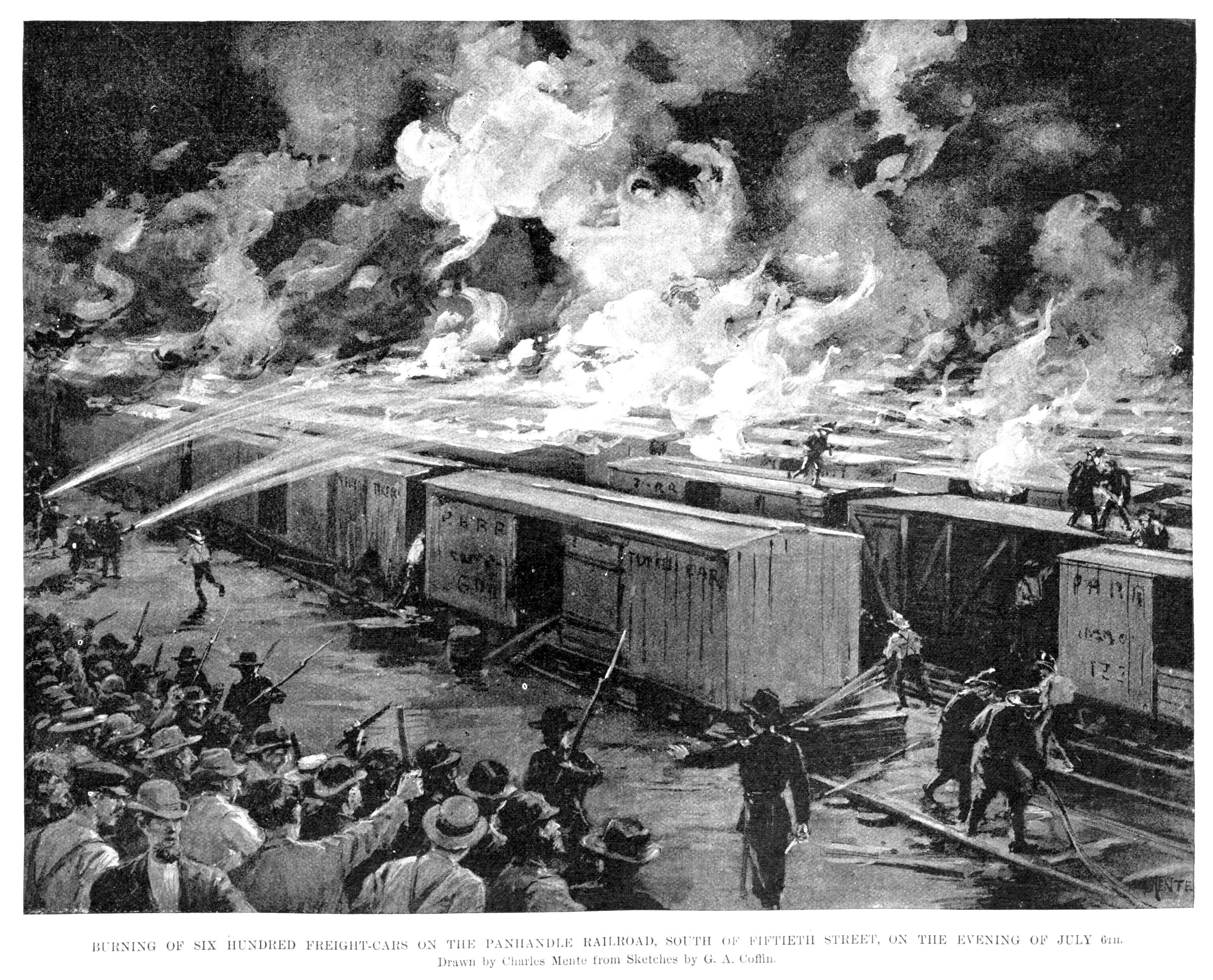
President Grover Cleveland, a hard-money Democrat, and generally no friend to organized labor, signed a bill making Labor Day a national holiday at the end of June in 1894, at the height of the Populist movement, and just after the American Railway Union, led by Eugene Debs, had launched a boycott and strike, starting in Pullman, Illinois. Protesting the Pullman Palace Car Company’s treatment of its workers, including harsh wage cuts, railway workers across the country refused to handle any train hauling a Pullman car.

The Federal government used an injunction, then troops, to battle the union and get the trains moving.  In July, just after announcing a national day to celebrate the contributions of American workers, President Cleveland ordered federal marshals–along with 12,000 Army troops, into Chicago to break up the strike. Workers fought back, and 13 workers were killed, and at least several dozen injured. Debs was tried for violating an injunction, and went to prison, where he discovered the writings of Karl Marx. Clarence Darrow provided a vigorous, but unsuccessful, defense.

Debs would go to prison again, for his opposition to US entry into World War I, and would run for president five times as a Socialist.

But I digress. President Cleveland created a distinctly American Labor Day, emphatically not on May 1, which had already been the occasion for vigorous and disruptive workers’ activism.  (Read about the Haymarket affair.)

May Day remains the day for international workers mobilization.  Instead, our Labor Day is a time to mark the end of summer by cooking outdoors and shopping for school supplies.

The  US Department of Labor’s website gives credit for Labor Day to the American worker, but makes no mention of the Pullman Strike or the Haymarket demonstrations.

So, commemoration can actually be a way to neuter the historical memory.  See our discussions of commemorative days for Martin Luther KingCesar Chavez, and Fred Korematsu, all significantly more difficult characters than what they’ve come to represent.

P.S. Organized labor’s cumulative difficulties and declines have begun to lead to new strategies. One involves organizing workers that unions in the past had largely overlooked. Established unions have tried to expand their reach by organizing in retail stores and in fast food outlets, working to unite less skilled workers. Most recently, as example, the National Labor Relations Board ruled that graduate teaching assistants at private colleges could organize unions and bargain collectively. But I’m not quite convinced that graduate students are the new vanguard for the working class.

Members of the Wisconsin Jobs Now group, representing Fight For 15, which favors a $15 an hour minimum wage, march down E. Chicago St. shortly before entering the Summerfest grounds for Labor Fest in 2015.

Likely more promising are efforts to use politics to improve the fortunes of American workers. Collective bargaining is one way to raise wages. Another is to mandate higher minimum wages for everyone. The Fight for $15 has had claimed some important successes in new ordinances in generally liberal cities, and has shifted the debate elsewhere. Bernie Sanders campaigned for the Democratic nomination by endorsing the proposal for a new minimum wage, and Hillary Clinton, competing for his voters, essentially endorsed the effort.

This past year, all of the Democratic hopefuls endorsed dramatically increasing wages. One future for labor is through Democratic Party politics.

2019: Reading over something I initially posted in 2011, I fear that the big story is basically the same: 1. Economic and political equality has generally increased, with the fate of less educated workers substantially worse; 2. government has done more to slant the slope of the political battlefield against workers generally and organized labor in particular…esp. see Janus v. American Federation of State, County, and Municipal Employees; 3. the current political battle pits conservative politicians against government workers.

But,

When well-honed routines of organizing are no longer working, organizers have to innovate. The Fight for $15 has made substantial inroads, particularly in the Democratic Party, and organizers now see immigrants as allies rather than competition, mostly. Family Leave campaigns provide a route to build bridges between different classes of workers which, ultimately, could have large payoff. Most generally, the campaign for workers welfare is transforming to a larger concern with political and economic inequality: it’s what’s left as viable strategy.

Posted in Uncategorized | Tagged , , , , , , , , , , , , , , , , , , | Leave a comment

Protest politics in the primary season

Pro-Palestine and antiwar advocates have done a good job of staging dramatic events outside the Democratic National Convention in Chicago. By commanding media attention, convention protest is a good way to reach the broader public. But it’s unlikely to have much effect on candidate Kamala Harris’s policies, much less what President Joe Biden actually does.

Plus: The Biden administration’s announced optimism about ratification of a cease-fire agreement complicates the public politics of everything. Even well-informed experts are unlikely to have reliable information about who’s gumming up progress. There is, of course, every reason to distrust public announcements from Israel and from Hamas.

But the presidential primary process is a great place for movements to execute influence…under normal circumstances.

If we go back to the 1968 Chicago convention, we can see both the extent and limits of protest influence in the OLD party system. Eugene McCarthy, a quirky senator from Minnesota challenged incumbent president Lyndon Johnson in the New Hampshire primary. Campaigning specifically on stopping the Vietnam War, McCarthy won 42 percent of the primary vote–4,000 fewer votes than Johnson won, but enough to shake up Democratic politics.

It was shocking. Johnson announced that he was dropping out of the race, and many other candidates, most notably New York Senator Robert F. Kennedy,* hopped in. By the time Chicago came around, Kennedy had been assassinated and it was very clear that the primary process wouldn’t influence the selection of the Democratic nominee nor the policies he would advocate. That frustration and lack of representation is one reason (of many) the streets of Chicago and the politics of the convention were so chaotic and crazy.

After Republican Richard Nixon narrowly defeated Democrat Hubert Humphrey, the Democratic Party set up a special commission to boost the representation of rank and file Democrats, particularly young people, women, and minorities. The McGovern-Fraser commission set up all sorts of rules to make the delegates representative and to make the primaries the main game. (Republicans followed with similar reforms.) George McGovern, senator from South Dakota, understood these new rules very well, and won the Democratic nomination to challenge Nixon in 1972–without ever gaining substantial support from mainstream party leaders. He lost the November election in an historic landslide.

But the primary process held. Below much national visibility, activists recognized great opportunities to present their issues to primary candidates hungry for attention and support. Movement activists were the ones who would actually show up for events, and they came prepared with pointed questions. In low visibility, low turnout events, they got to ask those questions….over and over again. Candidates eager to distinguish themselves responded to grassroots passions with commitments that most of the party regulars had no interest in.

In the Republican Party, social conservatives quickly became a valuable constituency, one successfully cultivated and exploited by Ronald Reagan, who took strong positions for prayer in schools and against abortion and the Equal Rights Amendment. The primary process made it critical for ambitious Republicans to sign pledges against all taxes–positions they would have avoided taking in the old system.

Democratic candidates took the opposite side, strongly, on those social issues, and sought to win activist support on new issues that came up in each election cycle: opposition to the B-1 bomber, support for the Nuclear Freeze Resolution, decriminalizing border crossing, and so on.

Often, strong positions were liabilities in the general election, but smart politicians knew that they had to get to the general election first–and then they could try to find some way to blur the strong positions they had eagerly endorsed not long before.

Issue activists quickly learned that a trip to Iowa or New Hampshire to shout questions at candidates could pay large dividends.

But not in 2024.

Donald Trump never really wanted to run on issues, and his challengers in the primary focused more on his persona. in an odd symmetry, Biden’s only challenger, Rep. Dean Phillips, ran a short-lived candidacy praising Biden on policy, but (prematurely!) arguing that Biden was too old to run an effective campaign. No issues here either.

Pro-Palestine activists ran “Uncommitted” slates of delegates in several states, trying to ensure a real debate at the convention, but Biden won sufficient delegates very early on. By the time Biden dropped out of the race and endorsed Kamala Harris, the primary opportunity was long gone.

For all of her energies and charms, Harris scooted to the Democratic nomination without any of the baggage that the primary process usually hangs on the ultimate nominee. She hasn’t had to offer sharp responses to the movements that would certainly demand them. And she hasn’t had to say no. She has been able to roll out her positions at a rather leisurely pace–surely an edge in most elections.

For oh so many reasons, the 2024 election will be very different than those of the past 50 years or so.

  • *Yes, it’s Senator Kennedy’s crazy son who has mounted an odd campaign for the presidency this year.
Posted in Uncategorized | Tagged , , , , , , , , , , , , , , , | Leave a comment

Protest at the Convention? Of course.

People always show up to protest at the national conventions of the Democratic and Republican Parties. The protests span the political spectrum, often including local and national issues. In looking through old reports for the second edition of The Politics of Protest, Amanda Pullum and I found protest at almost every major party convention in a presidential election year between 1948-2012. I bet there’s even more now.

The attractions for carrying signs and chanting in the streets–or more–are very clear. Usually located in major cities, it’s relatively easy to generate crowds and, more importantly, attention. Delegates include party activists, elected officials, and aspiring candidates for office. They are obvious targets and, sometimes, potential allies.

But the local audience is the least of it. Media outlets of all sorts swarm the national conventions looking for news and usually there isn’t much. Although party conventions are charged with selecting candidates for the presidency and vice presidency, since 1972 the nominees are well-known in advance. Reporters looking for stories might drift outside and see protesters for (or against) abortion rights, civil rights, immigration reform, organized labor, and peace, and war–and so much else.

Protesters demonstrate their concerns and their commitments, projecting everything to a broad national and international audience. They attack the Party opposing their positions, and demand the Party closer do more. And movements are far more likely to engage with distant audiences than those wearing funny hats inside.

And there’s a paradox here: Although the people inside the convention hall are better positioned to make policy, they are least likely to be responsive to pressure from most campaigns. By the time the national conventions take place, delegates and candidates are far more concerned with the November election and imagined swing voters than persistent opponents or putative allies in the streets.

The Chicago protests at the Democratic Convention of 1968 focused on the Vietnam War more than anything else, and one reason they were so disruptive and dramatic and dangerous was activist frustration at being unable to influence what was going on inside. Party insiders chose Vice President Hubert Humphrey as their nominee. Humphrey had difficulty sketching out a clear position on the war while demonstrating fealty to President Lyndon Johnson and had skipped all of the primaries. Activists locked out of the convention focused their efforts–and their rage–outside.

After the Chicago debacle, both parties executed reforms of the primary process that guaranteed issue activists more meaningful influence much earlier in the process.

By the convention, partisan positions are pretty clear, and leaders work to blur those that might hurt them at the polls.

Now look at the Gaza war–as demonstrators in Chicago urge. Protesters want the next president (and this one, as well) to put more pressure on Israel to stop the killing and reach some sort of settlement. They offer a range of remedies, from more forceful rhetoric to an embargo of arms to Israel.

President Joe Biden has adopted a policy mostly offering abundant arms and quite diplomacy to Israel, which clearly has been ineffective at ending the carnage. To the extent that we can derive a policy position from Donald Trump and the Republican Party, it’s one of more vigorous support of Israel.

In an electoral calculus, Democratic candidate Kamala Harris has every incentive to avoid a strong position on the issue. She called for a cease-fire months ago, and brokered meetings with the Israeli opposition to the Netanyahu government, but has been unwilling to risk a stronger stance.

Demonstrators will demand more from Harris, to be sure, but the real hope for influence is the audience watching from afar.

The prospects for influence in a presidential campaign are much better much earlier in the process.

Posted in Uncategorized | Tagged , , , , , , , , , , , , , | 1 Comment

Protest can build political capacity: The Case of Ferguson

Representative Cori Bush’s primary defeat last week gave The New York Times an excuse to look at the infrastructure that supported her surprise primary victory in 2020.

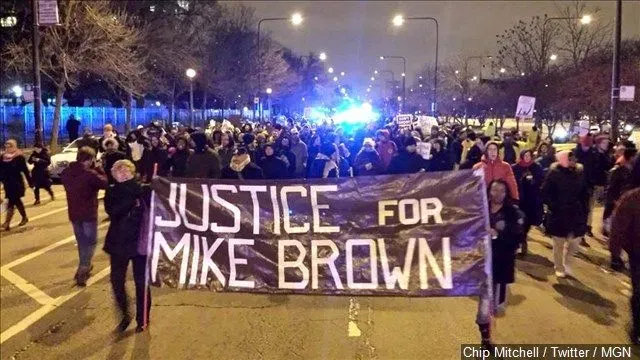
Audra D.S. Burch’s excellent article starts with the police killing of Michael Brown in 2014 and the waves of Black Lives Matter protests that followed. Cori Bush was one of many effective organizers who demonstrated commitment, savvy, and organizing skills in the protests, and one of more than a few who turned their attention to elective office. Burch notes that over the decade that followed, Ferguson elected its first Black mayor, hired its first Black police chief, and St. Louis County elected its first Black prosecutor. Veterans of the protest marches made their way into Boards of Alderman and into citizen action groups. (This, by the way, is nothing new in American politics. Many politicians start a political career in protest politics.)

None of this was visible during the disruptive protests of 2014, but staging those protests built the infrastructure and networks that made a different kind of politics and political leadership possible. People who were willing to come out to the marches were willing to walk the wards in an electoral campaign, and they were far more likely to campaign for those who marched beside them. Activists learned how to organize events, influence government, and manage interviews with the press. Organizer training provided a good foundation for electoral and institutional politics as well.

Cori Bush, who defeated a non-responsive incumbent in 2020, lost in 2024 to Wesley Bell, St. Louis County prosecutor, who also cut his political teeth in the response to Michael Brown’s killing.

Now, here’s the twist: Cori Bush still had citizens willing to walk the wards and knock on doors, but she also had new vulnerabilities, including a federal investigation for misuse of campaign funds. More than that, Bell got more than $8 million for his campaign from AIPAC’s (American Israel Political Affairs Committee) political action committee. Bush’s justice advocacy in Congress included harsh criticism of Israel, and well-funded and well-organized AIPAC made an example of her–and Rep. Jamaal Bowman, who also lost a Democratic primary in a mostly suburban New York district. AIPAC picked incumbents with vulnerabilities who were critical of Israel to send a message to everyone else.

Israel/Palestine is not a particularly salient issue in Ferguson, Missouri, but $8 million is a lot of money to raise a profile and attack an incumbent. Other prominent critics of Israel were able to fend off primary challenges. (Ilhan Omar [Minnesota] held her seats by a margin of 13 points!) But be sure that every Democrat in Congress who considers crossing AIPAC on Israel will know just how much money the group put into taking Cori Bush and Jamaal Bowman out.

There’s a double lesson about the outcomes of protest politics: Sustained mobilization can build the networks, experience, confidence, and skills needed to navigate institutional politics. But those networks need to be nurtured in order to sustain themselves and their champions.

Posted in Uncategorized | Tagged , , , , , , , , , , , , , , , | Leave a comment