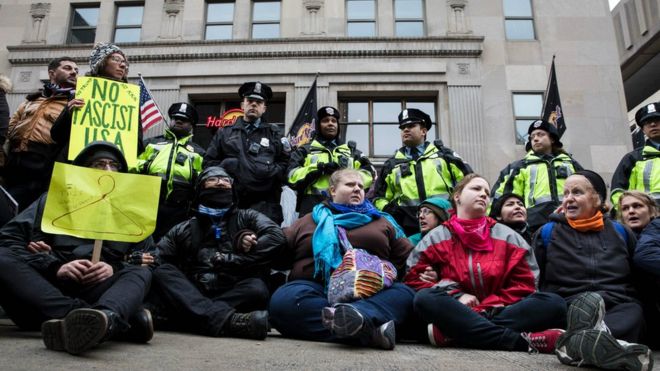
Cabin fever versus Covid fever, COVID-19, 6/x

The public reactions to the sprinkle of open up protests has been, like virtually everything else these days, heavily partisan and polemical.

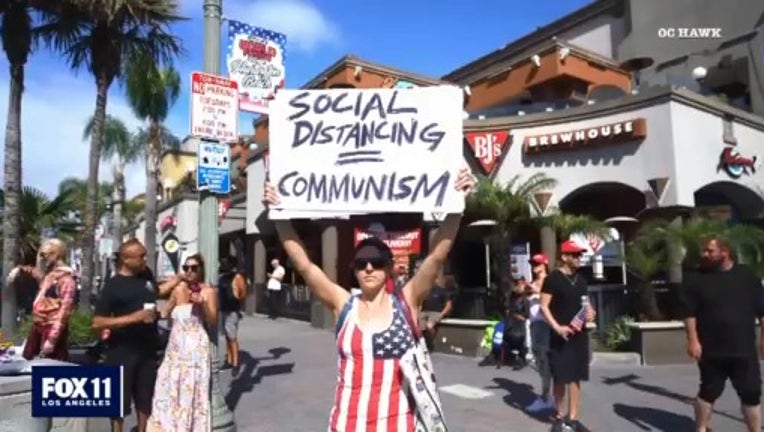
The picture at left, from Huntington Beach, is one of the scattered protests to end–or loosen–restrictions on commerce and public assembly. It differs from most of the other protests reported only in that the weather is milder.

Waving American flags, along with other sorts of flags, protesters have been touted as American heroes and derided as deluded American idiots. (Always appalling, the reliably dishonest conservative flack, Stephen Moore, compared the protesters to Rosa Parks.) It’s a drastic mistake to sign onto either of these views, but there’s plenty of frustration.
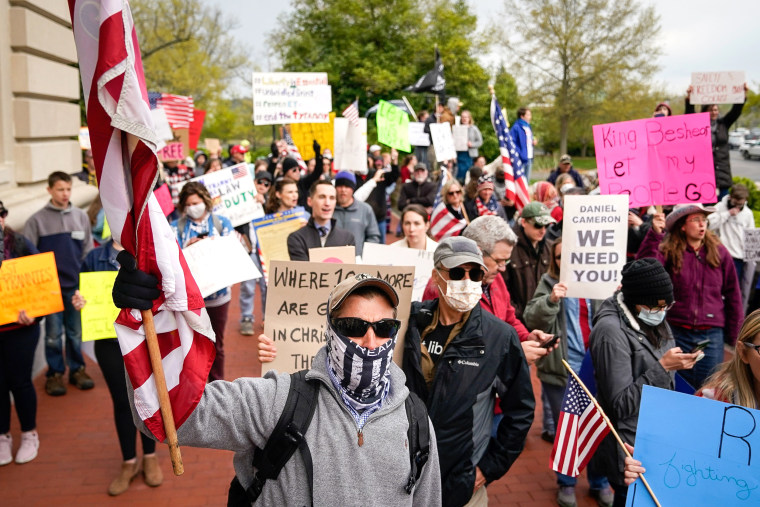
Frankfort, KY

Frankfort, Kentucky

Almost everyone wants the restrictions to end, but the overwhelming majority of  Americans, Republicans and Democrats, believe the public health experts who say that isolation/quarantine/social distance is the best way to manage strain on the health care system and minimize damage from the virus. A very recent poll reports that only 10 percent of Americans believe we “should stop social distancing to stimulate the economy, even if it means increasing the spread of coronavirus.”

But you don’t need majorities to stage protests or make movements. Reports on the demonstrations describe relatively small turnouts of 100-200 people, save for Boise, Idaho where there were about 1,000 people, some armed, and mostly without masks or social distance.

And there are LOTS of reports. Vigorous protest that seems personally risks makes for a good story, particularly when the president of the United States is calling them out. Americans are tired of being confined, blocked from jobs and gyms, barbers and beaches, most shopping, and social life generally. And they are understandably anxious about what happens next as the economy collapses. For most of us, who accept the collective wisdom of public health officials, the lock down is awful; for those who don’t believe the scientists, it’s worse.
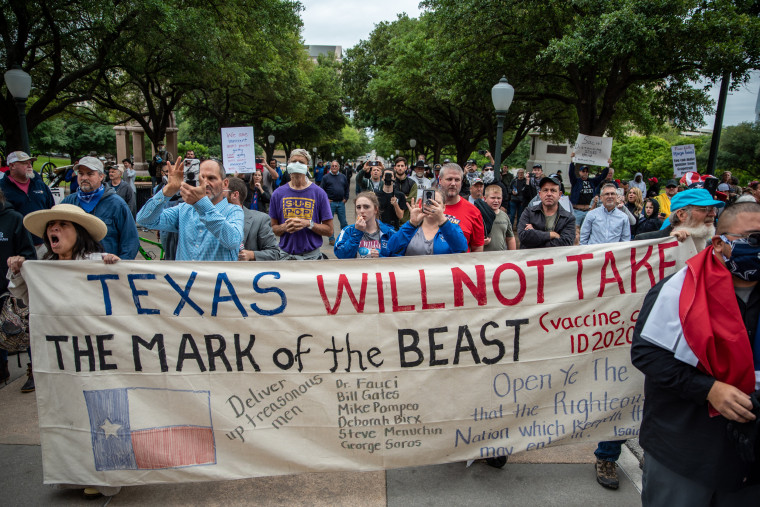
Image: Demonstrators Protests At Texas State Capitol Against Governor's Stay At Home Order

Austin, Texas

If you haven’t thoroughly studied public health, infectious diseases, or epidemiology (I haven’t!), the details of the restrictions won’t make intuitive sense. Responsible public servants will work hard to explain the details of their decisions, but it’s hard to think that most people are willing to listen right now.

Really, you want elected officials taking advice from people who know how epidemics work rather than those speaking only from personal frustration.

And there are paradoxes: On one hand, I should have the right to calibrate the risks I take with my life, suffering the consequences, including ridicule if things go wrong. (Like the motorcyclist who died in an accident while demonstrating against mandatory helmet laws.) On the other hand, there is no Constitutional right to infect. Public health officials are rightly more concerned about vectors than the risks individuals might choose.

Several hundred people attend a "Stand for Freedom" rally at the Capitol, protesting — and in violation of — Idaho Gov. Brad Little's stand-home order during the coronavirus pandemic in Boise, Idaho, Friday, April 17, 2020.

Boise, Idaho

The notion that we restrict ourselves or wear masks to protect others hasn’t been explained well enough or frequently enough, and it chafes at some versions of conservative belief anyway. Some conservative groups and politicians–who should know better–are working hard to ignore the social implications of individual choices.

People are turning up to protest because they’re angry, distrustful, and eager to change the world…back. But recognizing that their concerns are genuinely felt doesn’t mean these demonstrations are spontaneous or independent.

Alex Jones and Infowars helped organize the demonstration in Austin, Texas; a foundation funded by the DeVos family publicized the drive-in at Lansing. Tea Party Patriots, one of the organizations organizing the, uh, Tea Party, organized the demonstration in Virginia, along with gun rights groups, and Trump campaign organizations were everywhere.  The result of this constellation of sponsors is that the profile of the demonstrations skewed partisan, with Trump placards and hats, along with symbols from still-fringe elements of the right.

Meanwhile, Trump tweeted calls to “liberate” Virginia, Michigan, and Minnesota (states with restrictions and Democratic governors), even as none of those states came close to meeting the guidelines for lifting restrictions the Trump administration had announced a day earlier. The president made the difficult disputes about appropriate public safety measures much simpler, much more partisan, and far more distant from informed discussion.

At very least, the demonstrations will turn up the political heat on governors who are enforcing restrictions on social and economic life in their states, no matter how well-advised they are. But it’s likely to have a greater impact on Republican governors, like Ron DeSantis (Florida) or Gregg Abbott (Texas), who haven’t been very strict to begin with, than Democrats who don’t depend on those Republican voters.

The photos and videos online show few demonstrators wearing masks or observing public health advisories about social distance. Maybe no one will get infected, nor infect others after returning home from the demonstration or stopping for groceries on the way. Certainly, we have to hope so. Infections, if there are any, won’t show up for a week or two. If that happens, we have to remember the protests and the president’s enthusiastic support.
Posted in Uncategorized | Tagged , , , , , , , , , , , , | 1 Comment

Drive by tooting; protest in cars, COVID-19 5/x

Honk if you hate government. A report from Lansing:

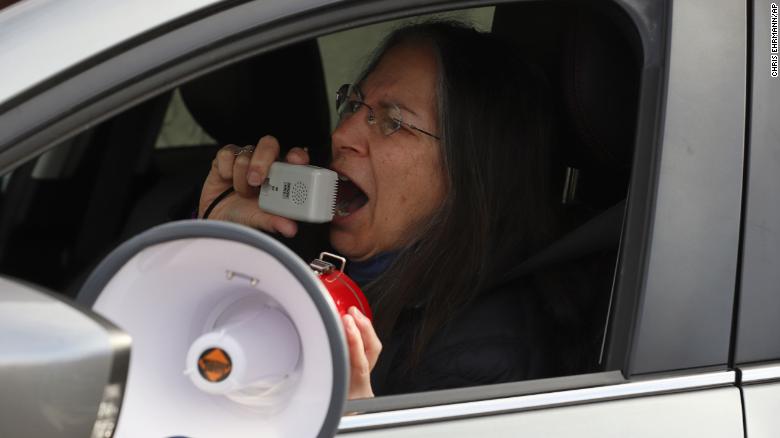
Activists are always looking for ways to demonstrate their concerns. A good tactic Protester Debra Cohen speaks into a megaphone at a demonstration against Immigration and Customs Enforcement in Hartford, Connecticut, on April 2.energizes your supporters, discomforts your opponents, and engages bystanders. Despite the extraordinary range of imaginable activities out there, most movements across the political spectrum rely heavily on a pretty narrow repertoire, and mass demonstrations are a familiar ingredient.

COVID-19 changes all that, and organizers are looking for alternatives (discussed here). So, maybe in the era of Carpool Karaoke and Comedians in Cars Getting Coffee, the automobile is an answer.

People in cars can protest. A car offers the recommended social distance, some physical protection, and it takes up much more space than a body, amplifying the size of a  demonstration. It’s certainly not a routine part of American protests, but it’s also not completely new. [Please note, Catherine Shoichet wrote a good article about car protests, focusing on immigrant rights protesters honking for justice in Arizona.]

In Charlottesville in 2017, a white nationalist unhappy about the anti-white nationalist protest drove a car into demonstrators, killing Heather Heyer. The driver has since been sentenced to life in prison.

Years earlier, in 1964, a flank of civil rights protesters in New York City threatened to shut CORE Dump Garbage and Sit-indown the roads to the World’s Fair. (Because the world’s NOT fair.) But lots of demonstrators took mass transit and the threat turned out the generate more attention than than the action.

Ideas, tactics, and even rhetoric aren’t limited to particular groups or causes. Instead, organizers watch their other social movements–including their opponents–to prospect for new approaches that seem to work. So, White people opposed to desegregating public schools in Boston in the early 1970s deployed the whole arsenal of tactics (pickets, busing2_640demonstrations, sit-ins, and so on) that they’d learned from watching the civil rights movement.
We’re likely to see a wide array of groups try motorized events this year, until police develop effective ways of containing them.

Yesterday, a couple of thousand cars drove on the Capitol building in Lansing, Michigan to protest Governor Gretchen Whitmer’s strict lockdown orders. At this writing, Michigan has recorded nearly 30,000 COVID diagnoses and nearly 2,000 deaths. The shutdown there, as everywhere, has created grievances large and small: no haircuts; no school; no jobs.

Conservative activists in Michigan want the economy to “open;” they want to go to the stores, to work, to restaurants, and bars, and they claim that Gov. Whitmer is overreacting to a global pandemic, creating a remedy that is worse than the disease.

“Operation Gridlock” demonstrated the call to open the economy by shutting down Lansing, including part of the highway and an entrance to an area hospital.

The Michigan Conservative Coalition and the Michigan Freedom Fund (a project of Education Secretary Betsy DeVos’s family) organized the event. The Freedom Fund explained that it hadn’t organized, but only publicized the event. C’mon, in real life, advance publicity is a large part of the organizing task.

The organizers urged the drive-by protesters to honk and chant and stall, but to stay in their cars and maintain social distance. But between the passions of the moment and the extraordinary skepticism about conventional medical wisdom on the new corona virus, a couple of hundred people left their cars and assembled in front of the Capitol.

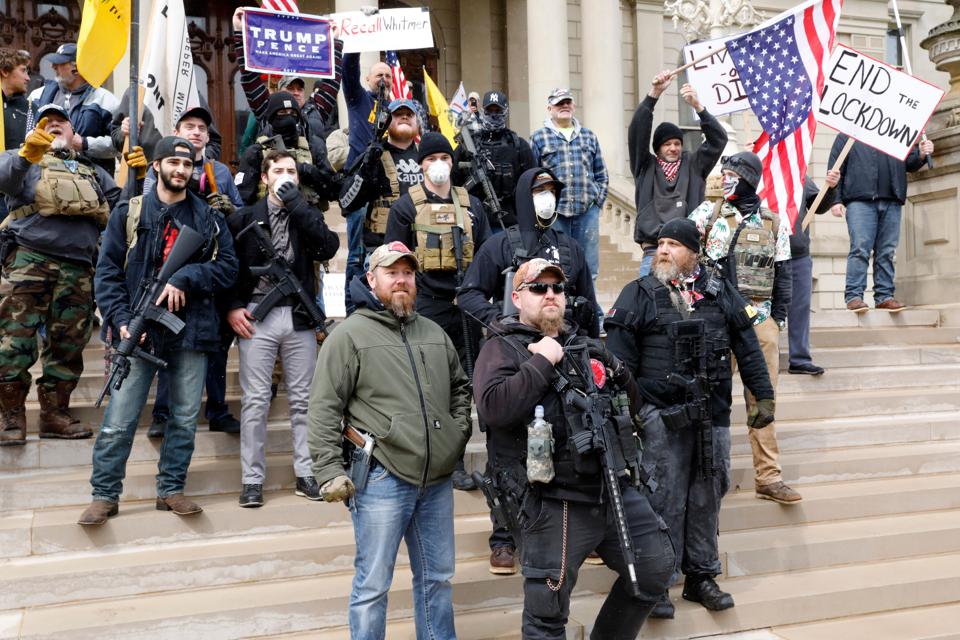
A few protesters wore masks, but most did not. Lots of American flags were visible, and it’s also easy to spot a few Gadsden (“Don’t Tread on Me”) flags, along with a couple of Confederate battle flags. (It’s hard to remember all of high school history, but my memory is that US-HEALTH-VIRUS-PROTESTMichigan fought for the Union during the Civil War.) There was visible support for Donald Trump, and a familiar recurrent chant about Gov. Whitmer: “Lock her up.”

And there were lots of guns, as in the picture at right. Whether or not the organizers wanted this look, when passionate people are mobilized, it’s very hard to maintain control of just what they say, what they carry, or even what they do.

Protesters discussed developing herd immunity instead of isolation, but were more interested in citizen expertise on the matter than  the advice of immunologists or epidemiologists on the matter.

Those who are listening to the medical experts, inside and outside the government, will find the herd in front of the Capitol alarming, and will worry about the transmission of the virus, then carried back to the families of the demonstrators. We may not know of any infections for a week or two, by which time demonstrators will have found an alternative cover story.


Posted in Uncategorized | Tagged , , , , , , , , , , , , | 5 Comments

Opportunistic Advocacy (1/x); COVID-19 (4/x)

Effective advocates don’t want to waste a crisis. They try to photobomb into public attention to advance their concerns. Sometimes, it’s a clear fit–in direct response to the challenges of the moment; sometimes, they fly a long favored reform or restriction as a potential solution to a completely unrelated problem.

Conservative movements have tried to exploit the coronacrisis to stop abortions, gun regulation, the protection of voting rights, and the general process of government altogether.

Defining essential services and medical procedures across the states afforded politicians and advocates an unusual opportunity to exercise influence around the edges in ways that dramatically affect lives. Groceries and gasoline and pharmacies were sort of obvious, but stores that sell bicycles or marijuana require at least an argument. Religious services? And no one should want to go to the hospital to have a mole removed when the medical system is overwhelmed by infectious patients. People can, with more or less convenience and relief, put off knee replacements and colonoscopies.

  1. But abortion? Opportunistic abortion opponents leaped to classify abortion as an elective procedure that could be postponed until…..the quarantine ends? abortion is no longer possible? In states where conservatives held the balance of political power, anti-abortion activists forced abortion rights supporters to defend existing rights in States That Use COVID-19 To Ban Abortion Increase Our Risks ...the midst of a health crisis. This happened in Ohio, where the response to COVID-19 was data-driven and aggressive, and in Texas, where it assuredly was not.

Women who had already decided that an abortion was essential for them suddenly faced a confusing landscape in which access to medical abortions (with or without supervision) or a surgical abortion was suddenly in flux, batted between judges and legislatures. And anti-abortion activists again successfully politicized a medical procedure and pushed it into the political debate.

2. Demand for guns was perhaps less eGun Store In Newington Had Lines Out The Doorffusive and extensive than demand for toilet paper, but lines outside gun shops shot down the street and dripped around corners, with little evident social distancing. If things are starting to shut down, well, it makes some kind of sense to make sure you have enough weapons and ammunition, particularly if the toilet paper squabbles escalate.

Look how federalism works: Some states ordered gun shops closed, like clothing and sporting goods stores, while others designated them as essential, therefore remaining open. Local officials battled each other over the details, with some officials choosing to leave gun shops alone just to avoid the fight. That’s a win for the gun rights enthusiasts.

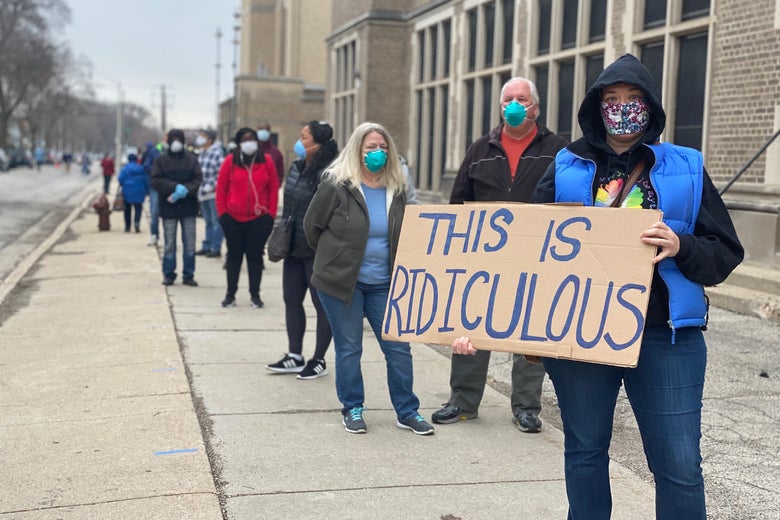
3. The battle over voting in Wisconsin went national, with the heavily gerrymandered, heavily Republican state legislature refusing the Democratic governor’s requests to A line of voters spread out on a sidewalk and wearing masks. In the front, a masked woman holds a sign that says "This Is Ridiculous."provide universal mail-in ballots or to postpone the election.

The circumstances were egregious: record numbers of people had requested absentee ballots and thousands hadn’t received them.

The US Supreme Court decided, 5-4, that these voting rights were really a minor matter, and reversed a lower court decision that would have extended the timeline for accepting absentee ballots–so at least everyone who requested one would have a chance to vote. (Ruth Bader Ginsburg penned a scathing dissent.) The Wisconsin Supreme Court ruled, 4-2, that the governor could not delay the election. Both decisions were conspicuously partisan: Democrats wanted to make it easier to vote; Republicans didn’t.

The shortage of poll workers meant that the number of places to vote was drastically reduced: Milwaukee normally offers 180 polling sites, but this year it mustered only 5.  This meant that voters, under public health orders to stay at home, could spend a couple of hours in line with hundreds of others to vote.

Voters turned out, maybe in spite, certainly in anger. In the marquee race of the election, a Democratic challenger, Jill Karofsky, unseated Republican Daniel Kelly from his post on that same Wisconsin Supreme Court, even though Trump had endorsed Kelly. Unlike most recent state-wide elections in Wisconsin, it wasn’t close; Karofsky won by more than 120,000 votes, 55.3%-44.7%.

But this isn’t near over. Access to voting rights, in the era of the coronacrisis through mail, has become inappropriately partisan, with the president of the United States arguing that absentee ballots should only be available to people like him—and, presumably, the 7 justices of the Wisconsin Supreme Court, who all voted by mail.

4. Anti-government activists in Idaho are planning a mass gathering to protest restrictions on the size of social gatherings. Ammon Bundy spoke to a planning group of dozens, itself a violation of the state government’s social distance orders. You may remember Bundy, son of rancher Cliven, who took up arms to avoiding paying the federal government to graze his cattle on public lands. Ammon led the armed occupation at the Malheur Wildlife Reserve in Oregon a few years ago.

Government restrictions on a “God-given constitutionally protected right to peacefully assemble,” represent a far greater threat to human welfare than a virus to those assembled. Besides, they don’t really trust expert Outside the Bonner General Health hospital in Sandpoint, Idaho, officials have erected two tents to help treat patients if extra space is needed.medical advice any more than they trust the government. Vulnerable people could be encouraged to stay at home and protect themselves (with distance….and maybe guns), but that’s it. Ammon announced that he wanted the virus!

In all of these cases, the protesters had well-developed grievances and agendas long before COVID-19 existed. Conservative activists had worked long and hard to restrict access to abortion and the ballot, and strictly limit government regulations on guns and so many other things. They were ready to jump at the new attention and opportunities provided by the coronacrisis.

Such opportunism isn’t activism 101, but it’s certainly well-covered in a basic class.

Posted in Uncategorized | Tagged , , , , , , , , , , , , , , , , , , | Leave a comment

Comfort, Congregation, Contagion,Contention, COVID-19 (3/x)

Public worship, especially when prohibited, is often political. The litany of martyrs who practiced their faith against the dictates of their governments Antigone vs. Creonstretches at least a couple of thousand years. Stories of individuals or groups standing up against authoritarian states to express devotion and fulfill duties–regardless of costs–make for powerful, sometimes inspiring, drama.

And picking the right (that is, wrong) place and time makes for politics even in countries that are broadly tolerant of religious practice. Religious people who pray trespassing on a nuclear weapons test site, civil rights or anti-abortion activists who pray while awaiting arrest, and Catholic human rights activists protesting cruel and inhumane policies on the border while practicing at least some of the sacraments, all deploy their faith in public as witness, and also as a political statement.

The First Amendment provides for rights to religious freedom and public assembly and, at least in principle, government bends over backwards to accommodate expressions of faith. Sometimes, the free exercise of religion entails tolerance of worship that seem risky or dangerous, including fasting, ingesting hallucinogens, or handling snakes.

But what are we to make of the arrests this week of pastors who led very large public services in defiance of public health bans on assemblies of even modest size?

Pastor Rodney Howard-Brown turned himself into authorities after acknowledging, proudly, that he had conducted two very large Sunday worship services at his church in Tampa, Florida, in violation of County orders. He was charged with unlawful assembly and violating public health emergency rules. Pastor Howard-Brown had announced that he would keep the doors of his church open until the Rapture. Besides, the church had kept family groups distanced and distributed hand santizer to the hundreds of worshippers. Given this context, it’s hardly surprising that he would describe the concern about the novel corona virus as “blown totally out of proportion.”

The next day, Pastor Tony Spell was arrested for holding Sunday services at his church in Baton Rouge, in violation of the governor’s orders prohibiting public gatherings of more than 10 people. Spell had promised to defy any public gathering bans in advance, suggesting that the governor was politically motivated. At his sermon, he defended the role of the church in meeting  the challenges of a public health crisis:

Our church is a hospital where the sick can come and get healing…Cancers are healed here, people are healed of HIV in these services, and we believe that tonight, we’re also going to pass out anointed handkerchiefs to people who may have a fear, who may have a sickness, and we believe that when those anointed handkerchiefs go, that healing virtue is going to go on them as well.

The pastors argue that churches provide a service every bit as essential as hospitals, groceries, and drug stores, and they’re not alone. Other ministers have held public services, tucking themselves into often ill-defined standards of essential services. The attraction is clear: in times of extreme stress, with uncertainty about not only health, but the economy, and the future more generally, many people can find comfort and direction in their personal faith, and in a community of faith. (Note that many churches, synagogues, mosques, and temples have responded to this need through online services or counseling, and even drive through communion.)

But the risks are also great, particularly in this case. The notorious “patient 31” was, apparently, a particularly prolific infector in her South Korean church, where people gather in dense crowds over long stretches of time before returning to the secular world. A close religious community provides a too-ideal setting for a virus to spread. Even more than that, Korean churches organized to oppose, mostly unsuccessfully, the strict public safety measures that seemed to have dampened the viral spread.

So, think: A faithful mishandler of snakes puts his life at risk, along with the well-being of his family, but does not put the larger community in jeopardy. In contrast, the person who decides that by exercising due care in sterile practices that he can minimize personal risk while attending a large service, also threatens the cashier at the grocery, and every person who passes through that check-out line–and their families. The careless vector sins against humanity.

The politics here are critical. The defiant churches are led by evangelical activists who support conservative causes and politicians. In their resistance, they call into question the real threats of viral contagion, and represent a real threat to public health. They are also, however, key constituencies for Republican politicians in some states, who put public health behind concern for commerce and Christ.

So, pastors have organized to demand that their services be classified as essential, nourishment of the soul being every bit as critical as for the body. Organized evangelicals have been extraordinarily faithful to the Trump presidency, and neither he nor his political acolytes have been eager to cross them. Trump has left it up to state officials to decide whether to issue restrictions on public gatherings, and more than a few Republican governors have followed his model. Texas governor Greg Abott, has relied on his evangelical faith to call for more God, rather than fewer guns, to prevent shootings in churches and schools; thus far, he’s left it up to local officials to decide whether to restrict public activity.

In Florida, Governor Ron DeSantis has charted his political career along spring breakTrump’s sitelines, delayed state-wide regulations–even during a typically raucous and atypically dangerous Spring Break season–in deference to local governments. But yesterday, DeSantis announced a state-wide shut-down of all but essential services.

He allowed a massive carve-out: public worship is classed as “essential business.”

Posted in Uncategorized | Tagged , , , , , , , , , , , , , , , , | 1 Comment

Cesar Chavez Day, 2020

In the virtual lockdown we’re living through in California, where one day bleeds into another, I’d almost forgotten about Cesar Chavez Day.  Here’s a piece I wrote about the holiday in 2018, recycled, augmented, and reedited, with a few distressing updates.)

Less tImage result for edna chavez speech, stephon clarkhan a week after Edna Chavez, the charismatic seventeen year old high schooler from South Los Angeles, electrified a national crowd with a demand to end gun violence, Californians celebrate the legacy of another Chavez.

On my campus, we commemorated Cesar Chavez Day today, rather than March 31 (his birthday), by closing.  The state established the holiday in 2000, and six other states have followed suit.  In California, the legislature calls upon public schools to develop appropriate curricula to teach about the farm labor movement in the United States, and particularly Chavez’s role in it.

A campaign to establish a national holiday has stalled so far (The Cesar Chavez National holiday website seems to have last been updated in 2008), but last year President Obama issued a proclamation announcing a day of commemoration, and calling upon all Americans “to observe this day with appropriate service, community, and education programs to honor Cesar Chavez’s enduring legacy.”

Political figures have many reasons for creating holidays, including remembering the past; identifying heroic models for the future; recognizing and cultivating a political constituency; and providing an occasion to appreciate a set of values.  Regardless of the original meaning, the holidays take on new meanings over time.  Columbus Day, for example, is celebrated as an occasion for pride in Italian Americans (e.g.), and commemorated and mourned as a symbol of genocide  and empire (e.g.).

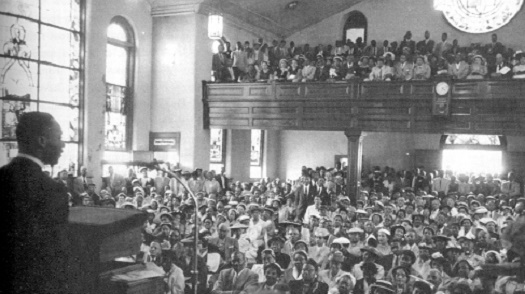
Cesar Chavez’s life and work is well worth remembering and considering, particularly now.  His career as a crusader was far longer than that of Martin Luther King discussed (here and here) and he was far more of an organizer than Fred Korematsu (discussed here). Chavez’s Medal of Freedom was awarded shortly after his death in 1993, by President Clinton, but many of his accomplishments were apparent well before then.

Dolores Huerta, 2009

As a young man, Chavez was an agricultural worker; by his mid-twenties, he became a civil rights organizer, working for the Community Service Organization in California.  With Dolores Huerta, in 1962 Chavez founded the National Farm Workers Association, which later became the United Farm Workers.  Focusing on poor, mostly Mexican-American workers, Chavez’s vision for activism was right at the cornerstone of racial and economic justice.  Establishing an organization, however, is a long way from winning recognition and bargaining rights as a union.

Chavez was a tactician, a public figure, a charismatic, and something of a mystic.  Modeling his efforts after Gandhi’s successful campaigns, Chavez was an emphatic practitioner of active nonviolence.  He employed boycotts, strikes, long fasts, demonstrations, long marches, and religious rhetoric in the service of his cause.  He also registered voters, lobbied, and worked in political campaigns.  He was a tireless and very effective organizer for most of his life.

But holidays are best celebrated with an eye to the future, rather than the past.

On Cesar Chavez Day this year, we can think about the large and growing Latino community in the United States.  The 2010 Census reports that Latinos now comprise roughly 1/6 of the American population, and more than 1/3 of the population in California. This is the youngest and fastest-growing population in America today, and they are severely underrepresented in the top levels of politics, education, and the economy.   The civil rights map is at least as complicated as at any time in American history, but not less important or urgent.  (The struggle about the DREAM Act is reminiscent of the debate about Voting Rights 45 years ago.)  The future of American Latinos is very much the future of America.

[2020: Through ill-advised, provocative, and racist policies, Donald Trump has done a great deal to make it easier to mobilize Latinos, and to forge a broader unity among the whole range of minority groups (racial, ethnic, religious, sexual, etc.). This organizing IS happening.]

And Chavez saw the civil rights struggle as a labor issue.  When Chavez and Huerta started their campaign, nearly one third of Americans were represented by unions.  The percentage now is now just about 10 percent, and less in the private sector.

And public sector workers, even if represented by unions aren’t doing so well.  The ongoing conflict in Wisconsin is all about weakening unions that are already making very large concessions on wages and pensions.  The campaign in Wisconsin is part of a larger national effort, which is playing out in Indiana, Ohio, Florida, and elsewhere.  Even in states where anti-union forces are weaker, state employees face lay-offs, wage cuts, and increased health and pension costs.

[The previous Wisconsin governor, Scott Walker, was largely effective at hobbling organized labor in his state. Aided by an extensive organizing effort and backlash to many Walker policies, Tony Evers eked out a narrow victory in 2018. Wisconsin may now be a highly contested true swing state, but one without many swing voters.]

This year, the Supreme Court will rule in Janus vs. AFSCME, and court watchers expect the Wisconsin model to be immediately exported across the country. [The wildcat teachers strikes in West Virginia, and now Kentucky, with credible threats in Oklahoma and Arizona, offer the hint of a new resurgent labor… more later.]

[Janus turned out exactly as union organizers fear, and continues to haunt the national landscape.]

But, we need to remember that you can’t attack teachers, nurses, police officers, and firefighters without hurting the people they serve: us.

Or should I say, US?

We commemorate the past to help guide the future. Edna Chavez, working in an urban setting far from Cesar Chavez’s organizing, carries the legacy forward, and adds more.

Posted in Uncategorized | Tagged , , , , , , , , , , , , , , , , | Leave a comment

Solidarity and social distance, COVID-19 2/x

If you can’t meet in person, how can you protest effectively, or build the communities that can support effective action in the future?

Twitter and Tear Gas: The Power and Fragility of Networked Protest by [Tufekci, Zeynep]Online connections and social media provide an exceptional set of resources for organizers to spread information about issues and actions, bypassing obstacles of mainstream media (neglect) and repression (e.g., police who chase away activists wheatpasting flyers on walls and electric polls), but much of the work of building social movements/networks/trust is face-to-face. Moreover, online networks can easily be more segregated and insular than their real-life expressions. (Zeynep Tufekci’s book, at left, describes the heft and limits of online action well.)

In ancient times, like the last century, large demonstrations reflected thousands of hours of organizing efforts played out over months or years, where local groups built activist communities, common understandings of problems and politics, and solidarity–a feeling of connection. Social media allow organizers to generate the numbers far more quickly, but can movements be effective without all the infrastructure? (Rhetorical question; I don’t think so.)

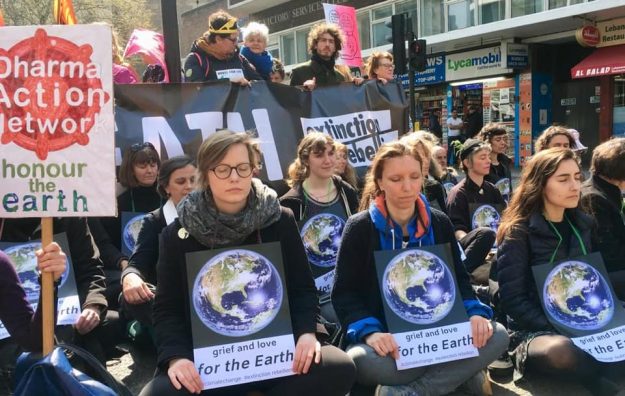
extinction rebellion buddhists

Dharma Action Network for Climate Engagement (DANCE)

In real life, organizers build solidarity by bringing people together for common purposes. Around coffee or tea, activists learn about each others’ families and favorite foods. They share brownies or cookies, tell jokes and stories, argue about places to shop or eat, and share rides. Sometimes, they make plans to go for walks or meals, organizer play dates for kids, and build friendships.
mbb1

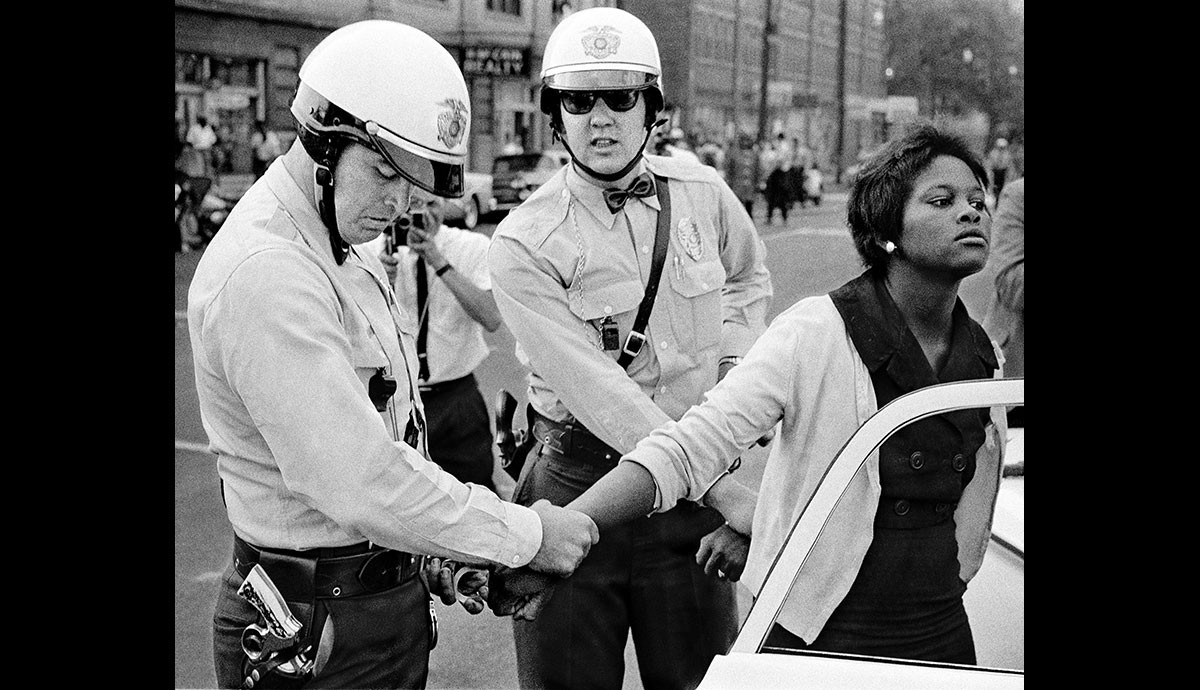
A picketer is arrested behind Loveman's Department Store. Civil rights leaders believed that if they could break segregation in Birmingham, it would collapse throughout the South. ©1963 Bob Adelman, Courtesy CDEA.


At meetings and at actions, people sometimes pray or chant or sing. There is a feeling that can come from such collective action, of warmth and trust and connection, that provides support and sustenance and courage to take on actions that feel scary or risky.

Sometimes an issue or a political commitment can bring people together, but political commitments also develop through social connections, and the accumulation of common experiences over time.  
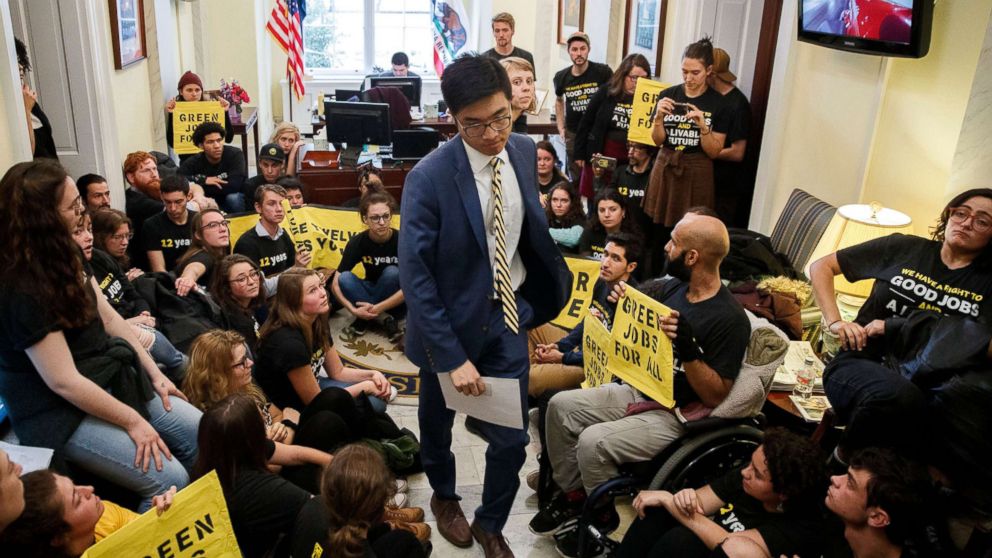
At demonstrations and actions, activists build bonds through proximity, like the two crusaders who confronted Sen. Jeff Flake at an elevator to urge him not to vote to confirm Justice Kavanaugh, or the young people in the Sunrise Movement who sat in at Speaker Pelosi’s office–and elsewhere in Congressional offices.

Canvassers meet neighbors and learn about issues that they aren’t organizing on at the moment, and learn to recognize people they might see at the grocery store later in the week.

Protesters linked arms in the street on Inauguration DayWhen academics write about the sense of connection, often expressed through physical ties, common language and slang, styles of dress, and familiar songs, they often use the term “collective identity.” It comes from personal and physical contact.

Can all of this be replicated online? I don’t know, but I’m doubtful. I had a good long Zoom meeting this morning with nearly a dozen others who shared a common purpose and similar values. But I muted my mic so that they didn’t have to hear me eat breakfast, and I made my own coffee. We tended our own obligations during a break; no small talk. Others were interrupted by calls or deliveries, and had to drop off at odd times to deal with children and normal household obligations. No stories, shared food, and not too many distractions. It was far more efficient than a meeting in-person, but far more instrumental and limited.

So, I’ve been interested in how local groups are working to build social contacts in these moments of social distance. My JCC has, surprisingly, been inspiring. In the phone and email messages that announced its closing, staff offered to check in with daily calls to people who wanted the connection. Fitness trainers offered free exercise classes online, and preschool teachers provided online story times, reading children’s books to children who must be climbing the walls.

Historian and activist Lara Putnam reports on Twitter of organizers cultivating mutual aid groups, trying to serve community needs even with the currently necessary distance. Neighbors are offering to pick up groceries or help with errands and information. This surely does something to build community and solidarity. Maybe this provides a core connection that can support political action later.

Maybe.

Posted in Uncategorized | Tagged , , , , , , , , , , , | Leave a comment

Social distance and social movements, COVID-19, #1/x

How does good medical advice affect meaningful collective action?

Before the recognition of the highly contagious novel coronavirus, we were living in a time of intense political mobilization–all over the world. But now, advisories to maintain social distance undermine the most visible elements of social movements: public meetings, canvassing, civil disobedience actions, lobbying trips, and, of course, demonstrations. It’s ridiculous to think that activists can stage a large demonstration in a public space while maintaining 6-10 feet distances from each other.

Protesters wore protective masks as a preventive measure against the coronavirus.Globally, in a few places activists are marching together outdoors anyway, the cause so pressing that they are willing to take what they know of the risks: last week, thousands turned out in Kyiv to protest Ukraine’s concessions to Russia in talks to end the ongoing war;  thousands of yellow vest protesters marched in Paris, in defiance of a government prohibition on large gatherings.

Urgency matters, of course,  but these dramatic efforts can’t be sustainable. coronavirus france paris yellow vests protests macronEven faster transmission of a viral infection is a risk for those taking to the streets, and–even more–it’s also a danger to the larger society that the protesters want to protect. Committed organizers won’t want to increase the risks their supporters take–nor risk diminishing turnouts.
The health threat, in conjunction with harsher government surveillance and repression have, at least for now, shut down the months-long protests in Hong Kong, and it’s hard to see how such mass movements will reemerge until everything feels a little safer.

In the meantime, what can organizers do to promote the issues they care about and build the citizen power they need to change the world?

Physical proximity has been almost a precondition for building collective action. More than 150 years ago, Marx and Engels wrote that capitalism, by bringing workers together in factories and cities, was handing shovels to its gravediggers. The piece that matters now is that they thought that once people were close to each other, sharing and comparing their troubles, finding common ground, and building trust–they could cooperate to make effective politics.

The idea that cohesive communities built on face-to-face contact can organize collective action, unlike other claims in the Communist Manifesto, has stood up pretty well. Workers who came to know each other on the factory floor built unions, organizers going door to door built neighborhood groups, and college students living in dorms organized and animated student movements. Activists of all sorts build community and make strategy over long meetings in kitchens and living rooms, pubs, and church basements. Good organizers listen to the people they wanted to engage and build human relationships, not just political transactions.

COVID-19 threatens every classic element of social movement organizing, from initial strategizing to visible political expressions.

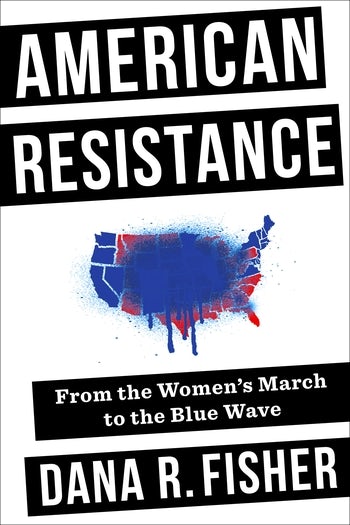
The Internet and social media can offer some responses:  Tea Party organizers used Meet-Up to find each other and set up in-person meetings. Occupy Wall Street streamed actions and meetings to get the word out when mainstream media neglected it. A stray Facebook post in the wake of the Trump election inspired organizers to put together the Women’s March.  Indivisible posted an online manual that reached millions of people across the American Resistancecountry, who built their own groups and planned independent actions, sometimes in coordination (see distributed organizing, described by Dana Fisher’s book–at right).

But all of those efforts were all directed to produce events in real life with people knocking up against each other, friends and foes and bystanders. The Tea Party staged national demonstrations and coordinated disruptions and Congressional townhall meetings. Occupy occupied—everywhere, with thousands of people living in encampments. The Women’s March appeared in hundreds of sites, mobilizing millions, and Indivisible groups organized in real life meetings and events across the country.

Social media provide a tremendous aid to organizers working to get attention to their issues and activities, and coordinating actions, but they don’t work around the need to present action beyond a computer screen or keyboard. The real life part of activism is blocked right now.

Beyond that, COVID-19 commands so much of our attention, both political and personal, that it’s hard to find space for action on other political and economic issues. People are worried about getting to or staying away from work, buying food and toilet paper, attending to children and parents, navigating social distance with friends and family, and trying to plan for a future that’s hard to envision. Organizers concerned with climate change, reproductive rights, health care, or economic inequality can’t ignore. Instead,  the challenge is to understand the daily struggles, maybe offer some help, and move to work for broader reforms.

The next question, in the shadow of the virus, is how.

(more to come).

Posted in Uncategorized | Tagged , , , , , , , , , , , , , , , , , , , , , , , , , | 4 Comments

Young people lead

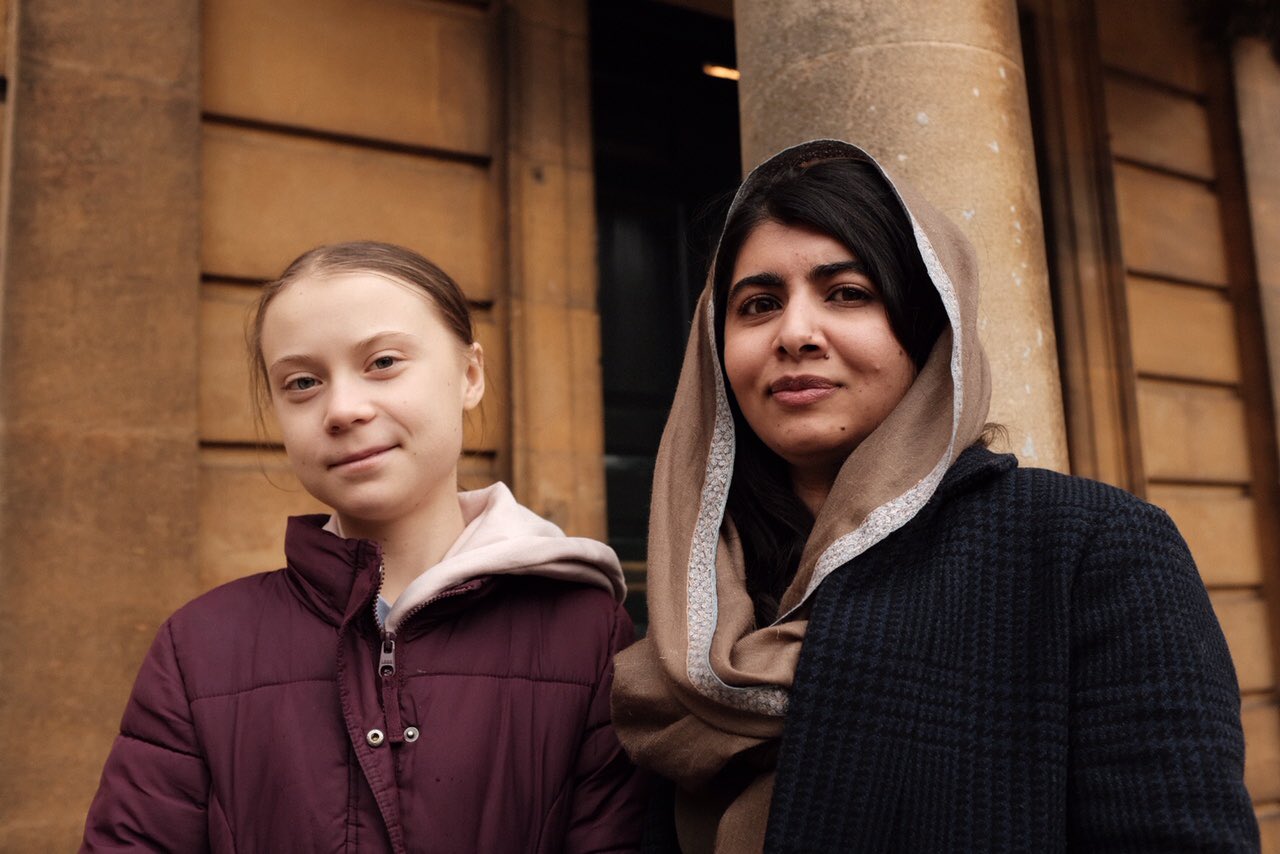
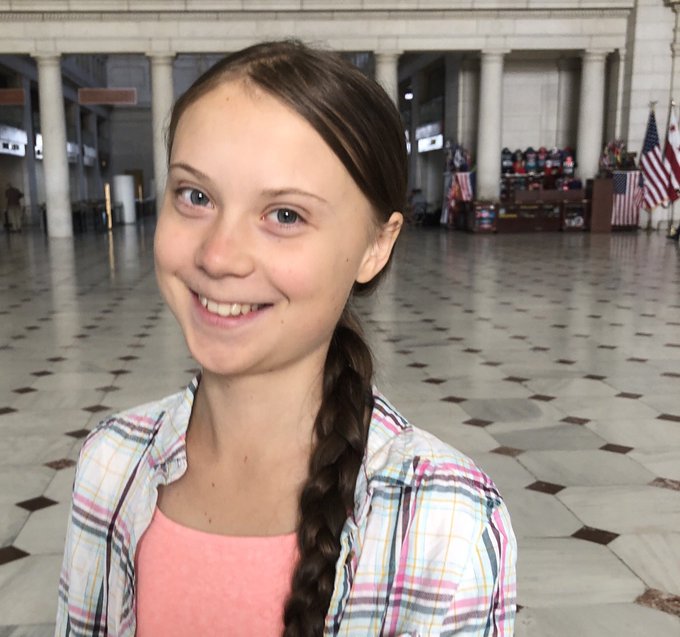
It felt good to see this new picture, posted on Twitter by both Malala Yousafzai and Greta ImageThunberg.

Malala,  now  23,  has  been  a crusader  for  human rights, particularly educating  girls  in  Pakistan.  She’s paid a severe price for her advocacy, shot in the head by a religious fundamentalist. Since recovery, she’s stepped up her efforts, writing, speaking, and appearing in virtually every public venue that might reach people. She won a Nobel Peace Prize in 2014, and she’s not done.

Greta, now 17, describes Malala as an inspiration and role model. For the past few years, Greta herself has been an inspiration and organizer of global student strikes for action on climate change. Greta, passionate in advocacy for the planet and for young people, has been a powerful and compelling presence in the movement for climate change action. She has been tireless, focused, and she and her family have been candid about Greta’s Aspergers’s diagnosis, and her struggle with an eating disorder.

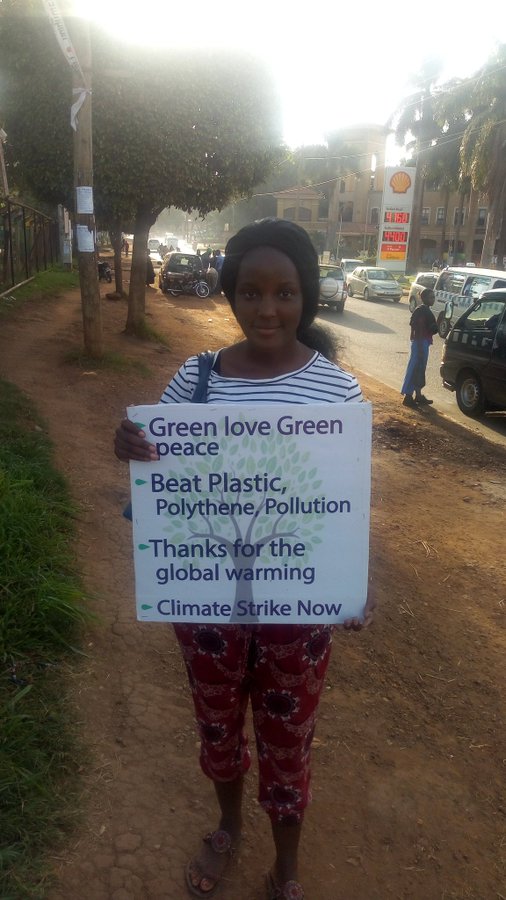
View image on TwitterGreta’s focus and the support of her family and a larger movement, have helped her become a focal point for the movement. She’s been ridiculed by Donald Trump, and nominated for a Nobel Prize herself. At times, media portrayals use her to obscure the great many young people globally who are similarly engaged. At left, see the young Ugandan activist, Vanessa Nakate, who was conspicuously cut out of a portrait of young climate change activists so that only white girls remained.
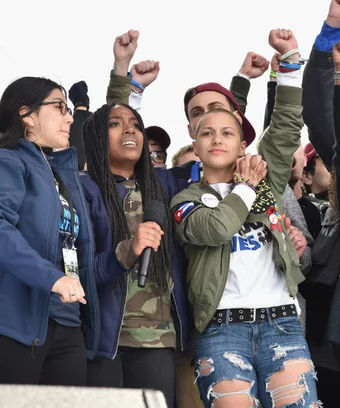
Vanessa cites Greta as one of her inspirations, and Greta has worked to share her spotlight with the much larger movement–and other youth activists. She also cites the Parkland kids, who organized March for Our LivParkland studentses, as inspiration.


And, while a few  of  the  activist  survivors  of  the Florida  shooting  have  gotten  lots  of  attention,  they  really are  a part  of  a much  larger  group  of  young  activists  around  the  country.

Young people are often at the forefront of major social movements, bringing passionate focus, commitment, and an image of innocence and authenticity.

If youthful activists are a tremendous resource for social movements, it doesn’t mean that every movement has equal access to them. Seeing the power and possibility of teen crusaders for gun safety and climate change, conservative opponents have been willing to look very hard for their own young activists, aggressively promoting their own alternatives.

If you can’t beat ’em, buy ’em.

It doesn’t always go well. Jonathan Krohn, a 13 year-old star speaker at the Conservative Political Action Committee’s 2009, got speaking invitations and published a book endorsed by Newt Gingrich and William Bennett while still in high school. But Jonathan came to question his conservative stance, calling his teen politics “naive,” and suggesting that he was likely to vote for Barack Obama.

Kyle Kashuv, a conservative teen survivor of the Parkland shooting, gained a national profile–at least in conservative circles, for arguing against stricter regulation of guns on Fox News. When Harvard University accepted the honor student, classmates at Stoneman Douglas publicized particularly ugly racist and sexist comments Kyle had made about his classmates on social media; Harvard rescinded admission.

A movement’s poster children can fail in all sorts of ways, with ignorance, inconsistency, or insistence on linking offensive positions on other issues.

We’re not done yet:

Seeking its own Greta, the Heartland Institute, a right wing climate denial shop that does not disclose its funding, has hired its own young blonde European spokesperson, 19 year old Naomi Seibt. Seibt says that she came to politics a few years ago, frustrated that her teachers were defending Germany’s policies of welcoming immigrants, including refugees.

Naomi is also skeptical about feminism and the scientific consensus on climate change. She came to the American right’s attention after speaking at an event sponsored by the right wing nationalist Alternative for Germany (AfD).

Recognizing that an outspoken and articulate teen climate skeptic is more rare than another Greta or Vanessa, Heartland put her on the payroll, sponsoring Naomi’s appearances at conferences and publicizing her Youtube channel.

Listen to what they say and consider the source.

It’s worth noting that Naomi, on Heartland’s dime, urges her audience to take her scientific speculations seriously and question the conclusions of scientists, who are basically untrustworthy. She argues against taking dramatic action that might hurt the fossil fuel industry which, along with libertarian conservatives, funds the Heartland Institute.

View image on TwitterIn contrast, Greta, sponsored by her parents, says that she’s a kid, not a scientist. Her advice has been consistent: “I don’t want you to listen to me, I want you to listen to the scientists.”

Posted in Uncategorized | Tagged , , , , , , , , , , , , , , | Leave a comment

Loyalty

Donald Trump is trying to destroy Mitt Romney.

It starts with snarky side comments in front of reporters and on Twitter, continues through allies–and other Trumps–disparaging disloyalty and demanding that Romney be ousted from the Republican caucus, and will escalate to threats against the personal safety of Romney and his family.

Don’t let the insatiable passion for retribution from a thin-skinned narcissist distract you from the logic of harsh retaliationImage result for machiavelli: at some level, Trump understands Machiavelli’s dictum that it is better to be feared than loved.

Loyalty is affiliation that supersedes considered judgment or impulse. We root for a favored team, frequent a familiar restaurant, or forgive a familial trespass because of loyalty. Loyalty means that friends can count on us even when it might be inconvenient. And the further you’ve gone to demonstrate loyalty, the stronger that affiliation will be. (Agreeing to pick up a friend from the airport will increase your commitment to that friend!)

Loyalty can come from tradition, from experiences, and from affection. It can also come from fear.

In the impeachment proceedings, Trump demanded–and received–lockstep fealty from the Republican caucus in the House and (almost) the Senate. The legal arguments and factual assertions were extraordinarily weak, but this really didn’t matter. Trump was clear that he–and his supporters–would punish defectors. Indeed, if we’re to believe Democratic Senator Sherrod Brown (Ohio), Senate Republicans know that their president is guilty and unstable, but they fear crossing him. After all, insufficient support for this president effectively ended the political careers of Jeff Flake and Bob Corker, episodically mild Republican critics in the Senate.

Run through the electoral logic: Senators who should know better, say Ben Sasse (Nebraska) or Lindsey Graham (South Carolina) are running for reelection in overwhelmingly Republican states where Trump remains popular. A pointed tweet can enable a primary opponent who will make life (and reelection) at least a little more difficult.

It’s worse for so-called moderates in swing states like Cory Gardner (Colorado) or Susan Collins (Maine): loss of enthusiastic support from even a small portion of the Republican base would be damning, and a little moderation won’t buy you any swing voters in the current political environment.

Of all the Republicans in the Senate, Romney was perhaps the very best situated to weather the upcoming onslaught. Extremely wealthy, well-respected in Utah, his presidential aspirations are also past. Romney isn’t up for reelection until 2024, when Trump might just be a remembered nightmare.

Mitt Romney also has a role model: his father, George Romney, a Republican governor George and Mitt Romneyfrom Michigan who opposed conservative Barry Goldwater’s nomination in 1964, and then came out against the Vietnam War in 1968. Romney the Elder never became president, and lost the support of his party.

For the first decades of his career, the lessons young Romney took were about the importance of political flexibility rather than moral rectitude. Romney’s flexibility on abortion, on health insurance, and even on Trump, are well-documented and dispiriting. And they didn’t bring him to the White House.

I believe that Mitt Romney’s explanation of his judgment and his commitment to his oath and the Constitution are genuine. But it’s important to realize that he was in a better position to act on them than many of his colleagues.

I think more than a few other Republican senators could have also withstood a Trumpian attack (obviously, they disagreed). It’s critically important for Trump to show that I’m wrong–and far more importantly, that Romney was wrong. Trumpians have to punish Romney so severely that other Republicans are scared to follow the Utah senator’s model.

It IS going to be ugly.

Posted in Uncategorized | Tagged , , , , , , , , , , , , , , , , , | Leave a comment

Sixtieth anniversary of the Greensboro sit-in

Tomorrow is the anniversary of the start of the sit-in campaign in Greensboro, North Carolina. I’m always moved and encouraged by the audacity of those young men, and there’s a special reason to repost this year.

As the stilted impeachment trial of Donald Trump crumples to a halt, it’s far too easy to be discouraged about democracy, racial justice, and the Constitutional order in the United States. It is a rough time.

But it’s hard to imagine that there’s anyone glancing over these words who is not better positioned today to change the world than these four young men were in 1960. The audacity of their imagination gave them courage, and a lesson like this doesn’t get old or out of date. It’s inspiring to see the same audacity among the young people animating current movements for gun safety, for action on climate change, and for democracy more generally.

There was once a store called Woolworths.  It sold dry goods, mostly cheap stuff, including paper and pencils.  Many Woolworths also housed a cheap restaurant where you could get coffee and a grilled cheese sandwich, also cheap.  Fifty-three (60!) years ago today, a
Woolworth sit-inWoolworths in Greensboro, North Carolina, was the site of a new phase in the civil rights movement, the beginning of the sit-in campaign.

On Monday morning, February 1, 1960, Ezell Blair, Jr., Franklin McCain, Joseph McNeil, and David Richmond, wearing their best clothes, went shopping at the Woolworths, bought some school supplies, then sat down at the lunch counter and tried to order coffee.  The four young men, freshmen at North Carolina Agricultural and Technical College,  knew the store wouldn’t serve food to black people, so they waited.  Woolworths shut the lunch counter down.

The next day, black and white students filled the lunch counter at Woolworths, and by the end of the week, every lunch counter in downtown Greensboro was filled with students protesting segregation–and organizing a boycott of the downtown businesses that practiced segregation.  Over the next weeks, sit-ins spread across the segregated South, led by student activists.

The four freshmen, no not the singing group, had all been active in the NAACP’s youth council, but none of them saw the large organization as a good foundation for a more activist and confrontational phase in the civil rights struggle. Pushed by the heroic Ella Baker, the NAACP launched an initiative to create a new student-based civil rights organization, the Student Nonviolent Coordinating Committee (SNCC), which staged dramatic education and direct action campaigns across the South for most of the rest of the decade.

Today is a great day to commemorate the sit-in movement, but anniversaries can be slippery.  When I tell the story to my classes, I usually start with the long Sunday night conversation when the brave young men talked themselves into action.  You could start the story much earlier, with the sit-ins organized by the Congress of Racial Equality (CORE) organized decades earlier, or with the sit-down strikes organized by the Industrial Workers of the World at the start of the 20th century, even before the founding of the NAACP.  You could also start the story with the Montgomery Bus Boycott and Rosa Parks, or the Brown v. Board of Education decision in 1954.  The Greensboro students knew all those stories.

Anniversaries help us remember important events and twists in history, but they invariably simplify longer and more complicated stories.  The drama of the Greensboro sit-in makes for a good entry into thinking about the civil rights movement, and into thinking about how regular people sometimes make history.  The names of Baker, Blair, McCain, McNeil, and Richmond are not particularly well-known today, not like those of Rosa Parks, Martin Luther King, John Lewis (who would lead SNCC), or Thurgood Marshall.  The names of the thousands of young people crusading against segregation with them are even lesser known.  But movements are only possible and potentially effective with people willing to take risks without counting on seeing their names in the history books.

Woolworth lunch counter


The lunch counter itself, or at least a portion of it, has been reassembled at the American Museum of National History (Smithsonian) in Washington, DC.  There are only four seats on display.  When we think about the civil rights movement, however, we need to extend the counter a long way.

Posted in Uncategorized | Tagged , , , , , , , , , , , , , | 2 Comments