Korematsu Day, 2017

Immigration protest at Denver International Airport

Airport protests in Denver

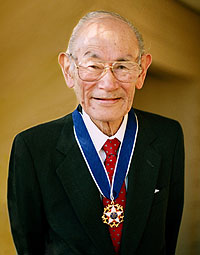
I try to post about Korematsu Day each year, and the repost is below. This year, of course, the treatment of people of different faiths or ethnic backgrounds is particularly salient. It’s important to recall that the Fred Korematsu who challenged the internment of Japanese Americans wasn’t an elderly gentleman wearing a medal, as pictured below. It’s at least a little encouraging that so many Americans today are able to see past the prejudices of their president.

Korematsu Day is celebrated today, and I repost the entry from the first Korematsu Day in 2011. The formal inclusion of commemoration in our calendar is a mixed blessing.  On one hand, it marks a terrible period in our nation’s history and recalls a destructive and explicitly racist policy of relocation.  It’s worth remembering.  On the other hand, it almost suggests that we’re beyond all of it today; we’re not.

Today Californians celebrate the first Fred Korematsu Day of Civil Liberties and the Constitution.  Represented by the American Civil Liberties Union, Korematsu challenged the constitutionality of relocating and interning Japanese Americans during World War II.  Three Supreme Court Justices agreed with him; six did not, finding that the emergency of korematsu.jpeg
a World War justified allowing Congress to put civil liberties on the back burner (Korematsu v. US, 1944).

Korematsu’s challenge exacerbated rifts within the Japanese American community; large organizations like the Japanese American Citizen’s League were eager to prove their patriotism by cooperating with internment.

Maybe the arc of history really does bend toward justice; it’s certainly long.  In 1980, President Jimmy Carter established a commission to investigate the internment of Japanese Americans during the war; in 1983, Korematsu’s conviction was vacated.   In 1988, Congress apologized to the Japanese Americans for the internment, and the government paid (modest) compensation to those interned.  In 1998, President Clinton awarded Korematsu the Presidential Medal of Freedom.  More than fifty years later, we recognized courage and heroism in what we first saw as a crime.

We should derive more benefit from the vindication of Fred Korematsu more than he did.  To do so, we need to draw lessons from the cause and the case that extend beyond Japanese Americans in World War II.  This means, I think, paying close attention to discrimination on the basis of race justified by appeals to national security.

We should tell Fred Korematsu’s story in New York City, where the construction of an Islamic Center in lower Manhattan draws opposition.  We should recall the history in Arizona, when the state passes a law mandating that police demand proof of citizenship from people who look like they might be undocumented.

And we should all think about how people learn.  California Attorney General Earl Warren pressed for interning Japanese Americans immediately after Pearl Harbor, arguing that their presence in California represented a threat to civilian defense.  Thirteen years later, as Chief Justice of the US Supreme Court, Warren organized the Court to issue unanimous decisions prohibiting racial segregation in the public schools.  I want to think he learned from the past, including his own past.

Apparently, one of the justices Earl Warren had to persuade was Robert Jackson, one of the three dissenters in Korematsu.  In dissent, Jackson wrote:

But once a judicial opinion rationalizes such an order to show that it conforms to the Constitution, or rather rationalizes the Constitution to show that the Constitution sanctions such an order, the Court for all time has validated the principle of racial discrimination in criminal procedure and of transplanting American citizens. The principle then lies about like a loaded weapon, ready for the hand of any authority that can bring forward a plausible claim of an urgent need.

Justice Jackson took a leave of absence from the Court to serve as as the chief US prosecutor during the Nuremberg war crimes trials, putting him in a very good position to think about a government’s use of race politics as a means of mobilization during moments of crisis.

Perhaps Korematsu Day will be an occasion for fireworks and picnics one day.  Today, it seems like a good time for reflection.

Posted in Uncategorized | Tagged , , , , , , , , , , | Leave a comment

Democracy’s rapid response: defending immigrant rights in the Trump era

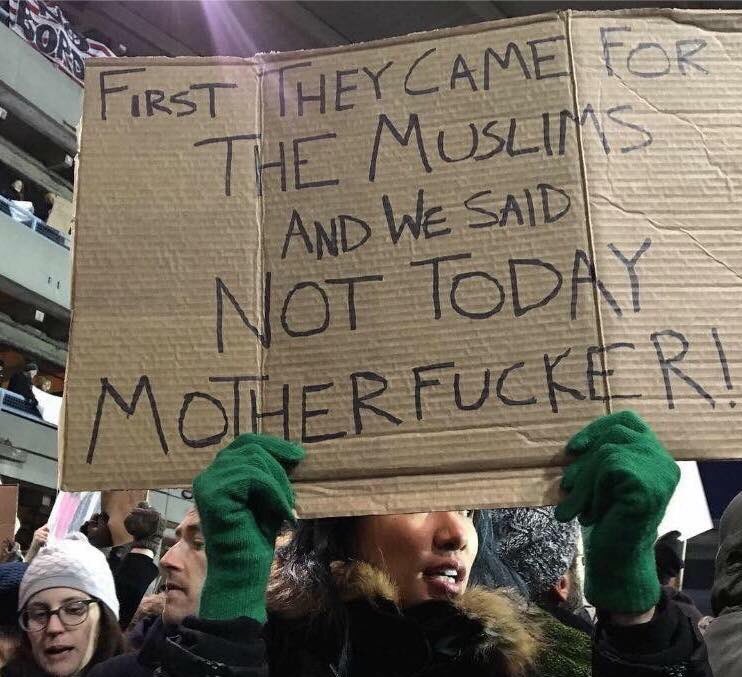
We live in extraordinary times, made so by the threat of tyranny, not of terrorism. When the Trump administration forced implementation of a new set of entry restrictions clearly Image result for First they came for the muslims, not this time motherfucker, cardboard signtargeted more at Muslims than terror, the responses were massive and virtually instant. When airline passengers from 7 mostly Muslim countries arrived in the United States, they were turned around or detained, including those with visas and even Green cards.

Protesters massed at major airports across the United States to announce their support for both migrants and travelers, and their opposition to Trump.

This is one of those moments that we’ll look back at years from now, and ask those who lived through it what they did. That Trump’s Executive Order was announced on Holocaust remembrance day, as the anniversary of the Executive Order authorizing the internment of Japanese Americans approached, made it all the easier to see the choices we have before us. There is an America that sent Jewish refugees back to Europe, imprisoned Japanese American families, and turned a blind eye to migrants fleeing wars, poverty, and political oppression. The protesters stood up for another America, one not defined by a skin tone or state religion, but by a inclusive civility that demands a great deal of work. It’s a more diverse, more colorful, and stronger America.

When reports of the first detainments trickled out on social media, protesters started showing up at Kennedy Airport, posting livestream feeds and tweeting to others. Only a sliver of those watching and cheering online made their way to the airports of large cities, where international flights arrive. Thousands turned out in Boston, New York, Chicago, Dallas, Atlanta, Seattle, Denver, Los Angeles, and Washington, DC–surely, elsewhere as well. Lawyers fanned out to offer their services to the detained, and the American Civil Liberties Union filed suit. Several Democratic members of Congress, including Elizabeth Warren (Massachusetts), Jerrold Nadler and Nydia Valazquez (New York), and John Lewis (Georgia) showed up at the airports to try to stand up for due process, support their constituents, and dump on Trump. By the end of the day, two federal judges had issued temporary restraining orders against immediate deportations and detainments.

Trump’s communications staff went to the media, awkwardly defending the policy by suggesting that it really didn’t inconvenience too many people.

Protesters assemble at John F. Kennedy International Airport in New York on Saturday.Of course, rights don’t work that way. We don’t excuse the Japanese internment because it really affected only a small portion of the population, or excuse lynchings or wrongful convictions because they don’t happen to many people.

The rapid mobilization was truly remarkable; the massive protest response was very much unlike historical reactions to government restrictions on minorities. It’s incredibly encouraging that so many Americans immediately realized something was wrong, and then were prepared to do something about it.

Of course, the Trump administration made it somewhat easier. The drafting, implementation, and political roll-out of the Executive Order was incredibly sloppy. 14 photos show the massive protests against Trump's Muslim ban at airports across the US(Benjamin Wittes offers a detailed analysis, describing “Malevolence Tempered by Incompetence.“) It was easy to find immediate victims who had worked for the American military abroad, who were scientists, doctors, Academy Award nominees–and even Christians.

But the activism and politics of the past few weeks of protest mattered as well. It took me about 4 seconds to find the photo at right of pussyhats from last week’s demonstrations at the airport protests. Every wave of protest builds networks and social media contacts that can make it a little easier to stage the next event.

So, where are we now? The judiciary has been independent, and federal judges have stood up to the administration. We have to watch to see if the administration complies with the rather limited restraining orders as the cases proceed through the system. Democratic politicians jumped in opportunistically–in the best sense of the word. A scattered few Republican officials have offered mostly tepid cautions about the policy, but most are staying silent….at this writing. We have to demand that the Republican Congress holds a Republican president accountable to the law.

Meanwhile, the democratic opposition movement responded forcefully. It’s a strong response to what amounts to a pop quiz for the movement. But the nativist and racist positions of the Trump administration will continue to push policies out of the Oval Office. Next comes the wall.

Posted in Uncategorized | Tagged , , , , , , , , , , , , , , , , , , , , | Leave a comment

March for Life 2017, with presidential support

If the annual March for Life (discussed here in the past) is able to generate anywhere near the turnout of the Women’s March last weekend, it will be an extraordinary achievement. Unlike many on the left, abortion opponents were able to ignore Donald Trump’s appalling persona and focus on policies.

Looking past Trump’s personal morality and previous support for reproductive rights, anti-abortion activists correctly judged that their prospects for a win were much better with Trump and the Republican Party than with Hillary Clinton and the Democrats.

Unlike Trump, Vice President Mike Pence has been a stalwart supporter of the anti-abortion cause–and a broad social conservative agenda–and will speak to the rally in person. He will be the first president or vice president who will actually show up at the march since its conception in 1974 as a reaction against Roe v. Wade. Previous anti-abortion presidents sometimes talked to the crowd on the phone.

Even more important, there’s every indication that the Trump administration will do everything possible to restrict access to abortion and reproductive rights more generally. The resurrection of an anti-abortion gag rule and the upcoming nomination for the Supreme Court mark the first moves to deliver for the anti-abortion cause.

But the anti-abortion movement’s good news on policy should make mobilization tougher. Most people are less likely to turn out for a protest when it doesn’t seem necessary to get what they want. If you’ve helped put allies in power and it’s cold, there’s plenty of other things to do.

In contrast, abortion rights supporters took to the streets in massive numbers last week as they recognized the real threat the Trump administration presented.

Expect the year-long effort to stage the march to turnout large numbers of committed anti-abortion activists again, but, at most, a sliver of the hundreds of thousands who turned out to protest Trump. Expect to see anti-abortion allies play the numbers game and inflate the turnout, while available objective measures (buses chartered, crowd photos, subway rides) undermine those claims. But don’t let those real numbers let you forget that the anti-abortion movement won a big victory in November.

Posted in Uncategorized | Tagged , , , , , , , , | 1 Comment

Protest in the Trump era, part 3 of ….: Loyalty?

Sometimes effective political action requires leaving a job you like; sometimes, it means finding a way to do that job properly.

Most of the political protest we think of as protest looks at least a little like the Image result for police wear pussy hatWomen’s March.  It’s Politics Outdoors, ornamented with placards and banners, dramatically choreographed, and occasionally including confrontation with police.

Sometimes, however, the demonstrators outdoors are dependent upon legislators and bureaucrats and judges doing their jobs properly…indoors. Elected officials are committed to working for their constituents; bureaucrats (police, food inspectors, and park rangers, for example) are committed to their institutions and their positions; judges are committed to the law.

Loyalty to the people, to the job, to the law, comes before commitment to the party or the president. Trump is betting that this formulation is just wrong.

The Trump administration’s newly reported gag orders to scientists and others in the Environmental Protection Agency and the Department of Agriculture–for starters are premised on the notion that loyalty to the Executive trumps commitments to the job, the law, and even the Constitution.

In immediate response to a shutdown of social media and academic communications, scientists and bureaucrats have begun to go rogue to do their jobs. Most immediately visible is a new wave of alt. and rogue. Twitter accounts. This will surely be followed by strategic leaks to independent media. If the new administrators sniff out the dissenters and try to punish them, we’ll see a series of court cases to see how much protection whistle blowers get from the law. Everything becomes even more public.

In addition to the wall, the Trump administration has announced plans to punish the cities that have promised to protect their immigrant populations by refusing to cooperate with deportation. Mayors of large cities across the country have  cultivated support with this promise; local police say that protecting public safety essentially requires focus on something other than the legal status of residents. People who are scared of deportation won’t cooperate with police, report crime, or testify in trials. A spokesman for the LA County Sheriff’s department announced shortly after the election:

We just want people to come forward so we have a better community. It doesn’t matter whether they’re an immigrant or going through the process of citizenship. Whatever it is, we want to hear from them. We don’t want them to not cooperate. It’s important to keep the community safe. We never ask about immigration status.

The bureaucrats, mayors, and police chiefs are all demonstrating their vision of loyalty to their jobs and their constituencies, even when it means defying the president.

The showdowns between local officials and mid-level appointees are likely to end up in the courts, and while the Trump administration may expect judicial deference, fealty to the law is more likely. The Constitution provides for an independent judiciary, and democracy depends upon it. Judges are supposed to be more loyal to the law and the Constitution than whoever happens to be in office.

Meanwhile, a slate of top level leaders in the State Department left their jobs at once, for reasons that will surely become clear in a little while.

None of these protesters will be chanting or carrying banners, but it’s protest and potentially very powerful.


Posted in Uncategorized | Tagged , , , , , , , , , , , , , , , | 4 Comments

Replaying the numbers game

Bizarrely, once he had assumed office, Donald Trump used his new platform to fight about reports of attendance and viewership at his inauguration. In real life, even much lower attendance would have little immediate effect on the fact that Trump is now president of the United States, and  Republicans control both houses of Congress. It’s odd that he would want to fight on the obviously less favorable grounds of turnout and public support.

PHOTO: Jan. 20, 2009 Inauguration, 11AM | Jan. 20, 2017 Inauguration, 12PM

Inauguration attendance: Obama (2009) left; Trump (2017) right.

But numbers matters more for protest demonstrators. The Women’s March turned out more than a half-million people in Washington, DC, and more than another 2 million in sister demonstrations across the country.

As we discussed in the early days of this blog:

When activists stage an event, they want to impress others with their commitment, unity, their worthiness, and their numbers.  (This formulation is from the great sociologist, Charles Tilly.)

They want to show their opponents that they are strong and powerful–and not going to go away.  They want to show their allies in government that there are enough of them to deliver the rewards politicians care about–votes and campaign support, for example.  They want to show potential supporters that they are worthy: perhaps that they are regular folk just like those watching; perhaps that they are particularly well-informed.

In general, the more dramatic and disruptive the action, the fewer people you need to make an impact.  But the large demonstration on the mall in Washington, DC is such a staple of American politics that large numbers matter….

But how do you know?  Activists routinely inflate their best estimates of crowd size.  Sometimes, it’s wishful thinking; often, they anticipate that police or media will A non-stop flow of people roll into the Capital asdeliberately low ball the count.  Certainly you can’t take their word on it.  The most earnest and intrepid reporter on the ground is poorly positioned to count into four or more digits (not a skill routinely developed in journalism school).

Crowd experts get photos from above and count.  They cut the field into grids, count some of them, multiply, and offer something of a fact-based estimate….

The National Parks Service used to provide the estimate mainstream media quoted, but stopped doing so in 1996 in the controversy about the (maybe not exactly) Million Man March the previous year.  Now, mainstream sources generally report broad ranges (even of hundreds of thousands) or competing claims.  And readers and viewers seem to accept the estimates of the people they like.

To find serious attempts to count the participants at the Women’s Marches, take a look at Nate Silver (538.com), who focuses on the big cities, and a much more comprehensive effort coordinated by political scientists Erica Chenoweth (University of Denver) and Jeremy Pressman (University of Connecticut). The academics have staged a crowd sourcing operation that features reports of ranges from much smaller demonstrations at much less visible places.  For example, the 18-22 people who showed up to demonstrate at Beaver Island, Michigan, were unlikely to be reported by any wire services. You can access their spreadsheet in progress. At this moment, it shows an estimated total of 3.3 to 4.6 million demonstrators across the United States, and another quarter-million people internationally. Unlike the Trump administration, the academics cite, and link to, their sources.

In Washington alone, the Women’s March turned out at least a little more than twice reasonable (non-Trump) estimates of attendance at the inauguration (460,000-1,000,000 protested, according to Chenoweth and Pressman). Activists can take some pride in their efforts, but most went home, while Trump and his people are moving into power. Arguing about easily verifiable facts is hardly going to help the new administration build support or do its work.

Posted in Uncategorized | Tagged , , , , , , , , , | 2 Comments

Protest in the Trump era, part 2 of …..

Donald Trump has provoked plenty of protest in his day, a period that, alas, will continue for at least a while. I’ve been trying to figure out which causes and constituencies are likely Several officers pose in front of police van Phillip Stuckyto be able to generate sustained, diversified, and potentially influential campaigns while he’s president.

Despite his repeated claims to the contrary, Trump is provocative, offensive, and unpleasant–at least in public. But Trump’s persona, reliable as it is, isn’t enough of a base for a winning political campaign. The Clinton campaign proved this. Sustained and effective activism is going to be based on policies and constituencies.

People who study social movements argue about what causes develop when, and the Trump era provides a new test.

One school of thought suggests that effective protest movements are likely to flourish when they enjoy support from allies in government. The iconic era of the civil rights movement took place in the wake of Brown v. Board of Education, punctuated by dramatic and effective campaigns in the early 1960s, when a president rhetorically supported claims for civil rights.

Another approach emphasizes the movements that grow in opposition. Just a little later in the 1960s, the movement against the Vietnam war grew larger and more volatile, focused squarely on the president who was prosecuting that war. Environmental, peace, gay, and reproductive rights activists have effectively targeted unwanted policies from conservative politicians to turn out their crowds, generating support and contributions. Already, the unwelcome election of Donald Trump has generated a windfall of financial support for Planned Parenthood and the American Civil Liberties Union.

My hunch is that groups that are generally marginalized need visible institutional allies to get the room to mobilize, while those that can normally function in institutional politics take to the streets when they get shut out.

If this is right:

The Trump era should see strong campaigns from a broad range of already organized groups, like those supporting reproductive rights, environmental action, and immigrants’ rights and welfare. They, and others, will rise to contest the policy changes Trump pushes. The enormous mobilization of Women’s marches across the United States, featuring a broad coalition of diverse groups deeply troubled by the likely policies of the Trump administration, supports that view.

Other pro-Trump demonstrators donned The Donald's signature red trucker cap bearing his campaign slogan 'Make America Great Again'But, it’s unlikely to be just organizations and activists on the political left. The racist right, explicitly marginalized by mainstream Republicans for a generation, found space and some tolerance in the Trump campaign. Under the rubric of the “alt.right,” neo-Nazis, the Ku Klux Klan, and others have organized more openly than I can ever recall. They view the Trump presidency with eager anticipation of spreading the word. Richard Spencer, white nationalist leader, explained: “Is Trump the answer? No. Is Trump the first step, hopefully, toward identity politics? Yes. That’s what got me so excited about him.”

Large and powerful movements emerge when people believe that protesting is both necessary and potentially effective. I suspect there’s more than enough urgency and uncertainty for many movements.

And, of course, the stakes involve more than an academic debate.

Posted in Uncategorized | Tagged , , , , , , , , | 1 Comment

Protest in the Trump era, part 1 of….

Donald Trump’s opponents didn’t wait for his election, much less his inauguration, to take to the streets.  As candidate and president-elect, Trump has been consistent in provoking organized protest. Over the past few days, activists have staged creative, disruptive, and occasionally destructive actions, questioning the legitimacy of this new president.

Demonstrators mean to show not only their rage, but their unity and also their commitment.

As always, the most creative, donald-trump-protests-smashed-windows.jpgunusual, and damaging efforts will receive disproportionate attention. Broken windows on limousines, banks, and coffee places make for better copy and art than the far more familiar marches and chants. Confrontations with police employing pepper spray and making arrests demand coverage. And violence and disruption polarize.

Trump’s supporters will use the violent demonstrators to represent the entire movement, announcing their support for the institutions, and by implication, Trump. The overwhelming majority of the overwhelming numbers of people who oppose the new president–or at least some of his agenda–are extremely unlikely to see the political utility, much less wisdom, of breaking a window at Starbucks.

The women’s march, scheduled for tomorrow, along with hundreds of sister marches, has emphasized a commitment to nonviolence, even if it accompanies fierce confrontation. The commitment reflects both strong ethical and practical considerations.

Polarization, by itself, isn’t necessarily a bad thing, particularly when most Americans are decidedly unsupportive of a President Trump. The challenge is to find creative ways to draw attention and provoke responses where a larger share of the audience sides with you. Perhaps the Queer Dance Party, outside new Vice President Mike Pence’s residence, was a way to do so.

Here too, the reaction of the target matters. Mike Pence, because of experience, wisdom, or disposition, has generally avoided responding to attacks with confrontation. Sometimes, he knows, it’s smart to remain silent.

There’s no reason to think that Trump has learned this lesson.


Posted in Uncategorized | Tagged , , , , , , , , , , , | 2 Comments

Will the Women’s March matter?

Event DetailsIncreasingly, the women’s march looks to sound the trumpet for a new surge in oppositional politics during the Trump era–however long it lasts.

Counter-inaugural protests are nothing new, but this effort is getting more and better attention than any others in memory. More than that, the prime target, Trump, is coming into office with a slighter reservoir of support than any president in at least a century.

Is the march going to change anything?

Not by itself, but as part of a much bigger process of organizing and staking out positions……..maybe.

Organizing the march started with a couple of stray social media posts on election night calling for an anti-Trump demonstration (See Julia Felsenthal’s Vogue article on the development). The organizers worked hard to avoid restating a familiar, but limited, white middle-class feminist take, bringing diverse organizers and organizations into the fold in early stages of planning. Early reports emphasized diversity and inclusion, but avoided a clear set of demands or issues. The familiar risk here was to use the extraordinarily diverse opposition Trump has provoked to put together a broad coalition that offered little more than general distaste.

There’s a trade-off between the breadth of an event coalition and its clarity and vigor. The foggier the issues, the more people and groups who might turn up….once. Tighter and clearer politics make for better sustained engagement, but expanding is tougher.  Organizers for any cause have to negotiate a tricky balance, walking a tightrope over the perils of vacuousness on one side and marginalization on the other.

But a platform appeared a few days ago, and although it’s extensive, it’s certainly not a tepid reach toward a mushy consensus. The guiding vision, that women’s rights are human rights and human rights are central, emphasizes not just equal opportunities, but protections of reproductive rights, sexual minorities, civil rights, labor, and the environment.  The list of participating organizations is very long, anchored by Planned Parenthood and the Natural Resources Defense Council, but it’s not unlimited. The spat about deleting New Wave Feminists, self-described as “badass prolife feminists.” demonstrated a willingness to take tough stances and risk enemies that is essential for building an effective campaign.

Although the first reports on Saturday are sure to focus on the size and tenor of the event (how many people? how disruptive?), more important are the organizatpussyhatprojectcover.jpgions and commitments that come out of it.

Evaluations of an event like this virtually always overemphasize the event itself, and look for instant responses that are rarely in evidence. A president Trump is unlikely to change his policies or tone in response, and elected officials who already support him are unlikely to defect dramatically.

But a successful campaign works over time. The women’s march will effect influence if:

Activists, analysts, reporters, and politicians feel compelled to pay attention to the issues the demonstrators raise;

people who attend get a sense of political possibilities and their own potential power;

activists return to their communities, sporting tee shirts and pussyhats, proudly claim their participation and work to find ways to continue their efforts at home;

protesters connect with people and issues they didn’t previously know, and forge new alliances;

organizations build contact lists and active memberships–as well as alliances;

allies in government are encouraged to take a tougher opposition line;

opponents in government find excuses to distance themselves from the new administration and its policies–and political advantage in doing so;

supportive spectators get a sense that they’re not alone.

If the women’s march makes for a spectacular display without follow-up or ongoing engagement, it won’t count for much. But if it’s the effective call to action that organizers envision, all kinds of things become possible.

It’s not the moment, but the momentum that matters.


Posted in Uncategorized | Tagged , , , , , , , , , , , | 2 Comments

Tangling with an icon: John Lewis and Donald Trump

At first glance, it seemed that Donald Trump had been foolish in going after Representative John Lewis, an authentic American hero. Through intense commitment, moral clarity, and physical courage, young John Lewis earned a place in American history long before he ran for Congress. By the time he’d turned 25, Lewis had scratched out what he surely knows is the first paragraph in his eventual obituary: beaten while praying on the Edmund Pettus Bridge.

Since then, John Lewis has continued to work for his vision of a just society, and over time has tried to transport his iconic status in the civil rights movement to other issues, including economic justice, opposition to war, protecting the environment, gun control, and standing up for gay rights. It’s a liberal Democratic agenda, promoted with speeches on the floor of Congress–and elsewhere, legislative efforts, and sometimes civil disobedience. Lewis has even published a graphic novel trilogy, offering his experience as inspiration for civic engagement to young people. He IS a comic book hero!

Lewis announced that he would be skipping Donald Trump’s inauguration because he didn’t consider the president-elect to be legitimate. Reflexively, Trump tweeted back with venom. It’s a familiar pattern, just like questioning the heroism displayed by Senator John McCain (R-Arizona) as a prisoner during the Vietnam War. The easier move, obviously, is to acknowledge heroism, sincerity, and commitment–and then discuss substantive political differences…politely. Republican members of the Senate Judiciary committee did exactly that when Representative Lewis testified against the confirmation of Attorney General designate Jeff Sessions (R- Alabama).

Trump’s Twitter attacks on Rep. Lewis immediately occasioned outrage, and the Internet filled with rather obvious comparisons of the two men’s historic political commitments. While Lewis was being beaten in Selma, Trump was cloistered in an expensive private military school. You can pick any year since then and find similarly stark differences in life choices: both Trump and Lewis have been consistent in living their values.

President-elect Trump’s attacks on an American hero didn’t tarnish Lewis’s reputation in the slightest. In Georgia’s 5th district, which Trump accused Lewis of neglecting for the past thirty years, residents were quick to announce their support. Note: Lewis was reelected with 84.6 percent of the vote in 2016

Democrats in Congress rallied to announce their friendship and support; a few agreed to skip the inauguration. And even Republicans who criticized his stance on the inaugural mostly began by announcing their respect for his record. Trump’s tweets didn’t undermine Lewis’s support with anyone who already supported John Lewis.

But it’s not clear that many of Trump’s supporters will desert him for criticizing a liberal Black congressman. They’ve had to grow accustomed to Trump’s hyperbolic invective (recall, Meryl Streep is overrated….). This won’t be the last straw for those who found a way to stick with Trump through so much already; they’ve learned to swallow and forgive.

As to John Lewis? The fact that he’s continued his efforts, maintaining his commitments over fifty years since Selma, makes him a difficult hero for many Americans. While opponents of liberal social and economic policies can speculate on what Martin Luther King might have said in this different time, John Lewis in Congress offers them no such latitude. Those who claim they would have supported the civil rights movement in 1965–most Americans didn’t–might clutch for a moment when they realize they have the opportunity to do so today.


Posted in Uncategorized | Tagged , , , , , , , , , , , , | 1 Comment

Martin Luther King Day, 2017

(This is a repost of the MLKing Day holiday note.)

Martin Luther King died young enough and dramatically enough to be turned into an American hero, but it was neither his youth nor his death that made him heroic.

In his rather brief public life, beginning in Montgomery at 26, and ending with his assassination at 39, King consistently displayed rhetorical brilliance (on the podium and the page), strategic acumen, and moral and physical courage.

The effort to honor Martin Luther King with a holiday commemorating his birthday started at the King Center, in Atlanta, in the year after his assassination.  States began to follow suit, and by 1983, more than half celebrated King’s life with a day.  In that year, Ronald Reagan signed a bill making Martin Luther King day a national holiday expressing ambivalence, acknowledging that it was costly, and that King may have been a Communist.

The King holiday was about Martin Luther King, to be sure, but it was meant to represent far more than the man.  King stands in for the civil rights movement and for African-American history more generally.  I often wonder if the eloquence of the 1963 “I have a dream” speech winds up obscuring not only a man with broader goals, but a much more contested–and ambitious–movement.

The man and the movement are ossified into an iconic image, like a statue, which locks King and the movement into the politics of 1963-1965.  We accept King’s dream, that little children will play together, and that people will be judged by “the content of their character” (a favorite phrase on the right).

The image, like a statue, is available for appropriation to advocates of all political stripes, and the establishment of the holiday itself represents an achievement of the civil rights movement, winning the holiday if not broader economic and social equality.

Before the transformation of the man into an icon, King transformed himself from a pastor into an activist, a peripatetic crusader for justice.

But the pastor didn’t disappear; rather this role grew into something larger, as King himself transformed himself from a minister into a an Old Testament prophet, one whose primary concern was always the people on the margins, the widows and orphans, the poor and hungry.  In standing with those on the margins, King courageously used–and risked–the advantages of his privilege, pedigree, and education.  He also knew that he risked his safety and his life.

In his writing, King used his education and his vocation to support his political goals.  In the critically important “Letter from a Birmingham Jail,” he cited both the Constitution and the Bible in support of Federal intervention in local politics to support desegregation and human rights.  (We know that other activists now use the same sources to justify pushing the Federal government out of local politics.)

King explained that he was in jail in Birmingham, Alabama, because he had nonviolently defied local authorities in the service of higher laws, the Constitution and the Gospel.  This was not like making a provocative statement on one’s own [profitable] radio or television show.  There were real costs and severe risks.

King was never less than controversial during his life, under FBI surveillance during his political career, and vigorously criticized by opponents (for demanding too much and too strongly) and allies (for not demanding more, more vigorously).

When he was assassinated outside a Memphis motel in 1968, he was standing with sanitation workers on strike, straying from a simpler civil rights agenda.  He had also alienated some civil rights supporters by coming out, strongly, against the war in Vietnam.  And Black Power activists saw their own efforts as overtaking King’s politics and rhetoric.  By the time he was killed, Martin Luther King’s popular support had been waning for some time.

Posterity has rescued an image of Martin Luther King, at the expense of the man’s own broader political vision.

Ironically, in elevating an insurgent to a position in America’s pantheon of historic heroes, we risk editing out the insurgency.

Posted in Uncategorized | Tagged , , , , , , , | Leave a comment