The protest(s) sessions and what comes next

Unlike most of his would-be Cabinet mates, Attorney General-designate Jeff Sessions has filed his ethics and financial disclosure forms. When Senate committee hearings began this morning, his opponents were ready.

Lisa Desjardins, from PBS Newshour, posted the welcome Senator Sessions received from the gallery.

You’ll note that the faux Klansman was removed pretty quickly, but the maroon Statue of Liberty, surely no fan of the senator, was allowed to stay–at least for a while. Sessions’s opponents–and there are plenty of them–waited until the hearing resumed, then popped up, one or two at a time, to lodge their charges from the gallery until they were removed. This “popcorn” protest can go on for a long time, interrupted, delaying, and inflecting the hearings.

Senator Sessions was pressed by both the protesters and tough questions from Democrats on the committee, who had themselves been pressured by email and calls from activists demanding a strong stance against the appointment.  Sessions felt compelled to announce his support for civil rights, voting rights, Supreme Court precedent, and the rule of law generally. He certainly knew this was coming, and prepared for it. Indeed, the NAACP staged a sit-in at one of his home offices a week ago (below).

Congressional hearings, confirmation hearings in particular, present a relatively compact stage for activists to advance their claims. The presence of opponents, elected officials, and media–against the backdrop of the Capitol, make for good drama and viral video.

The turbulence probably won’t stop Senator Sessions’s confirmation as Attorney General. Republicans enjoy a majority in the Senate, and he is apparently well-liked by his colleagues. There are no public reports of personal corruption or impropriety–charges of racism set aside. But the potential impact of a protest like this one–and there are likely to be many like this confronting most, if not all, of Trump’s appointees–plays out over a much longer time than the drama of a hearing, or even the days-long deliberations in the larger Senate.

Taunts and tough questions elicit qualifiers and assurances that might actually affect the way Attorney General General Sessions does his job; more likely, they’ll provide a recent and accessible record of almost promises that opponents can haul out when the Justice Department does anything like what the protesters fear. Most likely, they’ll elicit clear statements about the nominee’s views on immigration, reproductive rights, and access to voting that organizers can use to mobilize more opposition.

The point: although it’s easy and natural to focus on the drama of the moment, demonstrations like this only really matter in the context of much longer and varied campaigns; but, they really can matter.

Posted in Uncategorized | Tagged , , , , , , , , , , | 2 Comments

Twitter’s stormtroopers

It took me a long time to understand why Donald Trump’s nasty tweets about people he didn’t like mattered at all. Protecting free speech means that people, including candidates for office, are allowed to say stupid hateful things. I didn’t realize that Trump’s persistent Cover artthreats to unleash his “beautiful” Twitter account was something that could be feared.

But, it doesn’t take many of Trump’s millions of Twitter followers to unleash a hell on the momentary targets of his wrath. Megyn Kelly, of Fox News, now reports that her questions about Trump’s attitudes and conduct toward women won her a series of juvenile insults from the bloated bully. But it wasn’t just name-calling: Trump supporters alerted to their candidate’s irritation with her joined in to torment the television personality. Some of the harassment involved nastier comments and threats of violence on Twitter, but it didn’t end there.  Kelly says that she was stalked, and strange men occasionally turned up at her home; her children were terrified. In a recent interview promoting her book, she says:

It was my year of guards and guns — you know, thanks to Trump. I was under security threat for most of the nine months he was really coming after me. I had strange people showing up at my house. I had strange people casing my house. I had my children looking out the windows afraid. … Every time he would come after me, he would release — as I describe in the book — a torrent of nastiness in my life, and I had to sort of just be steady at the helm, because I was going to cover this race come hell or high water.

Kelly says that colleagues at Fox News tried to intervene with Trump, but the mogul demanded an apology from her. Although Kelly adamantly denies apologizing, she explains that she trekked to Trump Tower to discuss the issue; satisfied by this act of contrition, Trump stopped tweeting about her–for now.

Of course, this is awful, but we might think that people working in the public eye, like journalists, union leaders, or candidates for office, knowingly take on some risk.

That should not be the case for citizens who engage in political campaigns. In October 2015, when only the extraordinarily prescient or gullible thought Trump might be elected president, Lauren Batchelder, then an 18 year-old college student, asked him tough questions about women at a campaign event in New Hampshire. After the event, Trump tweeted an attack, and his followers quickly posted her name and address. For the past year, Batchelder’s social media accounts filled not only with criticism, but with explicit threats of violence. Again, it doesn’t take many crazy people to make someone’s life awful, and maybe to warn others off asking hard questions, or even going public in opposition.

Trump’s threats to unleash Twitter on his enemies suggest that he has some idea of what a sociopathic sliver of his followers are willing to do–and that he’s ready to intimidate would-be critics.

The violence, real and threatened, is an important dimension of fascist movements. I’d thought that the comparisons between the Trump campaign and noted fascists of the past, especially Hitler, were overblown and alarmist. I still do—but:

In the earliest days of the Nazi Party in the early 1920s, brown-shirted storm-troopers (SA) guarded party rallies–and violently disrupted the public meetings of rival parties, and fought in the streets with political opponents. Recruiting unemployed men, often veterans of World War I, the Party maintained control over its paramilitary forces, dispensing military titles and establishing a disciplined hierarchy. The SA gave frustrated and hungry young men discipline, a sense of belonging, and something to do that helped the Nazi Party. After coming to power, however, Hitler sought to consolidate the control of street violence within the state, obviate populist demands for somewhat socialist policies, and gain the support of the army and industrialists. In 1934, on the Night of the Long Knives, he had the leadership of the SA, including long time allies, arrested and executed.

The thugs motivated by hostile tweets differ from the SA in so many obvious ways: organization, coordination, and size (at its height, the SA numbered more than 3 million men) just to start, but the threat of violence can intimidate opposition and still political debate. This can’t be acceptable.

To date, there’s no hint that Trump, now elected president, has any intention of tempering his twitter threats, nor even picking his targets more selectively. But it’s hardly crazy to worry that a wayward tweet might lead to a violent outcome. Knowing the risks means taking responsibility.

Posted in Uncategorized | Tagged , , , , , , , , , , , | Leave a comment

Rosa Parks resistance, anniversary.

Today’s entry reposts on the anniversary of Rosa Parks’s refusal to move to the back of a Montgomery bus.


Fifty-seven (now, 61) years ago today, Rosa Parks refused to move to the back of a segregated bus in Montgomery, Alabama.  When local activists learned about her arrest, they organized a city-wide boycott and filed a lawsuit, kicking an emerging civil rights movement into a higher gear.

Mrs. Parks’s non-cooperation was courageous, but it wasn’t an isolated act.  She had been an activist for most of her life, and was chapter secretary of the local NAACP.  She had taken a summer course at the Highlander Institute, where she read about civil disobedience, the Constitution, and the Brown versus Board of Education decision.

She also wasn’t the first person to defy segregation laws on the city buses; earlier that year, Claudette Colvin (at right), then fifteen, was arrested for the same offense, but local activists were reluctant to organize around her.  She was young, less experienced, pregnant, and not married.  Image matters.

The Montgomery bus boycott spurred similar efforts around the United States and brought global attention to the civil rights movement.  It also introduced Martin Luther King, then a young minister, to national visibility.

Mrs. Parks herself became an icon of the movement–and indeed, in American history.  When I ask my students to list heroes of the American civil rights movement, she is second only to Martin Luther King in mentions.  Often, students know no other names from the movement.

Twenty-five years after her arrest, Mrs. Parks’s celebrity brought her an appearance on a game show, To Tell the Truth.  In the video below, you can watch celebrities question her–and two impostors–about the bus boycott.  It’s bizarre and compelling.  The last questioner is comedian Nipsey Russell, who uses his brief turn to shout out to other important, courageous, and now lesser-known heroes of the movement.

Posted in Uncategorized | Tagged , , , , , , , | Leave a comment

Flag battles at Hampshire College: the politics of diversion

Do you want to talk about the American flag? Hampshire College, in Western Massachusetts has (temporarily) removed the flag from its central flagpole to foster a dialogue about symbols. Upset about Donald Trump’s election, the next day students lowered the flag to half-mast, intended to be a peaceful protest about “the toxic tone of the monthslong election.”

This didn’t calm everyone–or maybe anyone; the following night, a group of students took down the American flag  and burned it. Hampshire replaced the flag for Veterans Day few nights later.

Students protested, explaining that they saw the flag as a symbol of inequality. In response to, uh, heated discussions, President Jonathan Lash ordered that, for a while, no flags would be flown from the main flagpole at the center of campus. In an email, he explained, “This decision to temporarily not fly the flag was intended to provide space to continue the campus-wide dialogue. The flag had become a heated symbol that was making conversations on campus this month impossible.”

As a sometimes proud alumnus of Hampshire College, I received his e-missive. I am most certainly not proud that President Lash thought the presence of an American flag in the driveway made honest and rational conversation impossible.

On Sunday, November 27, a group of veterans and their families brought their own flags to Hampshire College to protest in support of the flag. The New York Times cited protest organizers’ estimate of the crowd at about 400–as did local media; Fox News estimated about 1,000 veterans visiting campus. (I wasn’t there.)

Donald Trump saw the Fox report, and responded via Twitter that flag burning shouldn’t be permitted, and should certainly be punished, perhaps by jail or loss of citizenship. Trump’s tweet created a predictable round of responses, including discussions of Constitutional law, and another round of flag-burning outside Trump International Hotel by a fringe left group.

We can expect another round of outrage and reaction about the flag, the Constitution, symbols, patriotism, privilege, and Trump. None of it is likely to lead to anything resembling either civil or productive politics.

I’d like to unpack at least some of the massive amount of idiocy that we witness unfurling from a flagpole in Western Massachusetts–in the absence of a flag.

The flag burning at Hampshire was certainly legal, Constitutionally-protected, silly, and stupid.

First, some easy stuff: Burning an American flag doesn’t violate the laws of Massachusetts or the United States, and is a Constitutionally protected expression of free speech. I know this from a 1989 Supreme Court Decision, Texas v. Johnson, which found that Gregory Johnson’s burning of an American flag in a protest outside the 1984 Republican National Convention was “expressive conduct” protected by the First Amendment. The late Justice Antonin Scalia joined the majority decision, later explaining that the plain language of the Constitution was clear. President-elect Trump has previously cited Justice Scalia as a model for his own appointments to the Court.

As Justice Scalia would surely agree, many activities that the Constitution protects are unpleasant and unwise.

Second, it’s not surprising that students at Hampshire, like so many other students across the United States, were upset and disappointed by Trump’s victory in the electoral college. Most voters really did oppose him, and his campaign offered much to terrify supporters of, for example, immigrants, ethnic minorities, reproductive rights, public education, and the Constitution. (Obviously, this list could be so much longer.)

But Donald Trump doesn’t own the burned flag in South Amherst, nor the symbol for the entire United States. Hillary Clinton would have been inaugurated in front of the same flag; for that matter, Bernie Sanders, Jill Stein, Gary Johnson, or Evan McMullin would have waved the stars and stripes as well. Trump’s victory hardly reflects well on the country, but the flag stands for a big diverse community filled with conflict and contradictions. It’s foolish to let it become a symbol for Donald Trump. There’s no reason for activists on the left to cede the symbol to their political opponents (see Abbie Hoffman, at right). Civil rights activists, for example, refused to allow the Ku Klux Klan to claim a monopoly on the flag.

As a political tactic, the battle over the flag is completely counterproductive to the interests of those who started it. Protest is most effective when it promotes discussion and activism on the issues animating it. A tactic that overshadows the cause becomes a burden for activists and a bludgeon for their opponents. Protest polarizes, and savvy activists try to gain political advantage by picking issues, tactics, and rhetoric that draws larger numbers to their side.

And large numbers, certainly majorities, would join students opposing, for example, privatizing Medicare, cutting taxes for the wealthiest Americans, promoting racism, restricting access to abortion, or student debt–again, just a few examples.

But the story from the Pioneer Valley is all about the flag, privileged students, and angry veterans. At best, this is a distraction from real politics; at worst, it offers as substitute a new conflict on which many Americans are more likely to agree with Trump than the Supreme Court–much less the students.


By the way:

Fights about the flag are hardly new or unusual, and have appeared in Politics Outdoors. For example:

A few students at the University of California, Irvine, pushed a resolution to ban all flags from a specific lobby, provoking a visit by a small group of flag-loving Orange County residents.


San Francisco 49er quarterback Colin Kaepernick worked to direct national attention to San Francisco 49ers quarterback Colin Kaepernick, middle,police violence by kneeling during the national anthem before games.

SALESOUT NARCH EUO MNDTY


Following activist Bree Newsome’s lead, South Carolina Governor (future ambassador to the UN?) Nikki Haley worked to remove the Confederate Battle flag from the state capitol.

Posted in Uncategorized | Tagged , , , , , , , , , , , , | 3 Comments

Spartacus moments (solidarity)

The signal moment in Stanley Kubrick’s (1960) Spartacus takes place on a hillside after the Roman legions finally defeat a slave rebellion led by Kirk Douglas. The victorious Roman general announces that the suI'm-Spartacus-film1rviving rebels will all be welcomed back as slaves, except for Spartacus, who will be crucified. Across the hillside, one sees the opportunity for heroic action, stands, declaring, “I am Spartacus.” One after another, each slave stands in solidarity, yelling out, “I am Spartacus.” Even Spartacus joins in.

The crosses come out the next day, as the Romans crucify thousands of men along the sides of the Appian Way.

It’s a powerful film with a clear political agenda. I can’t tell you much about the actual slave rebellion 2,000 plus years ago, but the idea of valorizing solidarity under pressure came from blacklisted author Howard Fast’s novel, as dramatized by blacklisted screenwriter, Dalton Trumbo. The writers’ names appear in the movie’s credits, breaking Hollywood’s blacklist. The notion is that solidarity means taking risks that could be avoided; standing with those under fire is a way to combat oppression and discrimination. It’s always easier not to.

The challenges of the Trump presidency will include opportunities for solidarity, and some are already standing up. In response to trial balloons for a national Muslim registry, Jonathan Greenblatt, leader of the Anti-Defamation League, announced his attention to sign up:

The day they create a registry for Muslims is the day that I register as a Muslim because of my Jewish faith, because of my commitment to our core American values, because I want this country to be as great as it always has been. As a Jewish community, we know what happens with litmus tests. We can remember. We have painful memories of when we ourselves were identified, registered and tagged.

The threat of large numbers of people volunteering to swamp such a registry–along with some obvious Constitutional problems–may be enough to scuttle the idea, or minimally, to design a more limited program that will be harder to disrupt.

Article Image

Columbia University

Even more pressing are Trump’s promises to rescind President Obama’s DACA (Deferred Action for Childhood Arrivals) program, which offered a relatively safe status to young people who came to the United States as children, and commence largescale deportations. Large city governments, like Los Angeles and Chicago, local police forces, and many universities have announced that they won’t cooperate with a deportation force. The idea is that deportations are antithetical to the other elements of doing their jobs: local police want residents to cooperate with them in solving crime; universities want to foster diverse communities involved in learning.

Across the country, university presidents have issued statements affirming their commitments to safety and diversity. For example, see the letter from City College of New York’s interim president, Vincent Boudreau:

Our values demand, whatever the rhetoric outside our campus, that we embrace the possibility that there is a place for all of us, on this campus and in this society: wherever you were born, and however you came here. They demand that we embrace our differences as virtues rather than threats, and recognize and nurture the promise represented by each person moving across this earth. At the most fundamental level, they demand that we commit our private and public selves to the responsibility of taking care of one another: of recognizing pain, and want, and isolation when we see it in those around us, and offering such comfort as we can.

We are a campus of immigrants, and the advocacy for justice in the field of immigration will continue to be central to our educational efforts. We are a campus community that proclaims its diversity, and so we must be a refuge and a source of wisdom on questions of racial, religious and gender fairness. We are, as an institution, built on foundational beliefs about the necessary place of accessible education—and by implication the need for robust social and economic mobility—in any stable and democratic society. And all of this means that whenever and for whatever reason the climate shifts against these values outside our campus, we are obliged to reaffirm them within it.

The leaders of 90 schools, so far, have signed a statement calling for retaining and expanding DACA. Many schools have announced that they won’t help deport students, and some have declared themselves to be sanctuaries. Meanwhile, faculty, students, and alumni have started petition campaigns asking their campuses to join in. Students have held demonstrations and walked out of classes to underscore their demands.

The statements and the campaigns are all about getting people to take sides in the upcoming conflict, and find solidarity with those more vulnerable.

The rebels on the hillside in Kubrick’s movie made a strong moral statement and deprived the Romans of property. Beyond that, however, the rebellion didn’t turn out so well for them. Sanctuary entails risk, even if crucifixion isn’t on the table. The point, however, remains powerful and clear–to stand against efforts to isolate and punish a vulnerable group of people.

For those who pay attention, there are likely to be far too many opportunities to demonstrate solidarity in the future.

Posted in Uncategorized | Tagged , , , , , , , , , , , , , , , , , | Leave a comment

What these protests do…

Young people, particularly in places that didn’t support Donald Trump, continue to protest his election. (Below, you can see high school students in San Francisco marching.)

Two months before his inauguration, it’s worthwhile to think about just what these demonstrations can do.

To start, it’s extremely unlikely that the sincerity and vigor of the demonstrations will convince Donald Trump to resign in advance, nor motivate thirty plus Republican party stalwarts elected to the electoral college to vote for Trump to defect from their commitments.

This doesn’t mean demonstrating doesn’t matter.

Demonstrators demonstrate their convictions that Trump is unfit, by virtue of program or character, for the White House. Their concerns, about racism, misogyny, or the environment, to note just a few, draw public attention to Trump’s promises and his proposed appointments. They may provide a thumb on the scale for or against particular candidates for office and specific promises. The protests may also encourage Republicans in Congress to counsel the president-elect, or even to oppose some appointments or programs.

The protests set a policy agenda for news media, and pose questions that will be relayed not only to the new administration, but also to its supporters, inside and outside government. This week we see questions posed to the Trump campaign about just how racist, sexist, and anti-Semitic new senior strategist, Steve Bannon, really is. That’s not the conversation the administration wants to have. Trump can still decide that Bannon’s counsel is worth the hassle, but as long as the demonstrations continue, that cost will remain.

The demonstrations also matter for continued opposition to Trump’s presidency. People who turn out to protest see others who agree with them, and some of the other 61 million plus people who voted against Trump, watching the action online, see that they are not alone. People who take an action, carrying a placard, making a call, or even wearing a safety pin, identify themselves as activists, and are more likely to take another step. They’re also more likely to be asked to do something. Already, contributions to groups at the core of the new Trump opposition, like Planned Parenthood and the American Civil Liberties Union (ACLU) have seen spikes in their fundraising. Like fundraisers, good organizers make lists and know to go back to people who have already demonstrated their willingness to respond.

Demonstrators in action meet people who agree on Donald Trump, but have different priorities: abortion rights, civil liberties, immigration, environmental protection, police violence, for example. Making contacts and learning issues is how political coalitions are built in the streets.

Demonstrators also pressure local authorities to declare their own politics through action. Here in California, leaders of the state legislature, local police departments, and university administrators have declared their opposition to mass deportations.  Signals of support aren’t enough, but they matter. Resisters can’t stop Immigration and Customs Enforcement (ICE) officials from doing their jobs, but they can refuse to cooperate with them, passively, or openly by declaring zones of sanctuary. They can make deportation marginally more difficult.

And such sanctuary declarations expand the new administration’s list of opponents. Trump and some of his Congressional supporters have already announced their intent to cut federal funds for sanctuary cities and campuses. I doubt that majorities of Republicans will be willing to cross that line by explicitly defunding their cities and universities.

Taking a stance polarizes and engages a larger crowd, some of whom might then be enlisted in the great political battle. Right now, we’ve seen relatively small protests in mostly supportive settings, focusing on Trump himself and his campaign promises. The activists’ challenge will be to continue and focus their efforts as concrete policy proposals emerge from the new president and the Republican Congress. The first demonstrations that we’ve seen are just the start of what can be a much larger and more powerful politics.

Posted in Uncategorized | Tagged , , , , , , , , , , , , , | Leave a comment

Apocalypse not yet

Demonstrations against president-elect Donald Trump continue in cities and on college campuses. (The image at right is from an anti-Trump walkout at Rutgers University.) Small groups continue to torment people who look like they belong to groups (blacks, Latinos, gays, Jews) that lost when Trump won, and now a few Trump supporters report  harassment when they come out by wearing Trump garb. Many people are trying to figure out how to respond to both Trump and what they fear he will do in office–specifically, what he promised.

It’s not just in the streets. Democrats in Congress are arguing about how to pick and fight their legislative battles, and university administrators are issuing statements not only about the virtues of diversity, but even promises to protect students liable for deportation–which may include hundreds of thousands of people.

It’s not clear what these first eruptions of activism are going to lead to, nor how effective they will be. What Trump does in office is going to matter a lot, and right now most of his opponents and allies are guessing. Trump has demonstrated no reliable commitment to any set of ideas beyond his own Trumpiness, and is already backing off some of his commitments–and commitments that supporters imagined. He’s also demonstrated little capacity or interest in managing anything beyond his media coverage, and may therefore be reluctant to undertake all of the unpopular policies he’s embraced.

Americans are worried that he’s not competent; some large share of his supporters said he’s not up to the job.  But incompetence is hardly reassuring; those who are going out into the streets are more worried that he actually can follow through on his promises.

Anti-Trump demonstrators over the weekendAmerican political institutions are designed to prevent the sorts of things he’s promised from coming about. Thus far, the tripwires have failed: The Republican Party nominated a candidate without experience in public service nor demonstrated commitment to the party; mass media struggled to cover his background, and he refused to conform to norms that we thought were well-established about transparency or honesty; and the electoral college, designed as a check against such bold ambitions, actually delivered the election to him.

The next lines of defense are in the checks and balances of political institutions in Congress. With both Houses of Congress now controlled by the Republican Party, the question is how disciplined Republicans will be in acceding or challenging Trump.

Some historical context is helpful here. Donald Trump and the Republican Party performed substantially worse than Barack Obama and the Democrats did in 2008.  Compare the results in Congress:

House of Rep.                      Senate

D             R             Dgain     D             R             Dgain

2008                       257         178         (21)        60           40           (9)

2016                       193         238         (6)          51           48           (2)

President Obama, who actually won the popular vote, won a larger majority in the House and, for a brief time, a filibuster-proof majority in the Senate. Even then, his agenda narrowed as he sought to maintain the support of Democrats who held seats in more conservative states or districts (RIP, the public option, for example).

Within weeks of taking the office of office, Obama faced the newly emergent Tea Party, which opposed health care reform–among other things–emboldened Republicans, and scared more than a few Democrats.

If Trump had electoral coattails, they did not prevent the Republican Party from losing seats in both houses of Congress. Speaker of the House Paul Ryan and Senate Majority leader Mitch McConnell command smaller majorities than their counterparts eight years earlier, and their caucuses may be equally contentious.  They have also disagreed with candidate Trump on matters of policy. The issues on which they toe the line or draw the line with a new president are still unclear, but will matter.

The issues that Trump decides to push will set the initial terms of the movements that challenge him, just as opposition to health care reform became the litmus test that unified the Tea Party and the Republican Party.


Posted in Uncategorized | Tagged , , , , , , , , , , , , , , , , | Leave a comment

First responders to Trump’s election

I turned down an interview request yesterday on what to say to make the “rioters” stop. I said I had nothing to contribute. Shortly afterward, I wondered if I’d made a mistake. I could have said:

It’s understandable that young people who voted against a vigorously racist, xenophobic, and misogynist campaign that actively avoided the truth, who lived in communities and states that shared their views, and in a country where their candidate actually got the most votes, are frustrated. They’re scared about seeing their friends or family deported, health insurance eliminated, reproductive rights curtailed, and planet desecrated.

I could have said:

President-elect Trump could explain that he made campaign promises only to win votes and has no intention of following through on them, and then apologize for scaring people.

But,

It’s not surprising that the first fallouts from the Trump victory have emerged. Students have held rallies and marches on college campuses that expressed general horror and opposition, sometimes under the hashtag #notmypresident. Trump initially tweeted a whine about the unfairness of it all, blaming the media for inciting “professional protesters.” (If someone out there is being paid, please let me know. If someone out there is going to a demonstration because of an op-ed that she read, please let me know.)

But this is the kitchen that Trump chose to enter. Protests will continue at least up to the inaugural, which will surely feature much colorful opposition. This isn’t just about Trump; counterinaugurals are now a standard feature in our political life. Presidents Obama, Bush, Clinton, Bush, and Reagan all faced such demonstrations. A Million Women March screen-shot-2016-11-11-at-11-11-18-amhas already been announced for the day after Trump takes the oath of office, and surely there will be much more.

Somebody must have explained this to President-elect Trump, who later tweeted that he “love[d] the fact that the small groups of protesters last night have passion for our great country” (my italics). Perhaps he even realized that having an inexperienced billionaire just elected president of the United States whining about being mistreated isn’t a way to get people to stop protesting.

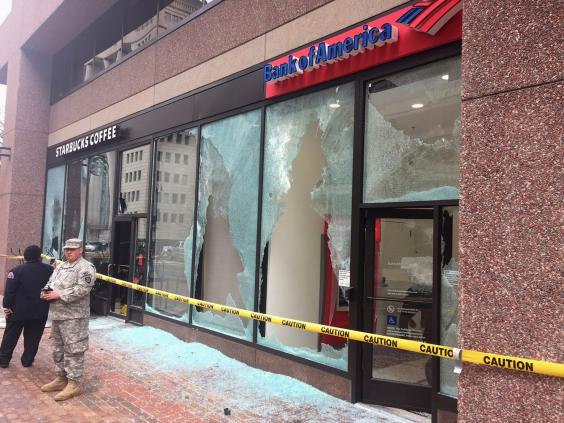
Scarier, I think, are the thus far scattered incidents of anti-Muslim, anti-black, anti-immigrant, anti-Semitic, and anti-women harassment across the United States, including many college campuses. It’s robbery, ridicule, and vandalism–so far.Graffiti on the windows on the abandoned Meglio Furs store in South Philadelphia. Photos by Jared Brey

Some of those who lost at the polls, seeing no other immediate recourse, have taken to the streets.

Some of those who won, finding support and encouragement in their victory, have celebrated by reclaiming spaces they think they own. It’s hardly new in America, but I’d venture to say it’s not what made America great in the past.

Organized demonstrations are harder to sustain than vandalism and violence perpetrated by small groups of people. What happens next is a function of both organization and responses. Trump’s opponents have the task of orchestrating a campaign that extends beyond limited events in supportive settings; it’s hard to think Speaker Paul Ryan, for example, is worried much about a march in Berkeley. But much more is possible.

Meanwhile, Trump’s supporters have the responsibility of not allowing thugs to define their victory. The president-elect’s opponents charge that his victory is a triumph of racism. Trump must now show that this is not the case, even at the risk of antagonizing some of his supporters. I fear this is another challenge that will be beyond him.

Posted in Uncategorized | Tagged , , , , , , , , , | 1 Comment

After the fall….what kind of protest follows?

I wrote yesterday’s post about concession speeches when I assumed, having steeped myself in all the aggregators and prognosticators I could find, that Hillary Clinton was going to win, and that Donald Trump would face the dilemma of navigating the concession ritual. Having to explain how I got this wrong is far and away the least consequential fallout from Trump’s election.

So, Hillary Clinton delivered a moving concession speech this morning, stamped out of the standard model I described yesterday.  Trump’s win gave him the more attractive task of claiming victory and promising conciliation. He promised, as Barack Obama and George W. Bush did–and Hillary Clinton certainly would have, to be the president of all Americans.

This laudable aim is difficult to pull off; certainly, neither Bush nor Obama were able to convince large segments of the American people that the president was operating in their interests. I’d think it would be even more difficult for Donald Trump.

But politics doesn’t end after an election, and even if Hillary Clinton won’t be out in the streets protesting, others will be. When someone new comes into office, the prospects and provocations that face activists across the political spectrum shift.

Shortly after Donald Trump deliverd a victory speech about 2,000 people rallied against the election at UCLA.

Students protest Trump’s election at UCLA

Some of those frustrated by the electoral results started protesting right away. College students marched against Trump on their campuses, including here at the University of California, Irvine. This first round of protests targeted Trump generally, and students announced their appreciation for diversity. Protests like this will surely continue through at least the inauguration of President (ulp!) Trump in January.

But that won’t be all of it. As appointments and prospective policies start pouring out of the Trump administration, activists will respond to the provocations they see. Candidate Trump promised to keep Muslims out of the country, to round up and deport undocumented immigrants, to repeal the Affordable Care Act, to build a Great Wall on the Mexican borders, to cut taxes for wealthy Americans, to withdraw from international agreements on climate change and trade, and to reduce regulations on coal mining and guns (to pick two). Plenty of people will be aggrieved.

With the Republicans, ostensibly allied with the new president, in control of both houses of Congress, people who want to fight unwanted policies will see little reason to focus on the legislative process, and much more incentive to take to the streets. This has happened before: in 2009 when Barack Obama worked to pass health care reform through a Democratic Congress, the Tea Party emerged  to challenge reformers through demonstrations large and small, and confront Democratic legislators at town meetings. The Tea Party shifted tactics and became less visible after Republicans won control of the House of Representatives in 2010. There’s no reason to expect opponents of Trump’s policy proposals not to fight back.

But it’s not just his opponents. The Trump campaign emboldened a nationalism cloaked in various shades of white (see Ku Klux Klan leader David Duke, a Trump enthusiast, at left). The campaign to “Make America Great Again” evoked a paler paradise located in a non-specific past where the white working class lived at the center of a much less colorful American dream. At least some Trump supporters will expect the new president to deliver on a set of essentially impossible promises. If he fails to deport masses of immigrants or create large numbers of well-paid manufacturing jobs for less educated workers, for example, expect those supporters to challenge him as well, and try to take nationalist politics into their own hands. It could get very ugly.

Trump’s election turns a page in a surprising end to a chapter in the American story. But it’s certainly not the end, and there’s no reason to believe it gets either easier or less disruptive.

Posted in Uncategorized | Tagged , , , , , , , , , , , | 1 Comment

When you lose at the polls…..

Donald Trump has called his campaign for the presidency the greatest movement in American history. Maybe not. But what happens to that movement if Trump doesn’t win the presidency?

How the losers behave tells you a great deal about the system as well as the competitors.

U.S. Sen. Bernie SandersMadison’s goal in designing America’s political institutions was to keep dissatisfied people focused on competing within mainstream political institutions. The system works when those who lose at the polls focus on organizing to compete again–rather than simply taking to the streets.

The standard concession speech features thanks to the
voters and campaign workers, more or less gracious congratulations to the victor, and praise for the system. Almost all successful politicians, including Barack Obama, Hillary Clinton, and Bill Clinton suffered significant defeats and persevered.

Senator Bernie Sanders waged a vigorous campaign for the Democratic presidential nomination, and conceded defeat when all the states were done voting. Deeply committed to a cause, he threw himself into his rival’s campaign, carrying his ideas. The Democratic platform responded to his concerns about issues like access to college and the minimum wage, and Sen. Sanders used the Clinton campaign to continue making his case for the 2016-03-31-1459468245-7773479-HillaryClinton.jpgcause. If he felt personal slights or disappointments, he certainly didn’t show it.

When New York senator Hillary Clinton lost a hard-fought campaign against Barack Obama in 2008, she quickly made her peace with the nominee, and worked to get him elected. Committed to public service–or personal ambition–Clinton joined the Obama administration and worked hard on behalf of the president’s policies, counting on his support when she again ran for office. It’s hard to imagine something far off the standard script if she loses the election.

Image result for donald trump

But what about Donald Trump? He has repeatedly announced that an electoral defeat would probably be the result of a rigged system. Regardless, he’s said that failing to win the presidency would reflect a tremendous waste of time and money. Does any kind of Trump movement continue after a defeat?

Trump has demonstrated no clear commitment to any set of issues. He’s backed off even his central campaign themes of stopping Muslims from entering the country and Mexicans from crossing the Southern border without navigating a wall. Very much unlike Bernie Sanders, he has no cause that is greater than his own personal ambitions.

There’s also no reason to see a clear commitment to the Re;publican party from its nominee. Whatever happens next, it’s hard to imagine Trump putting much effort into healing a divided party after the election.

Many pundits have speculated that Trump will use an electoral defeat to build a rightwing news network, either on cable television or the internet. I don’t think the numbers work easily for such an enterprise (cable viewership is down; Glenn Beck’s The Blaze is faltering online). More than that, Trump’s business record offers little evidence that he has the management patience to launch such a venture, or that he would be willing to invest his money in it.

If it’s hard to see Trump making a substantial commitment to building a movement or a business after losing at the polls, it’s quite easy to imagine intensified whining about bias and mistreatment. After a defeat, however, I don’t see how many Republicans are going to have much interest or patience for the whine. Trump will offer little support for any agenda, nor anything helpful for their personal political aspirations.

So, who will listen?

Posted in Uncategorized | Tagged , , , , , , , , | 3 Comments