Politicize this tragedy

half-mast

Flags at half-staff in Nevada

Gun control supporters need to respond to the awful Las Vegas shooting with the same speed and focus the police showed in response to the shooter. Before the FBI and police have finished conducting their investigations and cleaning up the debris on the strip, before any of the victims have been discharged from the hospital or buried, gun control groups must fill the airwaves and the Internet with concrete proposals to make America safe(r) again.

True American carnage, the shooting in Las Vegas makes the consequences of our easy access policy to firearms unusually clear. The vast majority of Americans don’t think about guns, much less silencers, most of the time, more concerned with economic inequality, carpool schedules, climate change, or the cost of cable tv. An engaged slice of America, including the gun industry, cares deeply, invests aggressively, and is extremely well-represented by the National Rifle Association. Most of the time, largely playing defense, this minority rules–ruthlessly and recklessly.

A chart shows America’s disproportionate levels of gun violence.


Opponents of sensible gun control will lament the presence of evil, sending thoughts and prayers into the ether, until this moment of clear vision passes. Unlike evil, guns can be regulated and the damage people inflict with them limited. (See chart above: everyone else does.) Enemies of gun control pray that public attention to the costs of our gun policy will pass when the next hurricane hits or the president again tweets about the national anthem.

The NRA has postponed airing its newest ad campaign. Donald Trump has called for prayer and unity, while the White House and Senator Majority Leader Mitch McConnell have called for mourning, rather than action, suggesting that political debate at the moment is unseemly.

The waiting game is a good strategy for those who are winning. Fans of easy access to guns would prefer not to talk about their plans when lots of people are listening carefully.

But gun control proponents, massively outfunded and usually out-organized, must seize the moment before the smoke has all cleared.

Posted in Uncategorized | Tagged , , , , , , , , , , , | 3 Comments

What hath Colin Kaepernick wrought

Donald Trump has ensured that the silent protests during the national anthem Colin Kaepernick started last year would not vanish into the ether like a career in professional sports.

Protest politics is all about generating reactions, and this president always rises to the bait. Displaying his propensity to dangle something stupid and shiny when things are going badly for him, Trump deployed his anger at black athletes with political opinions at a campaign rally in Alabama. In the context of an Iranian missile test, the ongoing development of nuclear weapons in North Korea, and the slow- motion unraveling of a Republican effort to end health coverage for millions of Americans, the anthem protests were an attractive distraction. Conservative white Republicans at the rally cheered. And Trump’s opponents rose to the bait as well.

Professional athletes engaged the Twitter war Trump started (the president’s preferred turf for battle–and not just in football. Trump disinvited the champion Golden State Warriors from a White House visit when star Stephen Curry announced that he wouldn’t attend. Curry announced that such pettiness was beneath the office of the president of the United States (score!).

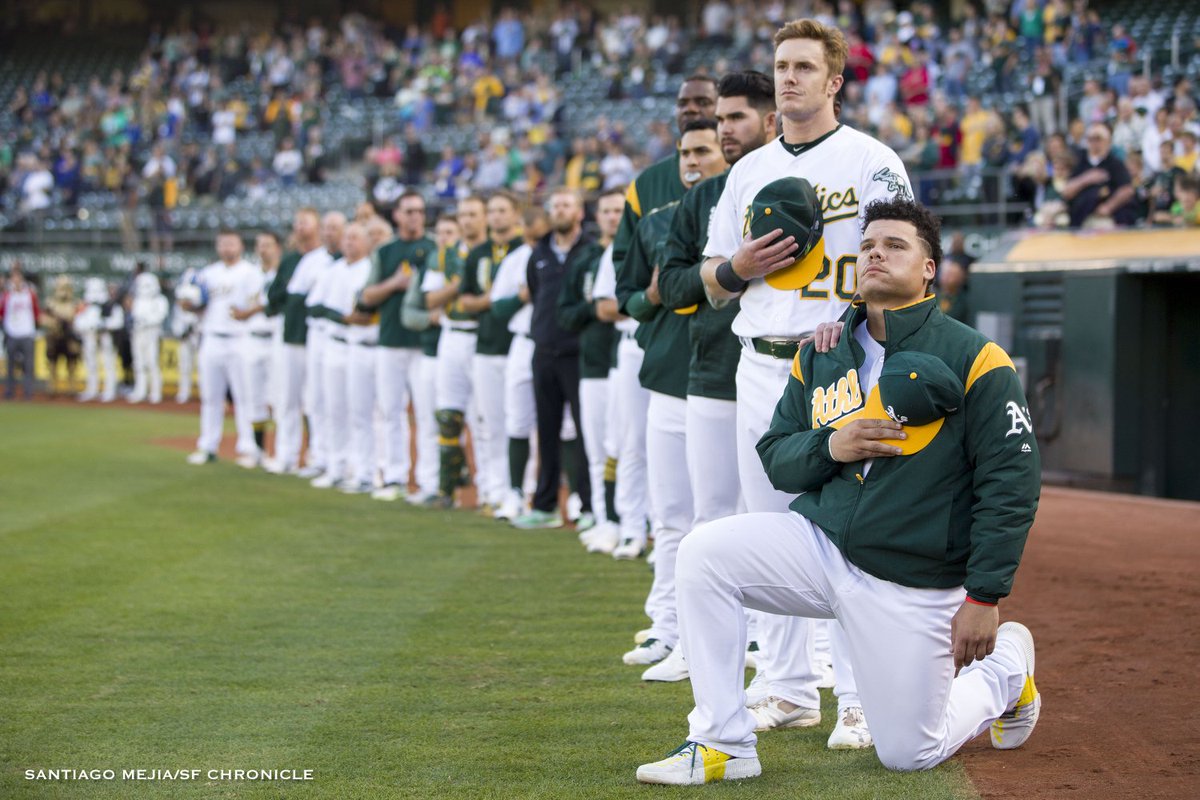
Meanwhile, others adopted Kaepernick’s protest, more in support of free speech than a cry against police violence. Stevie Wonder dropped to both knees at a concert. Bruce Maxwell, a rookie catcher for the Oakland Athletics, took a knee during the anthem, supported by both his teammates and the team owner, the first baseball player to join the campaign. Meanwhile, the leaders of the National Basketball Association (NBA) and the National Football League (NFL) announced support of the players, who enjoyed the rights of American citizens to engage in politics. Team owners, many of whom supported Trump or the Republican Party, criticized the president and supported the athletes.

The NFL, facing mounting evidence about chronic traumatic encephalopathy (CTE) from repeated concussions, has its own interests in finding distractions and building unity. (Trump, by the way, is appalled by the concerns about brain damage, a position that invites ridicule; write your own joke about how his political prospects depend on it.) Unsurprisingly, the number of athletes kneeling during the anthem increased on NFL Sunday. Even more visibly, athletes who didn’t want to kneel stood, linking arms in solidarity with those who did, including at least one owner, Shahid Khan of the Jacksonville Jaguars.

Colin Kaerpernick, whose own story is interesting, remains an engaged philanthropist and an uemployed quarterback. Both fans and analysts think he’s still valuable enough to play professionally. He has paid a price for his commitments. The protests Kaepernick spurred however, about police violence and racial justice, spread slowly through professional sports, continued in his absence from the field, taking on additional meanings as others join. Sometimes, Kaepernick’s sharp concerns were overwhelmed by others inspired by, and copying, his protest.

It’s not clear that Trump has made it attractive enough for an owner to bring Colin Kaepernick back to the field. Trump has, however, again provoked his opponents. In the Jacksonville Jaguars players kneel during the U.S. national anthem before their Sunday game.process, the meaning of the anthem protests has changed, from an explicit concern with racism and police violence, to a broader concern with free speech and political debate.

And, of course, more vigorous opposition to Trump.

Posted in Uncategorized | Tagged , , , , , , , , , , , , , , | 2 Comments

Trump’s rally turnout, unlike Trump, modest

The pro-Trump “Mother of All Rallies” turned out a People gathered on the National Mall in Washington on Saturday to attend a rally in support of President Trump in what organizers are calling “The Mother of All Rallies.”few hundred demonstrators in Washington, DC, rather than the planned thousands. Sympathy rallies across the country were much smaller–or canceled altogether.

Photos showing the assembled on an almost empty mall circulated on Twitter and around the Internet, posted by Trump’s opponents.

The turnout was substantially smaller than the Jugalo March on Washington or the croPHOTO: Protesters surround a car as they march in the street response to a not guilty verdict in the trial of former St. Louis police officer Jason Stockley Saturday, Sept. 16, 2017, in St. Louis.wds in St. Louis protesting the acquittal of another police officer who shot and killed Lamar Smith, a black man thought to be carrying drugs and (maybe) a gun, after a heated chase.


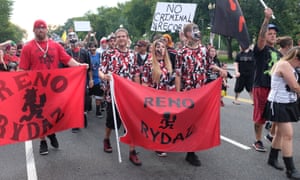
The Juggalos were out in Washington to demonstrate against the FBI’s designation as a gang.
Trump’s opponents take understandable, but mostly inappropriate delight, in the paltry turnout in support of a man who takes offense at such things and brags about the bigness of everything he touches.

But the other marches were staged by people who have grievances and a hard time finding powerful allies in government. Trump’s supporters have, they think, a president who is supported, mostly, by allies in both houses of Congress.

It’s tempting to read the small turnouts for Trump as a sign of his support eroding.  Alas, polls show a surprisingly small and disturbingly stable base of support. The intensity of that support might be diminishing, but we’ll see that in campaign donations, voting, and calls to members of Congress.

They don’t think they need to march.

Posted in Uncategorized | Tagged , , , , , , , | Leave a comment

The DREAM returns

The Trump administration’s decision to end President Obama’s Deferred Action for Childhood Arrivals (DACA) will unleash a world of trouble, and resurrect Dreamer politics. It’s most intense and threatening for the 800,000 recipients, their families, friends, neighbors, and employers, but the drama won’t stop there.

The Dreamers, young people brought to the United States as children, are the most photogenic, sympathetic, and politically engaged people directly touched by a failed DACA reversal sparks protests outside White House, Trump Tower immigration policy. The DREAM Act would have provided them with permanent legal status and, in many versions, a path toward citizenship. It also would have peeled off the simplest political problem from the larger immigration debate. Versions of the DREAM Act have floated up through the legislature for well over a decade, dramatically failing in the lame duck Congress legislating in the wake of the Tea Party election of 2010. (We’ve discussed the Dreamers since that time, here and here and here.) Brave Dreamers and their supporters marched, lobbied, fasted, and sat in at legislators’ offices to promote their cause.

When Republicans took control of the House, a significant Nativist caucus in their midst, President Obama tried to do what he could–and, it turned out, more than he could, in offering temporary work status and protection from deportation (DACA). An inadequate solution, the policy nonetheless brought some political peace, and the larger immigration debate festered and stalled at the same time. Mostly, the language of the Dream largely disappeared from the debate.

Ending DACA brings the politics of the DREAM back. These young people and their allies A protest near Trump Tower on Fifth Avenuenow have no options beyond politics. Expect the full range of protests from the last wave to come back, only stronger. The protests, in front of the Trump Tower and the White House and across the United States, are already here.

DACA made visible nearly a million young people to their teachers, employers, and neighbors, and their support has only grown. So too has their collective will and political skill in making a case for joining the American project. Their vigorous supporters now include big business, local politicians, university administrations, and many conservative Republicans in Congress. Obama’s Executive Order left the Dreamers not only more committed, but also politically stronger, than ever before.

In what has become his characteristic leadership style, Trump has demanded that Congress fix his political problem without providing a hint of what policy he wants to see. He is clearly more interested in avoiding blame than advancing policy. Because that Nativist caucus is at least as powerful in the Republican Party, Congress will be unable to act without some bipartisan cooperation.

There are some promising signs, like the DREAM bill cosponsored by Senators Lindsey Graham (R-SC) and Dick Durbin (D-IL), but any efforts will be opposed by that Nativist slice of the Republican Party–and the Attorney General of the United States, Jeff Sessions. Immigration reformers are going to want action that addresses the other 10 million or so undocumented immigrants in limbo. And any progress made by Congress will provoke the Trump voters who are still waiting for the wall.

Posted in Uncategorized | Tagged , , , , , , , , , , , , , , | Leave a comment

How activists should respond to the racist right: 2. shut them down (antifa) (?)

Standing up to a racist fascist movement when it is still small enough to start seems to make sense. Antifa is an umbrella term uniting people who commit to doing so aggressively, as (at right) in Berkeley in April. Of course, figuring out who’s a fascist and how to stand up to them effectively is at least a little more complicated.

A strong moral stance against racism and/or fascism doesn’t immediately justify any and all tactics of resistance. Here I’m less concerned with the moral debates about the nature of evil or the ethics of violence than in the political effects of different movement tactics.

Determined to keep the Bay Area safe from offensive conservative provocation, like speeches by Milo Yiannopoulos or Ann Coulter, antifa activists have worked to attack their hosts and command the streets. Because visits to Berkeley might generate confrontation, photos, and attention, the Bay Area  has become the indispensable spot on the book tour of any conservative. I’d code Yiannopoulos and Coutler as offensive and opportunistic, and advocates of policies that would hurt many people–but they were unarmed.

Members of white nationalists clash against a group of counter-protesters in Charlottesville VirginiaThat’s not the case with the Nazis and Klansmen who have been turning up at white nationalist events. When the Unite the Right rally came to Charlottesville, providing a jamboree for the racist right, antifa activists appeared as well, determined to do more than exercise moral suasion. Carrying sticks and deploying pepper spray or mace, antifa worked to meet the threat aggressively, and to protect nonviolent marchers. Several ministers credit the antifa with saving their lives during the demonstrations (e.g.). Antifa protest gives the young and committed something to do to stand up against what’s wrong.

Let me acknowledge all this before explaining why I think that violent confrontation of the racist right is a poor strategy, and one that is likely to be counterproductive.

First, control of the streets in the United States will not be decided by the strength of the battle between committed (and mostly poorly trained) paramilitary forces. Police and (if they fail) National Guard are far better armed and trained than activist forces on the left or right. Streetfighting invites their intervention. At best, this means active repression that will always advantage those in power. But it could be much worse; cautionary tales The U.S. Department of Justice has launched an investigation into the Ferguson Police Department after the fatal shooting of Michael Brown and its handling of protests that followed.abound. Think, for example, of the militarized suppression of protests against police violence in Ferguson, Missouri. Putting young committed people, perhaps masked, in the sites of scared or angry police forces–or the judicial system for that matter, hardly represents a risk worth taking lightly. Moreover, armed protesters effectively invite that repression for even the unarmed and nonviolent around them.

Obviously, this makes growing a movement tougher.

Second, battle ready and aggressive protesters will always command the most public attention, no matter how large their presence at an event. Oppositional media will focus on the images most offensive and terrifying to their audiences. Mainstream media will focus on the most dramatic story. Street fighting and injury will trump other tactics every time. Ultimately, this kind of coverage exaggerates both the size of the antifa and the power of the racist right they are confronting.

Third, antiracist violence offers both journalists and political opponents easy access to a fake judgment of moral equivalence. Trump supporters saw thin masked men carrying sticks when listening to their president’s assessment of violence on “many sides.” Of course, this is distorted and dishonest, but that doesn’t mean it’s not real.

Fourth, aggressive and virtually automatic response to the radical right puts a small and mostly marginal assemblage in the driver’s seat. The enemy effectively sets the agenda for antifa, again crowding out room for an affirmative agenda.

Fifth, antifa responses give white nationalists exactly the response they seek. The racist right mobilizes around a story of a country that is no longer safe for them, promising young men the chance to fight for their country or their race. Confronting those aspiring fighters with force confirms their story and provides the intense emotional experience they want. It creates drama and produces heroes for the right. (See, for example, the story of “Based Stickman,” who became a meme and a racist folk hero by battling with the antifa in Berkeley.) Violence in the streets invites rather than deters the racist right.

Plotting effective strategy means more than making a persuasive moral case against your enemy; it means considering the likely consequences of your actions. If antifa has made a political case for its approach, I haven’t yet seen it.

Posted in Uncategorized | Tagged , , , , , , , , , , , , , | 6 Comments

How activists should respond to the racist right: 1. nonviolent counterdemonstrations

Of course it’s heartening to see 40,000 explicitly anti-racist demonstrators turn out in Boston (August 20), dwarfing the assembly they were protesting against.

Was it the best approach to countering white nationalist mobilization advancing in response to Trump adminstration policies and rhetoric? I think it’s a hard question to answer.

The white nationalists represent a sliver of the American population, and today really can’t mobilize large numbers in the streets. Their opponents, who include most Americans, have suggested a range of responses to racist right protests, including disciplined nonviolent counterdemonstrations, ridicule, ignoring them until they go away, and violent resistance. You’d hope that serious study of movement politics in American history would provide clear answers. It’s disappointing, but not surprising, that consistent answers are hard to find. (See sociologist Pam Oliver’s smart overview of what we know so far.)

Over the next couple of days I want to look at the costs and consequences of different tactical responses to white nationalist protests.

At least on the surface, Boston offers an encouraging story.

Those at the big rally saw the “free speech” assembly,  which drew a few dozen to the Boston Common, as a cover for white nationalism, and demonstrated to show support for Image result for free speech rally bostonpluralism and tolerance. Police were out in very large numbers, and worked hard to keep the two sides apart. Despite a few scattered confrontations and 27 arrests, all reports emphasize nonviolence and discipline. The conservatives gave up and left early.

National audiences saw the anti-racists outnumber the provocative rally by more than 1,000-1. The “free speech” rally looked frail and marginal, and even its organizers sought to distance themselves from the KKK and Nazis in Charlottesville. It’s hardly an encouraging sign to their allies.

In contrast, local organizers demonstrated the depth of their support as well as their organizing strength. That should be a boost to the large numbers who share their views across the United States.

But:

A few dozen poorly resourced and marginal provocateurs wound up organizing the day for tens of thousands of Bostonians. The counterdemonstration generated attention for the conservatives that they would have never been able to get on their own. Organizing the response to white nationalism surely consumed far more effort than anything the conservatives invested.

In Boston, with a strong activist history and many well-connected progressive groups, the turnout was overwhelming; how many other cities could generate something similar? With intensive efforts, both the demonstrators and the police were able to limit violence and most confrontations. It’s a mistake to assume that most other activist groups and most other police forces could do the same. And if others can replicate the Boston success story, it will only be with a massive effort.

And what was the message?

Boston counter-demonstrationBecause many groups were involved and because it’s citizen activism and America, many messages floated across the crowd, but the national take-home was opposition to racism and violence. Although this surely isn’t bad, affirmative messages on, say, policing or voting rights or health care, for example, were drowned out.

American politics favors the defense. Although the nationalists didn’t advance any ideas or policies, it’s not clear the far more numerous counterdemonstrators did much better.

Letting your opponents set your agenda may not be the most effective way to organize for lasting social change.

Posted in Uncategorized | Tagged , , , , , , , , , , , , , , , , | 3 Comments

How Trump encourages and provokes political violence

Donald Trump has done great damage to more than his presidency. With his remarks about the tragedy in Charlottesville, Trump dramatically increased the nourishment and encouragement he has been feeding the racist right.

Activists respond to signals, and racist right leaders saw Donald Trump, standing in front of the gilded elevators in Trump Tower. frantically waving them on.WHITE NATIONALISTS MARCH: At the University of Virgina - @DAILYPROGRESS

In his misplaced and myopic commitment to a dishonest and evenhanded assessment of blame, Trump affirmed the white nationalist protests of those who support him, and warned their opponents that more were coming. It’s every bit as awful as you imagine, and maybe a little bit worse.

Whether or not the president realized what he was doing, his audience certainly understood; racist leaders got the message.

Klansman David Duke, whom Trump condemns every few years under duress, tweeted his gratitude:  “Thank you President Trump for your honesty & courage to tell the truth about #Charlottesville & condemn the leftist terrorists in BLM/Antifa.”

Richard Spencer, the white supremacist “identitarian,” didn’t even wait for the meltdown press conference, explaining that Trump’s earlier condemnation of the violence wasn’t to be taken seriously. “Only a dumb person,” he said, “would take those lines seriously,” identifying Trump as the “first true authentic nationalist in my lifetime” to be president.

Although a far larger number of Americans, including Trump’s putative allies in the Republican Party, were appalled by Trump’s response, social movements don’t need majorities to mobilize, nor to make a difference.

(AP Photo/Steve Helber) White nationalist demonstrators class with counter demonstrators at the entrance to Lee Park in Charlottesville, Va., Saturday, Aug. 12, 2017. Gov. Terry McAuliffe declared a state of emergency.Seeing an ally in the Oval Office, especially one beleaguered by mainstream politicians, fuels the difficult work of building a movement. Trump’s encouragement makes it easier to go to a meeting after work, stay later and talk to another potential convert, to find the temerity to go out in public and face people protesting against you. And if the counterprotesters outnumber you, it’s even easier to find justification for carrying arms.

Violence and confrontation brings attention to the white nationalist movement and, like their president, its activists welcome any attention. The president of the United States has accepted them, and effectively endorsed at least part of their cause in defending the Confederate monuments. In the face of policy defeats (the monuments are coming down), Trump’s support is feeding a new “Lost Cause” story.

Trump has expanded the space and attention available for white nationalist advocates, and you can expect them to try to fill it. They will be met by larger crowds of anti-racist activists and, at least sometimes, a smaller would-be vanguard of antifa activists ready to fight. Every confrontation will feed the beast.

Eager street fighters ready for violent confrontation with each other won’t make the police work easier. Indeed, first hand reports from Charlottesville credit antifa fighters with protecting non-violent activists–and even saving lives. They stepped in when police were not around. Depending upon committed amateurs to keep the peace is hardly a recipe for peace and civility. It’s particularly awful that sets of young men with very different political commitments are prepared to see themselves as the good guy with a gun–or shield or stick.

What’s even worse, whenever and however the Trump presidency ends, those who see him as their champion will view his failed presidency as yet another indictment of the degradation of the political mainstream, all the more reason to take to the streets–carrying Confederate and Nazi paraphernalia, brandishing whatever weapons they’re allowed to show.

Imagine what the president of the United States could do to counter this growing danger, then look at your Twitter feed tomorrow morning. I fear you won’t feel better.

Posted in Uncategorized | Tagged , , , , , , , , , , , , , , , | Leave a comment

Business defections, updated

Donald Trump’s advisory councils are no more.

This doesn’t mean, of course, that Trump will no longer be taking advice; it’s not clear that he ever listened to these groups anyway.

But, since the horrifying events in Charlottesville, and especially since Trump’s far more disturbing response to them, a few of America’s CEOs have decided they can’t, in good conscience, work with him. And then a few more followed, and then…

Initially, Trump announced that he could easily replace the defectors with more committed, patriotic, and energetic leaders.

And then he announced, via Twitter, that he would dissolve the councils altogether to take pressure off business leaders. (And so that he won’t have to make good on recruiting new corporate participants.)

But it was the executives on the council who first decided to disband, perhaps to take pressures off themselves. It’s hardly surprising that Trump claimed credit for something he could no longer do anything about.

Does it matter?

Presidential advisory councils like the Manufacturing Council and the Strategy and Policy Forum virtually never met anyway, and executives, when leaving, expressed disappointment about their lack of influence. It was all symbolic politics anyway. A few CEOs used their departures to make their own statements about the administration.

It’s hard to imagine that the end of these boards, which offered only a veneer of inclusion and consultation, will change anything materially. Then again, we will get yet another sign of the administration’s isolation.

Posted in Uncategorized | Tagged , , , , , , , | 1 Comment

Varieties of disruption: business defections

Protest can exercise influence by disrupting the usual politics of the moment, and there are lots of ways to create disruptions, and different people have vastly different opportunities.

Women's March on Washington (32593123745).jpgLarge demonstrations are one way to show strength, but you need to generate lots of people, as the Women’s March did earlier this year.

Less popular causes, like white nationalism, generate attention with smaller numbers and more aggressive tactics.

For those deeply entrenched in positions of power, sometimes disruption only requires saying no. Over the past day or so, four corporate leaders resigned from the Trump administration’s advisory American Manufacturing Council in response to Trump’s tepid response to the violence in Charlottesville. (Elon Musk, of Tesla, had already left the Council over Trump’s decision to leave the Paris Accord on climate change.)

Ken Frazier, chairman and chief executive officer of Merck, is leaving President Trump's American Manufacturing Council because of how Trump responded to the weekend violence in Charlottesville, Va. (AP Photo/Alex Brandon)

Kenneth Frazier

Kenneth C. Frazier, the Chief Executive Officer of Merck pharmaceuticals was the first to defect, explaining that it was a matter of moral conscience. The president quickly attacked him and his company on Twitter, but Merck’s share price increased over the day. Bizarrely, Trump was able to elicit sympathy for the had of a multinational drug company. At the end of the day, Frazier was followed by by Kevin Plank, CEO of Under Armour and Brian Krzanich, the CEO of Intel.

Trump pilloried the defectors as “grandstanders,” proclaiming that he had three replacements available for each of them. Then, Scott Paul, the president of the Alliance for American Manufacturing, resigned as well, because “it’s the right thing for me to do.”

The business protest doesn’t make for great pictures, placards, or police involvement, but it can matter.

Note: It’s a little easier for the second defector than for the first, and even easier for the 47th, and more CEOs may follow. If enough defect, it may become financially unwise to continue to work with the administration.


Posted in Uncategorized | Tagged , , , , , , , , , , | 1 Comment

And the Confederate monuments?

About those statues?

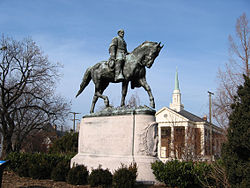
The Nazis and Klansmen and associated white racists said they were marching in Lee Park, Charlottesville, VA.jpgCharlottesville to save the statue of General Robert E. Lee on horseback.

Last year Charlottesville’s City Council voted to strike the statue and rename what was called “Lee Park” where it sat.  It’s now called “Emancipation Park.”

How’s that for provocation?

It’s hard to imagine that young white men hundreds of miles from Virginia could get so worked up about the landscape architecture of a city park.

I went looking for a statement from the organizers about why Lee’s statue was so important to them, and it turned out to be more difficult to find than I’d expected. Jason Kessler, who called for the Unite the Right demonstration, was unable to make it through a press conference about the events, and sometime in the past day, his website went down.

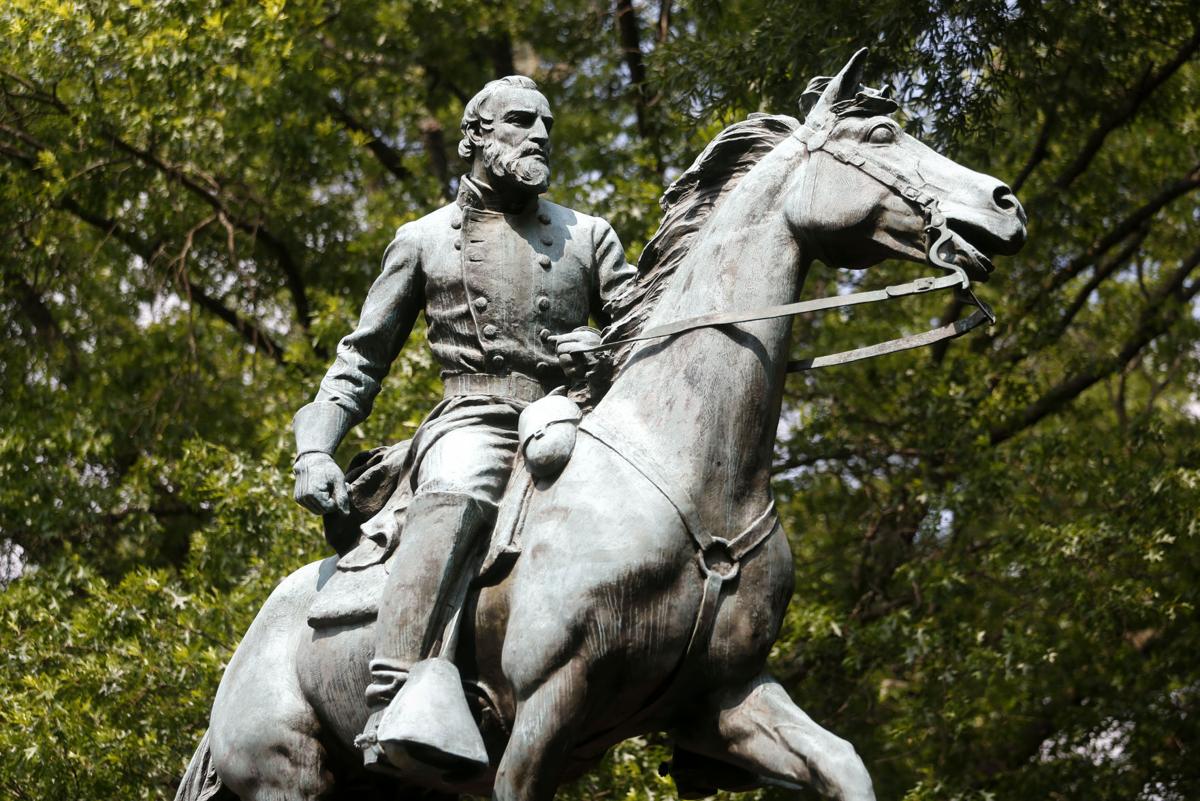
But Richard Spencer, who organized a rally in support of a statue of Stonewall Jackson a few Stonewall Jacksonweeks ago, explained it this way: “We will never back down from the cowardly attacks on our people and our heritage. What brings us together is that we are white. We are a people. We will not be replaced!”

It’s all about preserving white heritage.

Commemoration of the past is always mostly about the present and the future. Statues and memorials of the Confederacy proliferated in the early part of the 20th century, as another generation of white nationalists were setting up Jim Crow laws and institutionalizing racial segregation, along with a”lost cause” myth of the Civil War that foregrounded nobility and mostly edited out slavery. There are about 1500 Confederate memorials spread across 31 states.

The Southern Poverty Law Center put together a timeline noting how new statues came in packs, pretty much associated with Ku Klux Klan revivals (below).

In Charlottesville, Jackson’s statue was unveiled in 1921, before a crowd of 5,000 celebrating a reunion of the Daughters of the Confederacy. A huge Confederate flag was pulled back to reveal the general on horseback. Lee’s statue was unveiled in 1924, a highlight of a two-day gathering of the Sons of the Confederacy.

Of course, none of our heroes are pristine; we honor the triumphs that speak to the current moment, and try to make sense of their blemishes. Thomas Jefferson–to cite a Charlottesville example–wrote the Declaration of Independence, designed the University of Virginia, and maintained more than a hundred slaves on his estate, most of whom were sold upon his death. That’s a mixed legacy, and there’s certainly a lot worth arguing about.

That said, it’s tough to make the case to valorize a West Point educated career officer who resigns his commission to take up arms against the United States.

The first bad news for the white nationalist marchers is that their efforts are likely to undermine any attempt to preserve the Lee statue or, for that matter, Confederate monuments all across the South. As demonstrated this past weekend, the statues are exactly the wrong sorts of tourist attractions, and even Southern conservatives are coming to recognize fighting to retain them isn’t worth the trouble.

Last weekend on Meet the Press, National Review editor Rich Lowry explained, “I’ve always been skeptical of the rush to tear all these things down. There’s a distinction between Robert E. Lee and, say, Nathan Bedford Forrest, an early figure in the Klan. But if these monuments are going to become rallying points for neo-Nazis, maybe they do all have to go.”

Politicians may need to move quickly, or anti-racist activists will beat them to it.

Posted in Uncategorized | Tagged , , , , , , , , , , , , , , , , , | 2 Comments